


Most dry cleaners don't have a vendor problem until they suddenly have four of them at once. The tailor who used to turn alterations in two days starts taking five. The delivery hauler you contract for route overflow shows up late three Fridays in a row. Your poly and hanger supplier bumps prices mid-contract "because of freight." And the wholesale wet-cleaning plant you outsource leather to loses a $400 coat and shrugs.
None of these are catastrophic on their own. That's exactly why they're dangerous. Vendor slippage is slow — it shows up as a slightly worse week, then a slightly worse month, and by the time you feel it in your numbers, the relationship has already drifted somewhere you have no leverage to fix. The shops that handle dry cleaner vendor management well aren't the ones with the toughest contracts. They're the ones who built a simple, repeatable system for deciding which vendors matter, what "good" looks like in writing, and what happens when a vendor starts drifting. That's what this playbook covers — not legal armor, but an operating system for the people and companies you depend on.
Start by Sorting Your Vendors — Not All of Them Deserve the Same Attention
The first mistake shows up before any contract gets signed: treating every vendor like they carry the same weight. A shop will spend an hour negotiating hanger pricing and zero minutes thinking about the tailor who touches 30% of their high-ticket garments.
| Vendor Type | Customer Impact | Replaceability | How You Manage Them |
|---|---|---|---|
| Critical (tailors, outsourced specialty cleaning) | High | Hard | Formal SLA, monthly scorecard, quarterly reviews |
| Operational (delivery haulers, route overflow) | High | Medium | Light SLA, weekly glance at exceptions |
| Commodity (poly, hangers, solvent, detergent) | Low | Easy | Price + fill-rate tracking, renegotiate on cadence |
| Occasional (equipment repair, one-off restoration) | Varies | Varies | Written expectations per job, no standing contract |
The point isn't more paperwork — it's attention budgeting. You have maybe a couple hours a month to actively manage vendors. Spend it on the Critical and Operational rows, and put Commodity stuff on autopilot with a simple tracking sheet.
Worth noting: the vendors that quietly hurt shops most tend to sit in the "Operational" bucket, not "Critical." Everyone watches their tailor. Almost nobody watches the overflow hauler until a batch of Friday deliveries lands Saturday afternoon and three customers call angry.
What Actually Belongs in a Small-Shop SLA
A service-level agreement for a dry cleaner doesn't need to look like something a corporate procurement team drafted. The ones that actually get used are usually a single page. The goal is to remove ambiguity around the three things that cause most vendor friction: timing, quality, and what happens when something goes wrong.
Never lose track of an order again.
Pressesly helps you manage, track, and communicate every garment order seamlessly.
- Unified order management
- Real-time customer notifications
- Staff scheduling & workload tracking
No credit card required
Here's the skeleton that covers most tailor and hauler relationships:
-
Turnaround commitment — stated in business days, with a defined cutoff time. "Alterations picked up before 10am return within 48 business hours" is enforceable. "Fast turnaround" is not.
-
Quality standard — a defined defect threshold and who eats the cost of rework. Be specific about what counts as a defect versus a judgment call.
-
Capacity guarantee — the minimum volume they'll accept per day or week without a surcharge, and how much notice you need to give for a surge.
-
Communication rule — how fast they notify you when something will be late. This one clause prevents more customer blowups than any other.
-
Escalation path — a named person, a phone number, and a response-time expectation for problems.
Sample contract clauses you can adapt
> "Vendor agrees to complete all standard alterations within two (2) business days of pickup. Garments not completed within this window will be flagged to the Shop by 9:00am on the due date. Rework caused by Vendor error (incorrect hem, mismatched thread, sizing outside 1/4 inch tolerance) will be corrected at no charge within one (1) business day."
> "Vendor guarantees delivery of all assigned routes within the agreed time window. On-time delivery rate will be measured monthly and must remain at or above 95%. Failed or late deliveries attributable to Vendor will be re-delivered at Vendor's cost. Vendor will notify Shop within 30 minutes of any route delay expected to exceed 45 minutes."
> "Unit pricing is fixed for the contract term. Any proposed increase requires 30 days' written notice and applies only to orders placed after the effective date. Shop reserves the right to renegotiate or exit the agreement if any single increase exceeds 8%."
That last clause matters more than most people realize. Suppliers love a mid-cycle "freight adjustment," and without a written cap, you're negotiating from behind every time. If you want a deeper walkthrough on pricing leverage with consumables, the breakdown in Cut Hanger & Packaging Costs: Turn-Rate Calculations and Supplier Negotiation Scripts pairs well with this.
Scorecards: The Part Everyone Skips
An SLA without measurement is just a wish. The scorecard is what turns your agreement from a document into a working system — and it doesn't need to be complicated. Three to five KPIs per vendor is plenty. More than that and you'll stop filling it out by month three.
Pick metrics that map directly to how a vendor can hurt you. For a tailor and a hauler, the useful ones look like this:
Tailor scorecard KPIs:
-
On-time completion rate (target
95%+)
-
First-pass quality rate — jobs that come back needing no rework (target
97%+)
-
Rework turnaround when errors happen (target
within 1 business day)
-
Communication score — did they flag delays proactively? (simple yes/no tally)
Hauler scorecard KPIs:
-
On-time delivery rate (target
95%+)
-
Failed-drop rate (target
under 2%)
-
Damage/misdeliver incidents per 100 stops
-
Delay notification compliance (% of delays flagged within the agreed window)
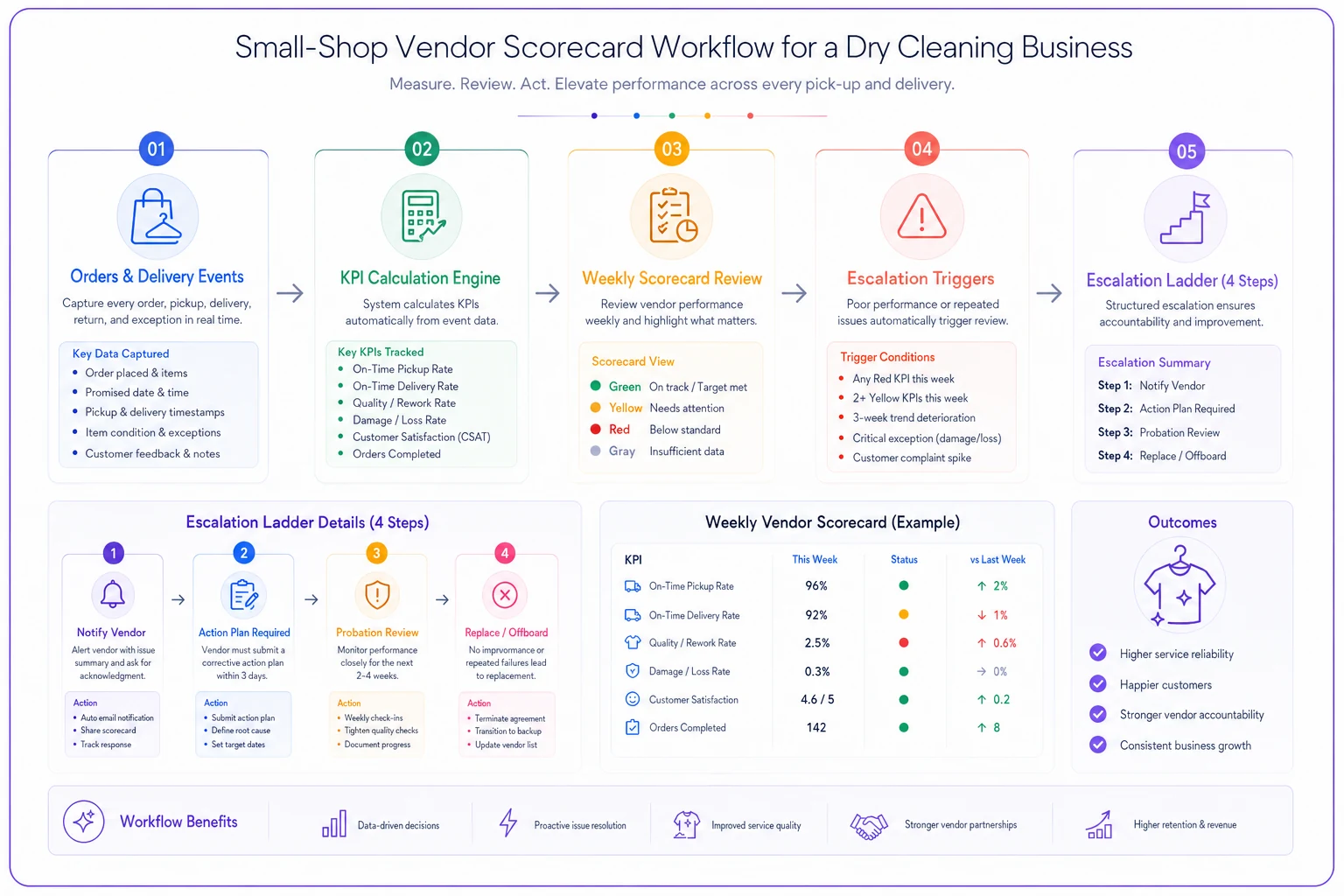
Scoring itself should be dead simple. Green, yellow, red per metric. Green means they hit target. Yellow means one miss or a near-miss. Red means a threshold breach that triggers a conversation. You don't need a weighted composite index — you need a clear signal that says "talk to this vendor now."
Track the communication metric weekly; it often slips before other performance metrics and gives you early warning.
One thing worth watching: the communication metric tends to predict problems earlier than the performance metrics do. A tailor who stops proactively flagging delays is usually a tailor whose own operation is starting to unravel. The communication score will slip a full month before the on-time rate does. Treat it as your early warning light.
Vendor scorecards should sit next to your internal ops metrics, not in a separate world — the same discipline that catches equipment issues in a good preventive maintenance plan and MTTR tracking applies to outside partners too. A late tailor and a broken boiler both show up first as small pattern shifts before they become emergencies.
Here’s a quick visual of the scorecard workflow and how data moves from daily operations to weekly review and escalation triggers.
The value isn't automation for its own sake; it's that a system nobody has to remember to maintain is the only kind that survives contact with a real shop week.
The Escalation Playbook: What Happens When a Vendor Drifts
Most vendor relationships fall apart not because a vendor fails, but because the shop has no defined response — so every failure becomes an awkward, personal, one-off conversation. You avoid the call, it happens again, and now you're annoyed and they're defensive.
An escalation playbook removes the emotion. It's a pre-agreed ladder that everyone understands from day one.
-
First yellow (soft flag). A quick, friendly heads-up — "Noticed a couple late returns this week, everything okay on your end?" No stakes yet. Half the time this alone fixes it, because the vendor didn't realize you were tracking.
-
Second yellow or first red (documented notice). A written note referencing the scorecard and the specific SLA clause. "Three of the last ten alterations missed the 48-hour window. Per our agreement, flagging this so we can correct it." Now it's on record.
-
Repeat red (review meeting). A short sit-down. You bring the scorecard. You ask what's driving the slip — capacity, staffing, their own supplier issues — and agree on a fix with a date attached.
-
Failure to correct (contractual remedy). Volume reduction, surcharge relief, or exit. This is where your backup plan actually gets used.
The step most shops skip is step one, and it's the most valuable. A soft flag early, before anyone's angry, resolves the majority of vendor drift without ever escalating further. The written notices exist mainly so that if you reach step four, you're not blindsiding anyone — the paper trail makes the exit clean instead of a fight.
Protecting capacity while you escalate
The reason people tolerate a failing vendor is fear of the gap. If your only tailor drops the ball and you have nowhere else to send work, you're stuck. So capacity protection isn't a separate topic — it's baked into escalation.
For any Critical vendor, keep a warm backup: a second tailor or plant you send maybe 10–15% of volume to on purpose, even when your primary is performing fine. It costs a little in convenience, but it means the backup already knows your standards and can absorb a surge or a switch on short notice. Shops that discover their backup on the day they need it almost always regret not having one already warmed up.
Negotiation Timing: When You Actually Have Leverage
Most shops negotiate at the worst possible moment — when they're already in a jam. You call the supplier because you're out of poly, or you're renegotiating the tailor's rate right after a busy season blew up your volume. That's negotiating from need, and vendors can smell it.
-
Renegotiate consumables on a fixed calendar, not on need. Set a review date — every 6 or 12 months — and go in with usage data whether or not you're feeling pressure. Predictable cadence beats reactive scrambling.
-
Negotiate labor and specialty vendors during your slow stretch, not your peak. When you have breathing room, you can credibly threaten to move volume. During peak, you can't.
-
Time supplier talks against their cycle, too. Many suppliers push to close volume commitments near quarter-end. That's when they'll bend on price to book the number. A shop that knows this walks in with real leverage.
-
Never sign a long-term deal right before your busy season. You'll accept worse terms because you can't risk disruption. Lock rates in the trough, not the peak.
A quiet pattern here: the shops that get the best supplier pricing aren't the biggest — they're the ones who show up organized, with usage numbers and a clear renewal cadence. Vendors reward predictability. A shop that orders erratically and negotiates in panic gets treated like a risk, and priced like one.
A Real Scenario
A single-location shop doing roughly $40k–$45k a month outsourced all alterations to one tailor and used a contract hauler for about a third of their delivery volume. No SLAs, no tracking — just relationships built on years of working together.
Over one spring, alteration returns started slipping from two days to four, and the hauler missed enough Friday windows that the shop was fielding several angry calls a week. The owner estimated they were quietly losing somewhere around $600–$800 a month in rework, re-deliveries, and comped orders — plus the harder-to-measure churn from customers who just stopped coming back.
They didn't do anything complicated. One-page SLAs for both vendors, a five-metric scorecard filled in every Friday in about ten minutes, and the four-step escalation ladder. The tailor's on-time rate came back up within two months once they realized returns were being tracked — turned out they'd hired a new person and had no idea the slip was that visible. The hauler took longer. After two documented notices and no real improvement, the shop moved to their warm backup and cut over cleanly, no drama, because the paper trail made the switch obvious rather than personal.
Six months in, comped orders from vendor errors were down to a fraction of what they'd been, and the owner spent maybe 45 minutes a month on vendor management instead of reacting to fires every week.
When This Level of Structure Makes Sense — And When It Doesn't
When it's worth it: You're outsourcing anything that touches the customer directly — alterations, specialty cleaning, delivery. The moment a vendor's failure becomes your customer's problem, you need it in writing and on a scorecard.
When it's overkill: For true commodity suppliers where switching is trivial, a full SLA and monthly scorecard is a waste of your attention. Track price and fill rate, renegotiate on cadence, and move on.
Who should hold off: If you're a brand-new shop still figuring out your own volume and standards, don't lock vendors into rigid SLAs yet — you don't know your own numbers well enough to set fair thresholds. Run informally for a few months, gather real data, then formalize. Setting SLA targets before you understand your own demand just means you'll be renegotiating badly six weeks later.
Where the System Actually Lives
The reason vendor management fails at small shops isn't ignorance — it's that the tracking lives in someone's head or on a sticky note, and it evaporates the first busy week. A scorecard you fill in "when you get to it" is a scorecard you'll abandon by spring.
Keeping vendor data inside the same platform you already use to run orders and track turnaround makes a real difference. When on-time completion, defect flags, and delivery exceptions get captured as part of normal order flow — rather than logged by hand in a separate spreadsheet — the scorecard basically fills itself, and escalation triggers fire on their own instead of waiting for you to notice. The value isn't automation for its own sake; it's that a system nobody has to remember to maintain is the only kind that survives contact with a real shop week.
For shops managing corporate or high-volume accounts, the vendor side connects directly to the customer side — the same SLA discipline you demand from your tailor is what your corporate clients demand from you. The tiered approach in Avoid Margin Erosion with Corporate Accounts is the mirror image of this playbook, pointed the other direction.
The Takeaway
Good vendor management isn't about airtight contracts or squeezing every partner on price. It's about deciding which relationships matter, writing down what "good" looks like, measuring it in a way you'll actually sustain, and having a calm, pre-agreed response the moment things drift. Do that consistently, and vendor problems stop being surprises that blow up a Friday — they become small signals you catch early and correct before a customer ever feels them. The paperwork is minimal. The discipline of actually using it, week after week, is the whole game.
Ready to elevate your dry cleaning operations?
Join hundreds of dry cleaners using Pressesly to save time, reduce errors, and enhance customer satisfaction.