



A dry cleaner's whole day can collapse around a single piece of equipment. When the boiler drops pressure at 8:40 a.m., your presses go cold, your finishing line stalls, and every promised same‑day order starts sliding into tomorrow. The frustrating part is that most of these breakdowns don't come out of nowhere — they send signals for days, sometimes weeks, before they finally take you down.
The goal here isn't to turn you into a mechanic. It's to give you a dry cleaner preventive maintenance rhythm that catches problems early, plus a simple 90‑day experiment to shrink your MTTR (mean time to repair) so that when something does break, you're back up in an hour instead of losing an afternoon.
Start by Learning What Your Equipment Sounds Like Before It Fails
Every machine on a dry cleaning floor has a "healthy" personality. The steam press has a certain hiss when it seals. The boiler cycles on a predictable rhythm. The cleaning machine's still runs at a temperature you can practically feel from across the room. When those personalities change, that's your early warning — and most shops just work through it because they're busy.
Breakdowns are rarely the first symptom. They're the last one. A solvent pump doesn't seize on a random Tuesday. It gets louder, starts short‑cycling, the filter pressure creeps up, and then it fails during your Friday rush when you can least afford it.
So the first move in any real maintenance program isn't a checklist. It's building a short list of failure‑mode signs for each critical machine, written in plain language your staff can actually recognize mid‑shift.
Failure‑mode signs worth writing on a laminated card
| Equipment | Early warning sign | What it usually means |
|---|---|---|
| Boiler | Longer cycles, pressure sags under load | Scale buildup, failing feed pump, or a leaking trap |
| Dry cleaning machine | Solvent smell, slow drying, high still temp | Clogged filter, low solvent level, distillation issue |
| Steam press | Weak seal, spitting water, uneven heat | Bad steam trap, clogged head, worn gasket |
| Air compressor | Short‑cycling, moisture in lines | Worn seals, failing dryer, tank drain clogged |
| Conveyor / assembly | Jerky movement, chain noise | Lube needed, misaligned track, motor strain |
The point of a card like this isn't to diagnose the exact repair. It's to get whoever's standing at the press to say "hey, this doesn't sound right" before it becomes a no‑steam morning. Shops that catch things early aren't necessarily smarter — they've just told their staff what to listen and smell for.
The Weekly and Monthly PM Checklists That Actually Get Done
Most maintenance checklists fail for a boring reason: they're too long, and they live in a binder nobody opens. A presser's 12‑hour day doesn't leave room for a 40‑point inspection. The checklists below are deliberately short — five to ten minutes, doable between order batches.
Never lose track of an order again.
Pressesly helps you manage, track, and communicate every garment order seamlessly.
- Unified order management
- Real-time customer notifications
- Staff scheduling & workload tracking
No credit card required
The split matters. Weekly items are the quick, high‑frequency checks that keep small problems from snowballing. Monthly items are the deeper inspections you'd otherwise forget until something breaks.
Weekly PM checklist (5–10 minutes)
-
Drain the air compressor tank and check lines for moisture
-
Check boiler water level and blow down the low‑water cutoff
-
Wipe down and inspect steam press heads for spitting or scale
-
Check solvent level and filter pressure on the cleaning machine
-
Clear lint from dryer screens and press exhaust areas
-
Listen to the conveyor motor and chain for new noises
-
Note any error codes and clear them (write down what appeared)
Monthly PM checklist (30–45 minutes)
-
Inspect and clean the boiler's feedwater system and check for scale
-
Replace or inspect cleaning machine filters based on cycle count
-
Check and test steam traps on presses and lines
-
Inspect belts, hoses, and gaskets for cracking or wear
-
Grease conveyor bearings and check track alignment
-
Test safety devices — low‑water cutoff, pressure relief, door interlocks
-
Review the month's error‑code notes for repeat offenders
One thing worth flagging: the weekly checklist is where the real payoff lives. Shops that skip weekly moisture drains on the compressor end up with water in their air lines, which fouls the press controls, which reads to staff as "the press is broken" — when it's really a two‑minute drain that was never done. The cheap habit prevents the expensive confusion.
A quick note on ownership: the person running the machine should own the weekly checks — not the owner, not a once‑a‑month tech. When the checklist belongs to the operator, it gets done in the natural rhythm of the shift. When it belongs to "someone," it belongs to no one.
The Spare‑Parts List That Turns a Lost Day Into a Lost Hour
This is the part almost every small shop underinvests in, and it's the single biggest lever on your MTTR. When a steam trap fails and you don't have a spare, your repair time isn't the 20 minutes it takes to swap it — it's two days waiting for the part to ship, plus the tech's second trip.
The math is brutal. A same‑day dry cleaner running $2k–$3k of daily volume can lose a significant chunk of that when the finishing line is down for an afternoon, plus the goodwill hit from broken promises. A spare‑parts shelf that costs a few hundred dollars pays for itself the first time it saves you a full shutdown.
Build your spare‑parts shelf around failure frequency
-
Fast‑failing, hard‑to‑source — steam trap components, press gaskets, solvent filters. Keep 2–3 on hand.
-
Fast‑failing, easy‑to‑source — hoses, screens, common fuses, belts. Keep at least one spare.
-
Slow‑failing, hard‑to‑source — pump rebuild kits, control boards, motor components. Keep the truly critical ones; know the lead time for the rest.
-
Slow‑failing, easy‑to‑source — don't stock, just know the supplier and part number.
Write the part numbers down. Nothing wastes MTTR like standing in front of a broken machine trying to figure out which gasket you need while your supplier's phone rings. A laminated sheet taped inside the electrical panel — part name, number, supplier, phone — saves more time than people expect.
A 90‑Day MTTR Improvement Experiment
MTTR is the number that decides whether a breakdown ruins your day or just annoys you. The idea here is to run a structured 90‑day experiment: measure your MTTR, make a few targeted changes, and see what actually moved the needle.
Small shops resist this because it sounds like corporate reliability engineering. It isn't. It's mostly writing down two timestamps and reviewing them once a week.
Phase 1 — Days 1–30: Measure honestly
-
What broke and any failure sign that preceded it
-
Time it went down
-
Time it was running again
-
What the repair actually required (part, adjustment, call to a tech)
By the end of month one you'll have a baseline. Most shops are surprised by their real MTTR — the honest one, including "waiting for the tech to call back" and "driving to get the part." A fix that felt like an hour was really four when you count the waiting.
Phase 2 — Days 31–60: Attack the biggest time sinks
Look at your log and ask a blunt question: where did the hours actually go? In most small shops, the answer isn't the repair itself — it's the delays around it. Waiting for parts. Not knowing who to call. Trying three things before finding the right fix.
-
Stock the spare parts your log shows you actually needed
-
Post the tech's number and key part numbers near each machine
-
Turn the weekly checklist into a habit so fewer things break in the first place
-
Write down the fix for anything that broke twice, so the second time is faster
Phase 3 — Days 61–90: Lock in and re‑measure
Keep logging, keep the new habits, and compare your month‑three MTTR to your month‑one baseline. This is where the experiment pays off — you get a real number showing whether your changes worked, and you learn which failures still hurt.
A realistic before‑and‑after
A single‑location shop running same‑day service with an aging boiler and two steam presses logged six breakdowns in month one, with an average MTTR somewhere around 5–6 hours — mostly because parts weren't on hand and nobody was sure which vendor to call.
This diagram shows the 90‑day experiment workflow in one image.
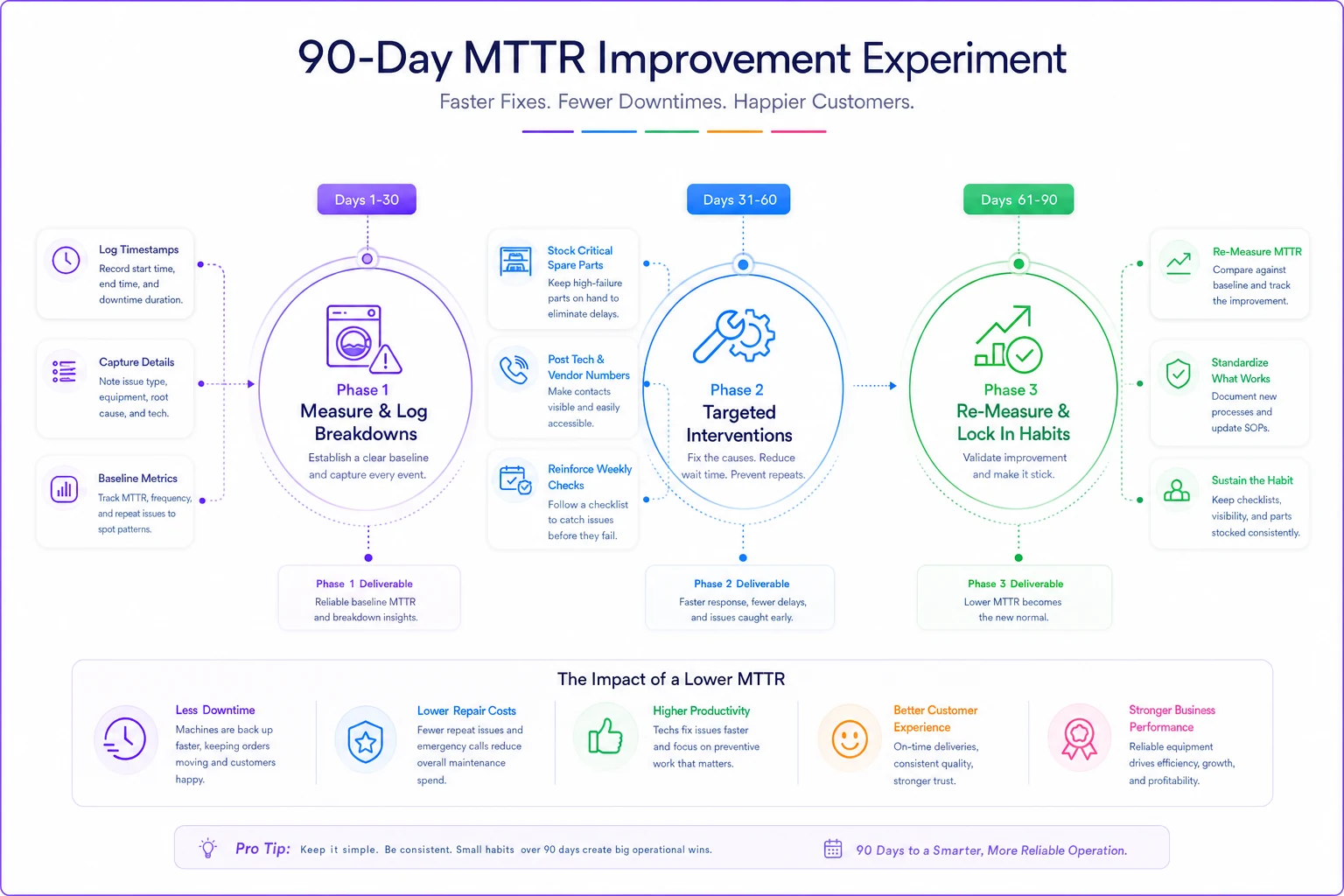
By month three, after stocking a small spare shelf (steam trap kit, press gaskets, a spare filter set) and posting part numbers and the tech's number by each machine, their average MTTR dropped to somewhere around 90 minutes to 2 hours. Same equipment, same failures — the waiting mostly disappeared. The quieter win: the weekly checklist caught a few issues early, so the number of breakdowns fell too.
Where This Ties Into the Rest of Your Operation
Reduced downtime is worthless if it doesn't protect your delivery promises. When a press goes down for two hours, the real damage is the ten same‑day orders that can't be finished on time — which is why MTTR and turnaround times are two sides of the same coin. If you've already built buffer rules and escalation flows using something like the Shop Turnaround Time Playbook, your maintenance log tells you exactly how much buffer your equipment reliability actually requires.
That connection is worth sitting with. Shops that get burned on delivery promises often blame staffing or volume, when the real culprit is a press that goes down twice a month and eats four hours each time. Your maintenance log turns that vague frustration into a specific, fixable number.
Keeping the Log From Becoming Another Abandoned Binder
The honest risk with any of this is that the logging dies after three weeks. Paper logs get coffee‑stained and forgotten; the operator who was diligent in month one gets busy in month two. Keeping the record somewhere shared and lightweight matters more than the format itself.
Plenty of shops now track breakdowns, checklist completion, and part numbers inside the same operational software they already use for orders and tagging — so the maintenance log isn't a separate chore living in a drawer. When the weekly checklist is a quick digital tap and a recurring reminder surfaces on the right day, the habit tends to survive past the initial enthusiasm. Some platforms will flag repeat failure patterns automatically, so you notice the steam trap that's failed three times this quarter without combing through handwritten notes. The tool matters far less than the fact that the record lives somewhere you'll actually look.
When This Level of Effort Is and Isn't Worth It
When it makes sense: If you run same‑day or next‑day service, a single major breakdown can cost you a day's promises and a stack of upset customers. For those shops, even a modest MTTR improvement pays for itself fast. It also makes sense if your equipment is aging and you're seeing more frequent or mysterious failures.
When it's overkill: If you're a small drop‑store that outsources cleaning and only runs a press or two, you don't need a 90‑day experiment. A weekly wipe‑down and a couple of spare gaskets will cover you.
Who should skip it: Shops planning to replace their major equipment within the next few months. There's little point optimizing repair time on a boiler you're about to retire — spend that energy on the transition instead.
The Takeaway
Breakdowns feel random when you're standing in front of a dead press at 8 a.m., but they almost never are. The machines warn you, the failures repeat, and the lost hours mostly come from waiting rather than fixing. A short weekly checklist, a plain list of failure‑mode signs, a small shelf of the right spare parts, and a 90‑day habit of writing down what broke and how long it took — that's the whole program.
It's not sophisticated, and that's exactly why it works in a shop that's already stretched thin. Start logging this week, and by month three you'll know precisely which failures are costing you and which ones you've already beaten.
Start logging this week, and by month three you'll know precisely which failures are costing you and which ones you've already beaten.
Ready to elevate your dry cleaning operations?
Join hundreds of dry cleaners using Pressesly to save time, reduce errors, and enhance customer satisfaction.