


The pitch always sounds great. A property management company, a hotel, a law firm with 40 lawyers who all wear pressed shirts — someone calls and asks if you can handle their account. Steady volume, predictable pickup schedule, invoicing instead of walk-in chaos. For a small shop doing mostly retail, it feels like the growth move.
Then six months in you look at the numbers and the corporate account that added 30% to your volume added maybe 6% to your profit. Sometimes less. Sometimes it's actually losing you money and you can't figure out why, because the invoices are getting paid.
That gap between "more volume" and "more profit" is where most small cleaners get hurt scaling into B2B. Dry cleaner corporate accounts fulfillment isn't hard because the cleaning is different — a dress shirt is a dress shirt. It's hard because the terms are different, and small shops tend to accept corporate terms designed to protect the corporate buyer, not the cleaner. This is exactly where the erosion happens, and how to build guardrails before you sign the next one.
The four places margin quietly disappears
Retail pricing has a lot of built-in slack. A walk-in customer pays list price, tips sometimes, doesn't negotiate, and absorbs your inefficiency without complaint. Corporate accounts strip all that slack out — usually without you noticing until the pattern is locked in.
Here's where it goes, in rough order of how much damage it does:
-
Discount stacking on top of already-thin volume pricing. The account negotiates 15% off list, then asks for free pickup and delivery, then wants net-30 terms. Each concession feels small. Together they can erase your entire garment-level margin.
-
Pickup cadence that doesn't match your route economics. A retail customer comes to you. A corporate account expects you to come to them — and if they want daily pickups for a light-volume location, you're running a van for 12 shirts.
-
Rework and "corporate standards" that are stricter than retail. Executive dress shirts often come with expectations no walk-in ever had. One re-press request per order eats the margin on the whole order.
-
Disputes and comped items with no rules. Retail customers argue occasionally. Corporate accounts have an office manager whose job partly involves getting credits, and without written dispute rules you'll comp your way to zero.
None of these are dramatic. That's the problem. It's not one bad decision, it's forty small ones that all defaulted in the customer's favor because you didn't have a structure to point to.
Onboarding: the part everyone skips and later regrets
Small shops onboard corporate accounts the same way they onboard a regular customer — someone drops off clothes, you clean them, you figure out billing later. That informality is exactly what costs you.
Never lose track of an order again.
Pressesly helps you manage, track, and communicate every garment order seamlessly.
- Unified order management
- Real-time customer notifications
- Staff scheduling & workload tracking
No credit card required
A corporate onboarding template forces the awkward conversations before the relationship starts, when you still have leverage. Once you've been cleaning their shirts for three months, asking to change terms feels like a rate hike. During onboarding, it's just how you do business.
At minimum your onboarding intake should nail down:
-
Volume commitment vs. estimate. "About 150 shirts a week" is not a commitment. Get a floor. Your pricing depends on it, and you want the right to revisit pricing if actual volume comes in 40% under estimate.
-
Item mix. 150 laundered shirts is a very different job than 150 dry-clean-only garments. Price the mix, not the count.
-
Pickup and delivery points. One central mailroom is cheap. Twelve individual desks or three floors is not. Define exactly where handoff happens.
-
Turnaround expectation. Next-day for the whole account is a promise you may not be able to keep in peak weeks. Tie this to your real capacity — the same logic in your turnaround time playbook applies, but corporate SLAs need to be written down, not assumed.
-
Billing cycle, payment terms, and who approves disputes. One named person. Not "the office."
-
Garment identification method. How do you separate their items from retail flow and from each other's within the account?
Have this as a physical or digital form the account signs. The signature matters less legally than psychologically — it sets the expectation that this is a structured relationship with rules, not a favor.
SLA tiers instead of one-size promises
The mistake is offering every corporate account the same service level — usually your best one, because you're trying to win the deal. Then you're locked into next-day turnaround and daily pickup for an account paying discounted rates.
Build three tiers and let the account pick. The pricing difference between tiers does the negotiating for you.
| Tier | Turnaround | Pickup cadence | Discount off list | Best fit |
|---|---|---|---|---|
| Standard | 3–4 business days | 2x per week, scheduled | 5–8% | Property managers, small offices, uneven volume |
| Priority | 2 business days | 3x per week | 10–12% | Mid-size firms with steady daily wear |
| Executive | Next-day guaranteed | Daily | 12–15% + surcharge on rush items | High-touch accounts that genuinely need it and will pay |
The key insight: the deepest discount should require the highest volume commitment AND accept surcharges on exceptions. Most shops do the opposite — they give the deep discount to win the deal and then eat the rush costs. Flip it. The account that wants next-day everything is the one that should be paying a surcharge structure on top, because next-day everything is what destroys your production scheduling.
Pickup cadence is baked into the tier deliberately. The single most common corporate margin leak is running vans on a schedule that makes no route sense, which brings us to the matrix.
The pickup cadence matrix
Van time is the cost small cleaners underestimate most when they go B2B. A retail customer's transportation cost is zero to you — they drive to you. Every corporate pickup is a mile, a minute, and a labor cost you're absorbing.
Don't set pickup frequency by what the customer asks for. Set it by a simple grid of volume per stop against distance from an existing route. The logic overlaps a lot with how you'd think about batching and zones for delivery generally — the route heuristics approach applies directly here.
-
High volume + on an existing route → daily pickup is fine, essentially free marginal cost.
-
High volume + off-route → 2–3x/week, batch it so the detour is worth it.
-
Low volume + on-route → pick up on your existing pass, but don't guarantee a fixed daily slot.
-
Low volume + off-route → this is the danger zone. Either bundle their pickup with a neighboring account, charge a pickup fee, or move them to a drop-off arrangement.
The pattern worth internalizing: a light account far from your route can cost more to service than it pays, even at full list price. No cleaning efficiency fixes a bad geography-to-volume ratio. If an account insists on daily pickup for 15 garments across town, that's not a customer, that's a subsidy you're paying them.
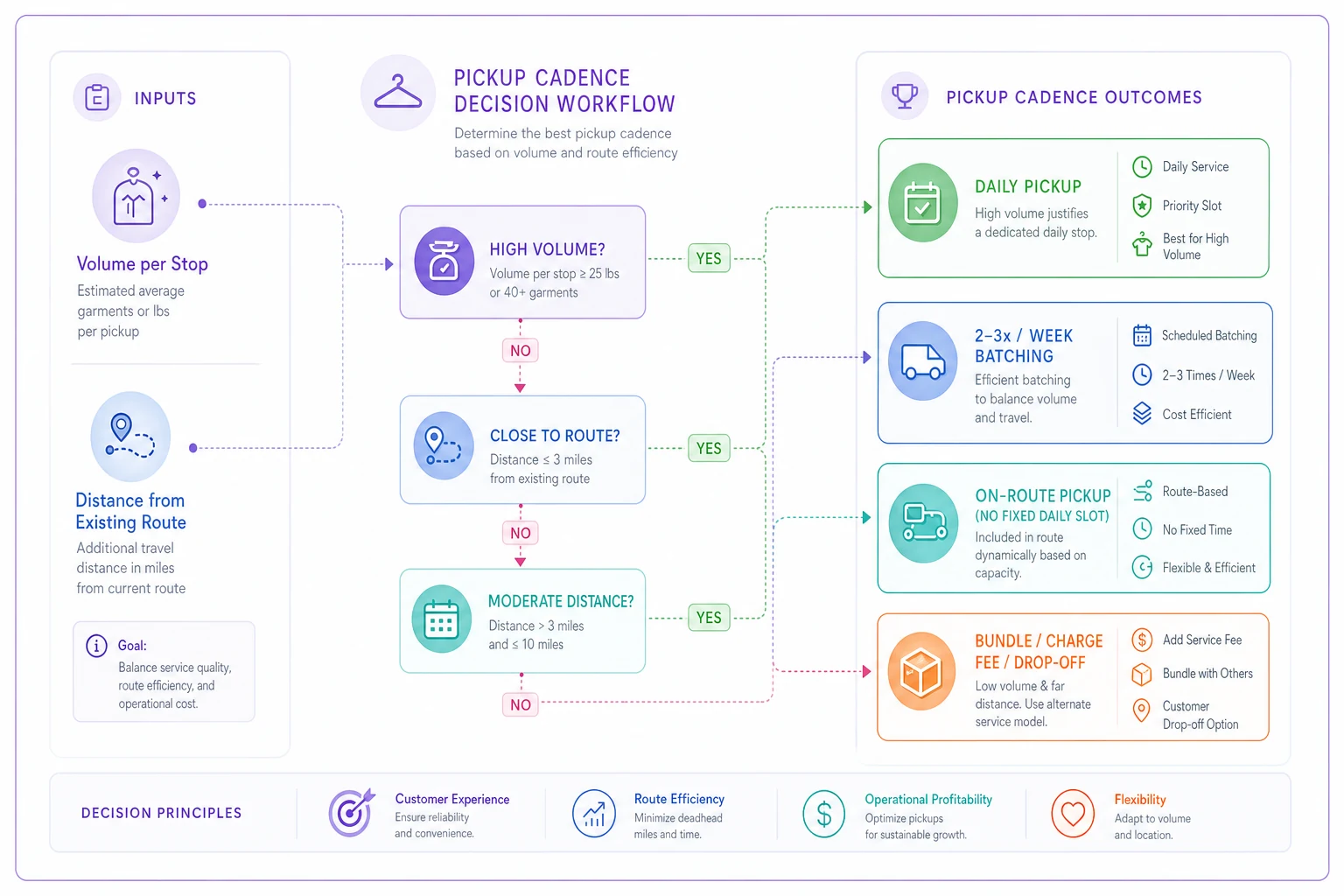
This flow makes it easy to decide pickup frequency based on volume and distance instead of customer requests.
Charge a pickup fee or bundle pickups for low-volume, off-route accounts to make route costs visible.
One shop realized three of their five corporate accounts were "low volume + off-route" and had been sitting that way for over a year. Consolidating pickups to twice weekly and adding a small trip fee to the two that refused recovered somewhere in the range of $600–$900 a month in van labor and fuel — money that had been invisible because it was buried in general delivery costs, not attached to any specific account.
Dispute rules: the credit that eats everything
A corporate account's office manager emails: "Three shirts came back with the crease off, we're deducting them from this invoice." You didn't see the shirts. There's no photo. You comp them to keep the peace. Next month it's five shirts. The precedent is set, and now every marginal complaint becomes a free re-clean or a credit.
Corporate disputes are structurally worse than retail disputes because the person filing them isn't the person who wore the garment, has no relationship with you, and is often measured on cost control. You need written rules that both sides agreed to during onboarding.
-
Window. Quality issues must be reported within 48 hours of delivery. After that, it's a new order.
-
Evidence. Credits require the garment returned or a photo of the defect. No "we threw it out but trust us."
-
Remedy hierarchy. First remedy is re-clean, not credit. Credit only if re-clean isn't possible or a garment is genuinely damaged.
-
Damage claims follow your standard intake-condition process, same as retail — pre-existing wear isn't your liability.
-
Volume cap on comps. If credits exceed a set percentage of monthly invoice, that triggers a review meeting, not an automatic payout.
That last one matters more than it looks. A dispute rate creeping past 2–3% of billing is a signal — either a real production problem or an account that's learned comps are easy. Either way you want it flagged, not absorbed.
Margin guardrails: the number that tells you to walk away
Every corporate account should have a floor margin you calculate before you sign and monitor after. This is the guardrail that keeps a "growth" account from becoming a slow leak.
-
Revenue at agreed (discounted) rates.
-
Minus direct production cost — labor, supplies, utilities per garment.
-
Minus transportation cost — actual van time and fuel allocated to their pickups, not a general average.
-
Minus rework and comps for the period.
-
Minus billing/admin cost — chasing net-30 payments is real labor.
What's left is your true account margin. Run it for the first 60 days and then quarterly.
The guardrail rule most small cleaners never set: if an account's true margin drops below your retail margin for the same work, it must be repriced or restructured — not tolerated because "at least it's volume." Volume that pays worse than your walk-in traffic is actively pulling your business average down while consuming your capacity.
A real scenario
A single-location cleaner took on a regional accounting firm — around 180 laundered shirts a week plus some suits during tax season. They'd offered 12% off list, free daily pickup, and net-30 to close the deal.
On paper it looked like roughly $2,800–$3,200 a month in new revenue. But the pickup was a daily 20-minute round trip off their normal route, disputes ran high because the firm's office manager rejected any shirt with a soft collar, and net-30 was really net-45 in practice.
When they finally ran a true account margin, it came out to about 9% — versus roughly 22% on comparable retail work. The account wasn't losing money outright, but it was tying up production capacity at less than half their normal margin. The fix wasn't dropping the account. They moved pickup to three days a week (the firm barely noticed), added written dispute rules with a 48-hour window and re-clean-first remedy, and shifted them to a Priority tier at 10% off instead of 12% with a small pickup fee baked in. True margin came up to around 17% within two months. Same account, restructured terms, most of the leak closed.
When corporate accounts actually make sense
They make sense when the account is on or near a route you already run, the volume is steady and committed, and the buyer is a real business relationship rather than a pure cost-shopper.
A hotel two blocks away with predictable daily volume is a genuinely great account. A law firm on your existing delivery loop is a great account.
When it's a bad idea
Skip it — or price it hard — when the account is far off-route with light volume, when they want your best SLA at your deepest discount, or when the buyer's entire posture is squeezing rate and filing disputes.
Some accounts exist to extract, and no amount of onboarding structure fixes an adversarial buyer. It's fine to lose that deal.
The through-line
The reason corporate accounts erode margin at small cleaners isn't that B2B is inherently unprofitable — it's that small shops sign retail-friendly people into corporate-friendly terms and never build the structure to protect themselves. Onboarding templates force the terms conversation early. SLA tiers stop you from giving your best service at your worst price. The cadence matrix keeps van costs from hiding. Dispute rules stop the slow bleed of comps. And a margin guardrail tells you, in an actual number, when an account is worth keeping and when it needs to be fixed or let go.
Build those five things before the next account calls, not after. The account you're about to say yes to is the easiest one to set terms on — right now, before you've cleaned a single shirt for them.
Build those five things before the next account calls, not after. The account you're about to say yes to is the easiest one to set terms on — right now, before you've cleaned a single shirt for them.
Ready to elevate your dry cleaning operations?
Join hundreds of dry cleaners using Pressesly to save time, reduce errors, and enhance customer satisfaction.