


Most shops handle refunds on feel. A regular looks upset about a scorched collar, so the counter person waves the ticket and comps the order. A stranger with a thin story gets a flat "no." Neither decision runs through any logic about what the garment actually cost you, how strong your evidence is, or whether that customer is worth protecting. Over a year, those scattered calls add up to real money leaking out one side and real goodwill getting torched out the other.
A dry cleaner refund and chargeback policy that actually works isn't a sign on the wall saying "we are not responsible for..." It's a connected system: a defect gets classified, evidence gets weighed, the customer's value gets factored in, and the resolution falls out of a matrix instead of a mood. And when a card dispute shows up weeks later, that same system already produced the packet you need to fight it.
This is the part of the operation most owners never build because it only hurts in small, forgettable increments — until it doesn't.
Why service recovery turns into a money pit
The leak rarely comes from the occasional $400 claim. Those get your attention. The real erosion is the steady stream of $18 comps, $35 "just redo it" orders, and $60 refunds that nobody logs, nobody categorizes, and nobody connects back to the shop floor.
The pattern that shows up across shops of every size is pretty consistent. Counter staff have no authority framework, so they do one of two things: over-refund to avoid conflict, or dig in to avoid looking soft. Both are expensive. Over-refunding bleeds margin directly. Under-refunding pushes the unhappy customer straight to their credit card company, where you lose the dispute and eat a chargeback fee on top of the refund you were trying to avoid.
What makes it worse is that both failure modes often live in the same shop. The owner is generous; the night manager is rigid. Same business, two completely different policies depending on who's standing at the register. Customers notice. Staff notices. And your financials just absorb whatever happened that shift.
The fix isn't "train people to be nicer" or "be firmer." It's removing the judgment call from the moment and replacing it with a decision the business already made — in advance, with numbers attached.
The three inputs every recovery decision needs
Every refund-or-repair-or-deny call sits on three variables. Get these three defined and most decisions make themselves.
Never lose track of an order again.
Pressesly helps you manage, track, and communicate every garment order seamlessly.
- Unified order management
- Real-time customer notifications
- Staff scheduling & workload tracking
No credit card required
1. Defect class. What actually went wrong, and whose fault is it? A dye-transfer you caused is a different animal than a pre-existing weakness in the fabric that failed under normal cleaning. If you've built a decent intake process, you already classify garments at drop-off, which means half this work is done before the problem even appears.
2. Evidence quality. Do you have intake photos, a signed ticket, a care-label note, a QC log? Or do you have a customer's word against your counter person's memory? Evidence quality is the single biggest swing factor and the one most shops are weakest on. Strong evidence lets you deny cleanly and win chargebacks. Weak evidence means you're negotiating from zero no matter how right you are.
3. Customer lifetime value. A customer who brings in four shirts a week for three years is worth protecting even when the claim is shaky. A one-time walk-in with a questionable story isn't. Lifetime value doesn't change whether the defect is your fault — but it absolutely changes how generous you are in the gray zone.
The mistake most owners make is using only one of these inputs. "We always refund" uses none. "The customer is always right" uses only #3. "We're not liable" uses only #1. The decisions get good when all three run together.
The decision matrix
Put the three inputs on a grid and attach a default action. This is the core of a workable dry cleaner refund and chargeback policy — not a paragraph of legalese, but a table your staff can actually read in ten seconds.
| Defect class | Evidence quality | Customer value | Default action |
|---|---|---|---|
| Shop-caused (clear) | Any | Any | Full refund or free repair + goodwill credit |
| Shop-caused (likely) | Weak/none | High | Refund + retention gesture |
| Shop-caused (likely) | Weak/none | Low/unknown | Repair offer first, refund if pushed |
| Ambiguous cause | Strong intake evidence | High | Partial refund (30–50%) + explanation |
| Ambiguous cause | Strong intake evidence | Low | Deny, offer discounted re-clean |
| Pre-existing / fabric failure | Strong intake photo | Any | Deny, show evidence, offer goodwill only if high-value |
| Customer misuse / wrong claim | Strong evidence | Any | Deny cleanly |
| Lost garment | Internal reconciliation confirms | Any | Reimburse per garment-class schedule |
Two things worth noticing. First, "high-value customer" never flips a genuine denial into a payout — it only softens the gray-zone calls and adds a retention gesture. You're not paying bribes to keep customers; you're being generous where the facts are genuinely unclear. Second, strong evidence changes everything. The same ambiguous stain gets a partial refund with weak evidence and a clean denial with a timestamped intake photo.
If your intake isn't producing that photo, this whole matrix collapses into guesswork. Shops that run a disciplined intake-to-claims photo protocol are the ones who get to say "no" with confidence, because the "no" is backed by something a card issuer will respect.
Reimbursement thresholds by garment class
The other number that needs to be settled in advance: what a lost or destroyed garment is actually worth to reimburse. Shops get hammered here because a customer claims their "coat" was a $900 designer piece, and with no policy in place, the owner either overpays to end the argument or lowballs and triggers a dispute.
-
Everyday items (shirts, basic trousers, blouses) reimburse up to a fixed cap, roughly 8–10x the cleaning charge, with a hard ceiling around $75–$100.
-
Mid-tier (suits, dresses, sport coats) 10x cleaning charge, depreciated by age, typical cap in the $150–$250 range.
-
Formalwear / specialty (gowns, tuxedos, beaded pieces) higher ceiling but require proof of value — receipt, photo, or appraisal — before anything above the standard cap.
-
Leather, suede, wedding gowns flag at intake for a separate liability waiver; these should never fall into the default schedule.
Flag high-value or specialty items at intake so you can require proof of value before they enter the default reimbursement schedule.
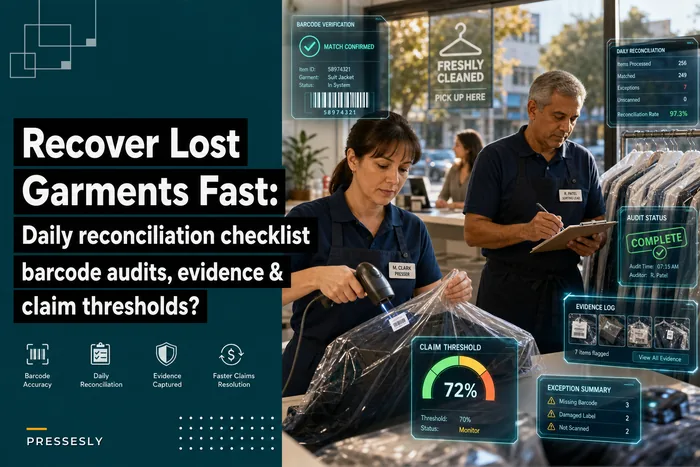
The key is depreciation. A three-year-old suit worn weekly is not worth its original retail. Applying a fair-wear reduction — commonly 10–20% per year down to a floor — keeps payouts defensible and consistent. When you reimburse a lost item, that number also needs to connect back to your reconciliation process so you're not paying out on a garment that's actually sitting in the wrong bin. Tightening daily reconciliation and evidence templates means fewer "lost" garments become payouts in the first place.
P&L guardrails so recovery doesn't eat your month
A recovery policy without a budget line is just a slower leak. Treat service recovery as a planned cost, track it, and set thresholds that trigger a real look.
-
Total refunds + comps + reimbursements should sit around 1–2% of monthly revenue. Under 1% and you may be denying too aggressively and losing customers quietly. Over 3% and something upstream is broken — a machine, a pressing station, a staff member.
-
Chargebacks should stay well under 1% of card transactions. Card networks start paying attention past that threshold, and so should you.
-
Any single reimbursement over your mid-tier cap gets owner sign-off, not counter discretion.
Folding recovery into your monthly P&L rhythm means the number stops being invisible. When you see recovery costs spike in week three, you can trace it back to the equipment or the shift that caused it — instead of discovering a $2,000 hole at year-end with no idea where it came from.
A pattern worth watching: a sudden cluster of same-defect claims almost never means your customers coordinated. It means a press is running hot, a solvent batch went bad, or someone skipped a QC step. The recovery log is an early-warning system for the shop floor, if you actually read it.
The chargeback rebuttal playbook
When a customer skips the counter and disputes the charge with their bank, you're on a different clock with different rules. You usually have a short window — often 7 to 20 days depending on the processor — to respond with compelling evidence, and the burden is on you.
-
Identify the reason code immediately. "Product not received," "not as described," and "unauthorized transaction" each require different proof. Don't send a generic response.
-
Pull the transaction record. Signed ticket or digital authorization, timestamp, amount, and the items on the order.
-
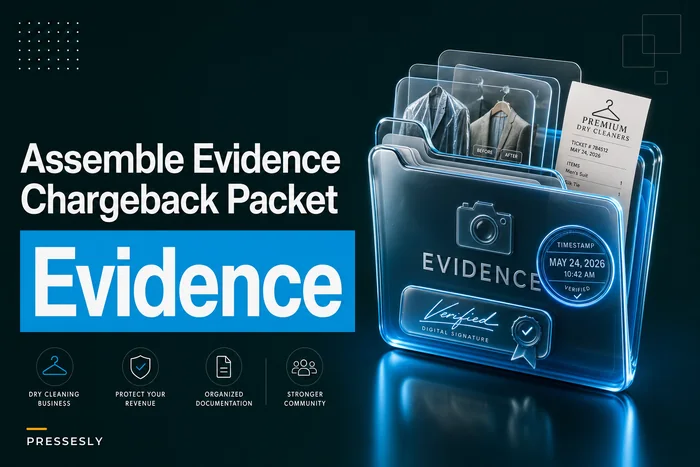
Assemble the evidence packet (template below). Match every claim in the dispute to a specific document.
-
Write a short, factual rebuttal letter. No emotion, no "this customer is lying." State what service was provided, when, and what evidence confirms it.
-
Submit before the deadline and log the submission. Missing the window loses the dispute automatically, regardless of how right you are.
-
Track the outcome and feed it back into your matrix. If you keep losing a certain dispute type, your intake evidence has a gap.
The reusable evidence packet should contain:
-
Itemized order/ticket with timestamps
-
Intake photos of the garment at drop-off
-
Final-inspection / QC photos before pickup
-
Proof of pickup or delivery (signature, photo, locker log)
-
Care-label documentation and any pre-existing condition notes
-
Written communication with the customer (texts, emails)
-
A one-page plain-language summary tying each item to the dispute reason
Shops that already run an evidence-first dispute workflow can assemble this packet in minutes because the pieces were captured at intake and inspection, not scrambled for after the dispute lands. That speed matters when you're racing a processor deadline.
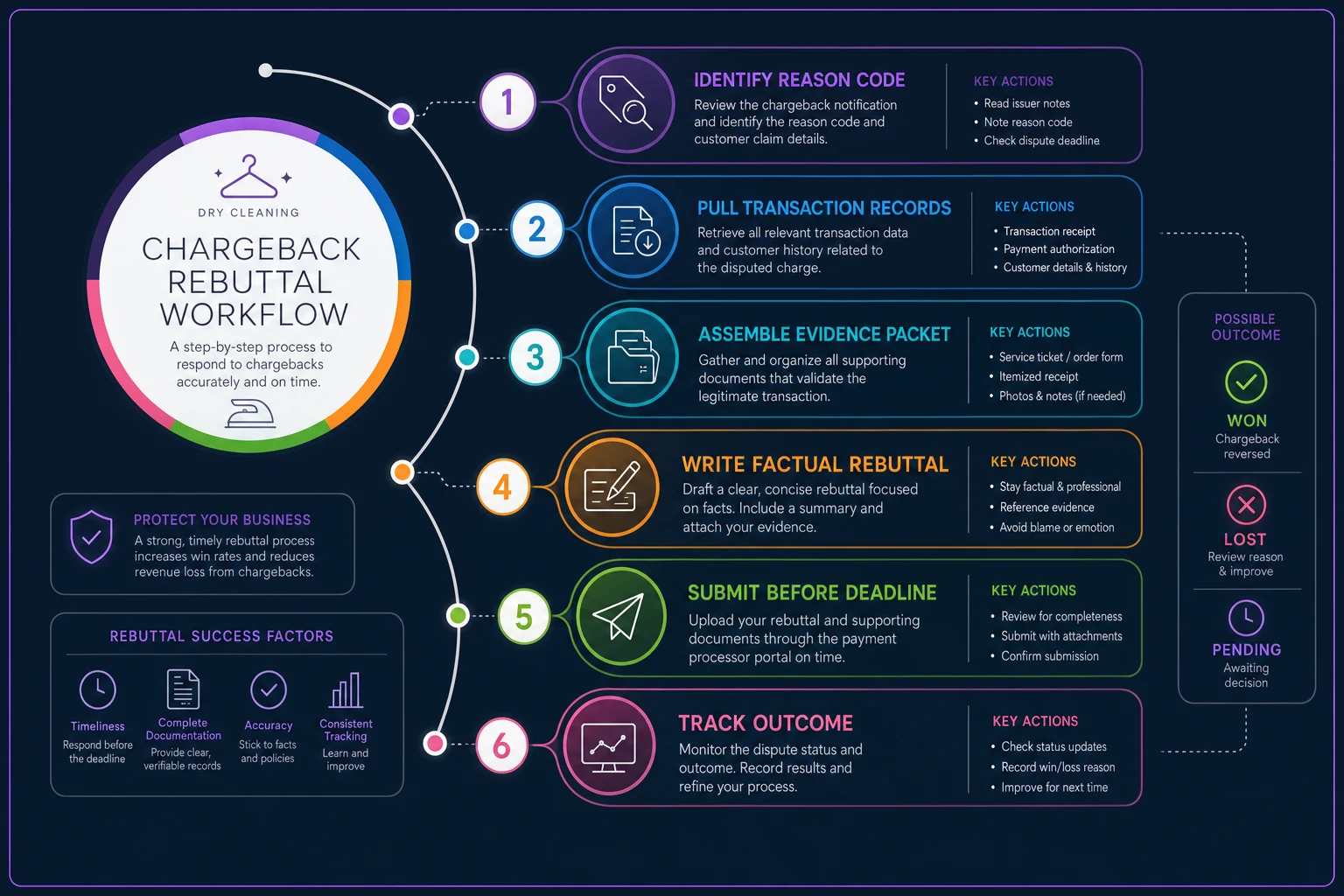
This diagram shows the rebuttal workflow at a glance.
When generous beats correct
There are moments where winning the argument costs more than losing it. A customer worth several thousand dollars over the next few years disputes a $40 order. You might have the evidence to win. Fighting it, winning, and keeping the $40 while losing the relationship is a bad trade.
The matrix handles this by weighting lifetime value in the gray zone — but owners should keep an override for the rare high-value, low-stakes case. Refund it, note why, move on. The discipline isn't "never be generous." It's "be generous on purpose, not by accident, and know what it cost."
When denial is the right call
The flip side: a clean denial backed by strong evidence is not something to apologize for. If your intake photo shows the stain was already there, if the care label called for a process the manufacturer mislabeled, if the customer's story doesn't match the ticket — deny it, show the evidence calmly, and offer a discounted re-clean if you want to leave the door open.
Caving on a claim you can disprove teaches customers and staff that the loudest complaint wins, which trains more bad claims over time.
Who should not build this yet
If your intake doesn't capture a photo and a signed ticket on most orders, a decision matrix won't save you — you'll have no evidence to feed it, and every row collapses to "refund to avoid a chargeback." Fix intake capture first. Same goes if your reconciliation is loose enough that you genuinely don't know whether a "lost" garment is lost or misfiled.
The recovery system assumes the evidence layer underneath it actually works.
A real scenario
A single-location shop doing roughly $38k–$42k a month was running recovery costs near 4% of revenue and taking two or three chargebacks a month, losing most of them. The owner was generous by instinct; two part-time counter staff were not. No two refunds followed the same logic.
They did three things. Built the defect-class-plus-evidence-plus-value matrix and laminated it at the register. Posted a garment-class reimbursement schedule so lost-item payouts stopped being negotiations. And standardized the evidence packet so disputes got answered the same day with intake and QC photos attached.
Over the next few months, recovery costs settled into the 1.5–2% range. Chargebacks didn't vanish, but they started winning more than half of the ones they contested — mostly because the evidence packets were suddenly complete and submitted on time. The quieter win: staff stopped dreading the refund conversation, because the answer wasn't theirs to improvise anymore. It was already decided.
The reason recovery feels chaotic is that most shops treat each incident as a one-off negotiation when it's actually a repeatable decision with three known inputs. Classify the defect. Weigh the evidence. Factor the customer. Let the matrix produce the action, let the reimbursement schedule price the losses, and let the evidence packet fight the disputes you shouldn't lose.
None of this requires more staff or more software — it requires deciding the hard calls once, writing them down, and making sure the evidence layer at intake is strong enough to back them up. Do that, and your dry cleaner refund and chargeback policy stops being a source of monthly surprises and starts behaving like every other managed line on your P&L: predictable, budgeted, and tied back to the part of the shop that actually caused it.
Ready to elevate your dry cleaning operations?
Join hundreds of dry cleaners using Pressesly to save time, reduce errors, and enhance customer satisfaction.