

A chargeback for a $38 silk blouse doesn't sound like much until you're digging through intake slips, texting the presser who handled it three weeks ago, and trying to piece together what the garment looked like when it came in. Most shops lose these disputes not because they were wrong, but because they can't prove they were right fast enough. The card networks give you a tight response window, and vague memories don't count as evidence.
The shops that consistently win chargebacks aren't the ones with better lawyers. They're the ones who treated every transaction like it might someday be challenged — and captured the proof at intake, not after the dispute notification hit their inbox.
The specific problem: your evidence exists, it's just scattered
Here's the pattern that burns dry cleaners. A customer picks up a garment, notices a faint discoloration on the collar two days later, and instead of calling the shop they call their card issuer and file a dispute for "goods not as described." The bank pulls the funds immediately. Now you're on defense.
-
A timestamped record of the garment's condition at intake
-
Proof the customer approved the service and any known risks
-
A signed or documented pickup confirming they received the item
-
Evidence the service was performed to standard
Most shops have fragments of this. A photo buried in someone's phone. A paper ticket with the customer's initials somewhere in a shoebox. A POS timestamp that doesn't connect to any image. Pulling it all together takes a couple of hours, and by then you've half-decided it's not worth the fight for $38.
That's exactly the math the dispute system counts on. Small amounts, high friction, shops that give up.
Why scattered evidence happens even in organized shops
Intake and dispute response get treated as two completely separate worlds, and that's where it falls apart. Intake is about getting the garment tagged and moving. Dispute response happens weeks later, triggered by a bank notification, and whoever handles it is essentially starting from scratch.
Never lose track of an order again.
Pressesly helps you manage, track, and communicate every garment order seamlessly.
- Unified order management
- Real-time customer notifications
- Staff scheduling & workload tracking
No credit card required
-
Photos are optional. Staff snap them "when something looks off," which means the clean garments — the ones that later get disputed as "they ruined it" — have no baseline image at all.
-
Timestamps live in different systems. The POS has a transaction time, the camera roll has a different time, and nothing links them together.
-
Signoffs are informal. A verbal "yeah that's fine" at pickup leaves no paper trail.
-
No one owns the packet. When a dispute comes in, there's no defined process, so it gets handled reactively.
A shop can be spotless on the floor and still have a completely broken evidence trail. Clean work and provable work are different disciplines.
What the card networks actually want to see
Before building the workflow, it helps to understand what actually moves the needle in a rebuttal. Chargeback reason codes vary, but for dry cleaning transactions the disputes almost always fall into a few buckets — and each has specific counter-evidence that tends to win it.
| Dispute reason | What the customer claims | Evidence that beats it |
|---|---|---|
| Service not as described | "They damaged my garment" | Intake photo showing pre-existing condition or clean result photo at final inspection |
| Goods/service not received | "I never got my clothes back" | Timestamped pickup signoff + POS pickup scan |
| Duplicate/unauthorized charge | "I didn't approve this" | Signed intake ticket, approved service list, card auth record |
| Quality dispute | "The stain is still there" | Intake stain assessment notes + customer acknowledgment of risk |
| Credit not processed | "They promised a refund" | Refund log showing threshold decision and any issued credit |
Notice the pattern: almost every winning piece of evidence has to be captured before the dispute exists.
You cannot retroactively create an intake photo. This is why a real dry cleaner dispute workflow gets built at the counter, not at the keyboard three weeks later.
The evidence-first intake capture
The fix starts the moment a garment crosses the counter. The goal is that every transaction automatically generates its own defense file — without anyone thinking about disputes.
-
Photograph the garment at intake, every time — not just the suspicious ones. Front, back, and any area with visible wear, staining, or damage. The baseline photo of a clean-looking garment is the one that saves you when someone later claims you created a flaw.
-
Tag the photo to the ticket number immediately. The photo is worthless in a dispute if you can't prove it belongs to this garment on this order. Filename or metadata should carry the ticket ID.
-
Record condition notes alongside the image. "Pre-existing yellowing on right cuff, customer notified" is a sentence that ends disputes. A disciplined intake stain assessment SOP pays off directly here — the same escalation thresholds you use to flag risky garments are the notes you'll cite in a rebuttal.
-
Capture explicit customer acknowledgment for any flagged risk. If a garment might not fully clean, or the care label is missing, get the customer to approve it in writing or via a signed ticket. "Customer accepts risk of incomplete stain removal" carries real weight.
-
Timestamp everything from one clock. The POS time, the photo time, and the signoff time need to agree. Mismatched timestamps give the issuer a reason to doubt the whole packet.
The discipline here is no exceptions on the baseline photo. The moment you let staff decide which garments are "worth" photographing, you've reintroduced the gap that loses disputes.
The pickup signoff — the step most shops skip
Intake photos defend quality disputes. The pickup signoff defends "I never got it" and "I didn't authorize this" disputes, and it's the step almost everyone neglects.
A clean pickup record needs three things: the timestamp, the scan or confirmation that this specific ticket was released, and some acknowledgment the customer took possession. For walk-in pickups, a quick digital signature or a tap-to-confirm on the POS works. For delivery, the driver's confirmation and a drop photo serve the same purpose.
The final inspection matters here too. The finished result captured during your final-inspection protocol becomes the "after" photo that pairs with your intake "before" shot. Those two images side by side — same ticket, same garment, timestamped — are close to unbeatable in a quality dispute.
How a transaction becomes a defensible record
The whole point of building this workflow is that each transaction flows through a consistent chain of capture — from first contact to final pickup. Here's how that chain looks when it works:
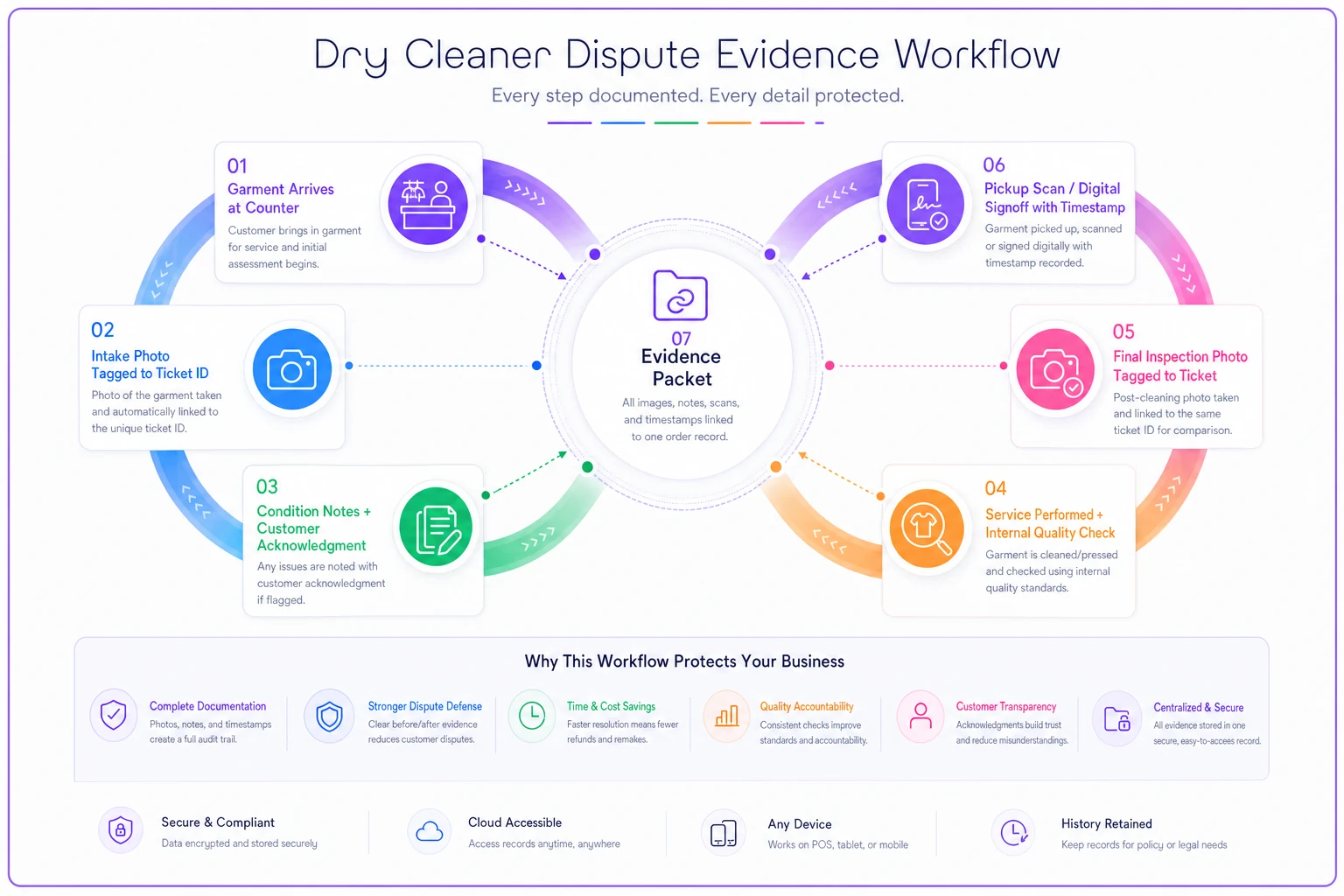
This diagram visualizes the capture chain from intake through pickup.
-
Garment arrives at counter
-
↓
-
Intake photo taken + tagged to ticket ID
-
↓
-
Condition notes recorded + customer acknowledgment (if flagged)
-
↓
-
Service performed + internal quality check
-
↓
-
Final inspection photo taken + tagged to same ticket
-
↓
-
Pickup scan or digital signoff captured with timestamp
-
↓
-
Full evidence packet linked to one order record
Each step feeds the next. Skip one, and the chain has a gap — which is exactly where disputes find their opening.
Predefined refund thresholds: decide before emotions get involved
Half the chargebacks dry cleaners face never needed to become chargebacks. The customer asked for a refund, the shop hesitated or declined, and the customer went straight to their bank. A chargeback costs you the disputed amount plus a fee, plus staff time, and it dings your dispute ratio with the processor. Sometimes the smarter move is to refund immediately and keep the transaction out of the dispute system entirely.
-
Auto-refund, no questions Garment value under roughly $40 with a legitimate complaint. The chargeback fee alone often approaches the refund amount, so fighting it is a losing trade.
-
Refund with documentation $40–$150 range. Refund if the evidence is ambiguous, but log the reason and keep the intake photos — if the customer still disputes, you have a packet ready.
-
Hold and defend Above roughly $150, or any case where your intake evidence clearly shows pre-existing damage or customer-acknowledged risk. This is where you fight, and this is why capturing everything at intake matters.
-
Escalate Repeat disputers, suspected fraud, or claims that don't match your records at all.
Writing these thresholds down does two things: it speeds up front-counter decisions, and it keeps a reasonable customer from reaching their bank over a $25 issue.
Assembling the rebuttal packet
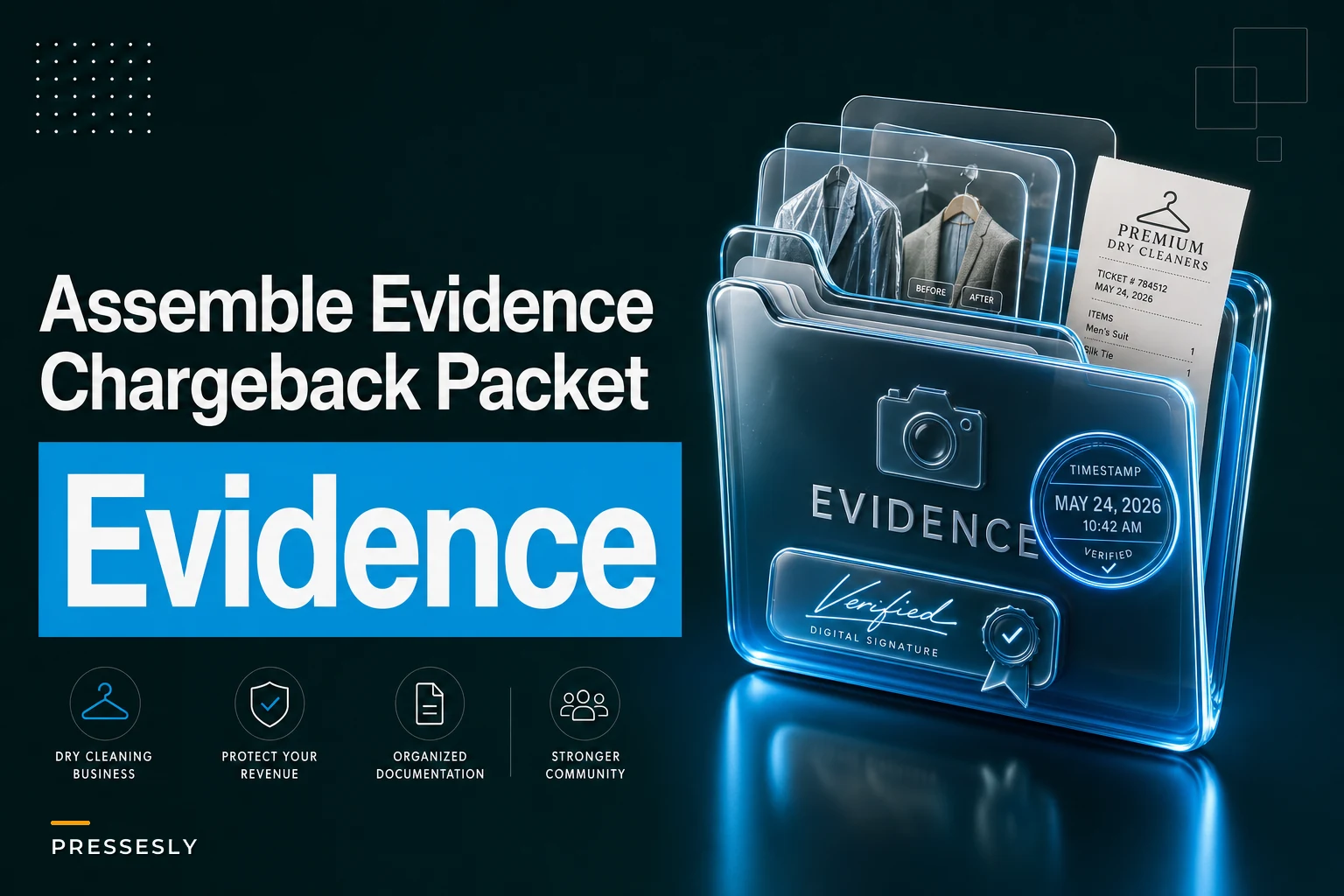
When a chargeback lands, you're on a clock — often 7 to 14 days to respond depending on the card network. A scrambled response loses. A packet you can pull together in fifteen minutes wins.
-
A short, factual cover statement (no emotion, just the sequence of events with dates)
-
The intake photo(s), timestamped and tied to the ticket
-
The final-inspection/result photo(s)
-
The signed or initialed intake ticket showing approved services
-
Any documented customer acknowledgment of risk
-
The pickup signoff with timestamp
-
The POS transaction record
-
Your refund log, if a credit was offered or issued
Keep the cover statement tight. Issuers review these quickly. Something like: "Garment received 3/14 with pre-existing yellowing on right cuff, documented and acknowledged by customer (see attached). Service completed and inspected 3/16. Garment released and signed for 3/17." That paragraph, backed by the attachments, wins more cases than three paragraphs of argument.
A real scenario
A single-location shop doing around $30k–$35k a month was losing most of its chargebacks — not because the work was bad, but because the owner couldn't pull evidence together in time and often missed the response window entirely. The disputes were small, mostly $30–$90, but running 4–6 a month. Lost revenue plus fees came to somewhere in the $300–$450 range monthly, before counting staff time burned on each one.
They changed three things: mandatory intake photos tied to every ticket, a one-tap pickup confirmation on the POS, and a written refund threshold so the front counter stopped stalling on small complaints. Within a couple of months, roughly half the would-be disputes disappeared because customers got refunded quickly on the small stuff before ever calling their bank. Of the disputes that did reach the issuer, they started winning the majority — because now there was a timestamped before-and-after and a signed ticket for each one.
The owner's estimate was around $200–$300 a month recovered in avoided fees and won disputes, with noticeably less time wasted. Not life-changing money, but it turned a reliable monthly leak into a solved problem.
Where tools quietly make this easier
None of this requires fancy software. A disciplined shop with a phone, a labeled folder system, and written thresholds can run this entire workflow manually. The manual version just depends on everyone remembering every step on every ticket — and that's where it breaks down during a rush.
Operational platforms help in a narrow, specific way: they make the capture automatic instead of optional. When the system requires a photo at intake, auto-tags it to the ticket, ties every event to a single timestamp, and keeps the pickup signoff attached to the same order, the evidence packet basically assembles itself. When a dispute comes in, you're not hunting across a phone, a POS, and a filing cabinet — the whole chain is already linked to one ticket. That's the actual advantage: removing the human memory step that creates the gap in the first place.
When fighting the dispute is the wrong move
Not every chargeback is worth defending. Fighting a legitimate complaint over a genuinely damaged garment just delays the refund and burns a customer who might have otherwise stayed. If your intake photo shows the garment was fine going in but your process clearly failed somewhere after, refund it, document the failure, and fix the process. The evidence trail is there to protect you from false claims — not to help you win fights you deserve to lose.
It's also not worth fighting tiny disputes where the fee plus staff time exceeds the disputed amount. That's exactly what the auto-refund threshold handles. Save the effort for cases where the evidence is strong and the amount justifies the fight.
The takeaway
The dry cleaners that win disputes aren't luckier or more aggressive. They simply decided, before any dispute existed, that every transaction would carry its own proof — a timestamped intake photo, a documented condition note, a customer acknowledgment where needed, and a signed pickup. Build that capture into the counter workflow, set refund thresholds so small complaints never reach a bank, and keep a packet template ready for the ones that do. Do that consistently, and the whole category of "disputes I should have won but couldn't prove" quietly disappears.
Ready to elevate your dry cleaning operations?
Join hundreds of dry cleaners using Pressesly to save time, reduce errors, and enhance customer satisfaction.