
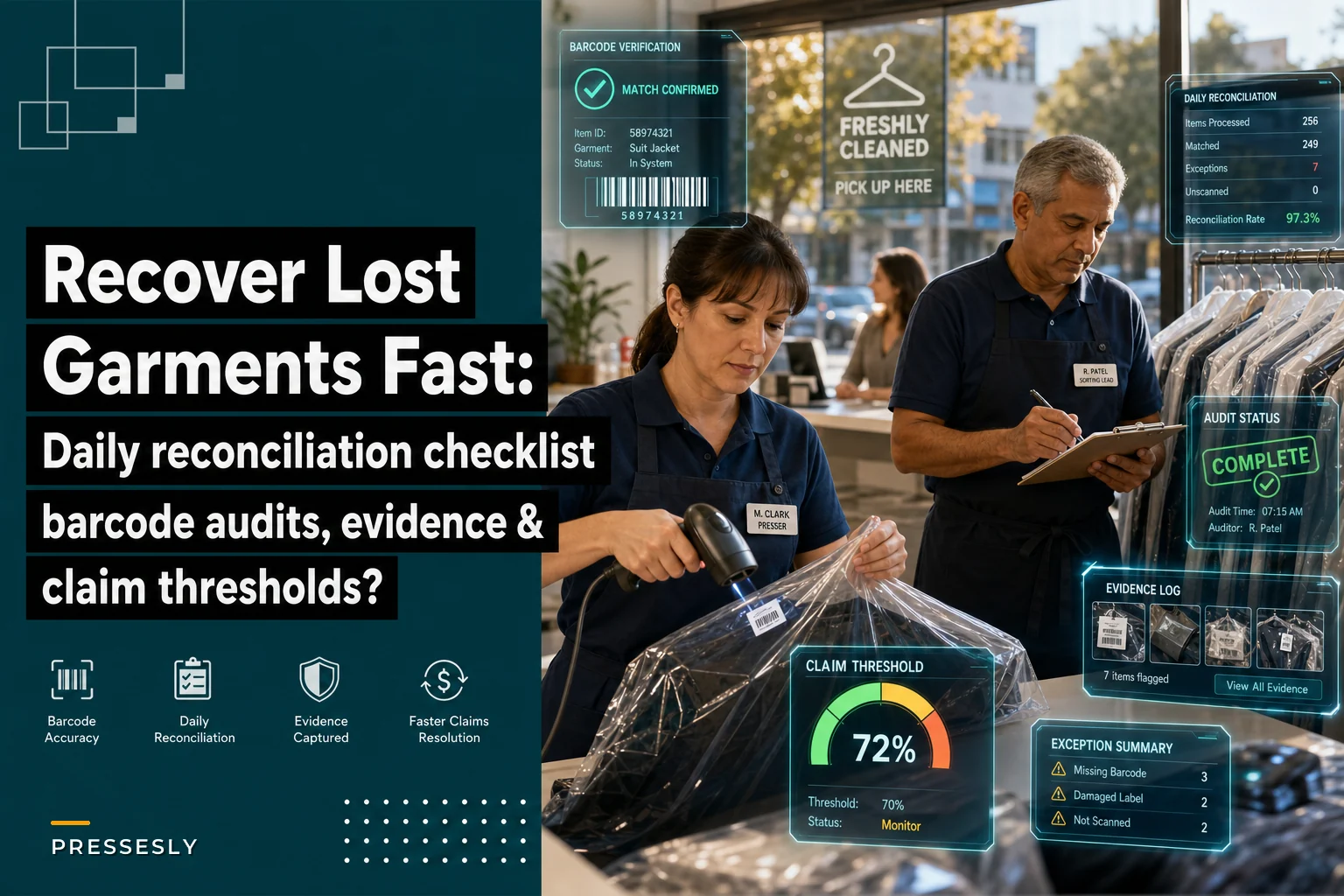

Lost garments kill dry cleaning businesses slowly. Not because of the replacement costs—those hurt, but they're manageable. The real damage is the reputation bleeding, the time-sucking investigations, and the operational chaos that follows every missing item incident.
A proper dry cleaner lost items workflow isn't really about finding lost clothes faster. It's about creating habits that stop items from disappearing in the first place, and when something does go missing, having documentation that protects your business from fraudulent claims while helping legitimate customers get resolved quickly.
The reconciliation trap that catches most shops
Daily reconciliation sounds straightforward. Count what came in, count what went out, make sure they match. Except that's not how a busy shop actually runs.
Morning drop-offs are still being tagged while yesterday's cleaning returns from the plant. Some items get rushed for same-day. Others sit in specialty queues for days. Customers pick up partial orders and leave the rest. By 5 PM, your counts are meaningless—you're comparing apples to incomplete oranges.
Shops that struggle with lost items usually reconcile weekly or monthly, which is basically when it's already too late. They find discrepancies when customers complain, and every missing item becomes a detective story that burns hours of staff time.
Segmented daily reconciliation works better. Instead of trying to balance the whole operation at once, you reconcile specific workflow segments:
Morning intake reconciliation (10 AM): Everything dropped off before 10 AM gets counted against intake tickets. Discrepancies get flagged immediately while customers can still be contacted about unclear items.
Production handoff reconciliation (2 PM): Items heading to cleaning get counted against batch sheets. This catches tagging errors before garments enter the cleaning process where they're harder to trace.
Evening return reconciliation (6 PM): Cleaned items returning from production get matched against their original batch sheets. Missing items trigger immediate investigation while the trail is still fresh.
This segmented approach means you're never reconciling more than 30-40 items at once in a typical single-location shop. About 5 minutes per checkpoint versus an hour of confusion at end of day.
Barcode auditing that actually catches problems
Installing a barcode system doesn't automatically solve tracking problems. We covered the basic hardware setup previously, but the audit process is what determines whether that system actually prevents losses.
Never lose track of an order again.
Pressesly helps you manage, track, and communicate every garment order seamlessly.
- Unified order management
- Real-time customer notifications
- Staff scheduling & workload tracking
No credit card required
Most shops scan items at intake and output and think that's enough. But garments go missing in between—during sorting, cleaning, pressing, and especially at handoffs between stations. Targeted audit sampling is what catches this.
Sorting station audit: Pull 10 random items from sorted bins every two hours. Scan them and verify they're in the right cleaning category. This catches the majority of routing errors before they cascade into lost items.
Press station audit: Sample 5 items per presser per shift. Scan and confirm they match the work order. Pressers sometimes grab similar items from the wrong order when they're rushing.
Rack placement audit: Check 15 items on the customer pickup rack twice daily. Verify the barcode matches the rack position. Items get misplaced here more than anywhere else.
A shop processing around 200 items daily spends maybe 20 minutes total on these audits. That's nothing compared to the 3-4 hour investigations that follow a lost item claim.
The key is making audits systematic, not random. Use a simple rotation:
-
Monday/Wednesday/Friday
Focus on sorting and pressing audits
-
Tuesday/Thursday
Focus on rack placement and specialty items
-
Saturday
Complete system audit of 50 random items
Document everything in a basic audit log—date, time, section audited, items checked, discrepancies found. This creates the evidence trail that protects you later.
Here's a quick visual of the audit workflow.
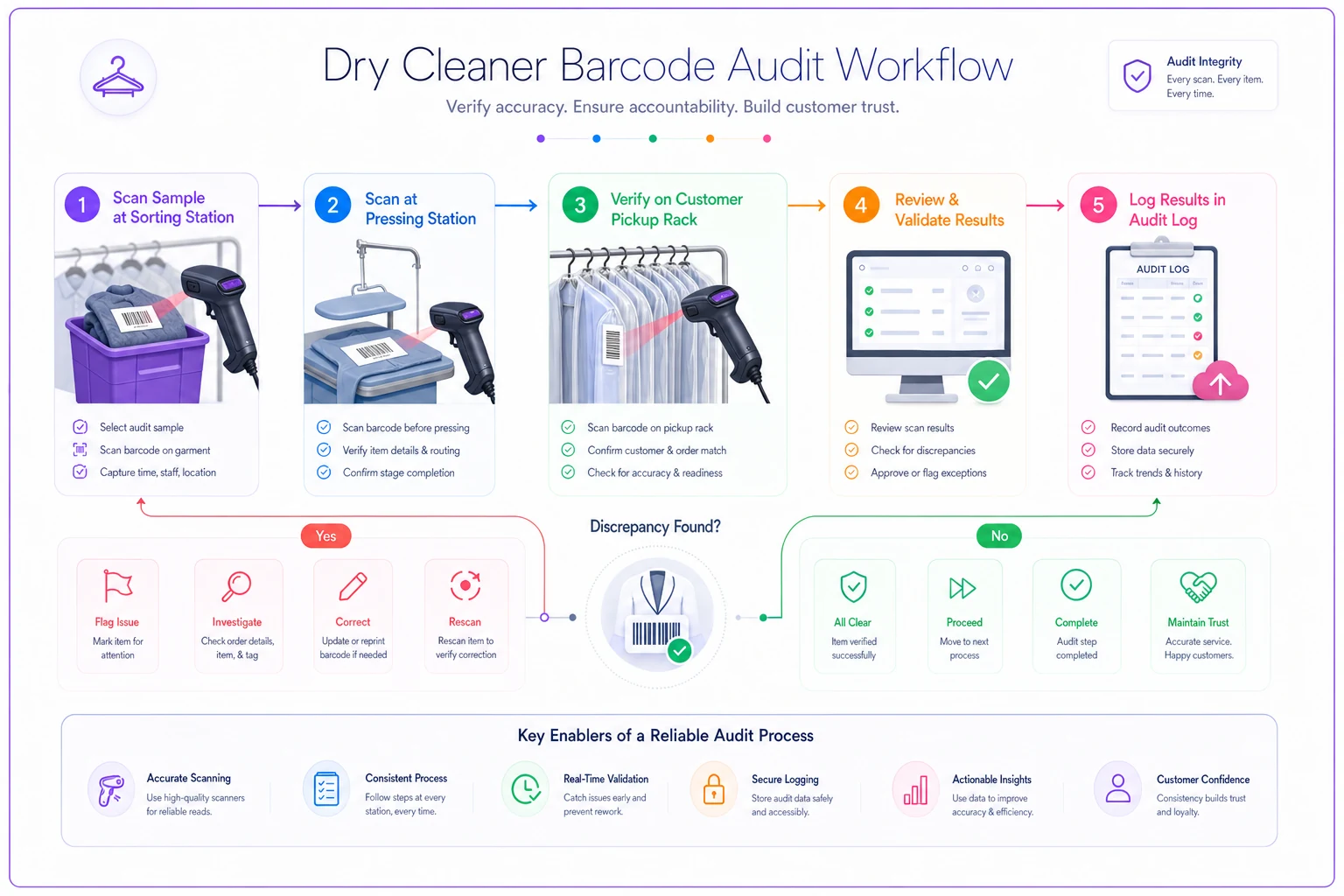
Use this visual to train staff on where and when to sample.
Evidence collection templates that insurance companies actually accept
When a customer claims you lost their $300 designer shirt, your word means nothing without documentation. Insurance companies and credit card dispute departments need specific evidence formatted in specific ways.
Shops that lose these disputes usually scramble to piece things together after the fact. They dig through security footage, search for receipts, interview staff—all while the customer gets more frustrated and starts writing reviews.
Build evidence collection into daily operations instead:
Intake photo protocol: Every item gets photographed during check-in, not just stained or damaged ones. Simple setup—white background, consistent lighting, item laid flat, ticket number in frame. Takes about 5 seconds per item once it becomes habit.
Take intake photos with a consistent background and distance so filenames are searchable.
Store photos organized by date and ticket number: "2024-01-15/Ticket-4782-ItemA.jpg". That structure makes retrieval instant when claims come up.
``
Ticket: [Number]
Date: [Intake date]
Item: [Description]
Brand: [If visible]
Pre-existing issues: [List any]
Customer notes: [What customer mentioned]
Staff observations: [Additional concerns]
Photo reference: [Filename]
``
Fill this out for any item worth over $50 or showing any wear. Takes 30 seconds and provides solid documentation.
``
Ticket: [Number]
Item: [Description]
Intake: [Date/time/staff]
To cleaning: [Date/time/staff]
From cleaning: [Date/time/staff]
To press: [Date/time/staff]
To rack: [Date/time/staff]
Pickup: [Date/time/staff]
``
Yes, it's extra work. But one saved dispute covers months of that effort.
``
Claim date: [When reported]
Ticket number: [Original ticket]
Item description: [Customer's description]
Last verified location: [From records]
Staff interviewed: [Names and statements]
Video reviewed: [Time ranges checked]
Similar items checked: [Other tickets reviewed]
Resolution: [Outcome]
Documentation provided: [List of evidence]
``
Complete within 24 hours while memories are still fresh. This template satisfies most insurance requirements and credit card dispute processes.
Insurance thresholds and refund rules for single shops
Large chains have legal departments and standardized policies. Single-location shops need practical thresholds that balance customer satisfaction with financial reality.
The wrong approach: flat refund limits like "We pay maximum $50 per item." That leads to arguments, bad reviews, and customers who never return after losing something valuable.
A graduated threshold system based on evidence and customer history works better:
| Tier | Details |
|---|---|
| Tier 1 - Automatic resolution ($0-$75) | Clear evidence the shop had the item (intake photo exists); Cannot locate after standard search; Customer has 6+ month history; Offer: Full refund or credit plus 20% toward future cleaning |
| Tier 2 - Investigated resolution ($75-$200) | Evidence item was received but condition unclear; Complete investigation template within 48 hours; Check similar items from the same day; Offer: Depreciated value refund (50-75% based on age/condition photos) or full credit |
| Tier 3 - Insurance claim territory ($200+) | Require proof of purchase or value from customer; Complete investigation with video review; File insurance claim if evidence supports; Offer: Insurance settlement or payment plan if denied |
| Special circumstances adjustments | New customers (under 3 visits): Require more documentation; Frequent claimers (3+ claims per year): Escalate everything to Tier 3; Rushes/same-day service: Add 25% to resolution offers (higher risk acknowledged) |
Track every resolution in a simple spreadsheet:
-
Date
-
Customer
-
Claimed value
-
Resolution offered
-
Actual cost
-
Notes
After six months, patterns emerge. Maybe Tuesday rushes generate more claims. Or certain staff members correlate with missing items. That data shapes better prevention.
The daily routine that actually prevents losses
The perfect tracking system means nothing if staff don't follow it. Most training covers the "what" but skips the "when" and "how often."
Opening (15 minutes):
-
Check overnight drop box, photograph everything before processing
-
Reconcile previous day's final counts
-
Flag any unresolved discrepancies for immediate investigation
-
Review high-value items in today's pipeline
Mid-morning (5 minutes):
-
First audit sample at sorting station
-
Quick scan of specialty cleaning area
-
Verify rush orders are properly tagged
Lunch break (10 minutes):
-
Production handoff reconciliation
-
Photograph items going to outside processors
-
Update chain of custody for high-value items
Mid-afternoon (5 minutes):
-
Press station audit sample
-
Check pickup rack organization
-
Verify completed rushes match tickets
Closing (15 minutes):
-
Final reconciliation of day's movements
-
Photograph unclaimed items over 30 days
-
Update investigation log for open claims
-
Flag tomorrow's high-risk items (rushes, specialty, high-value)
Total time: around 50 minutes spread across the whole day. Compare that to the 3-4 hours spent investigating a single lost designer jacket.
Software automation for tracking without the overhead
Manual tracking works, but it's exhausting. Staff skip steps when they're slammed. Documentation gets sloppy during rushes. Evidence folders turn into digital junkyards.
AI-powered operational software changes the economics here for small shops. Instead of choosing between expensive enterprise systems or error-prone manual processes, modern platforms handle the tedious parts while keeping costs reasonable.
The automation handles evidence organization automatically—photos upload from phones, tagged by ticket number. The system prompts for condition documentation on items over preset values. Audit schedules send as mobile notifications so nothing gets skipped during busy periods.
When someone reports a missing item, the platform pulls all relevant documentation—intake photos, audit records, staff notes—into one investigation file. What used to take hours of searching happens in seconds.
Reconciliation, instead of manual counting and cross-referencing, becomes automatic pattern detection. The system flags items that haven't moved through expected checkpoints before customers notice they're missing. And for insurance claims, evidence packages generate in the format insurers actually want. No more scrambling to prove you're not at fault.
These platforms now cost less than what most shops spend replacing lost items each month.
When this system saves your business
A shop in suburban Phoenix was losing around $400-500 monthly on lost item claims. The owner assumed it was theft, installed cameras everywhere, created elaborate checking procedures. Nothing changed.
Segmented reconciliation revealed the actual problem: their Tuesday/Thursday rush service was creating documentation gaps. Items got pushed through without proper tagging to meet deadlines. By the time customers claimed losses, nobody could prove what happened.
The fix was straightforward—rushes now require photos at every handoff point, no exceptions. Adds about 30 seconds per item. Lost item claims dropped to near zero within six weeks.
Another shop found through audit sampling that their new presser was grabbing items from wrong orders when similar garments were nearby. Not malicious, just rushing and making assumptions. A five-minute conversation fixed it.
The evidence templates proved their value when a customer claimed the shop had lost a $2,000 wedding dress. The shop had intake photos showing existing damage, condition documentation noting concerns, and the customer's signature acknowledging those issues. Claim denied, reputation intact.
Making reconciliation stick
Setting up these systems is the easy part. Maintaining them when things get busy is where most shops fall apart. Every shop starts strong and then gradually slides back into chaos.
The difference is building reconciliation into the natural workflow rather than treating it as an add-on task. Morning intake reconciliation happens while the register is being opened anyway. The afternoon audit runs during the natural lull between rush periods. Evidence collection becomes part of the intake conversation with customers.
Staff buy-in improves when they see the system protecting them from blame. When a customer insists they dropped off items that don't appear anywhere in the system, staff can point to the documentation instead of absorbing accusations.
Some shops gamify it slightly—whoever catches the most discrepancies during audits gets a small bonus or preferred scheduling. Turns a boring task into something staff actually pay attention to.
The insurance threshold system removes emotional decisions from the resolution process. Staff know exactly what to offer based on clear criteria, which takes the stress out of negotiating with an angry customer.
For more guidance on setting documentation standards at intake, check out the full inspection protocol here.
A solid dry cleaner lost items workflow isn't about perfect tracking. It's about systematic habits that prevent problems and protect your business when problems happen anyway. Daily reconciliation catches errors while they're still fixable. Audit sampling identifies problem areas before they become customer complaints. Evidence templates turn "he said, she said" disputes into documented facts. And insurance thresholds remove emotion from expensive decisions.
Small shops don't need enterprise-grade systems to get there. They need consistent processes, simple documentation, and increasingly, AI-assisted operational platforms that make consistency automatic rather than aspirational. The investment—whether in time or software—pays for itself the first time you avoid a fraudulent claim or prevent a genuine loss.
The shops still losing items and eating costs are usually obsessing over their cleaning process while ignoring their tracking process. In an environment where a single bad review can tank your reputation, operational excellence means more than clean clothes. It means knowing where every item is, being able to prove it when challenged, and systematically preventing the problems that erode customer trust.
Ready to elevate your dry cleaning operations?
Join hundreds of dry cleaners using Pressesly to save time, reduce errors, and enhance customer satisfaction.