



Most dry cleaners already track revenue. You know roughly what came in last week. What almost nobody tracks well is where each dollar went at the order level — and that gap is exactly why so many shops feel busy and broke at the same time.
The problem isn't that owners don't understand profit. It's that the information lives in five disconnected places: the POS shows tickets, the bank shows deposits, the solvent invoice sits in a drawer, payroll runs through a separate app, and the hanger bill shows up whenever the supplier gets around to sending it. By the time you stitch all that together into something resembling a profit picture, you're looking at numbers that are 45 days stale and the month is already gone.
This isn't about building a report. It's about building a rhythm — one that maps each order to the month it belongs in, flags margin problems while you can still fix them, and gives you a lightweight P&L you can actually run yourself on a Friday afternoon, not in April with your accountant.
Why order-to-month mapping is the thing that breaks first
There's a pattern that shows up constantly in shops that think their books are fine: revenue and costs land in different months.
A customer drops off a comforter and three suits on the 28th. You clean them that week, buying solvent and paying labor in that same period. But the ticket doesn't get paid until pickup on the 4th of the following month. Cost hit March, revenue hit April. Do that a few hundred times and your "March was a disaster, April was amazing" story is complete fiction — it's just timing noise.
This is the single most common reason owners misread their own business. They'll cut staff hours after a "bad" month that was actually fine, or spend freely after a "great" month that borrowed revenue from the previous one.
The fix is a rule, not a spreadsheet trick. Pick one basis and stick to it:
-
Service-date basis the order belongs to the month it was cleaned, regardless of when it was paid. This matches revenue to the costs that actually produced it.
-
Pickup-date basis the order belongs to the month it was picked up and paid. Simpler, matches your cash, but distorts margin on anything that straddles a month-end.
For a dry cleaner, service-date mapping almost always gives you a truer margin read because your costs — solvent, labor, utilities, packaging — are incurred at cleaning time. Cash-based pickup mapping is fine for watching your bank balance, but it will lie to you about profitability.
You don't have to pick just one. Run margin on service-date, run cash flow on pickup-date, and know which question each one answers.
The order-level costing layer most shops skip
You can't map costs to months if you never captured them at the order level in the first place. This is where the whole model either works or quietly falls apart.
Never lose track of an order again.
Pressesly helps you manage, track, and communicate every garment order seamlessly.
- Unified order management
- Real-time customer notifications
- Staff scheduling & workload tracking
No credit card required
Order-level costing doesn't mean accounting for every drop of perc per garment. It means assigning a defensible cost to each order using a small number of standard rates. A typical build looks like this:
| Cost component | How to assign it | Rough basis |
|---|---|---|
| Direct labor | Minutes per garment type × loaded wage | Press a shirt ≈ 2–3 min, suit ≈ 6–8 min |
| Solvent + supplies | Cost per cleaning cycle ÷ pieces per load | Spread load cost across the garments in it |
| Packaging | Hanger + poly + tag per piece | A few cents to ~$0.30 per garment |
| Delivery (if applicable) | Route cost ÷ stops | Fully-loaded, including fuel and driver time |
| Overhead allocation | Fixed monthly cost ÷ monthly pieces | Rent, utilities, software, insurance |
The point isn't precision to the penny — it's consistency. If every shirt carries the same standard labor and packaging cost, and every order rolls those up, you get a gross margin number per order. That's the raw material for every alert and reconciliation step that follows.
If you've already set up garment-level standard costs, you're most of the way there. The deeper build-out of that costing layer — including how to handle shared loads and cash rhythm — is covered in Protect Margins at Single‑Location Dry Cleaners: Garment‑Level Costing, Cash Rhythm and Promo Gates, and it pairs directly with everything below.
Margin alert rules: catch the leak, not the autopsy
A monthly P&L tells you what happened. Alert rules tell you what's happening now, while you can still change the outcome. That's the difference between running a business and reviewing one.
The trick is tying alerts to order-level thresholds, not shop-wide averages. A shop-wide gross margin of 62% can look perfectly healthy while your wedding-gown and specialty work quietly runs at 20% and drags everything down. Averages hide the problem.
Here are alert rules that actually earn their place:
-
Order margin floor. Any completed order with gross margin below a set floor — say, under 35% — gets flagged for review. Most will have an explanation: a complex stain job, a comped redo. But the ones that don't have an explanation are where your pricing is broken.
-
Negative-margin order. Any order that cost more than it charged, full stop. These should be near-zero in frequency. If you're seeing several a week, something structural is wrong — usually rush work, alterations, or a service category you're chronically underpricing.
-
Category margin drift. When a whole service type (comforters, leather, alterations) drops more than roughly 8–10 points below its trailing average, that's worth looking at. A vendor price hike, a newer staffer pressing slower, a promo that ran too long.
-
Rework cost spike. Redo and remake costs climbing past a threshold of revenue — even 3–4% is worth a look — usually points at a quality issue that's quietly eating margin.
-
Comp and discount creep. Total discounts exceeding a set share of weekly revenue. Discounts are the easiest margin leak to ignore because they never show up as an expense — they just silently shrink what you charged.
The mistake owners make is setting thresholds and then letting every alert fire into a void. An alert nobody acts on trains you to ignore alerts. Each threshold needs an owner and a defined next step, even if that step is just "review it Friday."
This is also where an operational platform earns its keep. When order-level cost and revenue already live in one system, these thresholds can run automatically and surface the three orders that actually need your attention — instead of making you scroll through three hundred. The value isn't the dashboard; it's that the review takes ten minutes instead of a lost afternoon.
The weekly reconciliation rhythm
Monthly reconciliation is too late to fix anything. By month-end, the mispriced orders are picked up, the discounts are given, the slow press shift is history. A weekly rhythm keeps the gap between "problem happened" and "I noticed" short enough to actually matter.
Weekly reconciliation isn't full accounting. It's a tightening pass — making sure what the system says matches what actually happened, and that nothing slipped through a crack. A checklist that runs in about 20–30 minutes once you're in the habit:
-
Deposits match tickets. Total POS sales for the week should tie to bank deposits (minus card processing lag). A persistent gap usually means voided tickets, cash leakage, or un-rung work.
-
Open tickets aged out. Any order cleaned but not picked up past your normal window — these tie up cash and often turn into lost-garment disputes.
-
Cost inputs entered. Did this week's solvent, packaging, and any ad-hoc supply costs get logged against the right period? Missing cost inputs inflate margin and make the model unreliable.
-
Discounts and comps reviewed. Pull the week's discounted orders. Are they intentional, or is someone at the counter freelancing with your margins?
-
Rework logged. Every redo should have a cost attached and a reason. Untracked rework is the margin leak nobody budgets for.
-
Alert queue cleared. Every flagged order from the week gets a yes/no decision. No carryover.
The shops that run this well treat it like closing the register — a non-negotiable end-of-week task, not something you get to "when there's time." There's never time. That's exactly why it needs to be a rhythm.
Inventory ties directly into this. If your supply costs swing wildly week to week, your order costing swings with them, and half your margin alerts become noise. A stable par-level system smooths that out — the mechanics are in How a Simple Par‑Level Inventory System Cuts Costs for Single‑Location Dry Cleaners.
Here's a simple visual workflow to follow for your weekly pass:
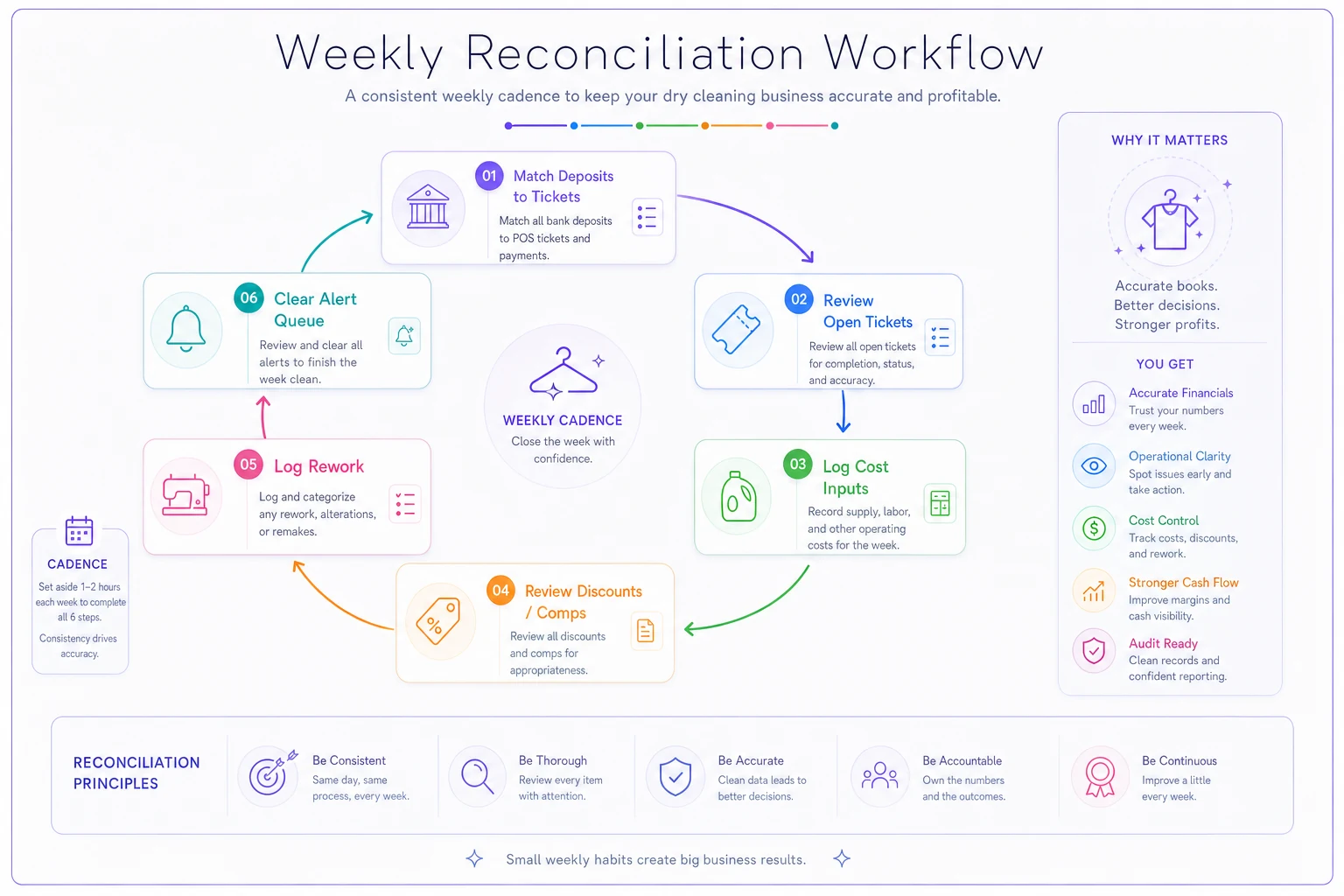
Use this as a checklist guide for your weekly pass so it stays short and repeatable.
A simple P&L guard you can run without an accountant
The goal here isn't a GAAP-compliant statement. It's a guard — a one-page view that tells you whether the month is on track and where it's bleeding. You build it from the order-level data you've been capturing all month.
Structure it top to bottom:
-
Revenue (service-date basis) — all orders mapped to this month by when they were cleaned.
-
Direct cost of service — rolled-up labor, solvent, packaging, delivery from your order-level costing.
-
Gross margin — revenue minus direct cost, in dollars and as a percent.
-
Discounts and comps — pulled out separately so you can actually see them. Burying discounts inside net revenue is how shops lose track of them entirely.
-
Fixed overhead — rent, utilities, insurance, software, base payroll. Mostly stable month to month, so deviations stand out quickly.
-
Operating profit — what's actually left.
The guard part is the comparison column. Every line gets compared to your trailing 3-month average, and anything off by more than a set band gets highlighted. You're not reading absolute numbers — you're reading deviations. A 4-point gross margin drop with flat revenue tells a very specific story (costs crept or discounts grew), and you can chase it down the same day.
A concrete example makes this clearer. Say a shop runs roughly $42k in monthly revenue on a service-date basis, with direct costs around $16k — gross margin near 62%. One month, revenue holds steady but direct cost jumps to about $19k, dropping margin to roughly 55%. The guard flags it. Two things turned up: a solvent vendor price increase nobody had renegotiated, and a run of comforter orders priced at last year's rate while labor time had quietly crept up. Neither was visible in the bank balance. Both were obvious in the guard, and both were fixable within the month — not discovered six months later by a bookkeeper.
This is the whole point of running a guard rather than waiting for a formal P&L. You're not doing accounting — you're catching drift while it's still small enough to correct.
When this system makes sense — and when it doesn't
When it's worth building: You're doing enough volume that eyeballing it no longer works — roughly a few hundred orders a month and up. You've got more than one service category with meaningfully different margins. You've had at least one "how did we lose money in a busy month" surprise. If any of those fit, the rhythm pays for itself quickly.
When it's overkill: If you're a very small operation running a few dozen orders a week with one service type and a clear read on your numbers, a full order-level model is more machinery than you need. Start with clean deposit-to-ticket reconciliation and a basic monthly margin check. Add the rest when the complexity earns it.
Who should not do this yet: If your POS doesn't capture order-level detail at all — no per-order cost, no category tagging — don't try to bolt a costing model onto missing data. Fix the capture layer first. A profit model built on guessed inputs isn't a model; it's a story you're telling yourself with a spreadsheet.
Making the rhythm stick
The hardest part of all this isn't the math. It's consistency. A profit model you run for two months and abandon is worse than none, because you'll half-trust stale numbers while thinking you have a handle on things.
What makes it stick is shrinking the work until skipping it feels harder than doing it. When order-level costs are captured automatically at the ticket, when deposits reconcile against tickets without manual tallying, and when margin alerts surface only the handful of orders that actually need attention, the weekly pass collapses into something you can do with a coffee in hand. That's the real argument for running this inside a system that already holds your order and cost data — not because software is magic, but because manual processes that take an hour get skipped, and the ones that take ten minutes survive.
Start with two or three margin thresholds and one weekly reconciliation pass so the process stays manageable.
Start small. Pick your mapping basis this week. Set two or three margin thresholds, not ten. Run one weekly reconciliation pass and one monthly guard. Let the rhythm prove itself before you add complexity. Within a couple of months, you'll stop guessing which months were good and start knowing — and more importantly, you'll catch the leaks while there's still something left to save.
Start small. Pick your mapping basis this week. Set two or three margin thresholds, not ten. Run one weekly reconciliation pass and one monthly guard. Let the rhythm prove itself before you add complexity. Within a couple of months, you'll stop guessing which months were good and start knowing — and more importantly, you'll catch the leaks while there's still something left to save.
Ready to elevate your dry cleaning operations?
Join hundreds of dry cleaners using Pressesly to save time, reduce errors, and enhance customer satisfaction.