



Most single-location dry cleaners run their finances one layer too high. They look at monthly revenue, subtract expenses, and if the number at the bottom is positive, everyone breathes. The problem is that tells you almost nothing about which parts of the operation are actually making money and which ones are quietly draining it.
A shop can be profitable overall while losing money on comforters, breaking even on shirts, and carrying the whole place on suede jackets and alterations. If you don't know that breakdown, you'll price wrong, promote the wrong services, and time your cash badly. This article walks through how the whole financial system connects — from garment-level margins to cash rhythm, to the reconciliation habits and promotion gates that keep you from making expensive mistakes.
Why shop-level financials hide the real problem
When you only look at the top and bottom line, you're averaging across every garment type — and averages lie. Two shops can have identical revenue and wildly different profit health depending on their service mix.
A pattern that shows up over and over: a shop takes on a big volume of low-margin work — household items, wash-and-fold, bulk comforters — because it feels like business is booming. Counter's busy, racks are full, revenue looks great. But the labor and machine time those items eat up crowds out the higher-margin garment work that actually pays the rent.
Good dry cleaner financial operations start by refusing to trust the average. You want to know your margin per garment category, because that's the number that drives every real decision — pricing, promotions, staffing, even whether to keep offering a service at all.
A quick example of how the average hides trouble:
| Service | Avg. price | Direct cost (labor + supplies + machine) | Margin | Share of volume |
|---|---|---|---|---|
| Dress shirts | $2.75 | $2.20 | ~$0.55 | 45% |
| Suits / 2‑pc | $14.00 | $7.50 | ~$6.50 | 20% |
| Comforters | $32.00 | $26.00 | ~$6.00 | 12% |
| Wash & fold (per lb) | $1.90 | $1.65 | ~$0.25 | 15% |
| Alterations | varies | ~40% of price | high | 8% |
Look at shirts. Forty-five percent of your volume, and only about 55 cents of margin each. If shirt costs creep up 20 cents — a small hanger price bump, a slightly slower presser — half your volume goes nearly break-even and you might not notice for months, because suits and alterations keep the overall number looking fine.
Building garment-level costing you'll actually maintain
The reason most shops don't do garment-level costing is that it sounds like an accounting project. It doesn't have to be. You're not chasing accounting precision — you're chasing decision-grade numbers, meaning accurate enough to make a good call.
Never lose track of an order again.
Pressesly helps you manage, track, and communicate every garment order seamlessly.
- Unified order management
- Real-time customer notifications
- Staff scheduling & workload tracking
No credit card required
-
Pick 6–8 categories, not 40. Shirts, pants, suits/multi-piece, dresses/formalwear, household (comforters, drapes), wash-and-fold, leather/suede, alterations. That's enough resolution to make decisions without drowning you.
-
Assign a realistic labor time to each. Time a few real garments through your process — intake, cleaning, pressing, inspection, bagging. Don't guess. A dress shirt might be 3–4 minutes of total handling; a suit closer to 12–15.
-
Convert time to cost. Take your fully-loaded labor rate (wage plus payroll taxes and any benefits) and multiply by minutes. If your loaded rate is around $22/hour, that's roughly $0.37 per minute.
-
Add direct supplies. Hangers, bags, poly, solvent share, detergent, tags. Your hanger and packaging spend matters more than most people think — if you haven't pinned those numbers down, the work in this breakdown of turn-rate calculations and supplier negotiation feeds directly into this step.
-
Allocate machine/utility cost per load. Rough is fine. Total your monthly utility and solvent cost, divide by loads, and assign a per-garment share.
-
Compare to price. Now you have margin per category. This is the number you govern the business with.
Build it rough, keep it in a simple spreadsheet, and revisit quarterly or whenever a major cost changes.
The mistake people make is over-engineering it and then abandoning it after a month. Build it rough, keep it in a simple spreadsheet, and revisit quarterly or whenever a major cost changes. Decision-grade beats perfect-but-dead.
One thing worth flagging: labor time, not supplies, is usually the hidden margin killer. Shops obsess over solvent and hanger pennies while a slow, rework-heavy pressing station adds three minutes to every garment. Three minutes at $0.37/min across a few hundred garments a day is real money.
Cashflow rhythm: tying money to hanger-turn and cycle time
This is the part most financial advice for small shops completely misses. Your cash doesn't move on a monthly calendar — it moves on your operational rhythm. Specifically, on how fast garments turn through the shop.
Think about the actual cash cycle. You pay for labor, utilities, and supplies now, when the garment is being processed. You collect cash when the customer picks up. The gap between those two events is your cash exposure, and it's driven entirely by cycle time and pickup behavior.
A shop with a 2-day turnaround and customers who pick up promptly has a tight, fast cash cycle. A shop with a 4-day turnaround and a rack full of aging "ready" orders nobody's collected has money frozen on hangers.
That frozen money has a name in operational terms: hanger-turn. Every garment sitting completed-but-uncollected is cash you've already spent, sitting on a rack, earning nothing. Two numbers worth tracking: cycle time (intake to ready) and dwell time (ready to picked up). The second one is the sneaky one. A shop can have great cycle time and still choke its cash because completed orders pile up. When you look at shops with cash-timing stress, an aging "ready" rack is one of the most common culprits — and it barely shows up in normal financial reports.
A workflow view of the cash cycle
Intake → cash committed starts (you'll spend labor/supplies) → Processing → most direct cost incurred here → Ready rack → cash fully spent, none recovered yet → Pickup/payment → cash recovered.
The longer a garment sits in Processing or on the Ready rack, the wider your working-capital gap. If you want your cash rhythm to breathe, you attack two things: cycle time (get it done faster) and dwell time (get it picked up faster — reminders, ready-notifications, prepaid pickup windows).
This is also why the KPIs you watch matter. If you're only tracking revenue, you're blind to the timing. Tracking the operational metrics that actually predict profit — cycle time, dwell, rework rate — gives you early warning. There's a fuller treatment of that in the piece on which KPIs actually predict profit at a dry cleaning shop, and it pairs naturally with everything here.
A visual makes it clear where cash is getting tied up.
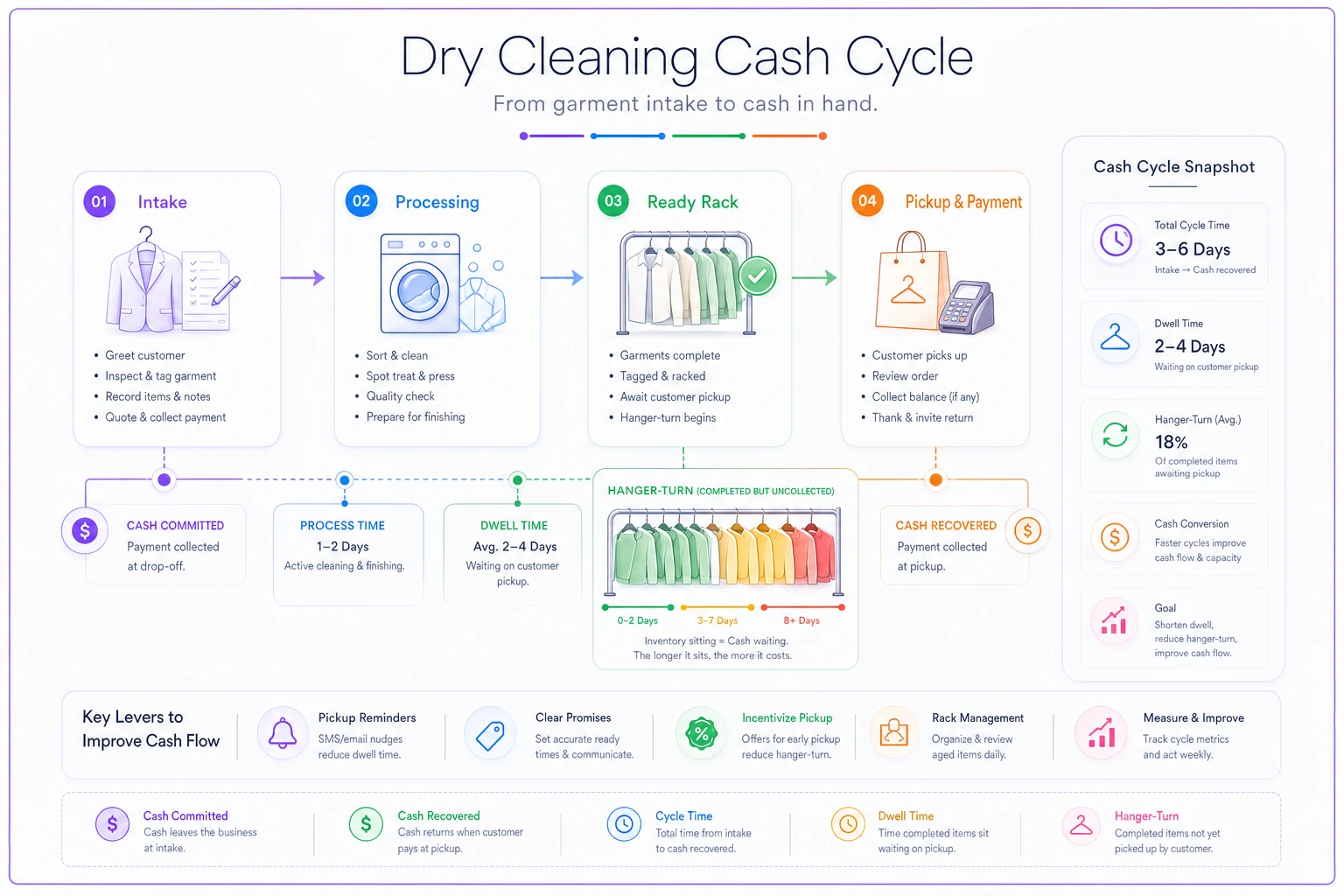
A simple diagram like this helps pinpoint which stage to attack first to free cash.
Reconciliation: the daily habit that catches leaks early
Margins and cash rhythm only mean something if the underlying numbers are trustworthy. Reconciliation is how you keep them honest. Not month-end accounting reconciliation — daily operational reconciliation.
The leaks in a dry cleaner are rarely one big theft. They're a hundred small mismatches: an order rung up wrong, a pickup handed over without payment, a comeback redone for free without logging it, a cash drawer that's $12 light and nobody knows why. Individually tiny. Cumulatively, they can erase your best category's margin.
-
[ ] Total sales (POS) matches payment records (cash + card + account)
-
[ ] Cash drawer counted, variance under a set threshold (e.g., $5) or flagged
-
[ ] Every "ready" order that left the shop shows a matching payment or account charge
-
[ ] Redos/comebacks logged with reason (ties into your rework tracking)
-
[ ] Voids and discounts reviewed — who authorized, why
-
[ ] Account/charge customers invoiced correctly for the day's work
-
[ ] Any garment logged as lost/misplaced flagged for next-day follow-up
Shops that reconcile daily catch problems while the trail is warm. A $40 discrepancy found today can be traced — you remember the shift, the customer, the order. The same $40 found at month-end is just a mystery you write off. Multiply mystery write-offs across a year and you're looking at real margin gone.
Where daily reconciliation connects to the bigger system: it's also your early-warning sensor for pricing drift. If reconciliation keeps showing that comforters are getting discounted "to be nice," or that redos on a particular garment type are climbing, that's margin data disguised as a bookkeeping note.
Decision thresholds for promotions: setting the gates
This is where a lot of shops bleed out slowly. Promotions feel free — they bring people in. But an unguarded promotion aimed at your lowest-margin service is a machine for destroying profit while looking busy.
Go back to that margin table. If shirts run about 55 cents of margin and you run "20% off shirts," you're not shaving profit — you're going underwater on nearly half your volume. Meanwhile a "15% off suits" promo still leaves healthy margin and pulls in the higher-value garments.
The fix is a set of promo gates — simple rules a promotion has to clear before it runs:
-
Margin floor gate. No promotion may push a category's per-garment margin below a set floor (say, $1.00 or a minimum percentage). Low-margin services simply aren't eligible for percentage-off deals.
-
Mix gate. Promotions should target mid-to-high-margin categories, or bundle a low-margin item with a high-margin one so the blended margin stays safe.
-
Redemption cap. Cap total discount exposure. "Up to first 200 redemptions" protects you if it takes off unexpectedly.
-
Break-even lift check. Estimate how much extra volume the promo needs to generate just to break even on the discount. If it needs a 40% volume lift to pay for itself, that's a bad bet.
When promotions actually make sense
-
You're promoting a mid/high-margin service (suits, formalwear, alterations)
-
You're pulling in new customers who'll return at full price (acquisition, not just discounting your regulars)
-
You're smoothing a genuine slow period, and the marginal work is nearly free capacity
-
You've bundled to protect blended margin
When a promotion is a bad idea
-
It targets your highest-volume, lowest-margin service
-
Your capacity is already tight — you'll just discount work you'd have gotten anyway
-
You can't measure whether it brought new demand versus cannibalizing full-price orders
-
Your reconciliation is loose, so you won't even see the damage until it's baked in
The break-even lift is the one most owners skip. Quick way to run it: if you discount a category by X% and its margin was M%, the volume increase you need just to stay even is roughly X / (M − X). Discount shirts 20% when margin is ~20% and the denominator is near zero — you literally can't sell enough to break even. That's the math telling you don't run this promo.
A real scenario: how the pieces catch a leak together
Consider a single-location shop doing somewhere around $28k–$32k a month. On paper, fine — modestly profitable, owner not stressed about the bank balance.
The owner builds garment-level costing for the first time and finds two things. Shirts, at close to half of total volume, are running barely above cost because a hanger price increase and a slow pressing station together added nearly 30 cents of cost per shirt over the past year — a change nobody flagged. Second, the "ready" rack routinely holds 350–400 uncollected orders, meaning a few thousand dollars of already-spent cash sitting frozen most of the time.
Three moves, all from the system above:
-
Costing flagged the shirt margin collapse, so they trimmed pressing rework and renegotiated hangers, recovering close to 20 cents a shirt.
-
Cash rhythm work targeted dwell time — ready-notifications and a nudge on aging orders pulled the uncollected rack down noticeably, freeing frozen cash.
-
Promo gates killed the "shirts special" they ran every spring (which had been quietly losing money) and replaced it with a suit-and-alterations bundle.
None of these were dramatic changes. Combined over a couple of quarters, the shop saw a meaningful improvement in monthly take-home and, just as important, a smoother cash position — fewer tight weeks even when a big supplier bill landed. The revenue number barely moved. The health of the business changed considerably.
How this scales (and where it breaks)
At one location with an owner on the floor, a lot of this governance lives in someone's head. The owner knows suits pay and comforters are marginal, feels when the ready rack is too full, eyeballs the drawer. That works — until it doesn't.
It breaks the moment you add a second shift, a manager, or a second location. The intuition doesn't transfer. New staff run promotions that fail the margin gate because nobody wrote the gate down. Reconciliation slips because the owner isn't there to catch the $40 gap. The ready rack ages because no one owns dwell time.
That's the real reason to systematize while you're small: you're not just protecting today's margin, you're building rules that can be handed off. Garment-level costing, a daily reconciliation checklist, a defined cash-cycle metric, and written promo gates are exactly the things that survive delegation. This governance layer also sits naturally on top of the operational fundamentals — inventory being a big one. If your consumables aren't controlled, your costing inputs drift constantly, which is why a tight par-level inventory system makes everything above more accurate.
Some of this is easier to maintain when the tracking isn't fully manual. Modern shop management platforms with built-in automation can flag aging ready-rack orders, roll up per-category margins from POS data, and surface reconciliation mismatches the next morning instead of at month-end — which mostly removes the "I'll do it later" failure mode that kills these systems in practice. But the logic matters more than the tool. A shop running this on a disciplined spreadsheet beats a shop with great software and no rules every time.
Pulling it together
These four things aren't separate chores — they're one connected system. Garment-level costing tells you where the margin is. Cash rhythm tells you when your money is actually available versus frozen on a rack. Reconciliation keeps the numbers honest enough to trust. And promo gates stop you from giving away the margin the first three worked so hard to protect.
Run them in isolation and each feels like busywork. Run them together and you get something most single-location shops never have: a clear, defensible view of what's actually making money, and the discipline to protect it before a slow month forces the question. Start with the costing spreadsheet — six categories, rough numbers, this week. Everything else has somewhere to attach once you can actually see the margins.
Ready to elevate your dry cleaning operations?
Join hundreds of dry cleaners using Pressesly to save time, reduce errors, and enhance customer satisfaction.