

Most single-location dry cleaners manage inventory the same broken way: someone walks around the shop, eyeballs what's low, scribbles notes on paper, then orders whatever they remember. You end up with $3,000 of perc sitting in storage while running out of poly bags during your busiest week.
That chaos directly eats into your margin. Running out of hangers means turning away same-day orders. Overordering solvents ties up cash you need for payroll. Emergency supply runs cost triple in labor and rush fees.
The shops that actually control costs run a structured par-level system tied to their actual consumption patterns. Not some complex enterprise software — just disciplined inventory management that matches how dry cleaning actually works.
Why Traditional Inventory Breaks at Dry Cleaners
Dry cleaning inventory behaves differently than retail or restaurants. You're not tracking sellable products — you're managing consumables that directly impact production capacity.
A typical single-location shop juggles somewhere between 40 and 60 different supply items across chemicals, hangers, bags, tags, and maintenance supplies. Each category has completely different consumption patterns. Hangers turn based on customer volume. Solvents deplete based on soil levels and fabric types. Spot removal chemicals spike during wedding season.
The "order when low" approach fails because it ignores these patterns entirely. You'll order 500 hangers thinking that's plenty, then Saturday's 80-piece rush wipes out your stock. Meanwhile, that case of leather conditioner from six months ago still sits unopened because you process maybe three leather items a month.
What really destroys margins is the hidden cost structure. When you run out of wire hangers mid-week, you either buy overpriced ones from the local supplier at $45 per box instead of $28 from your regular vendor, or you lose the sale. Both outcomes are painful.
The emergency ordering problem compounds everything. Staff wastes two to three hours weekly managing panicked supply runs — roughly $3,500 annually in pure labor waste, not counting the premium prices paid for rush orders.
Setting Par Levels That Actually Work
Par levels for dry cleaning need to account for your specific operation's rhythm. A shop processing 400 pieces daily needs completely different stock levels than one doing 150.
Never lose track of an order again.
Pressesly helps you manage, track, and communicate every garment order seamlessly.
- Unified order management
- Real-time customer notifications
- Staff scheduling & workload tracking
No credit card required
Start with hangers since they're the most straightforward. Calculate weekly hanger consumption by counting pieces processed, not orders. If you process around 1,800 pieces weekly and 70% go on wire hangers, you need at least 1,260 wire hangers per week. Set your par level at 2.5 weeks of supply (roughly 3,150 hangers) with a reorder trigger at the 1.5-week mark (around 1,890 hangers).
Chemical par levels require different math. Track actual consumption for one full month before setting any levels. Most shops discover they're massively overstocked on specialty chemicals. That bottle of suede cleaner might last eight months, meaning you only need one backup — not six gathering dust on a shelf.
For high-turn items like poly bags and tissue paper, the calculation shifts again. These items tend to have longer supplier lead times but stable consumption. A shop using 400 poly bags weekly should maintain three to four weeks of stock minimum, reordering at the two-week mark to account for delivery delays.
Here's what a working par level sheet looks like for core items:
| Item | Weekly Use | Par Level | Reorder Point | Order Quantity |
|---|---|---|---|---|
| Wire Hangers | 1,260 | 3,150 | 1,890 | 2,500 |
| Poly Bags (24") | 400 | 1,600 | 800 | 1,000 |
| Perc/Solvent | 12 gal | 36 gal | 18 gal | 30 gal |
| Safety Pins | 200 | 600 | 300 | 500 |
| Shirt Boxes | 45 | 135 | 70 | 100 |
The key difference from generic inventory advice: these levels account for the feast-or-famine nature of dry cleaning. Monday's 200-piece intake needs different supply availability than Thursday's 60-piece trickle.
ABC Classification for Dry Cleaner Supplies
Not every supply item deserves equal attention. ABC classification helps you focus inventory management where it actually matters.
A-Items (Monitor Weekly): These represent 70–80% of your supply spend but only 15–20% of your SKUs. For most shops, this includes primary solvent (perc, hydrocarbon, or alternative), wire and plastic hangers, poly bags and roll plastic, your main three or four spotting chemicals, and pressing pads and covers.
Track these religiously. A stockout here stops production. Set up weekly counts and strict reorder points. Many shops benefit from putting A-items on automatic reorder with suppliers once they've dialed in consumption patterns.
B-Items (Monitor Bi-Weekly): The middle tier, covering 15–20% of spend across 30–35% of SKUs. This includes tissue paper and garment covers, safety pins and garment tags, secondary spotting chemicals, machine filters and maintenance items, and shoulder and trouser guards.
Count these every two weeks. Maintain moderate safety stock but don't overinvest. Running out is inconvenient but won't halt operations.
C-Items (Monitor Monthly): The remaining 5–10% of spend spread across 45–50% of SKUs. Specialty chemicals (leather, suede, specific stain removers), repair supplies, marking chalk and pens, rubber bands and clips, and seasonal items all land here.
These barely move the needle on cash flow but create clutter and complexity. Order minimal quantities, count monthly, and consider eliminating anything used less than once per month.
The classification directly drives your turnaround time consistency. When A-items stay stocked, production flows smoothly. When you're hunting for hangers or out of spotting chemicals, everything backs up.
Building Cycle Count Templates
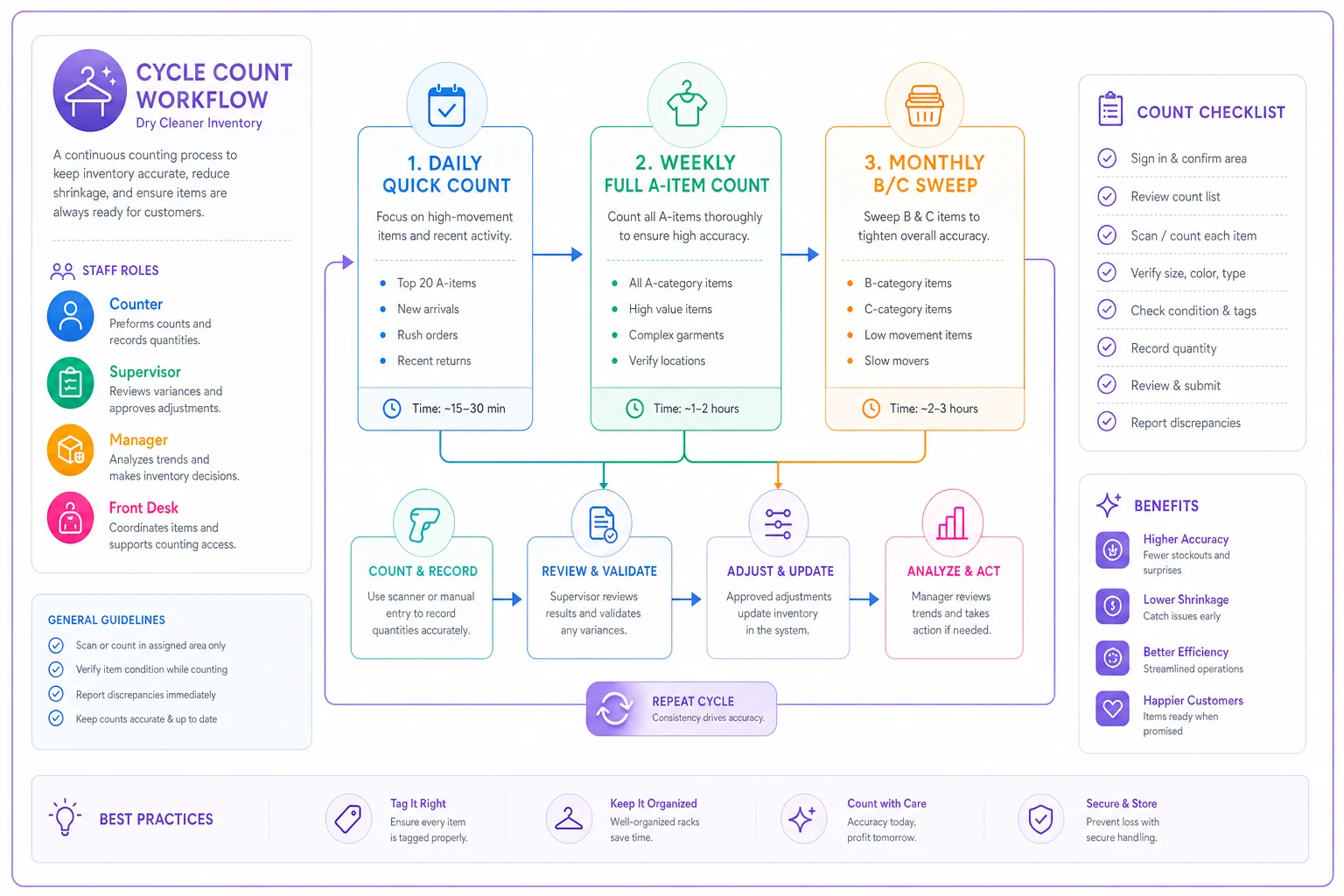
Full inventory counts waste time and rarely happen consistently anyway. Cycle counting — checking portions of inventory on rotation — works better for how shops actually operate.
Create three simple count sheets and use them on a fixed schedule.
Daily Quick Count (5 minutes at close): Focus on wire hangers (visual estimate to nearest 100), poly bag rolls (count full boxes), primary solvent level (check gauge), and any item that triggered a reorder the day before.
Weekly Full A-Item Count (20 minutes Sunday morning): Do an exact count of all hangers by type, all poly bags and packaging, all primary chemicals with measurements, then update the reorder list.
Monthly B/C Sweep (45 minutes): Count all B-items against the par sheet, spot-check C-items for expiration, flag anything unused for 60-plus days, and consolidate partial containers.
Keep the template as a simple printed sheet, not a complex spreadsheet. Staff need to complete counts quickly between tasks.
Visualize the cycle count workflow so staff can follow it quickly.
Track variances between counts and expected consumption. If you should have 2,000 hangers based on last week's count minus this week's processing but only find 1,750, something's off. Either hangers are walking out, getting damaged, or the tracking is broken somewhere.
Reorder Triggers Tied to Real Metrics
Generic reorder points fail because they don't account for how your specific shop operates. Two shops processing identical volume might need completely different reorder triggers based on supplier relationships, storage space, and cash flow patterns.
Cost-Per-Order Calculations: Every supply order carries hidden costs beyond the invoice. Staff time to place and receive (typically 45–60 minutes), interruption to production flow, storage space occupied, cash tied up in inventory, and risk of damage or expiration all factor in.
Hanger-Turn Metrics: Instead of thinking in boxes, track hanger turnover rate. If you process 7,000 pieces monthly and maintain 3,500 hangers in stock, you're turning inventory twice a month. Too fast (over 3x monthly) and you're constantly reordering. Too slow (under 1.5x) and you're hoarding cash in wire.
Dynamic Reorder Points: Your reorder trigger should flex with business patterns. During wedding season (April–June), bump poly bag reorder points up by 30%. In January's slow stretch, let hanger stocks run a bit lower since consumption drops anyway.
Build this into your ordering routine:
-
High season
Reorder at 2 weeks of stock on hand
-
Normal season
Reorder at 1.5 weeks of stock on hand
-
Slow season
Reorder at 1 week of stock on hand
This prevents overordering during slow periods and stockouts during rushes.
When Manual Systems Hit Their Limit
Manual par-level tracking works reasonably well up to around 300–400 pieces daily. Beyond that, the complexity starts overwhelming paper systems. You miss reorder points, counts get inconsistent, and emergency orders creep back in.
The breaking points show up predictably. Count sheets get completed a couple times a week instead of daily. Multiple emergency supply runs happen per month. Staff start "borrowing" from next week's supplies to cover today. Variance between expected and actual inventory keeps growing.
This is where operational software changes the equation. Instead of manual counts, hanger usage gets tracked automatically through your regular tagging process. AI-powered platforms can monitor consumption patterns and adjust reorder points based on actual trends — not static rules someone set 18 months ago.
That same kind of automation that helps with route optimization can forecast inventory needs by analyzing order patterns, so reorder alerts fire before you hit critical levels, not after you've already run out. The labor savings alone tend to justify the investment — shops using automated tracking typically save three to four hours weekly on inventory tasks, adding up to somewhere around $6,000–$7,000 annually in wages, plus virtually eliminating emergency orders and the premium costs that come with them.
Manual systems are a solid starting point, but knowing their ceiling matters. If you're consistently missing counts or placing panic orders, that's your signal.
Real Shop Implementation
A shop in suburban Detroit was struggling with constant hanger shortages a while back. They were processing about 350 pieces daily and spending roughly $24,000 annually on supplies with terrible cash flow timing.
First month, they counted everything and turned up $4,200 in excess specialty chemicals — some dating back three years. They returned what they could, used the credit toward future orders, and freed up cash immediately.
Setting proper par levels revealed they were ordering hangers weekly in small quantities and paying premium prices for frequent delivery. Switching to bi-weekly orders of larger quantities cut hanger costs by 18% annually — about $1,400 saved without changing vendors.
The cycle counting routine took a couple weeks to stick but immediately caught problems. They discovered their presser was tossing damaged hangers instead of putting them in the recycling bin for credit. That waste alone was costing $130 a month.
After six months, supply spend dropped from $24,000 to roughly $19,500 annually. Emergency orders went from twice monthly to once per quarter. The owner stopped spending Sundays doing inventory and used that time on customer acquisition instead.
Making It Stick
The gap between having a system and actually using it kills most inventory improvements. You need embedded triggers that force compliance without requiring constant discipline.
Print count sheets and clip them to the register where closing staff can't ignore them. Make the daily count part of the closing checklist — shop doesn't close until counts are logged. Takes five minutes but prevents hours of crisis management.
Clip count sheets to the register so closing staff can't skip them.
Set calendar alerts for reorder reviews. Every Thursday at 2 PM, someone reviews the par level sheet and places orders. Not when they remember, not when supplies run low — Thursday at 2 PM, every week.
Spread ownership across job roles. Counter staff handles daily counts during slow periods. The presser reports hanger damage weekly. The spotter tracks chemical usage. When inventory becomes everyone's responsibility instead of one person's burden, it actually gets done consistently.
Track the money saved and make it visible. When you avoid three emergency orders in a month, post that savings somewhere staff can see it. People need to understand that their five-minute counts prevent $200 in rush charges — otherwise it just feels like unnecessary paperwork.
Beyond Basic Supplies
Once core inventory runs smoothly, expand the system to other consumables. Machine parts benefit enormously from par-level management given their long lead times and high costs. That $400 pump seal that takes two weeks to arrive? Keep one in stock once you understand your failure patterns.
Marketing materials follow similar logic. Business cards, flyers, and promotional items have long production times but predictable consumption. Apply the same par-level thinking to avoid rush printing charges.
Even office supplies are worth the attention. One shop found they were spending $30 monthly on emergency receipt paper purchases — $360 annually for something that costs half that when ordered properly.
The operational discipline from managing dry cleaner inventory tends to spill into other areas too. Staff who consistently count hangers start noticing other inefficiencies. The same systematic thinking that prevents supply stockouts improves equipment maintenance, customer service, and quality control.
The Profit Impact
When inventory management actually works, the financial improvement shows up fairly quickly. Most single-location shops running a proper par-level system see supply costs drop 15–25% through better ordering and reduced waste, emergency orders virtually eliminated (saving $2,000–$4,000 annually), labor hours reduced by three to four weekly on inventory tasks, cash flow improved by $3,000–$5,000 from optimal stock levels, and lost sales from stockouts cut by around 90%.
The bigger win is operational calm. You stop firefighting and start improving. That mental energy spent panicking about hangers gets redirected to customer service, marketing, or actually growing the business.
The framework scales as you grow too. The same logic that manages 40 SKUs at 300 pieces daily handles 60 SKUs at 600 pieces daily — you adjust the numbers, not the system. Smart inventory management for dry cleaners isn't about perfection. It's about consistency. When you know what you have, what you need, and when to order it, the chaos disappears and growth becomes possible instead of just survival.
The framework scales as you grow too. The same logic that manages 40 SKUs at 300 pieces daily handles 60 SKUs at 600 pieces daily — you adjust the numbers, not the system. Smart inventory management for dry cleaners isn't about perfection. It's about consistency. When you know what you have, what you need, and when to order it, the chaos disappears and growth becomes possible instead of just survival.
Ready to elevate your dry cleaning operations?
Join hundreds of dry cleaners using Pressesly to save time, reduce errors, and enhance customer satisfaction.