


Most dry cleaners don't lose money on promos because the discount was too deep. They lose money because nobody set the rules before the promo went live. The "buy 3 shirts, get 1 free" ran six weeks instead of two. The 20%-off coupon got stacked with the loyalty discount because the POS didn't block it. Nobody checked whether the promo pulled in new customers or just handed a discount to people who were coming anyway.
That's the real problem with dry cleaner pricing experiments — they're rarely run as experiments. They're run on gut feel. Someone sees a slow Tuesday, throws out a discount, and never circles back to see if it moved anything. So this article isn't a list of promo ideas. It's a governance framework: the decision gates, sample-size rules, margin floors, and rollback triggers that let you test pricing aggressively without quietly destroying your margin.
If you already track garment-level costs, you're most of the way there. If you don't, start with garment-level costing and promo gates first, because every rule below depends on knowing your true cost per piece.
Why promos break at dry cleaners specifically
A retail store discounting a product still moves inventory — the cost is mostly the margin given up. Dry cleaning is different. Every discounted order still burns press time, solvent, hangers, poly bags, and labor. When a promo spikes volume, you're not just giving up margin per ticket — you're loading the shop during hours it may not have the capacity to absorb.
That's the trap nobody models. A "40% off comforters" promo sounds harmless until 60 comforters arrive in one week, your machine backs up, turnaround slips, and your full-price customers start getting their orders late. The promo didn't just cost you the discount. It cost you the goodwill of your best customers and probably some overtime to dig out.
Promos at a cleaner have two cost surfaces: the margin you give up, and the throughput you consume. Any framework that ignores the second one is incomplete. The throughput cost is usually bigger than the margin cost, and almost nobody measures it.
The hypothesis canvas: write it down before you discount anything
Before a promo runs, it should fit on one page. Not a marketing plan — a hypothesis. The discipline of writing it forces you to answer questions you'd otherwise skip.
Never lose track of an order again.
Pressesly helps you manage, track, and communicate every garment order seamlessly.
- Unified order management
- Real-time customer notifications
- Staff scheduling & workload tracking
No credit card required
Fill every field or don't run the test.
| Field | What it forces you to decide |
|---|---|
| Hypothesis | "Offering X will cause Y among Z customers" — stated as a testable claim |
| Target segment | New customers only? Lapsed? Everyone? (This changes everything) |
| Primary metric | The ONE number that decides success (e.g. new-customer orders) |
| Guardrail metrics | Numbers that must NOT get worse (turnaround, full-price mix, margin) |
| Margin floor | The lowest blended margin you'll tolerate before pulling it |
| Sample size | How many orders/customers you need before judging |
| Test window | Start and hard stop dates |
| Rollback trigger | The specific condition that kills the promo early |
The most common mistake is a fuzzy hypothesis like "we want more business." That's not testable. A real one looks like: "A first-visit 25%-off coupon will bring in at least 40 new customers over 3 weeks, of whom 30%+ return within 60 days, without dropping blended margin below 42% or pushing average turnaround past 3 days."
Now you have something you can actually pass or fail. It names a segment, a return condition, a margin floor, and a throughput guardrail. That one sentence prevents the majority of ways promos quietly fail.
Sample-size rules: don't call it a win on Thursday
The second-biggest promo mistake is judging results too early. A cleaner runs a Monday–Tuesday discount, sees 12 extra tickets, and declares victory. Twelve tickets tells you almost nothing — that's easily normal week-to-week noise.
-
For a volume/traffic promo wait for at least 50–80 discounted orders before reading anything into it. Below that, weather and randomness dominate.
-
For a retention promo (does the discounted customer come back?): you need at least 30–40 first-time redeemers and enough elapsed time — usually 45–60 days — to see whether they actually return.
-
Always compare to a baseline period, not to zero. What did that same Tuesday do last month? Same week last year? A promo that "added" 15 orders on a week that's naturally up 15 orders added nothing.
One thing most owners miss: run promos against a segment, not the whole customer list. If you blast a discount to everyone, you can't separate "new demand created" from "discount handed to loyal regulars." Restrict the offer to a testable slice — new customers, one ZIP code, one intake channel — and you get a clean read. This is the same segmentation logic that makes behaviorally framed bundles work: the audience and framing matter more than the raw discount size.
Margin gates: the numbers that must hold
A margin gate is a hard floor. If blended margin during the promo drops below it, the test stops — no debate, no "let's give it one more week." The gate exists precisely so you don't rationalize a bleeding promo while you're in the middle of it.
To set gates properly you need three numbers per service line:
-
True variable cost per piece — solvent, poly, hanger, press labor, allocated utilities. Not a guess.
-
Normal margin at full price.
-
Discount-adjusted margin at the promo price, including any stacking risk.
A simplified example for a shirt promo:
| Metric | Full price | 25% off | 25% off + stacked loyalty |
|---|---|---|---|
| Price per shirt | $3.20 | $2.40 | $2.16 |
| Variable cost | $1.35 | $1.35 | $1.35 |
| Margin | $1.85 (58%) | $1.05 (44%) | $0.81 (38%) |
Two things jump out. At 25% off you're still healthy at 44%. But if that coupon stacks with an existing loyalty discount and nobody blocks it, you're at 38% — and possibly lower depending on your cost structure. Stacking is where promos silently go underwater. Your margin gate should assume worst-case stacking unless your POS physically prevents it.
Set the gate a few points above your real pain threshold. If 40% is where a service line stops being worth running, set the gate at 43%. You want to catch the slide before it hits bottom.
Throughput-impact analysis: the cost nobody prices in
This is the piece that separates a real framework from a marketing calendar. Before launching, estimate how much capacity the promo could consume at its upper range — not your expected range, not what you're hoping for.
-
Expected uplift in discounted units (from your hypothesis).
-
Upper-bound uplift — roughly double your expected, because promos surprise you.
-
Capacity consumed — units × minutes of bottleneck time (usually pressing or the cleaning machine).
-
Slack available in that bottleneck during the promo window.
-
Spillover risk — if upper-bound demand exceeds slack, by how much, and what does it do to turnaround for full-price work?
Here's the flow in one line.
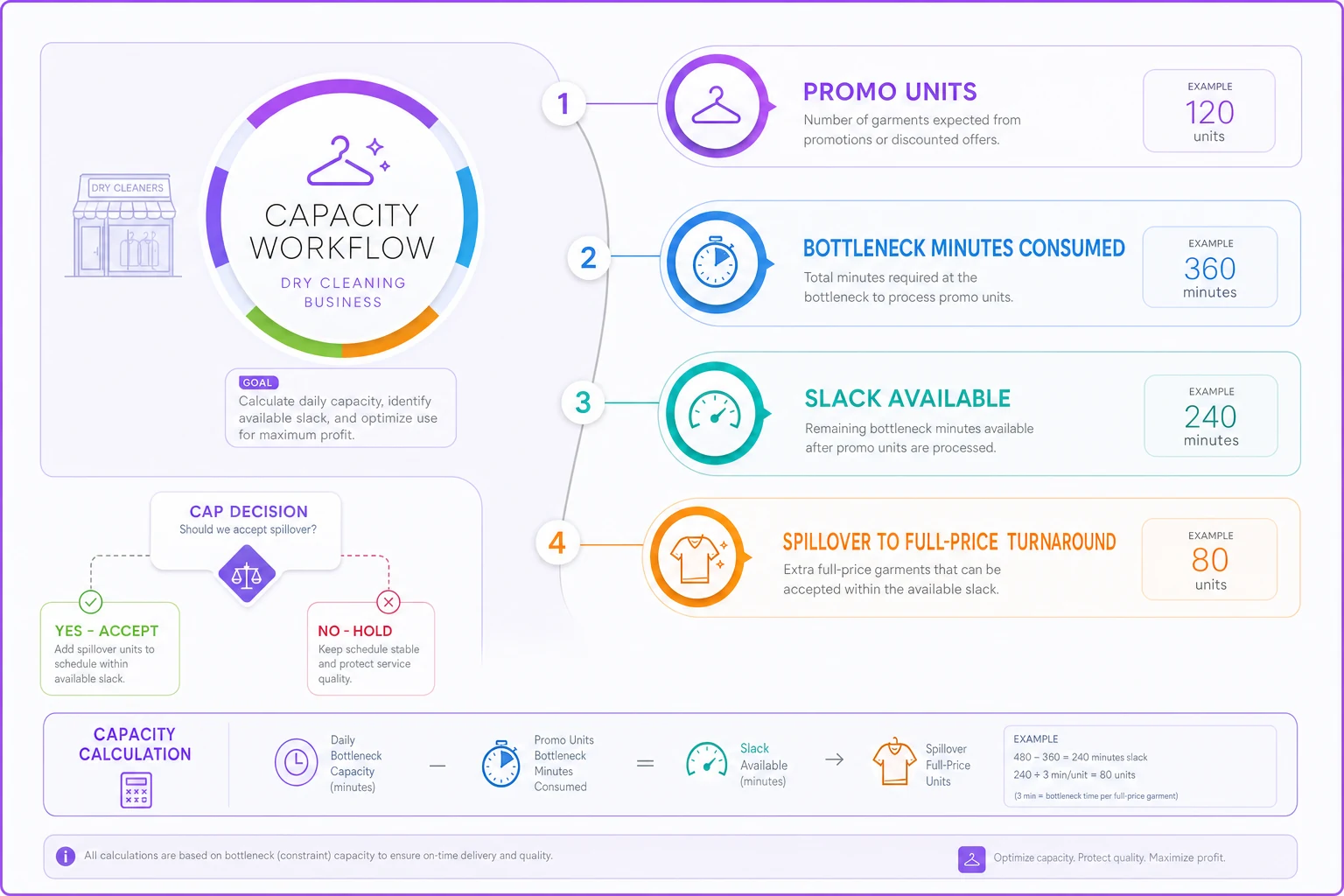
A worked example. A comforter promo is expected to add 20 comforters over two weeks. Upper bound: 40. Each comforter ties up roughly 25 minutes of machine and finishing time. Forty comforters is around 1,000 extra bottleneck-minutes — nearly 17 hours — crammed into two weeks. If your slack is only 8–10 hours, you've just designed a turnaround crisis for every full-price order in the shop.
The fix isn't to cancel the promo. It's to cap it. "First 25 comforters" or "Tuesday/Wednesday drop-off only" turns an uncontrolled demand spike into a bounded one. Capping is the most underused promo tool at dry cleaners, and it's the one that actually protects your regulars. If the promo also touches subscription or recurring customers, the throughput hit compounds — the mechanics in keeping subscriptions from becoming a loss apply here too, because recurring volume plus promo volume can easily overload the same week.
Cap promos (e.g., "First 25 comforters" or "Tuesday/Wednesday drop-off only") to turn spikes into bounded demand.
Capping is the most underused promo tool at dry cleaners, and it's the one that actually protects your regulars.
Rollback criteria: decide how it dies before it launches
Every promo needs a pre-written kill switch. Not "we'll keep an eye on it" — a specific condition that ends it. If you don't define this in advance, you'll always find a reason to let a losing promo limp along another week.
-
Blended margin on the promo line drops below the gate for two consecutive check-ins.
-
Average turnaround for the affected service exceeds your SLA by more than half a day.
-
Full-price mix falls below a set threshold — meaning people are trading down instead of new demand showing up.
-
Redemption comes mostly from existing regulars, which means you're discounting loyalty, not buying growth.
-
Complaint or redo rate on rushed promo work climbs above baseline.
Set a fixed check-in cadence — twice a week for a short promo, weekly for longer ones. The rollback isn't a one-time decision at the end; it's a gate you pass through repeatedly. Same discipline used in multi-site SOP governance, just applied to pricing instead of process.
A clean run-through: the whole system in one flow
Here's how the pieces connect from start to finish:
-
Write the hypothesis canvas. One page, all fields filled, testable claim.
-
Set the margin gate using real garment-level costs, assuming worst-case stacking.
-
Run the throughput template at upper-bound demand and add a cap if you'll blow past slack.
-
Define the sample size — how many redeemers and how much elapsed time before you judge.
-
Write the rollback triggers and pick a check-in cadence.
-
Launch to a segment, not the whole book, so the read stays clean.
-
Check in on schedule. Compare to baseline, not to zero.
-
Pass or fail against the canvas. Keep, kill, or scale — then archive the result so the next promo starts smarter.
The archiving step matters more than it looks. Shops that keep a simple log of past promos — what ran, what the hypothesis was, whether it passed — stop re-running the same losing offers every season.
Most cleaners have no institutional memory of their promos, so duds get repeated annually out of habit.
A real scenario
A single-location cleaner had a standing "20% off dry cleaning over $30" that had been live so long nobody remembered starting it. Blended margin on those tickets had drifted to around 39%, and roughly two-thirds of redemptions were long-time regulars — people who would have paid full price anyway.
They rebuilt it as an actual experiment. New rules: coupon restricted to first-time customers only, POS set to block stacking with loyalty, a margin gate at 44%, a Monday check-in every week, and a rollback if new-customer share of redemptions fell below half. Sample-size rule: don't judge until 40 new redeemers and 45 days in.
Over about seven weeks they pulled in roughly 50 new customers, and a little under a third came back for a second full-price order within two months. Because the discount was walled off from regulars, the margin they'd been giving away to loyal customers came back — a recovery in the low-to-mid thousands annually just from stopping the leak. The promo that "worked" for years had mostly been a slow refund to people who never needed it.
When this framework makes sense — and when it doesn't
Use the full framework when: you're testing a new offer, a deeper-than-usual discount, anything that could spike volume, or any promo you're tempted to make permanent. Also use it whenever an offer stacks with existing discounts — that's the highest-risk category.
You can go lighter when: it's a small, capped, one-off — like 10 free garment repairs for a community event. The overhead of a full canvas isn't worth it for something that genuinely can't hurt you.
Don't run pricing experiments at all if: you don't yet know your true variable cost per piece, or your POS can't restrict offers by segment or block stacking. Without those two things you're not experimenting — you're guessing with your margin, and the guardrails that make experimentation safe simply don't exist yet. Fix costing and offer controls first, then test.
Where the tooling actually helps
The reason most cleaners never run promos this way isn't laziness — doing it manually is genuinely tedious. Pulling baseline comparisons, tracking margin per promo ticket, watching turnaround creep, flagging when a rollback trigger fires — that's a lot of spreadsheet babysitting on top of actually running a shop.
This is where an AI-powered operational platform earns its keep. When your POS and job data live in one system, the margin gate and rollback triggers can be monitored automatically, and the weekly check-in becomes a glance at a dashboard instead of an afternoon of exports. AI-assisted tools can watch the guardrail metrics in the background and surface a promo that's drifting below its margin floor or eating too much bottleneck capacity — before your regulars feel it.
Start with the discipline, not the software though. A promo run through the hypothesis canvas, with a real margin gate and a written rollback trigger, tracked on a plain spreadsheet, will beat a fully automated promo with no rules every single time. The rules are the product. Everything else just makes them easier to follow.
Ready to elevate your dry cleaning operations?
Join hundreds of dry cleaners using Pressesly to save time, reduce errors, and enhance customer satisfaction.