

Subscriptions seemed like a perfect fit for dry cleaners. Predictable revenue, loyal customers, simplified billing. Three years ago, every consultant pushed them as the cure for cash flow headaches. Now I'm watching shops lose money through subscription models that nobody actually manages.
The numbers aren't pretty. A typical shop with 80 subscription customers loses somewhere around $2,400 monthly from failed payments, service confusion, and preventable churn. That's before counting the hours spent manually chasing payments or explaining tier benefits to confused customers. Most owners don't realize how bad it is until they actually sit down and compare what they're collecting against what they're supposed to be collecting.
Why subscription operations fall apart at small shops
Small dry cleaners tend to run subscriptions like they're just regular accounts with automatic billing. They're not. Subscription customers behave differently, expect different service levels, and churn for completely different reasons than walk-in customers.
The operational gaps show up everywhere. Counter staff don't know which tier includes what. Nobody tracks when customers stop using their credits. Payment failures get noticed weeks late. Customers cancel because they forgot they even had a subscription, not because anything went wrong with the service.
What makes this worse is that dry cleaner subscription operations require coordination between multiple systems that rarely talk to each other. Your POS might handle billing, but it doesn't track service usage patterns. Your route software shows delivery schedules, but it doesn't flag when a subscription customer hasn't ordered in three weeks. Everything runs in silos, and problems only surface when customers complain or cancel.
The real killer is capacity planning. Subscription models promise unlimited or high-volume service, but shops still operate with fixed cleaning capacity. When twenty subscription customers all need rush service the same week, something breaks. Either you disappoint subscription customers who expect priority, or you push back regular customers and hurt your reputation there too.
Service cadence templates that actually prevent confusion
Three simple subscription tiers with crystal-clear service boundaries. Not five tiers with complex credit systems. Not customizable plans that nobody can explain at the counter. Three tiers.
Never lose track of an order again.
Pressesly helps you manage, track, and communicate every garment order seamlessly.
- Unified order management
- Real-time customer notifications
- Staff scheduling & workload tracking
No credit card required
Basic Tier ($79/month)
-
2 pickups monthly, scheduled first and third weeks
-
Standard 3-day turnaround
-
Up to 15 items per pickup
-
Text reminder 24 hours before pickup
Professional Tier ($149/month)
-
Weekly pickup, same day each week
-
2-day turnaround
-
Up to 25 items per pickup
-
Priority phone line
-
One free rush service monthly
Executive Tier ($289/month)
-
Twice-weekly pickup
-
Next-day turnaround on all items
-
Unlimited items (within reason)
-
Dedicated service rep
-
Seasonal storage included
The pricing and limits matter less than the operational rules behind each tier. Basic tier pickups happen on set routes with other customers. Professional tier gets dedicated route slots. Executive tier triggers specific workflows in your shop—pre-assigned cleaning slots, dedicated pressing time.
Map each tier to actual operational capacity. If your shop processes 400 items daily, executive tier customers can't exceed 15% of that. Professional tier caps at 30%. This prevents subscription customers from overwhelming your operation during busy stretches.
Failed-payment recovery that doesn't burn relationships
Payment failures happen constantly with subscriptions. Cards expire, accounts run short, billing addresses change after a move. The difference between shops that make money on subscriptions and those that don't usually comes down to how fast they respond.
This sequence works:
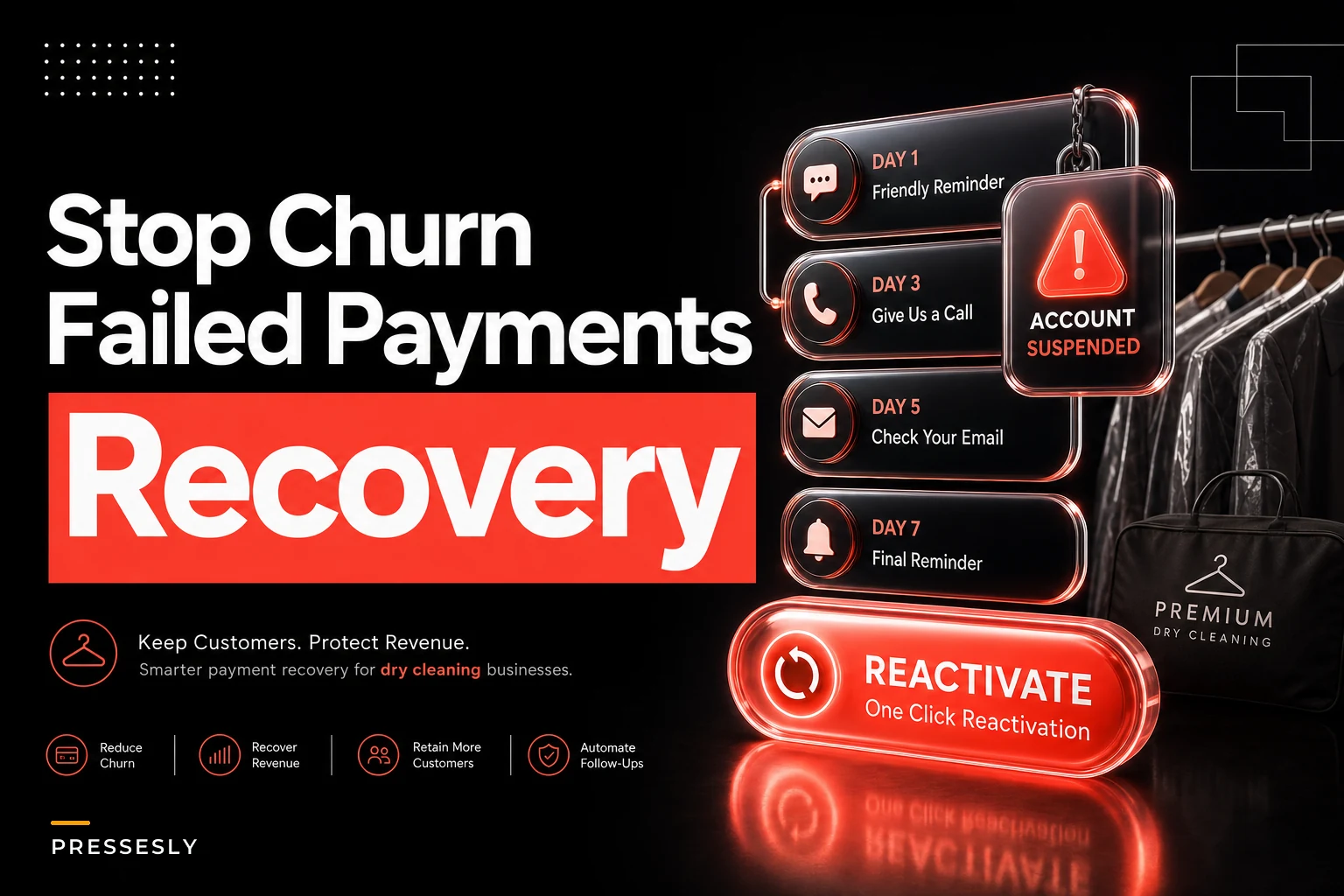
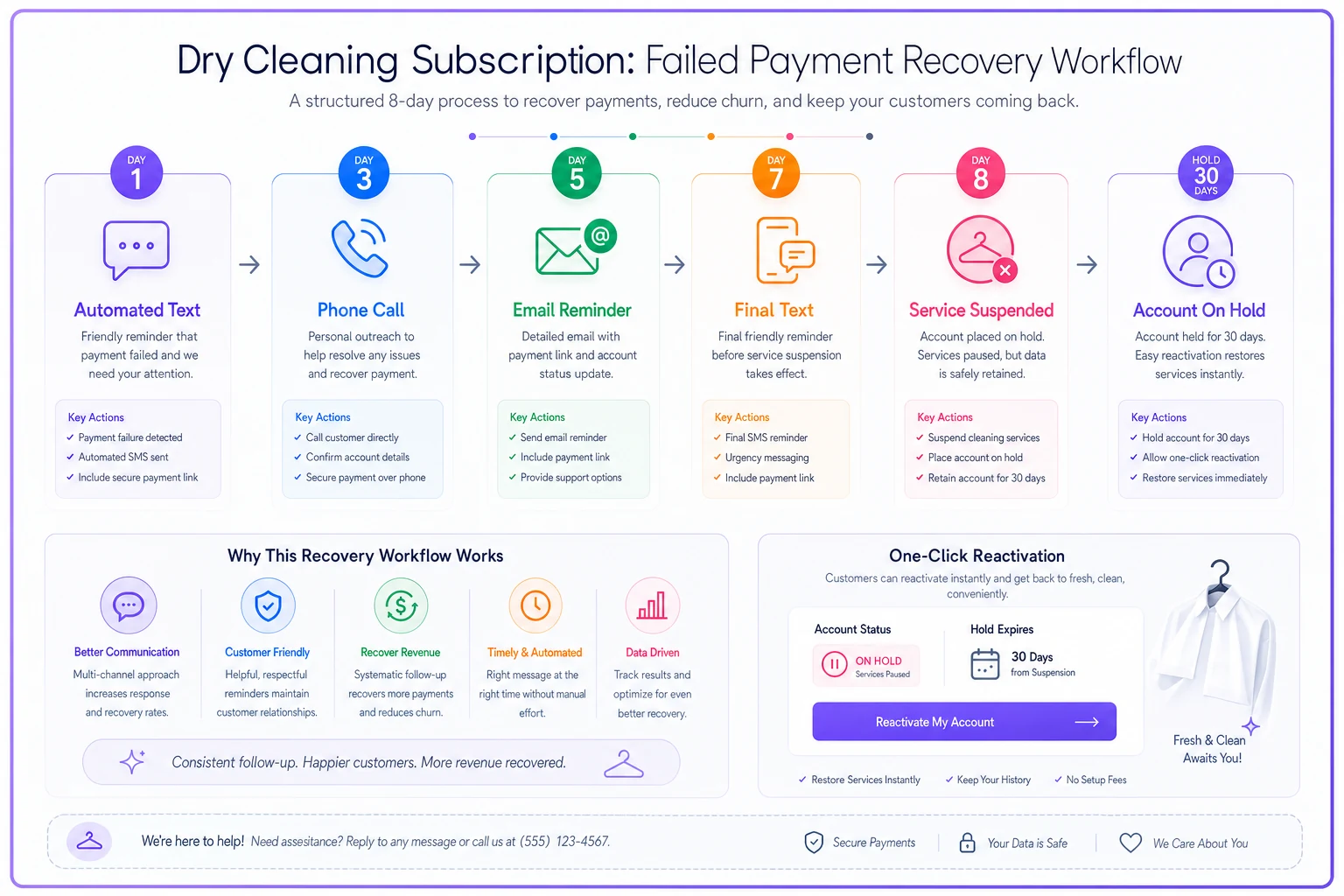
Day 1 (Payment Fails): Automated text within 2 hours. "Hi [Name], your dry cleaning subscription payment didn't process. Update your card at [link] to keep your Tuesday pickup." Casual, not threatening.
Day 3: Phone call from counter staff during a slow period—usually around 2 or 3pm. "Quick heads up, we couldn't process your monthly subscription. Want me to try another card while I have you?" Around 40% fix it on that call.
Day 5: Email with subject line "Keeping your dry cleaning subscription active." Include their tier benefits and usage history. Show them what they'd lose. "You've saved $340 over the past 4 months with your Professional subscription."
Day 7: Final text before service suspension. "Your subscription pauses tomorrow at noon unless payment is updated. Your next pickup is scheduled for Thursday—should we keep it?"
Day 8: Suspend service but keep the account active for 30 days. Don't delete their preferences, addresses, or history. Make reactivation one click.
Here's a visual of the failed-payment recovery workflow.
If a customer updates payment on a call, update their account immediately to avoid repeated failures.
Shops that wait two weeks to deal with failed payments recover maybe 35% of them. Shops that start recovery within 24 hours are closer to 70%. That gap is pure revenue left on the table.
Early warning triggers that catch churn before it happens
Customers rarely cancel without warning. They drift away first. The signals are obvious if you're watching:
Usage Drop Triggers:
-
Subscription customer hasn't scheduled pickup in 14 days (weekly tier)
-
Order volume drops 50% from their 3-month average
-
Customer skips two scheduled pickups in a row
-
Credit accumulation exceeds 2 months worth
Service Issue Triggers:
-
Customer reports any quality issue, even a minor one
-
Delivery attempt fails twice in 30 days
-
A special request gets missed
-
Turnaround exceeds the promised time
Payment Behavior Triggers:
-
Customer calls to ask about the subscription price
-
Payment method gets updated (often precedes cancellation)
-
Customer asks to pause service
-
Customer downgrades their tier
When any of these hit, you have roughly 10 days to turn it around. Not with discounts or overly apologetic outreach, but with operational fixes that address the actual problem.
Customer hasn't scheduled in two weeks? Text them: "Hi Sarah, noticed you haven't scheduled your usual Wednesday pickup. Everything okay? Reply 1 for this week's pickup, 2 to skip this week, or 3 if you need help with something."
Order volume dropped? Call during a quiet period: "Noticed you've been sending less lately. Did your schedule change? We can adjust your pickup day if that helps."
These aren't sales calls. They're operational check-ins that catch problems before they become cancellations.
Fulfillment capacity rules that prevent subscription overload
If you have 50 subscription customers averaging 20 items per week, that's 1,000 guaranteed items weekly before any walk-in business. At 400 items daily capacity, subscriptions already eat 35% of total bandwidth. Most shops don't do this math until operations are already strained.
Capacity Allocation Rules:
-
Subscriptions can't exceed 40% of total weekly capacity
-
Executive tier limited to 5% of customer base
-
Rush requests from subscriptions cap at 10% of daily capacity
-
Tuesday/Wednesday subscription pickups can't exceed 60% of route capacity
Build buffer into your subscription limits. If your shop handles 2,000 items weekly, cap subscription volume at 800. It seems conservative, but it prevents the week when everyone needs service at once.
Track subscription capacity weekly:
| Metric | Target | Actual | Warning Level |
|---|---|---|---|
| Weekly subscription items | <800 | 742 | >900 |
| Daily subscription percentage | <40% | 38% | >45% |
| Rush requests from subscriptions | <10% | 7% | >12% |
| Route capacity for subscriptions | <60% | 52% | >65% |
When you approach warning levels, stop selling new subscriptions temporarily. A waitlist is far better than degrading service for customers already paying for it.
The subscription metrics that actually matter
Track five numbers:
Active Payment Rate: Percentage of subscriptions successfully billing each month. Should stay above 92%. Below 88% and your recovery process needs work.
Usage Rate: Percentage of subscription customers who've used service in the last 30 days. Target 85%. Below 70% usually means cancellations are coming.
Capacity Utilization: Subscription volume divided by reserved capacity. Keep it between 70–85%. Below 70% means unused potential. Above 85% means service problems are on the way.
Churn Prediction Score: Count customers currently hitting early warning triggers. If more than 15% are in warning state, you have an operational problem, not a customer problem.
Revenue per Subscription Slot: Total subscription revenue divided by capacity reserved for subscriptions. This tells you whether subscriptions actually make more sense than walk-in business for those slots.
A shop with 80 subscription customers should roughly see:
-
$9,000 monthly subscription revenue
-
74 active users monthly
-
6–7 payment failures per month (around 5 recovered)
-
2–3 cancellations
-
3–4 new signups
If your numbers are significantly off, something in operations needs attention.
Common subscription mistakes that torch profitability
Unlimited Plans Without Limits
Shops offer "unlimited" cleaning then get blindsided when a few customers start sending 80–100 items every week. Even unlimited plans need soft caps. Something like: "Unlimited up to 40 items weekly, then 20% discount on additional items."
Mixing Subscription and Regular Customers
Subscription customers expect priority. Regular customers pay full price. When you treat them the same, both groups end up frustrated. Subscription customers need dedicated time slots, dedicated routes, or dedicated staff hours.
Ignoring Seasonal Patterns
Dry cleaning demand isn't flat year-round. December tends to slow down, April picks back up. Subscriptions that don't account for this either waste capacity or disappoint customers. Build in seasonal adjustments: "Professional tier includes 4 pickups monthly April–October, 3 pickups monthly November–March."
Complicated Benefit Structures
One shop built tiers with points, credits, rollover benefits, and bonus services. Counter staff couldn't explain it, customers were constantly confused, and the owner was spending hours weekly sorting out disputes. Simple beats sophisticated every time.
When to audit and adjust your subscription model
Every 90 days, run through this:
Financial Check:
-
Compare subscription revenue to what was promised
-
Calculate actual margin after failed payments and service costs
-
Compare to the same capacity used for walk-in business
Operational Check:
-
Count service complaints from subscription vs. regular customers
-
Measure time spent on subscription administration
-
Check whether subscription customers are actually getting the service levels they were sold
Capacity Check:
-
Graph subscription volume against total capacity over the 90 days
-
Identify bottleneck days
-
Calculate unused subscription capacity
If subscription customers generate more complaints per dollar than regular customers, your operations can't handle the model. If margins are running 20% lower than walk-in business after accounting for everything, subscriptions might not be the right fit for your shop.
Some shops genuinely shouldn't run subscriptions. If you're already at 85% capacity with walk-in business, subscriptions will create more problems than they solve. If you can't consistently deliver 3-day turnaround, don't promise 2-day for subscription tiers.
Building the operational foundation for sustainable subscriptions
The subscription model only works when operations actually support it.
Clear contracts that specify exact service levels, not vague language. "Next-day turnaround" means ready by 6pm the following day, not "usually next day unless we're busy."
Dedicated workflow paths for each tier. Basic tier follows standard workflow, professional tier gets priority pressing, executive tier has dedicated handling from drop-off to delivery.
Proactive communication built into the process. Subscription customers shouldn't have to wonder about their order. Automatic updates when items are received, cleaned, and ready. Proactive outreach if a delay is coming.
AI-powered operational software makes this manageable without adding staff. Instead of manually tracking usage patterns, payment status, and capacity, modern platforms monitor all of it automatically—flagging when a subscription customer goes quiet, alerting you to failed payments the same day, and keeping capacity utilization visible in real time.
The shops succeeding with subscriptions aren't doing anything magical. They've just built operational discipline around the model. When that foundation is solid, subscriptions really do become predictable revenue. Without it, they become a slow drain that's hard to diagnose until the damage is already done.
Making subscriptions work without overwhelming your shop
Small dry cleaners can make subscriptions profitable, but not without the right operational constraints in place. The shops doing it well aren't the ones with the fanciest software or the most elaborate tier structures—they're the ones with tight fulfillment rules and fast problem resolution.
Start with simple tiers, clear capacity limits, and aggressive failed-payment recovery. Track the five metrics that matter, pay attention to the early warning signs, and adjust quickly when operations show stress. Don't let subscriptions exceed 40% of total capacity unless you want service problems bleeding into your regular customer base too.
The dry cleaning shops thriving with subscriptions treat them as a separate operational channel with different workflows, dedicated capacity, and proactive service management. The ones trying to bolt subscriptions onto existing operations without changing anything are the ones you see posting equipment for sale a year or two later.
Get the operations right first. The revenue follows from there.
Ready to elevate your dry cleaning operations?
Join hundreds of dry cleaners using Pressesly to save time, reduce errors, and enhance customer satisfaction.