

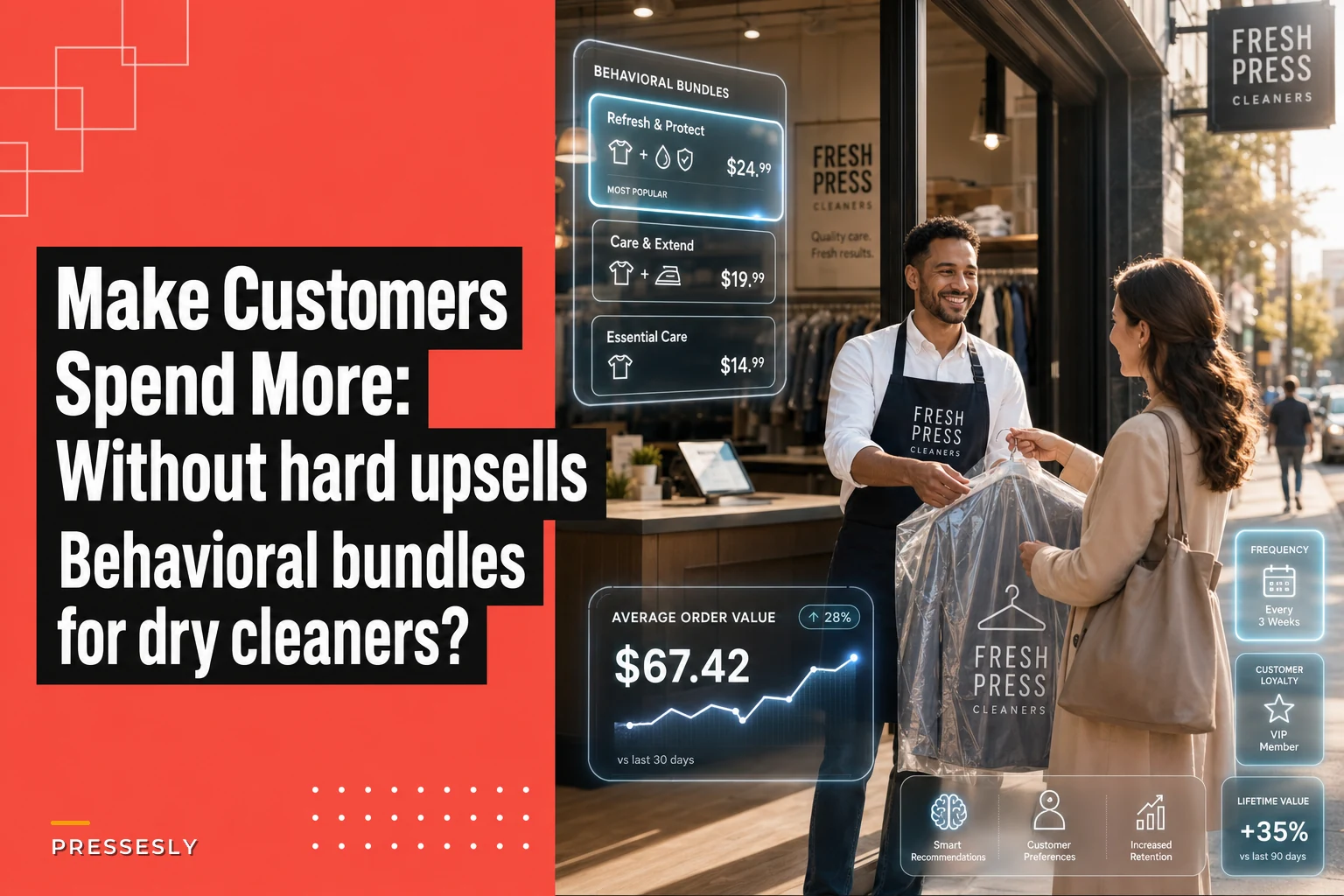

Most dry cleaners leave money on the table because they approach bundling backwards. They create discount packages hoping customers will bite, then wonder why average tickets stay flat while margins shrink.
The problem isn't that customers don't want more services. It's that standard bundle structures work against how people actually make spending decisions at the counter.
Why Standard Bundle Pricing Fails at Counter Interactions
Standard dry cleaning bundles typically look like this: "5 shirts for $15" or "Suit + 3 shirts for $45." These work fine for price-conscious regulars who plan their cleaning trips. But for walk-ins and occasional customers—which make up a real chunk of most shops' revenue—these bundles create decision paralysis.
Watch what happens when someone drops off two suits and you offer them a "3-suit special" for 20% off. Their brain immediately goes into evaluation mode. Do they have another suit at home? Is it dirty enough? Will they even remember to bring it next time?
You've just turned a simple transaction into homework.
The operational fallout compounds from there. Staff spend extra time explaining bundle terms. Customers promise to "bring more items next time" and forget. Your team ends up mentally tracking partial bundle fulfillments that never complete. Meanwhile, the customer who could have added dress shirts or a coat walks out with just their original two suits.
Frequency Triggers That Actually Drive Add-On Behavior
Shops seeing meaningfully higher average tickets tend to use frequency-based incentives that feel like rewards, not requirements. Instead of forcing bundle decisions at dropoff, they create natural escalation points.
Never lose track of an order again.
Pressesly helps you manage, track, and communicate every garment order seamlessly.
- Unified order management
- Real-time customer notifications
- Staff scheduling & workload tracking
No credit card required
One approach that works consistently: graduated bonuses tied to visit frequency rather than item count. Instead of asking customers to decide what to bundle today, you reward them for coming back. When they do, they naturally bring more items because the discount applies to everything.
A simple structure that's worth testing:
-
Visit 1 in a month
Standard pricing
-
Visit 2 within 30 days
15% off entire order
-
Visit 3+ within 30 days
20% off plus free pickup
Operationally, this simplifies things. No partial bundle tracking. No complex pricing explanations. Just a timestamp system that triggers automatic discounts.
Another pattern that drives volume is the cleaning subscription model—customers prepay for a set number of items per month at a discount. The critical detail that makes subscriptions actually work is rollover. If unused items expire at month-end, customers feel pressured and resentful. Give them 45 to 60 days, and that pressure disappears. They use the subscription naturally and tend to max it out once they stop worrying about wasting it.
Low-Friction Add-On Scripts That Convert
The difference between pushy upselling and a natural add-on comes down to framing. Good counter staff don't pitch bundles—they solve upcoming problems.
Standard approach: "We have a special on shirts if you want to add any."
Better approach: "I noticed you're dropping off your navy suit. A lot of people who wear navy rotate their charcoal or gray too. Want me to schedule a Tuesday pickup if you have others you'd like cleaned this week?"
-
Validates their current choice
-
Suggests a logical companion item without pushing
-
Offers convenient timing instead of an immediate decision
Another frame that converts well: occasion-based suggestions.
Standard: "Don't forget we clean formal wear too."
Better: "Since you're getting your interview suit cleaned, should I schedule a backup cleaning for Thursday in case you get a callback next week?"
It works because you're solving a future problem they haven't thought of yet. The suggestion feels helpful, not salesy.
Packaging Structures That Increase Ticket Size
The most effective bundle structures don't look like bundles at all. They look like smart shopping.
The Decoy Bundle Effect
-
Basic
1 suit cleaning - $18
-
Professional
1 suit + 2 shirts + 1 tie - $32
-
Executive
2 suits + 5 shirts + 2 ties - $58
Most customers choose Professional because Basic feels incomplete and Executive seems excessive. The key is to price Professional at roughly what customers typically spend anyway when adding items individually. You're not deeply discounting—you're simplifying their decision.
Position the middle option near the average historical spend to make it feel like the obvious, effortless choice.
Time-Based Packaging
-
Next-Day Express
+40% on any order
-
Standard 3-Day
Regular pricing
-
Economy Week
-20% if picked up after 7 days
This naturally increases order size because customers adding the express upcharge want to spread that premium across more pieces. Someone paying extra for next-day on one shirt will almost always add more items before they leave the counter.
The Protection Add-On
Adding a "Stain Guard Protection" option—essentially extra spotting attention and a re-clean guarantee—for a small per-garment fee tends to convert well when framed right. The incremental cost feels like insurance, not an upsell. Customers already spending $50+ on cleaning don't hesitate much to add a few dollars for a guarantee. The operational cost is minimal, usually one re-clean per several dozen protection sales.
Pricing Psychology That Removes Friction
How you display prices affects add-on rates more than the actual prices themselves.
Anchoring Against Retail Replacement
-
New dress shirt
$45-85
-
New suit
$200-500
-
Wool coat
$150-300
Below that: "Professional cleaning extends garment life significantly"
This reframes cleaning from an expense to an investment. Customers who see replacement costs tend to add more items per visit because the cleaning price feels minor by comparison.
Bundle Savings Without Discount Language
Instead of "Save 20% on 5+ items," try "Smart pricing: 5+ items"
| Items | Pricing |
|---|---|
| 1-2 items | Standard pricing |
| 3-4 items | Smart pricing (-10%) |
| 5+ items | Best value pricing (-20%) |
The word "save" triggers evaluation of whether the discount is worth it. "Smart pricing" suggests the customer is already making a good choice regardless of savings.
Payment Timing
Shops that offer "Clean now, pay on pickup" tend to see higher average tickets. The psychological separation between service selection and payment reduces friction. Customers add items more freely when payment feels like a future problem.
When Bundle Strategies Backfire
Not every shop should implement complex bundling. A few conditions predict bundle failure:
High rush-hour concentration: If the bulk of your business hits during morning dropoff or evening pickup, complex bundles slow throughput. Stick to simple frequency rewards.
Predominantly monthly customers: Shops where most customers visit once a month or less won't see frequency bonuses trigger. Focus on occasion-based suggestions instead.
Limited service range: If you only offer basic cleaning without alterations, repairs, or specialty services, bundles feel forced. Add service variety before pushing packages.
Tourist or transient areas: Hotels, airports, and business districts with mostly one-time customers need simple, transparent pricing. Bundles confuse more than they convert.
Measuring What Actually Matters
Most shops track average ticket size and call it a day. That metric hides whether bundles actually work. A shop can show higher average tickets simply because price-sensitive customers stopped coming.
Track these instead:
-
Items per transaction
Should increase with good bundling
-
Customer visit frequency
Should stay flat or improve
-
Percentage of single-item orders
Should drop
-
Bundle attachment rate
What percentage actually use bundles versus standard pricing
Some owners have found their "successful" bundle program showed higher tickets but noticeably fewer repeat customers. They were optimizing themselves out of business without realizing it.
The Automation Advantage for Bundle Management
Manual bundle tracking creates real operational headaches. Staff must remember multiple bundle types, track partial completions, calculate discounts, and explain everything at the counter under time pressure. Small errors compound quickly.
This is where AI-powered operational software makes a genuine difference. Modern platforms can automatically recognize when orders qualify for bundles, apply discounts, and track completion rates without staff needing to manage it in their heads.
Visualizing the automation workflow makes it easier to understand how it reduces friction.
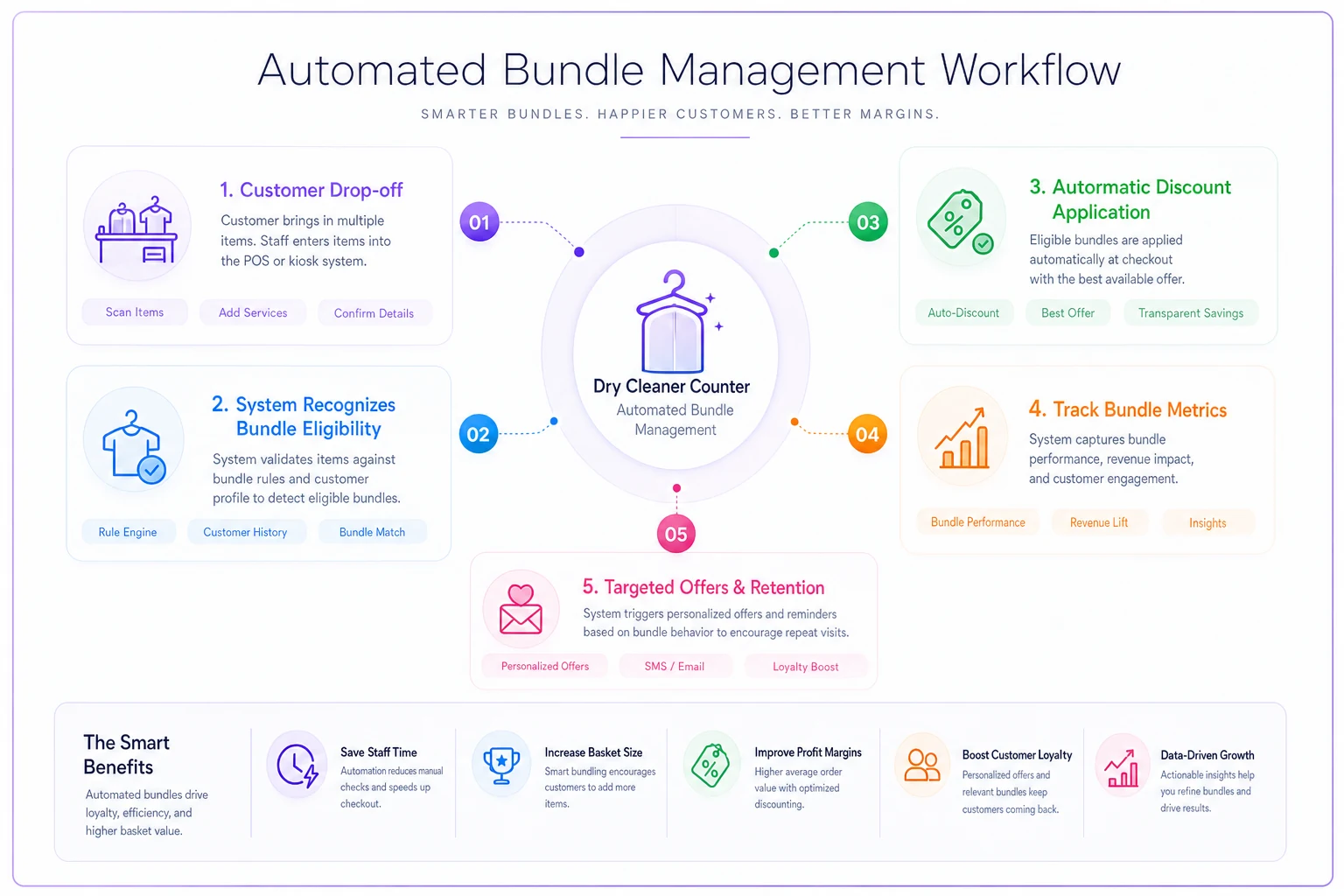
Beyond that, these systems catch patterns humans miss at volume. When a customer regularly brings dress shirts but never suits, the system flags it. When someone's visit frequency drops, it can trigger a targeted offer. That kind of consistent pattern recognition is genuinely hard to replicate manually when you're managing a busy counter.
The efficiency gain goes beyond sales too. Automated bundle management reduces pricing errors, speeds up counter transactions, and gives you clear data on what bundle structures actually drive revenue versus just reshuffling existing spending.
Making Bundles Work Tomorrow
Start with one low-friction addition to your current flow. Don't rebuild your entire pricing structure overnight.
Pick one:
-
Add a frequency bonus for second visits within 30 days
-
Create one occasion-based suggestion for your counter staff
-
Implement a simple three-tier structure for your most common service
Test for 30 days. Track items per transaction, not just revenue. Adjust based on what customers actually do, not what the theory says they should.
Customers don't resist spending more—they resist feeling manipulated into spending more. Build your dry cleaning service bundles around natural behavior patterns and average tickets will climb without the pushy sales tactics that drive people away.
Stop trying to sell bundles. Start removing the friction that prevents customers from bringing in what they already need cleaned.
Ready to elevate your dry cleaning operations?
Join hundreds of dry cleaners using Pressesly to save time, reduce errors, and enhance customer satisfaction.