

A multi‑location operation can absorb a dead boiler. They shuffle work to another plant, lose a day or two, and move on. A single shop doesn't have that option. When your one dry‑cleaning machine goes down, you're not running at 60% — you're at zero. When your solvent distributor suddenly can't deliver, there's no sister store to borrow from. The whole operation leans on a handful of machines, one or two key people, and a short list of vendors who are basically irreplaceable in the short term.
That concentration is the real risk. Not the breakdown itself — the fact that one failure cascades through everything. This playbook is about building enough slack and enough pre‑decided responses that a shock becomes a bad week instead of a closed business. We'll cover mapping what actually can't fail, defining what "still open" means when you're wounded, lining up temporary fulfillment, pre‑writing vendor substitutions, and handling the customer side so you don't bleed your base while you recover.
Why Single Shops Break Differently
Most continuity advice is written for companies with redundancy built in. Backup servers, second facilities, deep vendor rosters. A neighborhood cleaner has none of that, and the failure modes look completely different.
The pattern is pretty consistent: the shop runs fine for years, so nobody plans for the day it doesn't. Then one Tuesday the boiler won't hold pressure and the owner spends the next six hours calling repair techs instead of cleaning clothes. Racks fill with tagged garments that promised Friday pickup. Phones ring. Nobody updates customers because everyone's firefighting. By the time the machine is back, the shop has a backlog it can't clear and a dozen regulars quietly deciding to try the place across town.
The damage isn't the repair bill. It's the coordination collapse that happens when there's no plan and everyone improvises at once. Dry cleaner business continuity isn't about preventing every failure — you can't. It's about making sure a single point of failure doesn't turn into five simultaneous problems because nobody knew their role.
-
People concentration. One master presser or spotter often holds skills nobody else has. Lose them for a week and quality drops even if the machines run fine.
-
Vendor concentration. Most shops buy solvent, hangers, poly, and chemicals from one or two suppliers because the pricing is better and it's simpler. Simpler until one of them has a shortage.
-
Cash thinness. A two‑week disruption during a slow season can push a healthy shop into a cash crunch, which limits your ability to pay for the emergency fix that would end the disruption.
Single points of failure aren't always machines.
The 90‑Day Frame: Build It Before You Need It
Ninety days is enough time to build real resilience without it feeling like a second job. The idea isn't to do everything at once — spend the first month mapping and deciding, the second lining up backups and writing scripts, and the third testing so the plans aren't just paper.
Never lose track of an order again.
Pressesly helps you manage, track, and communicate every garment order seamlessly.
- Unified order management
- Real-time customer notifications
- Staff scheduling & workload tracking
No credit card required
| Phase | Timeframe | Main Output | Goal |
|---|---|---|---|
| Phase 1 | Days 1–30 | Critical‑asset map + minimum‑viable ops definition | Know exactly what can't fail and what "open" means when wounded |
| Phase 2 | Days 31–60 | Vendor‑substitution playbooks + temporary fulfillment contracts + comms scripts | Have the backups and words ready before the emergency |
| Phase 3 | Days 61–90 | Dry runs, a cash buffer target, and a one‑page response card | Make sure the plan survives contact with a real shock |
Most shops skip straight to Phase 3 thinking they'll figure it out when it happens. The problem is that figuring it out mid‑crisis is just about the most expensive way to run a business. Decisions made under pressure with a full rack and a ringing phone are almost always worse than decisions made on a quiet afternoon.
Phase 1: Map What Actually Can't Fail
Start by separating what feels important from what actually stops the business. These aren't the same. Your point‑of‑sale matters, but you can run intake on paper for a day. Your dry‑cleaning machine or boiler? That's a hard stop.
-
Stops everything if it fails. Boiler, dry‑cleaning machine, primary washer, the one person who can operate them. If this goes, you're not cleaning.
-
Degrades quality or speed. The good spotting board, your best presser, the barcode scanner, delivery driver. You can limp, but output drops and defects rise.
-
Annoying but survivable. Second register, one of three steam irons, the fancy packaging. You'll be fine for a week.
The useful insight here: most owners discover during this exercise that they have a person in Tier 1 they never thought about. The spouse who does all the books. The weekend counter person who's the only one who knows the regulars by name. Single points of failure aren't always machines.
For each Tier 1 item, write down three things on one line: what breaks, who you call, and how long until it's fixed in a realistic worst case. That's it. If your boiler tech takes three days to show up in July, you need to know that now, not when the boiler dies.
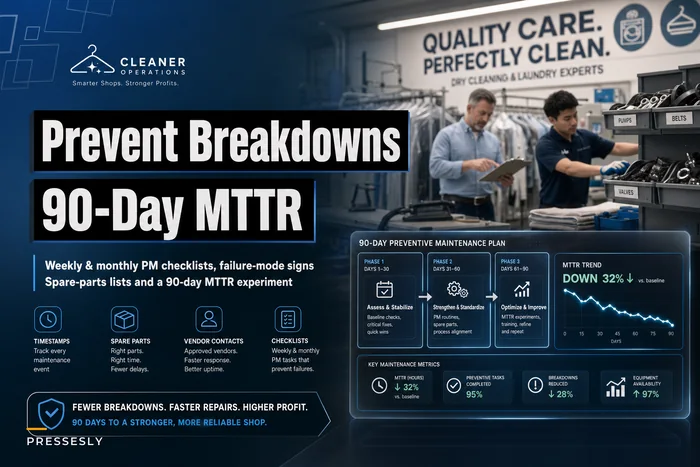
A preventive‑maintenance rhythm does a lot of the heavy lifting on the equipment side — fewer surprise breakdowns means you need the rest of this playbook less often. If you haven't built one yet, the 90‑day preventive maintenance plan is the natural companion to this work, since it attacks the failure before it becomes a continuity event.
Phase 1, Continued: Define Minimum‑Viable Operations
Almost no owner has a clear answer to this question: when you're down to half your capacity, what do you still do, and what do you drop?
Without a predefined answer, the instinct is to try to do everything at reduced speed. That's the trap. You end up doing all services badly, missing every promise date, and making every customer unhappy — instead of keeping most of them satisfied by triaging honestly.
-
Keep running Standard dry cleaning and press on everyday garments — shirts, pants, basic suits. This is your bread‑and‑butter cash flow.
-
Triage carefully Rush orders, wedding gowns, specialty leather, anything with a hard deadline. Only accept what you can genuinely deliver.
-
Pause and communicate Alterations, bulk household items, non‑urgent specialty work. Tell customers upfront there's a delay.
The move most people miss: when you pause a service, you have to stop taking it in, not just slow it down. A shop that keeps accepting alterations during a machine outage is building a second backlog on top of the first. Put a sign up. Train the counter to say it. Turn off the booking for it if your intake is digital.
Your minimum‑viable definition should tie directly into whatever turnaround promises you make. If you've already built SLAs and buffer rules into normal operations — and you should have — your crisis mode is just a documented downgrade of those targets. The shop turnaround time playbook covers the normal‑state version of this; your continuity plan is essentially the "degraded mode" setting of that same system.
Phase 2: Temporary Fulfillment — Who Cleans Your Clothes When You Can't
This is the single most valuable thing on the list, and almost nobody sets it up before they need it.
If your machine is down for a week, you have two choices: tell everyone to wait, or get the work done somewhere else. The second option keeps customers and cash flowing. But you can't negotiate a wholesale arrangement with another plant in the middle of an emergency — you'll get bad terms, or they'll be full, or they won't trust you yet.
-
Identify two candidate plants within reasonable driving distance — one primary, one backup.
-
Agree on wholesale pricing in advance (usually a per‑piece rate noticeably below your retail).
-
Settle the logistics
who drives the garments, how they're tagged so nothing gets mixed up, and who's liable if something's damaged in transit.
-
Run one small test batch so the handoff isn't brand new when it matters.
-
Document it on a single page with phone numbers and the agreed rate.
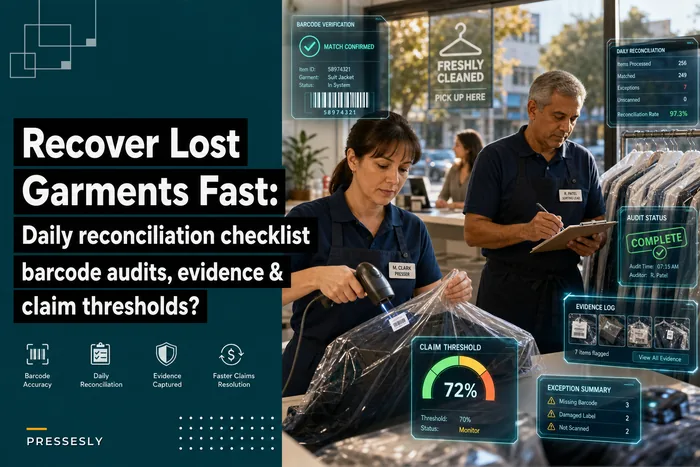
The tagging piece matters more than people expect. When garments leave your shop and go to someone else's rack, the risk of lost or mismatched items spikes. Having a tight intake and reconciliation habit already in place is what keeps a fulfillment handoff from turning into a claims nightmare. If your tracking is loose, tighten it first — the daily reconciliation and evidence templates are the foundation that makes outsourcing safe.
GRAPH: Temporary Fulfillment Handoff Workflow
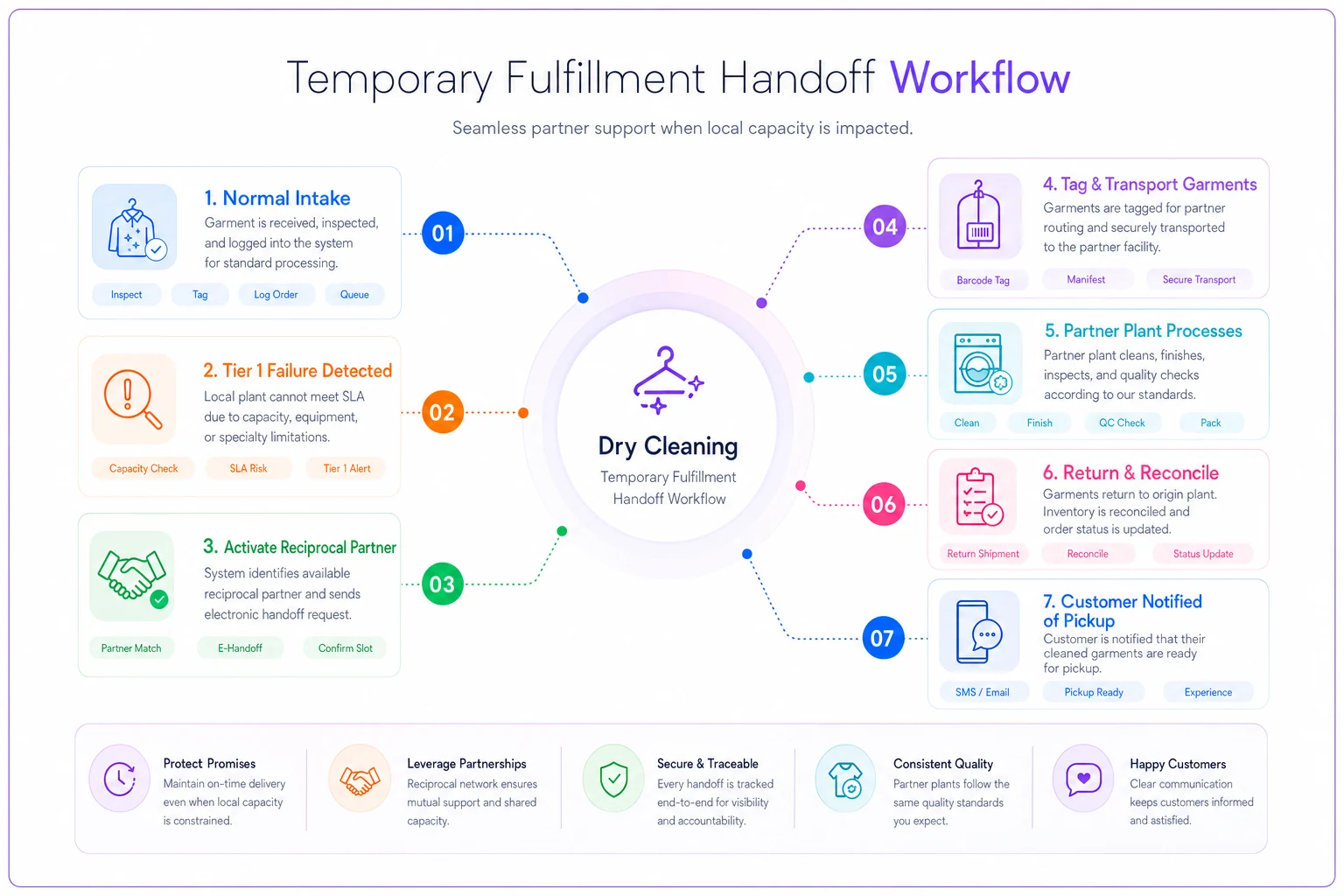
> Normal intake → Tier 1 failure detected → Activate reciprocal partner → Tag and transport garments → Partner plant processes → Return and reconcile → Customer notified of pickup
When Temporary Fulfillment Makes Sense — and When It Doesn't
It makes sense for standard cleaning volume during an equipment outage, where the work is routine and the margin can absorb a wholesale rate.
It's a bad idea for specialty or high‑value work. Shipping a $4,000 wedding gown to a shop whose quality you haven't vetted is how you turn a machine problem into a lawsuit. For those items, honest delays beat risky outsourcing every time.
Phase 2, Continued: Vendor‑Substitution Playbooks
Equipment isn't the only thing that fails. Supply shocks hit just as hard and get less attention because they build slowly — until the morning your solvent delivery doesn't show and you've got half a drum left.
A vendor‑substitution playbook is a short document per critical supply that answers: who's my backup, what's their lead time, and what changes if I switch?
-
Solvent Primary = Vendor A. Backup = Vendor B (3‑day lead, requires minor cycle adjustment). Secondary = Vendor C (5‑day lead, premium price).
-
Poly/packaging Primary = Vendor A. Backup = local restaurant‑supply distributor for emergency rolls.
-
Hangers Primary = Vendor A. Backup = buy retail‑pack locally at higher cost for a week.
The backups are often worse — slower, pricier, lower quality. That's fine. The point of a substitution playbook isn't to find an equal alternative. It's to keep the doors open at a known cost until your primary recovers. Owners who refuse to use a more expensive backup because "the margin's too thin" usually end up losing far more by shutting down than they'd have lost on premium hangers for ten days.
One pattern worth naming: shops that buy everything from a single distributor for the volume discount are the most exposed. The discount is real, but so is the risk. Splitting even a small portion of your spend across a second vendor keeps that relationship warm, so the backup isn't a cold call when you actually need it.
Phase 2, Continued: Customer‑Communication Scripts Tuned to Single Shops
How you communicate during a disruption decides whether customers wait patiently or walk. The biggest mistake — by far — is silence.
What happens in the typical shop: something breaks, everyone's heads‑down fixing it, and customers only find out there's a problem when they show up for a pickup that isn't ready. Now you've got an angry person at the counter and a backlog. The anger was completely avoidable.
Pre‑write the messages now, while you're calm, so during a crisis you're copy‑pasting instead of composing under pressure. You need maybe four:
-
1. The proactive delay notice (text/email to affected orders) > "Hi [Name] — quick heads up, we had an equipment issue and your order will be ready [new date] instead of [original]. Everything's fine with your garments, just running behind. Thanks for your patience — we'll text you the moment it's ready."
-
2. The counter script (for walk‑ins during the outage) > "We're running a bit behind this week due to an equipment repair. Standard cleaning is still going out, but it'll be [X days] instead of [Y]. If you've got something urgent, let me know and I'll tell you honestly whether we can hit your date."
-
3. The service‑pause notice > "We've temporarily paused alterations while we catch up on cleaning. We expect to reopen that service by [date] and we'll let you know."
-
4. The recovery / thank‑you (once you're back to normal) > "We're fully back to normal turnaround as of today — thanks for sticking with us through the delay. As a thank you, [small gesture] on your next order."
That last one matters more than it looks. A short, honest thank‑you after a disruption often strengthens loyalty — customers remember how you handled the bad week more than they remember the week itself.
What makes these scripts work is reach. If you only have paper tickets and no way to text the affected customers, you can't send message #1 at all — which is the most valuable one. This is where having customer contact info captured at intake pays off. Many shops run this through their management software now, so a "notify all orders due this week" message is a two‑minute job instead of a manual phone marathon. The software isn't the point; the ability to reach people fast is.
Phase 3: Test It, Fund It, and Put It on One Page
A plan you've never tested is a guess. Phase 3 is about making the first two months real.
Run one dry run. Pick a slow afternoon. Pretend the boiler died. Can you actually reach your backup plant? Does the reciprocal cleaner answer? Do your counter staff know the script? You'll find the gaps immediately — a phone number that changed, a vendor who no longer offers that rate, a staff member who's never heard of any of this.
Fund a thin buffer. You don't need months of runway. A target of roughly two to four weeks of fixed costs in reserve is enough to pay for an emergency boiler repair without choosing between the fix and payroll. The most common reason a short disruption becomes a long one is that the owner couldn't afford the fast fix.
Put the whole response on one laminated page. Tier 1 assets, who to call for each, backup vendors with phone numbers and rates, the fulfillment plant contact, and where the comms scripts live. Tape it inside a cabinet door. When something breaks, nobody should have to think — they grab the card.
-
[ ] Every Tier 1 asset has a named backup and a realistic repair‑time estimate
-
[ ] Minimum‑viable service list is written and staff know what to pause
-
[ ] A reciprocal fulfillment agreement exists and has been tested once
-
[ ] Each critical supply has at least one backup vendor with known lead time
-
[ ] All four customer messages are pre‑written and reachable from your phone
-
[ ] A cash buffer target is set and being funded
-
[ ] The one‑page response card is printed and posted
Shops that actually run the dry run almost always find at least one thing that would have failed silently in a real emergency — a number that's no longer valid, a vendor relationship that went cold, a staff member who assumed someone else had the playbook. The exercise itself is worth it, even if you never need the plan.
A Real Scenario
A single‑location cleaner doing roughly $30k–$35k a month had their dry‑cleaning machine fail on a Monday in late spring — peak graduation and wedding season. No backup plan existed. The owner spent two days chasing repair techs; the part took four more days to arrive. Six days down.
With no plan, they turned away work, couldn't reach most waiting customers in time, and watched a fully loaded rack of promised orders go stale. Their rough estimate of lost and refunded business from that single week was somewhere in the $6k–$8k range, plus a handful of regulars who didn't come back.
The following quarter they built the 90‑day version of this playbook. A reciprocal arrangement with a cleaner two towns over, a backup solvent and poly vendor, pre‑written texts, and a four‑week cash buffer. When their boiler hiccuped again the next winter, the difference was stark: standard cleaning shifted to the partner plant within a day, affected customers got a heads‑up text that morning, and the shop stayed effectively open. The disruption cost them a bit of margin on wholesale fees — a few hundred dollars — instead of thousands in lost orders and goodwill.
Same failure. Completely different outcome. The only variable that changed was preparation.
The Bigger Point
Resilience for a single shop isn't about buying redundant equipment you can't afford or hiring staff you don't need. It's about pre‑deciding your responses so a shock doesn't force a dozen bad decisions in one afternoon. The map tells you what can't fail. The minimum‑viable definition tells you what to protect. The fulfillment and vendor backups keep work moving. The scripts keep customers calm. And the cash buffer keeps a short problem from becoming a long one.
None of this is complicated. It's just rarely done, because it feels optional right up until the Tuesday it isn't. Spend the ninety days now, while the machines are humming and the rack is clearing on schedule. The shop you're protecting is the one you've already built — and a single bad week shouldn't be allowed to undo years of it.
Ready to elevate your dry cleaning operations?
Join hundreds of dry cleaners using Pressesly to save time, reduce errors, and enhance customer satisfaction.