



Most dry cleaners think turnaround problems come from slow pressers or broken equipment. They're looking at symptoms. The real issue runs deeper—it's about how orders move through your operation, where they get stuck, and what happens when things go sideways.
The pattern becomes obvious pretty quickly when you've worked across a range of dry cleaning operations. Shops struggling with delivery times aren't slower at cleaning. They're worse at managing the flow between steps. One delayed wedding dress backs up five regular orders. A sick presser on Tuesday means Thursday's pickups run late. A misplaced ticket turns a 24-hour promise into a three-day scramble.
The difference between consistent 24-hour turnaround and unpredictable 3-5 day delivery isn't speed—it's systematic order management. This playbook maps out how successful shops structure their operations to hit delivery promises consistently.
Understanding Your Real Order Lifecycle
Your order lifecycle isn't what you think it is. Most owners mentally track orders from drop-off to rack. But orders actually move through seven distinct phases, and missing any single transition point creates cascading delays downstream.
The real lifecycle starts before the customer walks in. It begins when they decide they need cleaning, extends through every touchpoint in your shop, and doesn't end until days after pickup. Each phase has specific failure points that compound if you're not paying attention.
Drop-off seems simple until you realize this phase actually includes pre-inspection, tagging, sorting, and initial routing decisions. A two-minute conversation about a stain turns into a ten-minute backup. Three customers waiting means your counter person starts rushing inspections. Rushed inspections mean missed stains. Missed stains mean re-dos. Re-dos mean broken promises.
The sorting phase hides more complexity than most owners give it credit for. Orders don't just need sorting by service type—they need sequencing by promise date, fabric requirements, and customer priority. Get this wrong and your presser spends Tuesday working on Friday orders while Wednesday's rush sits untouched in a cart.
Processing involves multiple decision trees. Standard cleaning, special care, spot treatment, hand finishing—each path has different timing requirements. Most shops treat everything like standard service then scramble when specialty items need extra time. Silk blouses and leather jackets run on completely different timelines than cotton shirts, but if your routing doesn't account for that, you're setting yourself up for failure from the start.
Assembly becomes a nightmare without proper systems. Orders cleaned on different days, items requiring different services, pieces spread across multiple racks—finding and matching everything turns into a daily treasure hunt. One missing shirt from a 10-piece order means the whole thing sits incomplete.
SLA Targets by Customer Cohort
Not all customers are equal, and your turnaround targets should reflect that reality. A business professional dropping off five suits weekly has different expectations than someone cleaning a winter coat once a year. Smart shops segment customers into operational cohorts with specific service level agreements for each.
Never lose track of an order again.
Pressesly helps you manage, track, and communicate every garment order seamlessly.
- Unified order management
- Real-time customer notifications
- Staff scheduling & workload tracking
No credit card required
Regular Business Customers (25-30% of revenue) These customers need predictable, fast turnaround. Target 24-hour service for standard items, 48 hours for specialty cleaning. They'll pay premium prices for consistency. Miss their deadline once and it might be forgiven. Miss it twice and they find another cleaner. Buffer time: 4 hours maximum. These orders get first priority during processing.
Subscription/Route Customers (15-20% of revenue) Weekly or bi-weekly service on fixed schedules. Target same-day or next-day return on their scheduled day. No additional buffer needed—the schedule itself is the buffer. These orders process in dedicated time blocks to maintain route efficiency.
Walk-in Retail (40-50% of revenue) Standard 2-3 day turnaround for regular cleaning, 3-5 days for specialty items. Buffer time: 1 full day. These customers chose you for convenience or price, not speed. They'll accept longer turnaround if you're upfront about it at drop-off.
Event/Emergency (5-10% of revenue) Same-day or rush service at premium pricing. No buffer—these are already covered by the premium charge. Process immediately or slot into the next available opening. Clear communication about feasibility matters a lot here before you commit.
Bulk/Seasonal (5-10% of revenue) Large orders with flexible timing. 5-7 day turnaround is acceptable. Buffer: 2-3 days. Process during slow periods to level out workload across the week.
| Customer Type | Standard SLA | Rush SLA | Buffer | Priority Level |
|---|---|---|---|---|
| Business Regular | 24 hours | 4 hours | 4 hours | 1 |
| Subscription | Per schedule | Same day | Built-in | 2 |
| Walk-in | 48-72 hours | 24 hours | 24 hours | 3 |
| Event/Emergency | Same day | 2 hours | None | 1 |
| Bulk/Seasonal | 5-7 days | 48 hours | 48 hours | 4 |
These orders get first priority during processing.
Buffer Management and Priority Rules
Buffers aren't padding—they're strategic capacity reserved for when things go wrong. And things always go wrong. The question isn't whether you'll need buffers, it's whether you've planned for them before something breaks.
Think of buffers like lanes on a highway. Regular traffic flows fine until something stalls. Without shoulder room, one problem stops everything behind it.
Operational buffers need to exist at three levels. First, time buffers between your promise and your actual capability. If you can clean and press a shirt in 3 hours, promise 24-hour service. That extra window handles equipment issues, re-dos, and unexpected volume spikes.
Second, capacity buffers in your workflow. Running equipment at 100% means no room for rush orders or re-dos. Keep roughly 20% capacity available for priority work and problems—which means scheduling for about 80% of your maximum daily capability, not your theoretical maximum.
Schedule daily capacity at ~80% to preserve room for rushes and re-dos.
Third, inventory buffers for supplies and chemistry. Running out of pressing pads or specialty chemicals creates immediate bottlenecks that are completely avoidable. Maintain two-week minimums on critical supplies, one week on standard materials.
Priority rules determine how you allocate scarce resources when buffers get consumed. Most shops default to first-in-first-out, which sounds fair but ignores business reality. A better system weighs multiple factors simultaneously.
Promise date drives baseline priority—orders due today before orders due tomorrow. But within same-day orders, customer value and service type create sub-priorities. Your $500/month business account gets priority over a one-time $20 cleaning. Silk blouses that need special handling process before cotton shirts that can wait another hour.
When multiple orders have equal priority, sort by completion complexity. Simple orders that finish quickly clear the pipeline for complex work. Ten shirts needing basic pressing go before one wedding dress requiring hand finishing—unless that wedding is tomorrow.
Escalation Flows for Service Breakdowns
Service breakdowns happen. Equipment fails, employees make mistakes, customers have emergencies. The difference between a minor hiccup and a real customer service problem comes down to whether your escalation protocols are clear before anything goes wrong.
Level 1 escalations handle routine delays. Order won't be ready by promise time but will complete within the buffer window. Counter staff notify the customer proactively, offer a specific completion time, document the reason in the system. No management involvement needed unless the customer pushes back.
Level 2 escalations involve buffer violations. Order will miss the buffer window, or the customer is unhappy with the Level 1 response. Shift supervisor takes ownership, contacts the customer directly, offers concrete resolution—rush completion, delivery, discount. Supervisors should be authorized to offer roughly 25% off or a free service on the next order without needing manager approval.
Level 3 escalations threaten the customer relationship entirely. High-value customer facing a service failure, lost or damaged orders, repeated failures for the same person. Manager or owner intervenes immediately, builds a custom resolution—which might include a full refund plus future service credits. These always require root cause analysis afterward to prevent a repeat.
Each escalation level needs specific triggers, authorized responders, and defined resolution options. Counter staff shouldn't be guessing when to involve management. Clear protocols remove hesitation and speed up resolution significantly.
Use this flow to route issues quickly.
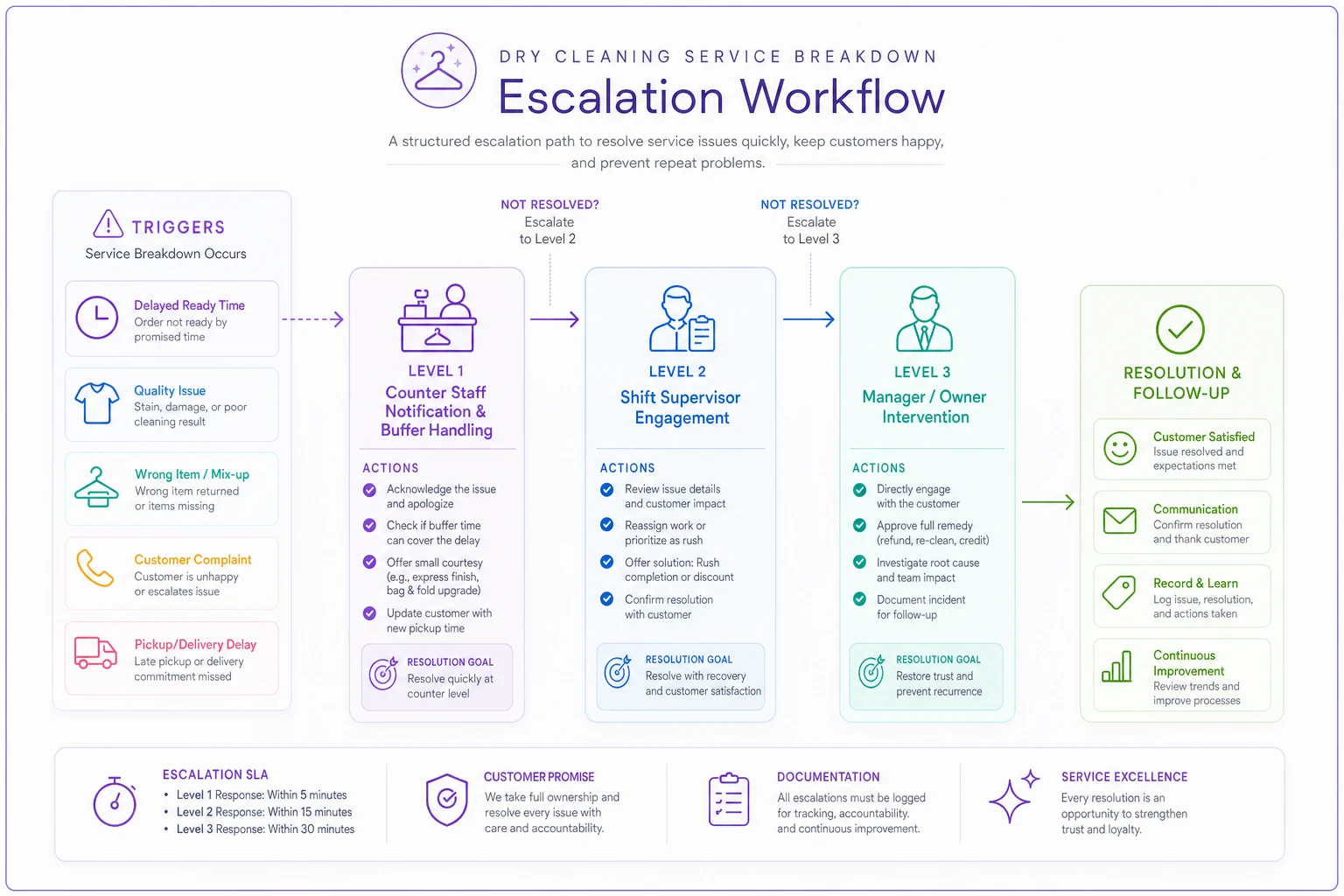
Document every escalation in your operational system. Patterns reveal systematic problems that individual incidents hide. Three Level 2 escalations about Tuesday delays might indicate a scheduling issue. Multiple escalations about damaged items could point to equipment problems or training gaps in your team.
Workflow Configurations for Different Shop Sizes
Single-Shop Operations
Small shops face unique challenges. Limited equipment means sequential processing instead of parallel workflows. One person calling out might represent a quarter of your workforce. You can't maintain dedicated roles, so everyone needs cross-training on at least two functions.
Your workflow has to maximize flexibility while maintaining consistency. Morning focus on inspection and tagging, midday on cleaning and pressing, afternoon on assembly and customer service. This rhythm aligns naturally with customer traffic patterns and equipment availability throughout the day.
Create micro-batches based on promise dates and service types. Instead of processing all shirts then all pants, group orders by delivery date. Tuesday's mixed orders process together, whether shirts, pants, or dresses. This prevents the common problem where some items from an order finish days before others, leaving assembly incomplete.
Build slack time into your daily schedule. If your presser can handle 100 pieces in eight hours, schedule for 80. That extra capacity absorbs rush orders, re-dos, and unexpected complexity without derailing the whole day's workflow.
Multi-Shift Coordination
Larger operations with multiple shifts face coordination challenges that single-shop owners rarely have to think about. Information gaps between shifts create duplicate work, missed orders, and customer confusion. The morning shift promises something the evening shift doesn't know about. Night cleaning processes orders the day shift already handled.
Shift handoffs need more structure than verbal communication allows. Each shift should end with a written or digital transition report covering orders in process, equipment issues, customer concerns, and priority items for the next shift. It takes five minutes but saves hours of confusion.
Stagger shift overlaps intentionally. Thirty minutes of overlap between shifts allows proper handoff, question resolution, and continuity. That overlap isn't downtime—it's when critical information actually transfers from one team to another.
Dedicate specific workflows to each shift based on your shop's patterns. First shift handles retail counter and route preparation. Second shift focuses on processing and specialty work. Third shift, if you run one, handles bulk cleaning and equipment maintenance. Clear separation prevents people from stepping on each other while maintaining continuous flow through the day.
Building Reusable Templates and SOPs
Standard operating procedures sound tedious until you're trying to train your third new hire in two months. Templates aren't bureaucracy—they're what make quality repeatable regardless of who's working.
Start with your order tag template. Beyond basic customer information, build in routing intelligence. Color coding for service types, priority stickers for rush orders, special handling flags for delicate items. A well-designed tag eliminates most communication errors before they start.
Create service-specific checklists that travel with orders through the shop. Leather cleaning has different steps than shirt laundry. Wedding dress preservation requires documentation that regular cleaning doesn't. When each service type has a defined checklist, quality becomes consistent rather than dependent on whoever happens to be working that shift.
Build escalation scripts for common situations. "I understand you need this suit for tomorrow's meeting—let me check with our pressing team about expediting your order" sounds a lot better than improvised rambling under pressure. Scripts ensure consistent communication while still leaving room for personality and judgment.
Document your equipment settings for different fabric types. Which temperature for silk versus polyester? What pressing pressure for wool versus cotton? New operators shouldn't be guessing or experimenting on customer clothes to figure it out.
Measuring and Optimizing Your Turnaround Performance
Track promise attainment, not average turnaround time. A shop averaging 48-hour turnaround might miss 30% of its promises while another averaging 72 hours hits 95% of commitments. Customers care about reliability, not your averages.
Measure turnaround by cohort and service type. Overall metrics hide important patterns. Maybe you nail shirt service but consistently miss leather cleaning deadlines. Or business customers get perfect service while retail customers face regular delays. You won't know until you break the data down properly.
Monitor buffer consumption rates over time. If you're constantly eating into buffer time, your standard SLAs need adjustment. It's better to promise 72 hours and deliver in 48 than promise 24 and deliver in 36.
Track escalation frequency and resolution outcomes. Rising escalations indicate process problems, not customer problems. Successful resolutions that retain customers show your escalation process is working as intended.
Use bottleneck analysis to find improvement opportunities. Where do orders spend the most time waiting? Usually it's not during processing—it's in transitions between steps. Orders sit in carts waiting for pressing. Pressed items wait for assembly. Assembled orders wait for pickup. The wait time between steps is almost always longer than the step itself.
Heat mapping order locations throughout the day reveals flow problems. If orders cluster at certain points, you've found your constraints. Maybe your pressing capacity exceeds cleaning capacity, or assembly happens too late for afternoon pickups. Either way, you can't fix what you haven't measured.
Technology Integration Without Complexity
Modern AI-powered operational software handles a lot of the complexity that used to require constant manual attention. These platforms track orders through every phase, alert staff when SLAs are at risk, and can flag bottlenecks before they actually impact customers.
The key isn't adopting every possible feature at once—it's implementing the core workflows that reduce manual coordination first.
-
First, digitize your order flow to eliminate paper-based confusion.
-
Then add automated customer communications to cut down on inbound phone calls.
-
Finally, layer in analytics to catch problems before customers notice them.
Smart shops start with basic order tracking and then add sophistication gradually. First, digitize your order flow to eliminate paper-based confusion. Then add automated customer communications to cut down on inbound phone calls. Finally, layer in analytics to catch problems before customers notice them.
AI automation handles the repetitive, tedious work—matching orders, calculating promise dates, flagging delays—while your team focuses on actual service delivery. It's not about replacing human judgment. It's about giving your people systematic consistency so they're not constantly firefighting the same problems every week.
Adapting Your Playbook as You Scale
What works at 100 orders daily breaks at 500. Informal coordination that handled a single shop falls apart across multiple locations. The playbook has to evolve with your operation, not stay frozen at whatever worked when you started.
Early-stage shops need flexibility over rigid process. Seven employees can communicate directly, adjust on the fly, and handle exceptions personally. Focus on basic workflows and clear priorities rather than complex systems that create overhead without value.
Growth-phase operations require standardization without strangling flexibility. Written procedures, defined roles, and clear escalation paths become essential. But keep enough adaptability to handle unique situations and customer needs as they come up—you're not running a factory.
Mature operations need systematic approaches with more sophisticated exception handling. Multiple locations, dozens of employees, thousands of orders—coordination has to be built into the system rather than dependent on individual heroics or institutional memory.
The progression looks roughly like this: informal coordination, documented procedures, systematic workflows, algorithmic optimization. Each phase builds on the previous one, but timing the transitions matters. Move too fast and you create unnecessary bureaucracy. Move too slow and chaos takes over.
Putting It Together
Turnaround time isn't about speed—it's about flow. The fastest presser in the city can't overcome poor order routing. The best equipment won't fix bad priority rules. Consistent delivery comes from understanding how orders move through your operation and building systems that maintain that flow regardless of daily variations.
Your turnaround playbook shouldn't be a wish list or theoretical framework. It needs to reflect your actual capacity, real customer patterns, and operational constraints. Start with accurate lifecycle mapping, establish realistic SLAs by customer segment, build appropriate buffers, and create clear escalation paths before you need them.
The shops hitting 24-hour turnaround consistently aren't necessarily faster at cleaning clothes. They're better at managing the entire order journey from drop-off to pickup. They've built systematic approaches that turn day-to-day chaos into predictable flow.
Whether you're running a single shop or managing multiple locations, the core principles stay the same: segment your customers, set appropriate targets, maintain strategic buffers, and escalate problems before they become disasters. Add modern operational software to handle the coordination complexity, and you've got a system that delivers on promises while your competitors scramble.
Consistent delivery comes from preventing problems, not heroically solving them every day. Build the system right and it stops feeling exceptional—it just becomes how you operate.
Ready to elevate your dry cleaning operations?
Join hundreds of dry cleaners using Pressesly to save time, reduce errors, and enhance customer satisfaction.