

Most dry cleaners treat customer acquisition, onboarding, retention, and win-back as four separate jobs owned by four different mindsets. Marketing runs the promos. The front counter handles onboarding, sort of. Retention is whatever the POS emails do automatically. And reactivation is a coupon someone remembers to send in February.
The problem isn't any one of those pieces. It's that none of them talk to the shop floor. You run a "50% off first order" campaign the same week your presser calls out sick and your turnaround is already slipping to four days. Now you've got a wave of first-time customers experiencing your worst version of service, and most of them never come back. You paid to acquire people just to teach them not to trust you.
That's leaky revenue, and it almost never shows up as one big hole. It's a slow drip across the whole lifecycle. This article is about wiring those four stages together — and tying every one of them to your actual shop capacity, SLA rules, and fulfillment limits. Because an offer you can't fulfill on time isn't a growth lever. It's a churn generator with a marketing budget.
The lifecycle is a system, not a funnel
A funnel implies people fall through in one direction and you're done. At a dry cleaner it's a loop, and the loop has capacity constraints baked into every turn.
Here's what actually connects the stages:
-
Acquisition floods intake with new orders that take longer to process — new customers mean new preferences, unknown fabrics, more questions at the counter.
-
Onboarding determines whether those first three orders hit your SLA — and whether the customer sets up autopay, gives you a real phone number, and tries a second service category.
-
Retention depends entirely on whether onboarding built a habit. A customer who came in twice and got their stuff back on time is a completely different animal than one who came once during a promo.
-
Reactivation is really just retention that failed quietly. Nobody "quits" a dry cleaner. They just stop showing up and you don't notice for 60 days.
The pattern worth internalizing: every stage borrows capacity from the shop, and every stage's success or failure feeds the next. When you run acquisition without checking throughput, you don't just risk a bad first impression — you steal buffer from your existing loyal customers, which quietly pushes them toward the reactivation bucket. You can grow your top line and shrink your base at the same time. Plenty of shops do exactly this without realizing it.
Where the leaks actually are
Before templates and checklists, it helps to name the failure points, because they're rarely where owners think.
Never lose track of an order again.
Pressesly helps you manage, track, and communicate every garment order seamlessly.
- Unified order management
- Real-time customer notifications
- Staff scheduling & workload tracking
No credit card required
Leak 1: Acquisition that ignores calendar reality. Promos launched during formalwear season or a staffing dip. You're buying demand during the exact window you can't serve it.
Leak 2: Onboarding that ends at the transaction. The first order gets processed and… nothing. No confirmation their preferences were captured, no nudge to set up recurring pickup, no second-order incentive timed to when they'd naturally need you again.
Leak 3: Silent SLA breaches. A customer's order is a day late. Not late enough to trigger a complaint, so nobody logs it. But that customer's next visit is now less likely, and you have no data trail showing why.
Leak 4: Retention on autopilot with no capacity awareness. Your POS sends "we miss you!" blasts to everyone on the same day, and 40 of them show up Thursday when you're already underwater.
Leak 5: Reactivation offers that don't map to profit. Deep discounts to win back customers who were low-margin, low-frequency in the first place. You're paying to reacquire your worst cohort.
The common thread: decisions made without visibility into throughput. A healthy customer lifecycle for a dry cleaner isn't a marketing problem. It's an operations problem wearing a marketing costume.
Capacity is the constraint everything else answers to
Start here, because everything downstream depends on it. You need a rough, honest number for how many garments — not orders, garments — your shop can process per day while hitting your target SLA, with your current staff and equipment.
Say your working number is around 600–700 garments a day at a 2-day turnaround. That's your ceiling. Now everything in the lifecycle gets a capacity cost:
-
A new customer's first order runs slower — call it 1.3x the normal handling time at intake because of setup and questions.
-
A rush order consumes buffer that would otherwise absorb variability.
-
A promo-driven spike is concentrated, not spread — it hits in the three days after the offer lands.
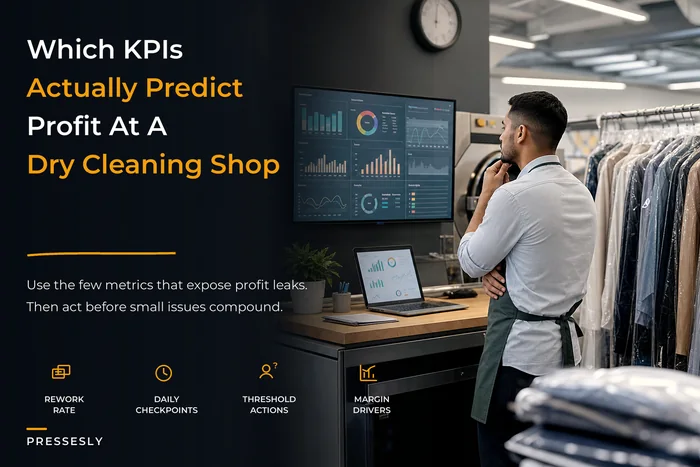
If you've mapped which numbers actually move your bottom line, this becomes much cleaner. The relationship between turnaround, capacity, and repeat behavior is the core of what's worth watching, and it's covered in more depth in which KPIs actually predict profit at a dry cleaning shop. Short version: turnaround reliability predicts retention better than almost anything else. Which means acquisition and onboarding should never be allowed to push turnaround past the line.
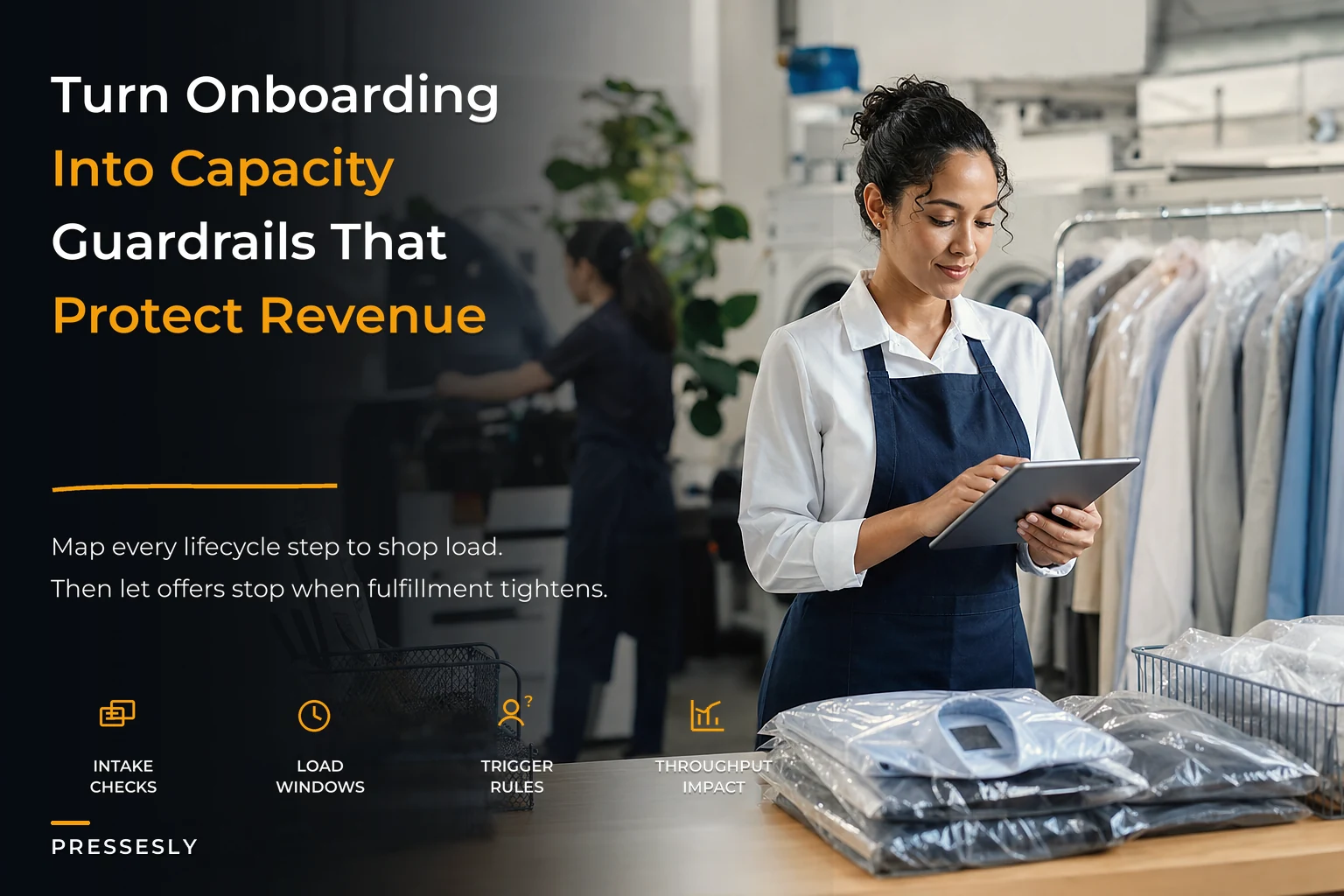
Give every offer a throughput score before you give it a budget.
The rule that fixes most of this: no lifecycle campaign launches without a capacity check for the fulfillment window it will hit. Simple guardrail, enormous impact.
The onboarding sequence that actually builds a second visit
Acquisition gets all the attention and budget, but the first 30 days after a customer's first order decide whether you ever earn back your acquisition cost. Onboarding is where the leak is widest and cheapest to fix.
A workable onboarding checklist for a new customer's first three interactions:
-
At first intake capture phone, email, and one preference (starch level, hanger vs. fold, allergies/sensitivities). Tag the account as "new" so the shop knows to double-check the first order.
-
First order completion send a confirmation that explicitly states the turnaround you hit, not just "ready." ("Ready in 2 days, as promised.") This trains reliability perception early.
-
Within 3 days of pickup a low-key second-service nudge tied to what they didn't bring in. If they brought shirts, mention household items or a wash-and-fold trial.
-
Before the 21-day mark an autopay / recurring pickup invitation. This is the single biggest lever for turning a trial customer into a base customer.
-
Day 30 if no second order a soft check-in, not a discount. Discounting too early trains people to wait for coupons.
Notice what's not here: a big discount on order two. Onboarding built on discounts creates discount-dependent customers. The goal is habit and trust, not a second cheap transaction.
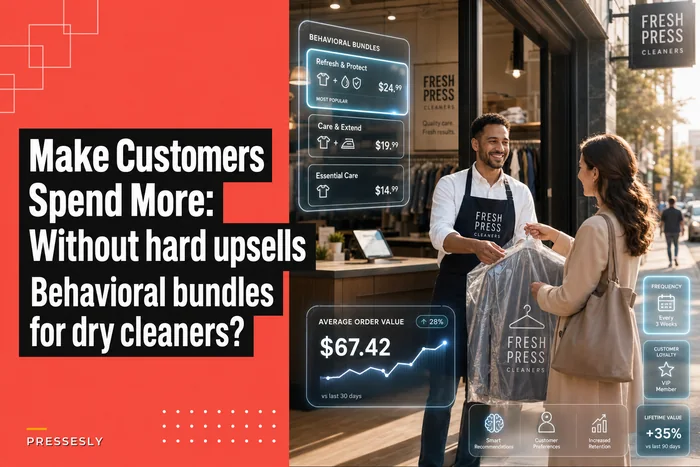
The behavioral framing of that second-service nudge matters more than most owners realize — push too hard and it dies, but get the frame right and it lifts basket size without feeling salesy. There's a full breakdown of that in making customers spend more without hard upsells.
Retention cadence, and why timing is a capacity decision
Retention isn't a message. It's a rhythm. The mistake shops make is running that rhythm on a fixed calendar instead of on customer behavior filtered through shop capacity.
A sane cadence framework looks roughly like this:
| Segment | Behavior signal | Cadence | Capacity note |
|---|---|---|---|
| Active regular | Order in last 14 days | Light-touch only; don't over-message | Already baked into baseline load |
| Slipping | No order in 21–35 days | One personal nudge, no discount | Route to slower days |
| At-risk | No order in 36–60 days | Value reminder + small incentive | Cap daily volume of these offers |
| Dormant | 60+ days silent | Move to reactivation track | Never batch-send all at once |
The column most shops ignore is the last one. If your "at-risk" push brings back 50 customers, you do not want them all arriving the same afternoon. Stagger the sends so returning demand lands on your lighter days. A reactivated customer who hits a slammed Thursday and gets a late order is a customer you'll lose twice.
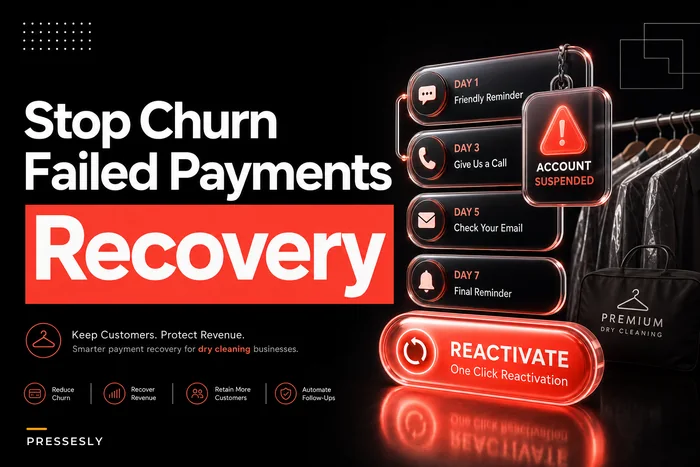
Subscription and recurring-pickup customers deserve their own cadence entirely, because the failure modes are different — mostly failed payments and silent lapses rather than simply forgetting to come in. That whole sub-system is worth handling separately, and it's laid out in stopping subscriptions from becoming a loss.
Churn triggers worth watching
Reactivation is expensive. Preventing the slip is cheaper. The trick is defining triggers before the customer is fully gone, because by the time someone's been silent 90 days, the relationship is cold.
Practical early triggers:
-
Turnaround miss on their order. Any SLA breach on a repeat customer should flag the account, full stop. This is the most predictive signal you have and the most commonly ignored.
-
Frequency drop, not just absence. A customer who came weekly and is now coming every three weeks is churning in slow motion. Don't wait for zero.
-
Category collapse. They used to bring shirts and dry cleaning; now it's just shirts. You're losing share of wallet before you lose the customer.
-
A complaint that didn't get a follow-up. An unresolved issue is a near-certain exit.
-
Autopay/recurring cancellation without a new order pattern forming. Silent lapse risk.
The important design choice: these triggers should generate a routed action, not just a report nobody reads. A frequency-drop flag should produce a specific, timed nudge — ideally scheduled for a day with spare capacity.
It's also worth being honest about what you're watching for. Most churn doesn't announce itself. The customer doesn't call and say they're leaving — they just quietly stop, and you notice three months later when you run a report. Building early triggers means you're catching the signal before it becomes a statistic.
The experiment matrix: mapping offers to throughput impact
This is the piece almost nobody does, and it's where the whole system earns its keep. Every offer you run has two dimensions that matter: does it drive profitable behavior, and what does it do to your throughput? An offer that lifts revenue but wrecks your turnaround is a net loss once you count the churn it causes downstream.
Run offers as small experiments and score them on both axes:
| Offer | Target stage | Expected behavior lift | Throughput impact | Verdict |
|---|---|---|---|---|
| First-order confirmation w/ SLA callout | Onboarding | Higher 2nd-visit rate | None | Always on |
| Recurring pickup invite (day 21) | Onboarding→Retention | Big frequency lift | Smooths load (predictable) | Scale it |
| "Add wash-and-fold" cross-sell | Retention | Higher basket | Adds volume — check capacity | Run on light days |
| 40% off win-back blast | Reactivation | Spiky, low-margin returns | Concentrated overload | Restrict / stagger |
| Off-peak discount (Mon–Tue drop-off) | Retention | Modest lift | Reduces peak strain | Underused gem |
That last row is the one to steal. Offers that shift demand toward your slow days are the closest thing to free money in this business — incremental revenue using capacity you were already paying for. Most shops obsess over discounts that pull demand into their busiest windows, which is exactly backwards.
The discipline is straightforward: give every offer a throughput score before you give it a budget. If it concentrates demand into an already-tight window, either restage it, stagger it, or kill it.
A short real scenario
A single-location shop doing roughly $40k–$45k a month kept running aggressive first-order promos — half off, heavily advertised. New-customer counts looked great. But their 90-day repeat rate on promo customers was sitting somewhere around 18–20%, and their loyal regulars had started complaining about slower turnaround during promo weeks.
They changed three things. Dropped the deep first-order discount and replaced it with an onboarding sequence: SLA-confirmation message, a day-21 recurring pickup invite, and a soft cross-sell. They added a capacity check before any campaign launched. And they built an off-peak drop-off offer to pull volume off their brutal Thursday-Friday crunch.
Nothing dramatic happened in month one. Over the next quarter, though, promo-customer repeat rate climbed into the low 30s, recurring-pickup signups roughly doubled off a small base, and Thursday overload eased enough that their turnaround stopped slipping. Revenue didn't spike — it got steadier, and the churn drip slowed. That steadiness is the actual prize.
When this system makes sense — and when it doesn't
When it makes sense: You're past the "just get customers in the door" phase, you have repeat business worth protecting, and your turnaround occasionally breaks under demand. If you're losing customers you already paid to acquire, this is the highest-leverage work you can do.
When it's overkill: A brand-new shop with excess capacity and almost no repeat history. Focus on acquisition and clean fulfillment first. The lifecycle system matters once your capacity and your demand start colliding.
Who should not do this yet: Any shop whose turnaround is chronically broken. Don't build retention campaigns on top of a shop that can't hit its SLA. You'll just be paying to remind people about your reliability problem. Fix throughput first, then wire the lifecycle to it.
Making it run without a full-time coordinator
The honest obstacle isn't understanding any of this — it's execution. Nobody at a busy shop has time to manually check capacity before every send, tag new customers, watch frequency-drop triggers, and stagger win-back offers across slow days. That's why most of these systems live in a spreadsheet for two weeks and then die.
This is where operational software that connects your intake, scheduling, and customer data actually earns its place — not as a marketing gadget, but as the thing that lets a churn trigger automatically route a nudge to a light-capacity day, or holds a campaign when the fulfillment window is already full. AI-assisted workflows handle the boring-but-critical parts well: flagging slipping-frequency accounts, catching SLA misses on repeat customers, scheduling reactivation sends against your actual load instead of blasting everyone on the same Tuesday. The goal isn't automation for its own sake — it's that the lifecycle only works when the pieces stay coordinated, and coordination at volume is exactly what gets dropped when things get busy.
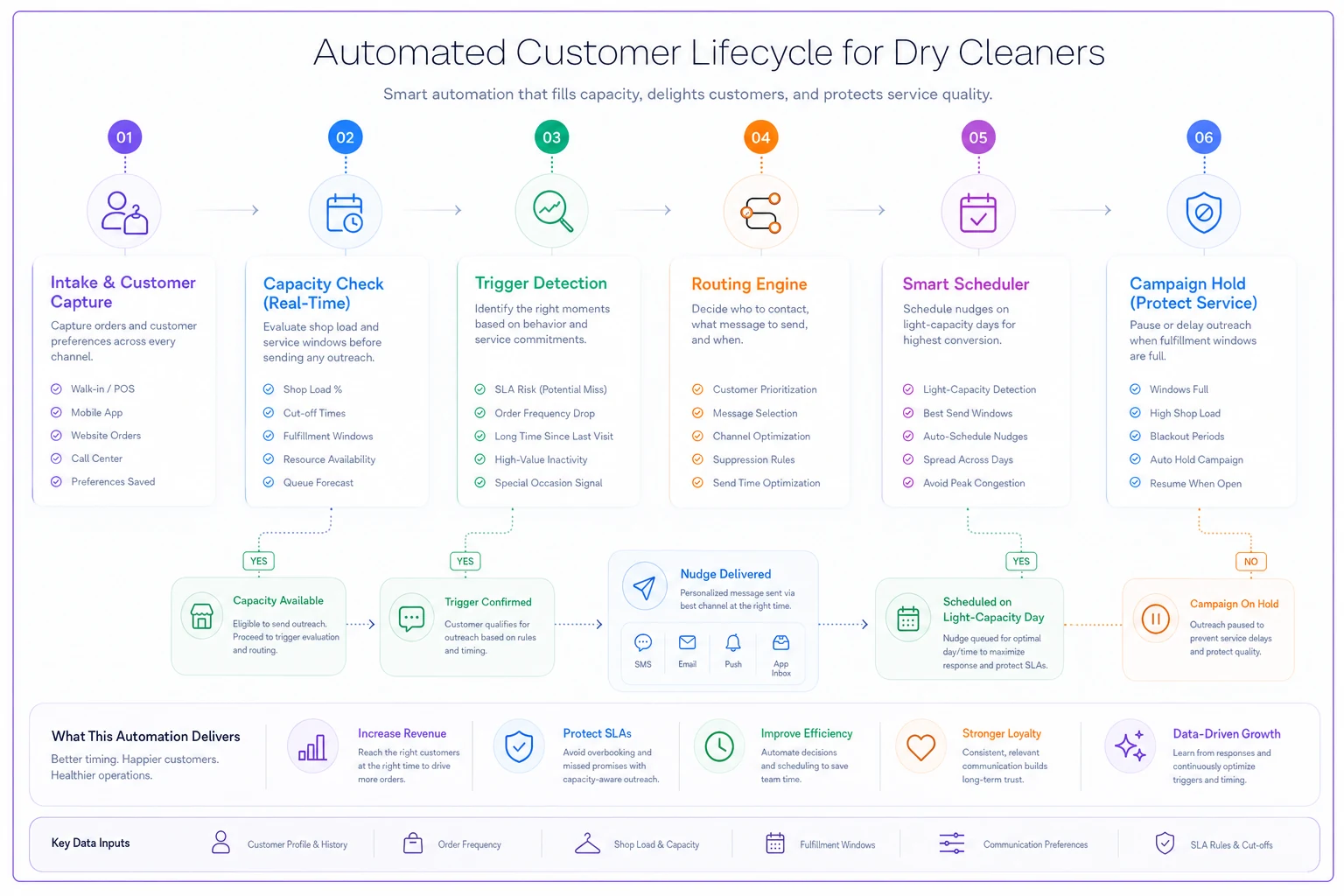
Getting this running doesn't require a sophisticated tech stack. It requires one source of truth for customer status, a way to check capacity before campaigns go out, and clear rules for when a trigger should fire versus when it should wait. That's it. The shops that make this work aren't the ones with the fanciest software — they're the ones who stopped treating each stage as someone else's problem.
The takeaway
The four stages — acquisition, onboarding, retention, reactivation — are not four campaigns. They're one loop, and the loop is governed by how many garments you can actually move on time. Every offer either respects your capacity or steals from it. Every onboarding sequence either builds a habit or trains a discount-hunter. Every silent SLA miss is a future reactivation cost you can't see yet.
Wire the whole thing to your throughput. Score offers on both behavior and capacity impact. Catch the slip before the silence. Do that, and the leaks close not because you plugged one hole, but because the system finally stops fighting itself.
The four stages — acquisition, onboarding, retention, reactivation — are not four campaigns. They're one loop, and the loop is governed by how many garments you can actually move on time. Every offer either respects your capacity or steals from it. Every onboarding sequence either builds a habit or trains a discount-hunter. Every silent SLA miss is a future reactivation cost you can't see yet.
Wire the whole thing to your throughput. Score offers on both behavior and capacity impact. Catch the slip before the silence. Do that, and the leaks close not because you plugged one hole, but because the system finally stops fighting itself.
Ready to elevate your dry cleaning operations?
Join hundreds of dry cleaners using Pressesly to save time, reduce errors, and enhance customer satisfaction.