

Garment delivery is weird. You're not dropping a sealed cardboard box that can sit on a porch for six hours. You're dropping a clear poly bag with someone's $400 suit inside, often at an apartment building with a locked lobby, sometimes into a parcel room, sometimes onto a doorknob that faces a hallway with twelve other units. The failure modes are different, and so the proof you collect has to be different too.
Most "proof of delivery" advice was written for Amazon-style parcels. Snap a photo and move on. That photo is useless when a customer calls three days later saying the bag with their wedding dress never arrived, and your driver's picture shows a blurry bag on a doorstep that could be anyone's.
This is a tight, garment-specific dry cleaner proof of delivery SOP — one page a driver can actually follow, with photo angles tuned to bags and lockers, geofence and timestamp rules, fallback steps when building access fails, and an evidence template that holds up when a customer disputes the drop or files a chargeback.
Why garment drops fail differently than package drops
Before the checklist, it helps to see exactly where garment POD breaks down — because the fixes map directly to the failure points.
A poly bag doesn't photograph like a box. It's translucent, reflects flash, and blends into dark hallway carpet. Drivers rush, snap a dim photo at an angle that shows no door number, and that image proves nothing later.
Apartment access is the bigger killer. A driver gets buzzed in once, delivers four bags to four units, and the geofence pings all four at the same lobby coordinate because the GPS never updated inside the building. Now you have four deliveries "confirmed" at the same spot, and when one customer disputes, you can't tell their drop apart from the others.
Then there's handoff ambiguity. With garments, the customer usually wants the bag hung, not left on the floor. A bag left on the ground in a humid hallway for two hours can pick up odor or wrinkles — and now it's a redo, not a dispute, but it costs you just the same.
The common thread: the driver collected something, but not the right something. The whole point of the SOP below is to make the right evidence the default — fast, and impossible to skip.
The one‑page driver checklist
This is meant to live on a laminated card in the van, or as a single screen in whatever delivery app the driver uses. Keep it to one page. If it runs longer, drivers stop reading it.
Never lose track of an order again.
Pressesly helps you manage, track, and communicate every garment order seamlessly.
- Unified order management
- Real-time customer notifications
- Staff scheduling & workload tracking
No credit card required
At every drop, in order:
-
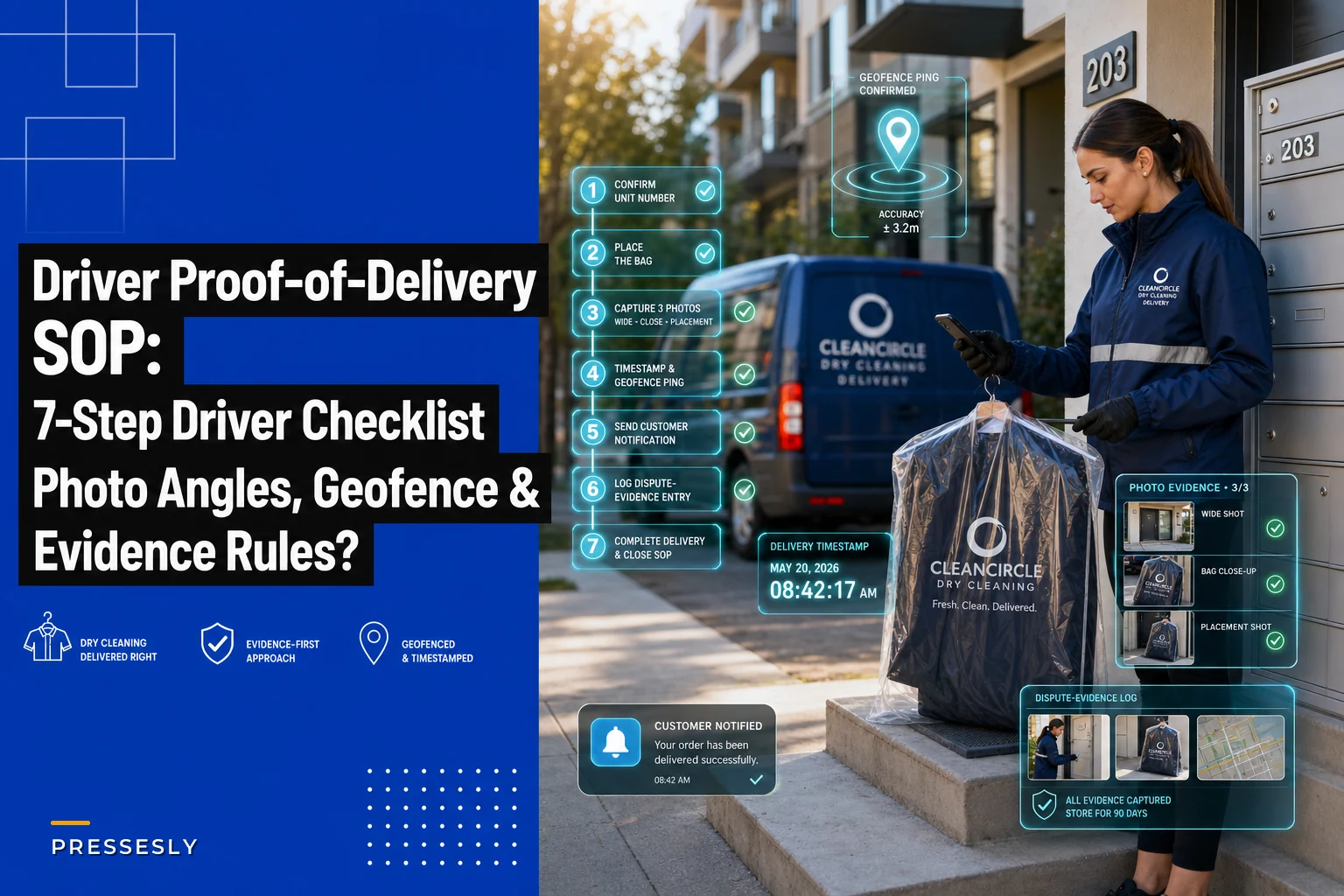
1. Confirm the right unit. Match the bag tag to the stop address AND the unit number. Say the unit number out loud.
-
2. Place the bag correctly. Hang if a hook or handle is available. If leaving on the ground, use the clean side of the entry mat, bag opening facing up — never on bare wet concrete.
-
3. Photo 1 — the wide shot. Door, unit number, and bag all in one frame. The unit number must be legible.
-
4. Photo 2 — the bag close-up. Garment tag or ticket number visible through the bag, so the photo proves which order this is.
-
5. Photo 3 — context/placement. Shows the bag relative to the door (hung on handle, leaned against frame, inside parcel room slot).
-
6. Confirm geofence ping. Do not tap "Delivered" until the app shows you inside the stop's geofence radius. If it won't ping, use the manual override and add a note (see fallback rules).
-
7. Trigger the customer notification. The "your order was delivered" text with the wide-shot photo goes out immediately, not at end of route.
Seven steps, three photos, under 90 seconds per stop once a driver has done it a few dozen times.
Quick visual: follow these steps in order at every stop.
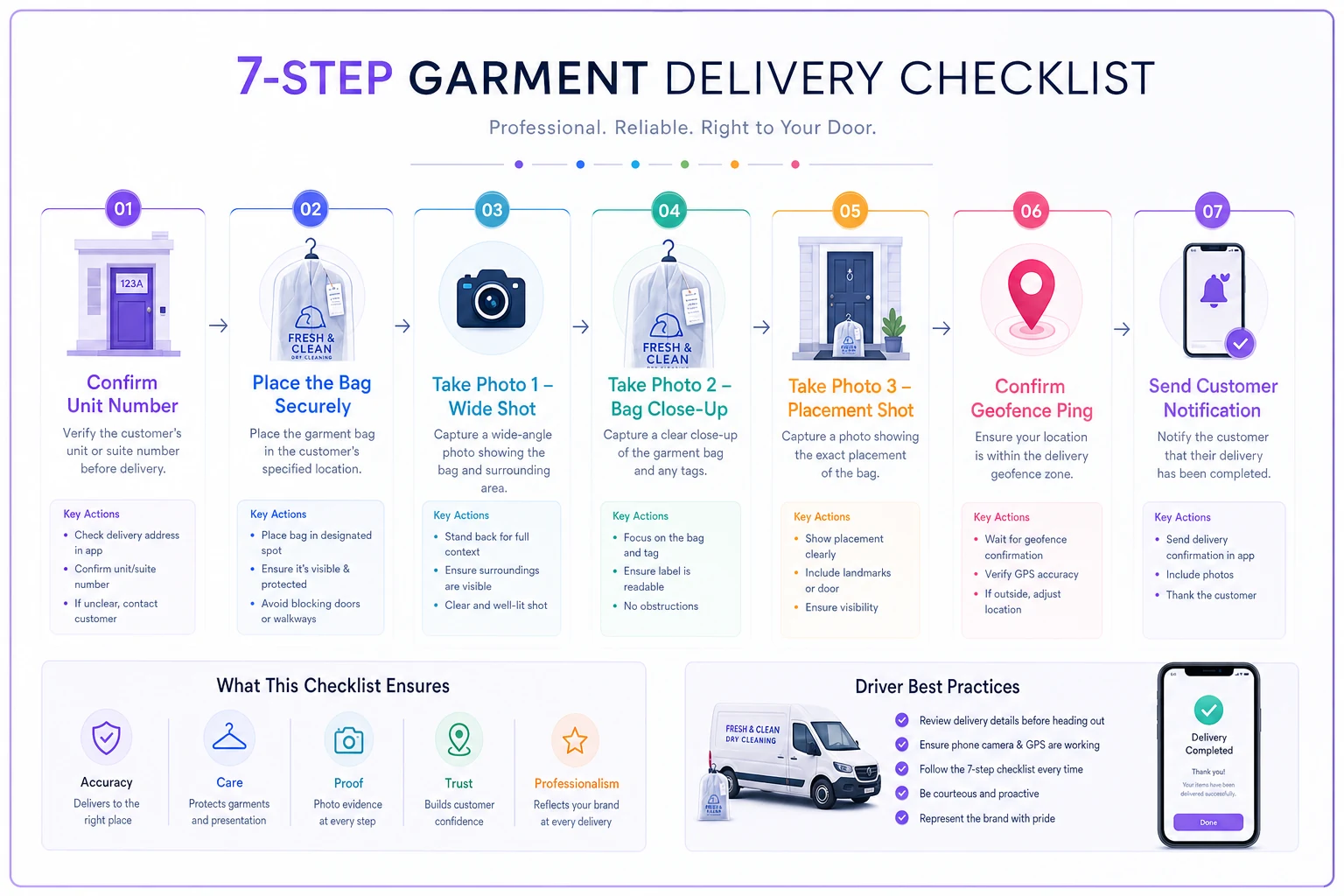
Use this visual as a quick reference.
Required photo angles, tuned for bags and lockers
Generic POD guidance says "take a photo." Garment delivery needs specific angles because the bag material and the drop location fight you. Here's what each photo must capture and why.
| Photo | What it must show | Why it matters for garments |
|---|---|---|
| Wide shot | Door + legible unit number + bag in one frame | Proves location. A bag photo without a door number proves nothing in a dispute. |
| Bag close‑up | Ticket/order number readable through poly | Proves which order. Critical when a driver drops multiple bags in one building. |
| Placement/context | Bag hung or positioned, relative to entry | Proves condition and handoff type. Kills "it was left on the wet ground" complaints. |
| Locker shot (if locker) | Locker number + closed door + confirmation screen | Proves which locker and that it locked. |
A few specifics worth knowing:
-
- Shoot with the hallway light behind you, not in front. Backlit poly bags turn into a white glare blob. One sideways step usually fixes it.
-
- Get the unit number sharp, not the bag. If you have to choose what's in focus, the door number wins. The bag you can re-identify later; a mystery doorway you can't.
-
- For parcel rooms and lockers, include the room or locker number signage in frame. A bag sitting inside "a room" is not evidence. A bag inside "Parcel Room B, slot 14" is.
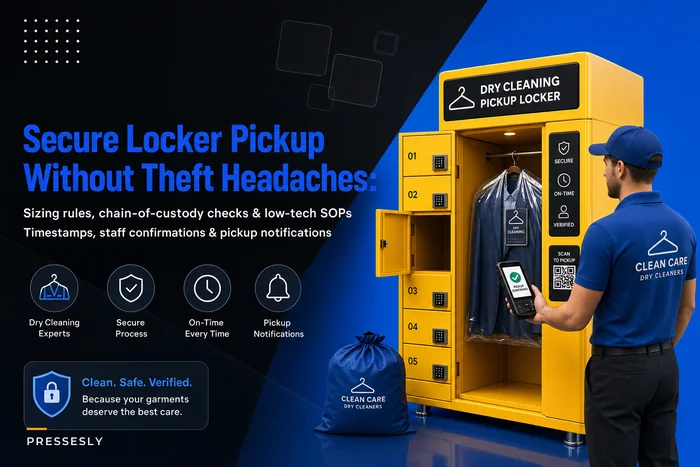
If you're already running pickup lockers for part of your route, the locker-specific proof steps pair directly with the setup rules in how to deploy pickup lockers without adding theft or delivery headaches — the POD photo is the last link in that chain.
Timestamp and geofence guidance
Timestamps and geofence pings are what turn three photos into defensible proof. They're also where the most silent failures happen, because GPS drifts indoors and drivers don't always notice.
The rules that actually hold up:
-
- The "Delivered" tap must fire inside the stop's geofence — set to a tight radius, around 50–75 meters for a house, tighter if your mapping allows it. Too wide and a drop "confirmed" from the parking lot counts as delivered, which a disputing customer will shred.
-
- Timestamp the photo and the status tap together. If your app timestamps the photo at 2:14 and the delivery tap at 2:47 from a different location, that gap looks like the driver circled back and staged a photo. Tight pairing kills that story.
-
- Inside large buildings, GPS won't update. A driver walks three floors up and the phone still thinks they're in the lobby. For these situations, the geofence confirms building arrival, and the unit-number photo carries the last-leg proof. Don't rely on GPS to prove the floor — rely on the legible unit number in Photo 1.
A realistic example: a driver delivers to units 204, 207, and 211 in the same building within four minutes. All three geofence pings read nearly identical coordinates because GPS considers them all "the lobby." What separates those three drops in a dispute is three clearly legible door numbers in three wide shots. Geofence gets you to the building. Photos get you to the door.
Building‑access fallback rules
This is where failed drops are won or lost. The driver can't get in, and without a clear rule, they improvise — leave it in the lobby, hand it to a stranger, or mark it "attempted" and drive away with the garment still in the van. All three cost you money.
Set an explicit fallback ladder so drivers never have to guess:
-
1. Buzz the unit. Wait the agreed window (usually 60–90 seconds). If answered, hand off and photograph the handoff context.
-
2. Try the building code or fob on file. If you have a standing access arrangement, use it, deliver to the door, run the normal three-photo sequence.
-
3. Secure parcel room or concierge. If the building has a staffed desk or a parcel room on the agreement, drop there, photograph the signage plus bag plus any sign-in, and note the staff name if handing to a person.
-
4. No safe option → do NOT leave the garment. Mark "access failed," photograph the locked entry as proof of the attempt, and return the bag to the van. Trigger the reschedule flow immediately.
The rule that saves you the most money: a garment is never left anywhere unsecured just to clear the stop. A suit left on a public lobby floor to avoid a redelivery almost always becomes a full claim, which costs far more than a second trip.
Pro-tip: If you hand a bag to concierge or staff, note their name and, if possible, take a quick photo of the sign-in to avoid later disputes.
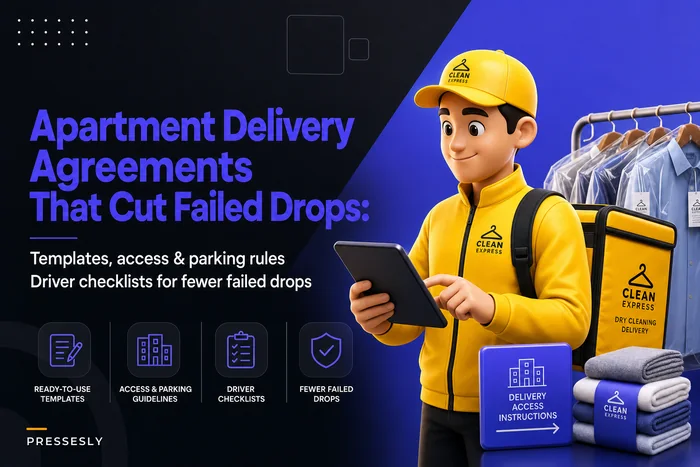
These fallback rules work much better when access details are negotiated upfront with the building, not discovered by the driver at the door. If you haven't set those arrangements yet, the templates in apartment delivery agreements that cut failed drops give you the access-rule language that makes steps 2 and 3 above actually possible.
Sample driver scripts
Handing off at the door:
> "Hi, delivery from [Shop] for unit [number] — I've got your [order]. I'll hang it right here on the handle, and you'll get a text with a photo confirmation."
Neighbor offers to take it:
> "Thanks, but I'm only able to leave it at the unit on file or with building staff. I'll get it to them directly."
(This one matters. A bag handed to a helpful neighbor is the single most common source of "I never got it" disputes.)
Concierge/front desk drop:
> "This is for unit [number]. Could I get your first name for our delivery record? I'll note you accepted it at [time]."
Access failed, leaving a voicemail or text:
> "Hi, this is [Shop] delivery — I wasn't able to get into your building to drop your order. I didn't want to leave your garments unsecured. We'll reschedule for [next window] — reply here if a specific time works better."
New drivers find the neighbor refusal script uncomfortable, so they skip it. Train on that one specifically. It's the cheapest dispute you'll ever prevent.
The dispute‑evidence template
When a customer says "it never arrived" or files a chargeback, you need to assemble proof in minutes — not dig through a driver's camera roll. Standardize the evidence packet so it's always the same fields in the same order.
Garment POD dispute packet should contain:
-
- Order/ticket number and customer name
-
- Delivery address and unit number
-
- Driver name and route ID
-
- Delivery timestamp (status tap) + photo timestamps
-
- Geofence ping coordinates / building-arrival confirmation
-
- Photo 1 (wide — door + unit + bag)
-
- Photo 2 (bag close-up — order number visible)
-
- Photo 3 (placement/context)
-
- Customer notification record (the "delivered" text + timestamp it was sent)
-
- Any fallback notes (concierge name, access code used, attempt photo)
The notification record is the quiet hero here. A customer disputing "I never got it" is a very different conversation when you can show that a delivery text with a door-number photo landed on their phone at 2:14 PM and they didn't reply for three days.
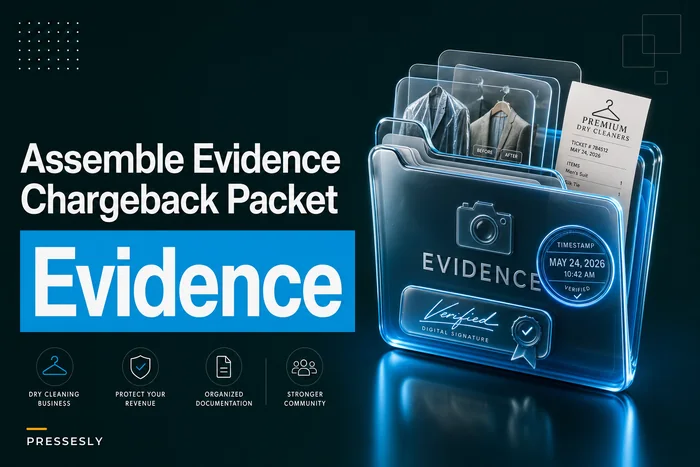
For chargebacks specifically, this packet feeds directly into the rebuttal format covered in the evidence‑first dispute workflow for assembling photos, timestamps, and a chargeback rebuttal packet. The POD SOP here is what feeds that packet clean data — the two are designed to work together.
Escalation rules
Not every failed drop is the same, and treating them identically either wastes your time or lets real losses slip through. Sort them.
-
- Tier 1 — Standard reschedule. Access failed, garment returned to van, customer notified. No judgment call, just rebook. Driver handles it, no manager involved.
-
- Tier 2 — Disputed delivery. Customer says it's missing but POD shows a clean drop. Pull the evidence packet, send the photo and timestamp to the customer. Most resolve here once they see the door-number shot.
-
- Tier 3 — Loss or claim. POD is incomplete (missing unit number, no geofence, bag left unsecured), or a high-value garment is genuinely gone. Manager reviews, and this one goes into your records to coach the driver — because a Tier 3 almost always traces back to a skipped checklist step.
The useful signal here is tracking how many disputes escalate past Tier 2. If a particular driver's drops keep going to Tier 3, it's not bad luck — it's a photo or geofence step they're skipping. The SOP isn't just protection against customers; it's your clearest window into which driver habits are quietly costing you money.
When this level of rigor makes sense — and when it's overkill
A three-photo, geofence-confirmed SOP is worth the investment when you're delivering garments that are hard to re-create and easy to dispute: suits, dresses, bulk apartment routes, corporate accounts. The cost of one lost formalwear claim dwarfs the extra 60 seconds per stop.
It's overkill if your "delivery" is counter pickup, or a handful of drops a week to houses with doorbells and no access friction. Don't bolt a full dispute-evidence process onto four easy residential stops — you'll just frustrate a good driver.
Where it genuinely pays off is the messy middle: shops running 30–80 drops a day across a mix of houses, apartments, and lockers, where a few disputes a month were quietly turning into redos and credits. Tightening the photo and geofence rules there tends to convert "he said / she said" into "here's the timestamped door photo," and the disputes that actually cost money drop off within a month or two.
A quick real scenario
A mid-size cleaner running two vans on mostly apartment-heavy routes was eating around four to six "never arrived" claims a month. Most weren't fraud — they were bags dropped with neighbors, photos taken without a visible unit number, and geofence pings that all read "lobby" so nobody could distinguish one drop from another. Each claim turned into a redo or a credit, roughly $40–$70 a pop once you factor in the garment, the second trip, and the goodwill discount.
They didn't buy anything new. They laminated the one-page checklist, required the three-angle photo set with a legible door number, and set a hard rule: bags never get handed to neighbors or left unsecured. Within about two months, the disputes that actually turned into losses dropped to one or two a month, and most of those resolved at Tier 2 the moment the customer saw the door-number photo. The redelivery count fell too, because drivers stopped guessing at access and started using the fallback ladder.
Nothing fancy. Just evidence that pointed at the right door, collected the same way every time.
Garment deliveries get disputed not usually because of theft or dishonest customers — it's that drivers collect vague proof that can't distinguish one bag, one door, or one building floor from another. Fix the proof and most disputes clear up fast.
Build the SOP around the three things a poly bag at an apartment actually needs: a legible unit number in frame, an order number readable through the bag, and a geofence ping that at minimum places the driver at the right building. Add a fallback ladder so nobody ever leaves a suit on a wet lobby floor to clear a stop, and a standard evidence packet so a dispute takes five minutes to answer instead of an afternoon. Keep it to one page, drill the neighbor-refusal script, and watch how fast "it never arrived" turns into "oh — there it is, thanks."
Ready to elevate your dry cleaning operations?
Join hundreds of dry cleaners using Pressesly to save time, reduce errors, and enhance customer satisfaction.