
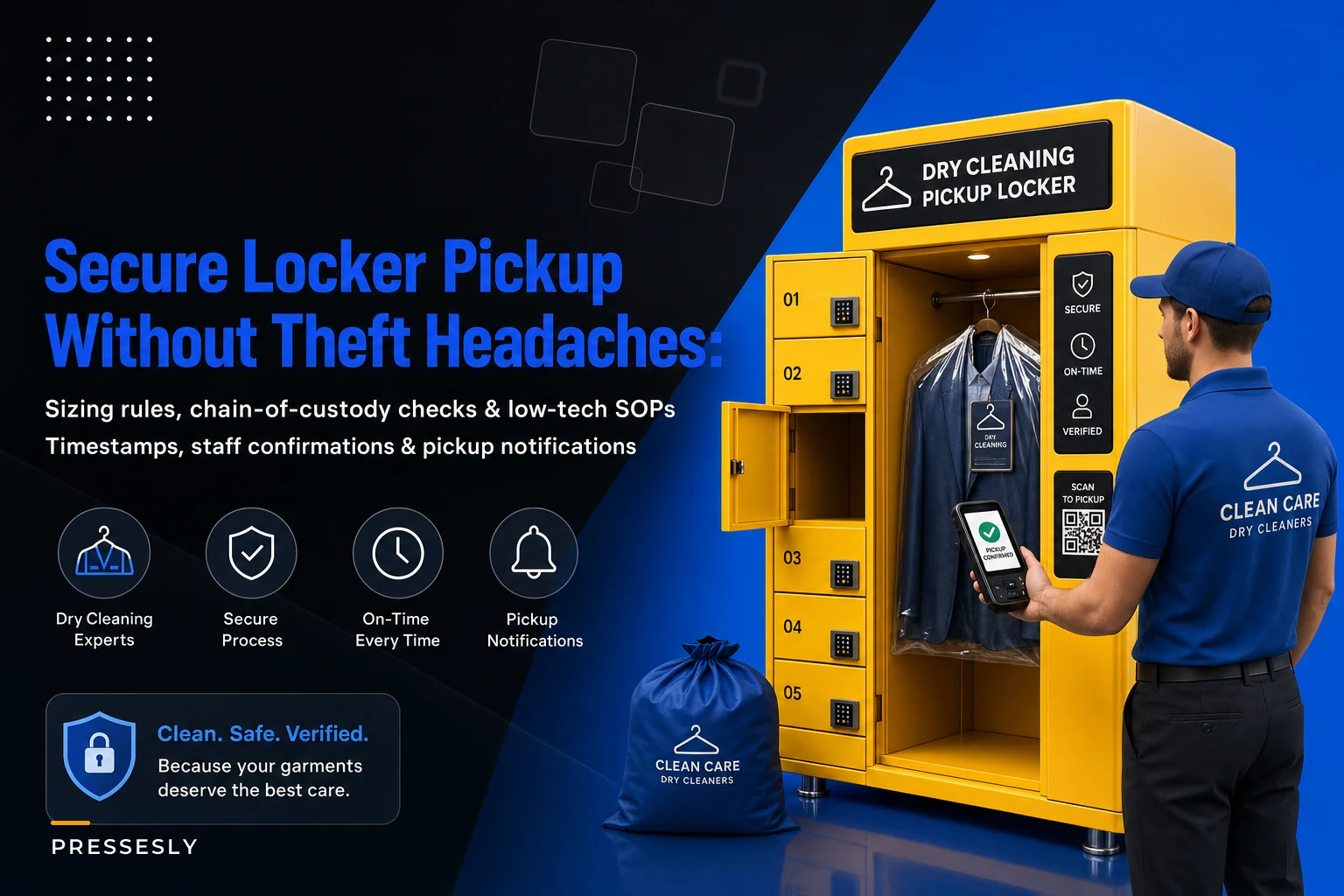

Lockers sound simple. You buy a bank of compartments, bolt them to a wall, and suddenly customers can grab their cleaned garments at 11pm without you staffing a counter. That's the pitch anyway.
In practice, lockers quietly create a whole new category of problems: garments going into the wrong box, a customer swearing their suit "was never there," compartments jammed with a week-old order nobody picked up, and that awkward moment when you realize you have no paper trail for who opened what and when. The locker itself is dumb metal. Everything that goes wrong happens in the handoff into the locker and the handoff out of it.
This post stays narrow on purpose. We're not covering whether lockers are worth it financially or how to market them. We're covering the operational mechanics — sizing, placement, chain-of-custody, notifications, and cleaning cadence — so you don't end up eating claims and chasing ghosts.
The two handoffs that actually matter
Forget the locker for a second. A locker deployment lives or dies on two moments:
-
Load-in — garment leaves your custody, goes into a compartment.
-
Pickup — customer opens the compartment, takes the garment, custody ends.
Everything between those two moments is dead time where the garment is sitting in a box you can't see. Most shops obsess over the hardware and ignore that those two handoffs are where the vast majority of disputes are born.
A typical failure looks like this: a counter employee bags three orders, walks them to the locker bank, and loads them fast at the end of a shift. Two go in the right compartments. The third gets put in the box assigned to a different customer because the codes were one digit off. Customer A opens their locker, sees two bags, takes both. Customer B shows up the next morning to an empty box and a shop with no idea what happened.
No camera footage, no signature, no barcode scan at load-in. Just vibes. That's the whole problem in one scene.
Sizing: the mistake is buying for average, not peak
Shops almost always size locker banks around their average ready-order volume. That's backwards. You size for the worst realistic pileup — usually a Friday evening stacked onto a Saturday where nobody's staffed to clear unclaimed orders.
Never lose track of an order again.
Pressesly helps you manage, track, and communicate every garment order seamlessly.
- Unified order management
- Real-time customer notifications
- Staff scheduling & workload tracking
No credit card required
Here's the pattern: a shop processes around 120 orders a day, maybe 30% going to locker pickup. That's roughly 36 locker orders daily. Easy math says 36 compartments. But orders don't clear instantly. If customers average 1.6 days to actually pick up, and some leave stuff for 4–5 days, your true occupancy on a bad day can hit 60–70 compartments even though daily new volume is only 36.
The second sizing mistake is compartment dimensions. Dry cleaning isn't lockers-for-packages. You've got:
-
Flat-folded shirts and household items (small/medium)
-
Hanging suits, dresses, coats on the rail (tall compartments with a hook)
-
Bulky comforters and bedding (oversized, and they eat space fast)
| Compartment type | Rough % of mix | What goes wrong if you skimp |
|---|---|---|
| Small (folded) | 30–40% | Fine, rarely the bottleneck |
| Medium | 20–30% | Shirts get crammed, wrinkle, re-press claims |
| Tall/hanging | 30–40% | The real constraint — suits crush or won't fit |
| Oversized | 5–10% | Comforters jam a whole column, block other orders |
If you under-buy tall compartments, staff start cramming hanging garments into mediums, folding suit jackets, and generating exactly the re-press and wrinkle complaints lockers were supposed to eliminate. A good starting ratio for most garment-heavy shops skews toward tall: roughly 40% tall, 30% small, 25% medium, 5% oversized. Adjust after you watch real occupancy for a month.
Placement: visibility beats convenience
There's a tension between where customers want lockers (right outside the front door, 24/7 access) and where they're safe (within camera view, decent lighting, not a blind alley).
One rule worth pushing hard: a locker bank that isn't covered by a camera with a clean, readable angle is a liability you're volunteering for. If a customer claims their locker was empty, your only defense is footage showing the compartment being loaded and later opened. Bad angle, glare off the metal, or a camera pointed at the parking lot instead of the locker face — and you've got nothing.
Practical placement checklist:
-
Camera coverage with the compartment faces clearly in frame, not just a wide lobby shot
-
Lighting good enough that footage is usable at night (this is where most outdoor setups fail)
-
Weather protection if outdoor — direct rain or afternoon sun on a metal bank cooks garments and warps electronics
-
Not in a dead-end or blind corner where someone can loiter unseen
-
ADA-reachable compartments at accessible heights for a portion of the bank
-
Away from the drop-off flow so pickup traffic doesn't tangle with intake
One underrated placement issue: if lockers sit inside your lobby with after-hours access via a door code, you've now turned your whole lobby into an unattended space. That's a different risk profile than a sealed outdoor bank. Decide which one you're actually running before you sign the install.
Chain-of-custody: the part everyone skips
This is the heart of it. A locker without a custody trail is just a place for garments to disappear with no accountability. You need a record at both handoffs.
At load-in, the minimum viable trail:
-
Scan the order barcode (you already tag orders — if you don't, that's step zero; affordable barcode tagging is a prerequisite for this whole thing working).
-
Assign the order to a specific compartment — the system logs order #, compartment #, employee, timestamp.
-
Confirm the compartment is empty before loading (sounds obvious, prevents the double-load nightmare).
-
Close and verify locked.
At pickup:
-
Customer authenticates — unique code, QR, or app, never a shared code.
-
System logs which compartment opened, which order, timestamp.
-
Compartment registers as empty/available again.
The single biggest custody mistake is reusing pickup codes. Shops hand out a static door code or a reusable PIN "for convenience," and now you can't tell who opened what. Codes should be one-time or order-specific, full stop. The moment a code works twice, your audit trail is worthless.
Use one-time or order-specific pickup codes so every access is traceable to a single order.
The second mistake is manual compartment assignment with no verification. When a human types "compartment 14" instead of scanning it, you get fat-finger errors that put orders in the wrong box. If your locker system can confirm the physical compartment electronically at load, use it. If it can't, you need a two-step visual confirm: scan order, read compartment number aloud or on screen, match before closing.
A simple load-in verification workflow
Here's the flow in simple steps.
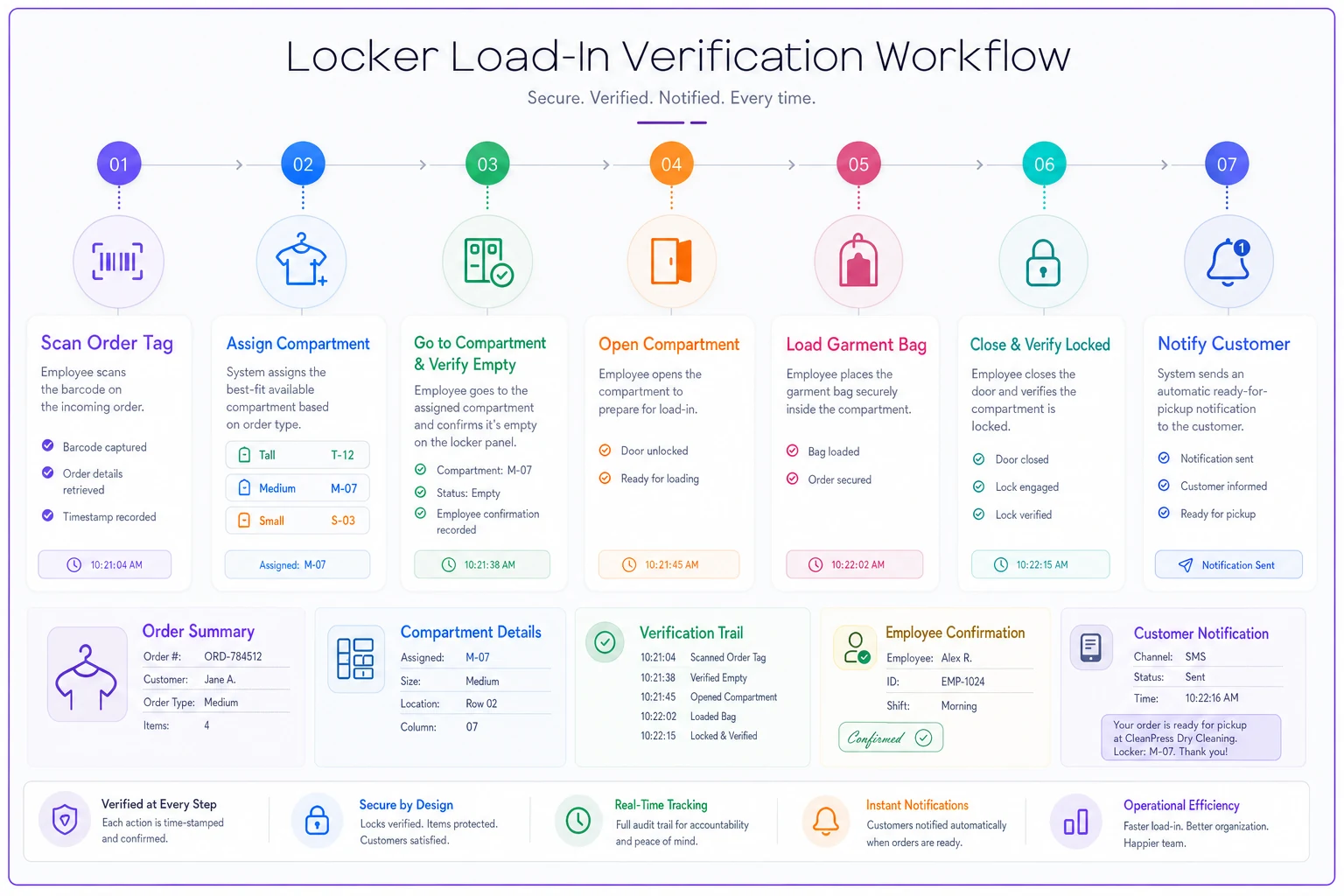
Grab finished, bagged order off ready rack ↓ Scan order tag ↓ System assigns available compartment (tall/medium/small based on order type) ↓ Walk to compartment → confirm empty on panel ↓ Open → load → close → verify locked ↓ System fires ready-for-pickup notification automatically
That last step matters more than it seems. When notifications are a separate manual task, they get skipped during rushes, and customers show up to find their order isn't actually loaded yet — or worse, they don't show up for days because nobody told them it was ready, and now the compartment's held hostage.
Notification templates that actually reduce confusion
Vague notifications generate phone calls, which defeats the entire point of unattended pickup. Three messages carry most of the load. Keep them short and specific.
Ready for pickup:
> Your order #4821 is ready in Locker 12 at [location]. Access code: 7734. Pickup anytime before Sat 8pm. Reply HELP for assistance.
Reminder (if unclaimed after ~24–36 hrs):
> Reminder: Order #4821 is still waiting in Locker 12. Code: 7734. Please collect by Sat 8pm to free the locker. After that we'll hold it at the counter.
Final / hold notice:
> Order #4821 wasn't collected and has been moved to our front counter. Pick up during business hours, no code needed. Questions? Call [number].
Two things most shops get wrong in these messages:
-
No expiry. If you never state a pickup deadline, customers treat the locker as free long-term storage and your bank clogs.
-
No fallback instruction. When a code fails at 10pm, the customer needs to know what happens next — reply, call, come back during hours — instead of standing there frustrated and leaving a one-star review.
Getting the notification sequence right is one of those things that feels minor until you're fielding three "is my order ready?" calls on a Saturday morning.
Liability and the cleaning cadence nobody plans for
Two garments sitting in a sealed metal box for four days in a warm location don't come out the way they went in. Plastic-bagged clothes can develop a musty smell, pressed shirts relax, and in a hot outdoor bank you risk real heat damage. The longer the dwell time, the more your "finished" quality degrades on its own.
This is where you need explicit rules, not good intentions.
Liability rules to decide upfront:
-
Maximum dwell time before a garment gets pulled back to climate-controlled storage (3–4 days for standard items is a reasonable ceiling; leather, suede, or anything delicate arguably shouldn't go in lockers at all).
-
What's excluded from locker pickup entirely — high-value items, leather/suede, wedding gowns, anything over a claim threshold you're not comfortable leaving unattended. Counter pickup only.
-
Posted terms at the locker and in the notification about how long you're responsible for garment condition once it's loaded.
Cleaning and inspection cadence:
| Task | Frequency | Why |
|---|---|---|
| Visual sweep of empty compartments | Daily | Catch spills, left items, damage |
| Wipe-down of interiors | Weekly | Dust, residue, odor prevention |
| Deep clean + hinge/lock check | Monthly | Mechanical failures lock customers out |
| Pull unclaimed > dwell limit | Daily | Prevents clogging and condition claims |
| Camera angle + footage retention check | Weekly | Your angle drifts; verify it still frames the faces |
That last line is sneaky-important. Cameras get bumped, knocked out of alignment, or the retention window silently fills up and starts overwriting. The day you need footage is the worst day to discover the camera's been pointed at a wall for two weeks. Build the weekly check into whoever opens or closes the shop — it takes two minutes and has saved more than a few shops from eating a claim they couldn't defend.
A quick real scenario
A single-location shop running about 110 orders a day added a 24-unit locker bank in a strip-mall alcove. First month, two disputes: one "empty locker" claim and one heat-wrinkled suit. The empty-locker claim had no footage — the camera framed the parking lot, not the locker faces — so they ate roughly a $180 replacement rather than fight it.
The fixes weren't fancy. They re-aimed the camera to frame the compartment faces, switched from a reusable PIN to one-time codes tied to each order, added a 3-day dwell limit with a daily pull of anything older, and moved hanging suits out of mediums by reconfiguring a few columns to tall. Disputes dropped to basically nothing over the next couple months, and the "is my order ready?" calls fell off because the ready notification fired automatically at load-in instead of whenever someone remembered.
Nothing there required heavy technology. It required deciding the rules before the first garment went in a box.
When lockers make sense — and when they don't
Lockers are a good fit when:
-
You have steady after-hours pickup demand (commuters, apartment-dense area)
-
Your orders are already barcoded and your intake-to-pickup flow is tight
-
You have a placement spot with real camera coverage and climate protection
-
Your garment mix skews toward standard items that tolerate short dwell
Lockers are a bad idea when:
-
You handle a lot of high-value, leather, or delicate pieces (claim exposure isn't worth it)
-
You can't cover the bank with a usable camera angle
-
Your ready-notification process is still manual and inconsistent
-
Your pickup turnaround is already erratic — lockers amplify chaos, they don't fix it
If your turnaround and pickup timing are shaky to begin with, lockers won't rescue you; tighten the underlying flow first. The same discipline that keeps delivery routes clean — knowing exactly where every order is and when it's due — is what makes unattended pickup work. If you haven't nailed that yet, the turnaround time playbook with SLAs and escalation flows is the better starting point, and if you're also running delivery, the local route heuristics for batching and time windows pair naturally with locker pickup zones.
The bottom line
Lockers don't add theft or confusion on their own. Weak handoffs do. The shops that run them cleanly treat the locker as the least important part of the system — the real work is a scannable load-in, a one-time pickup code, an automatic ready notification, a camera that actually frames the compartment faces, and a cleaning-and-dwell cadence that keeps garments from degrading and compartments from clogging.
Get those five things right before you bolt a single unit to the wall, and the hardware just quietly does its job. Skip them, and you've bought yourself a very expensive box of disputes.
Ready to elevate your dry cleaning operations?
Join hundreds of dry cleaners using Pressesly to save time, reduce errors, and enhance customer satisfaction.