

Apartment deliveries kill dry cleaning margins through a death of a thousand cuts. Your driver shows up with $280 worth of cleaned garments, buzzes apartment 4B, waits five minutes, calls the customer, texts them, waits another five, then drives back to the shop with the whole order. Tomorrow that customer calls angry because they needed their suit for a meeting. Now you're sending another driver out during peak hours, eating the delivery cost twice while the customer posts about their "terrible experience" online.
The core problem isn't lazy drivers or flaky customers. Apartment buildings operate like small kingdoms with their own rules, and most dry cleaners treat every delivery like it's going to a single-family home with a doorstep.
Why apartment deliveries become operational black holes
Apartment complexes create friction points that compound into failures fast. The concierge who was there Monday through Thursday suddenly isn't there Friday. The building that allowed lobby drop-offs last month now requires written permission slips. The parking situation that worked fine at 2pm becomes impossible at 5pm when residents get home from work.
These variables multiply across your delivery zone. If you serve 12 apartment buildings and each has four or five unique requirements, you're managing 50+ different protocols in drivers' heads. No wonder they default to "buzz and bail" when things get complicated.
The financial hit goes beyond doubled delivery costs. Failed apartment deliveries generate roughly 3x more customer service calls than house deliveries. Each call runs 8-12 minutes once you factor in rescheduling and smoothing over the relationship. For a shop doing 40 apartment deliveries weekly with a 25% failure rate, that's somewhere between 80 and 120 minutes of phone time per week just managing failures — not counting the actual redelivery.
Apartment residents also tend to be high-value customers. They typically don't have washer/dryer access and lean heavily on dry cleaning services. When you fumble their delivery, they don't just get annoyed. They switch to whoever figured out their building's system.
Building the permission framework that eliminates guesswork
Core Agreement Components
Never lose track of an order again.
Pressesly helps you manage, track, and communicate every garment order seamlessly.
- Unified order management
- Real-time customer notifications
- Staff scheduling & workload tracking
No credit card required
-
Delivery zones and timing - Where exactly items can be left, and during which hours
-
Resident notification requirements - Who notifies residents and how
-
Liability boundaries - When responsibility transfers from your business to the building
-
Access credentials - Keys, codes, or authorized personnel needed
-
Contingency protocols - What happens when the primary delivery method fails
A working agreement might read: "Deliveries accepted at concierge desk Monday-Friday 9am-6pm. Concierge will text resident upon arrival using building's notification system. Items held in package room for 72 hours. After 6pm or weekends, driver must deliver directly to unit door with resident present."
That level of detail feels like overkill until you calculate the cost of ambiguity. One failed delivery attempt costs $12-18 in driver time and fuel. One lost customer runs $800-1,500 in annual revenue. The math on prevention becomes pretty obvious.
The driver checklist system that works in practice
Agreements mean nothing if drivers can't execute them under time pressure. The gap between what management negotiates and what actually happens in the field is where most delivery failures live.
Pre-Delivery Verification Process
-
Building-specific delivery instructions printed or loaded on their device
-
Customer contact info with a backup number
-
A photo of acceptable drop locations from a previous successful delivery
-
Time windows when building access is guaranteed
-
A fallback protocol if the primary method doesn't work
Dry cleaners using operational software can populate these automatically when orders get assigned to routes. The system pulls building requirements based on the delivery address and flags any special considerations before the driver even leaves.
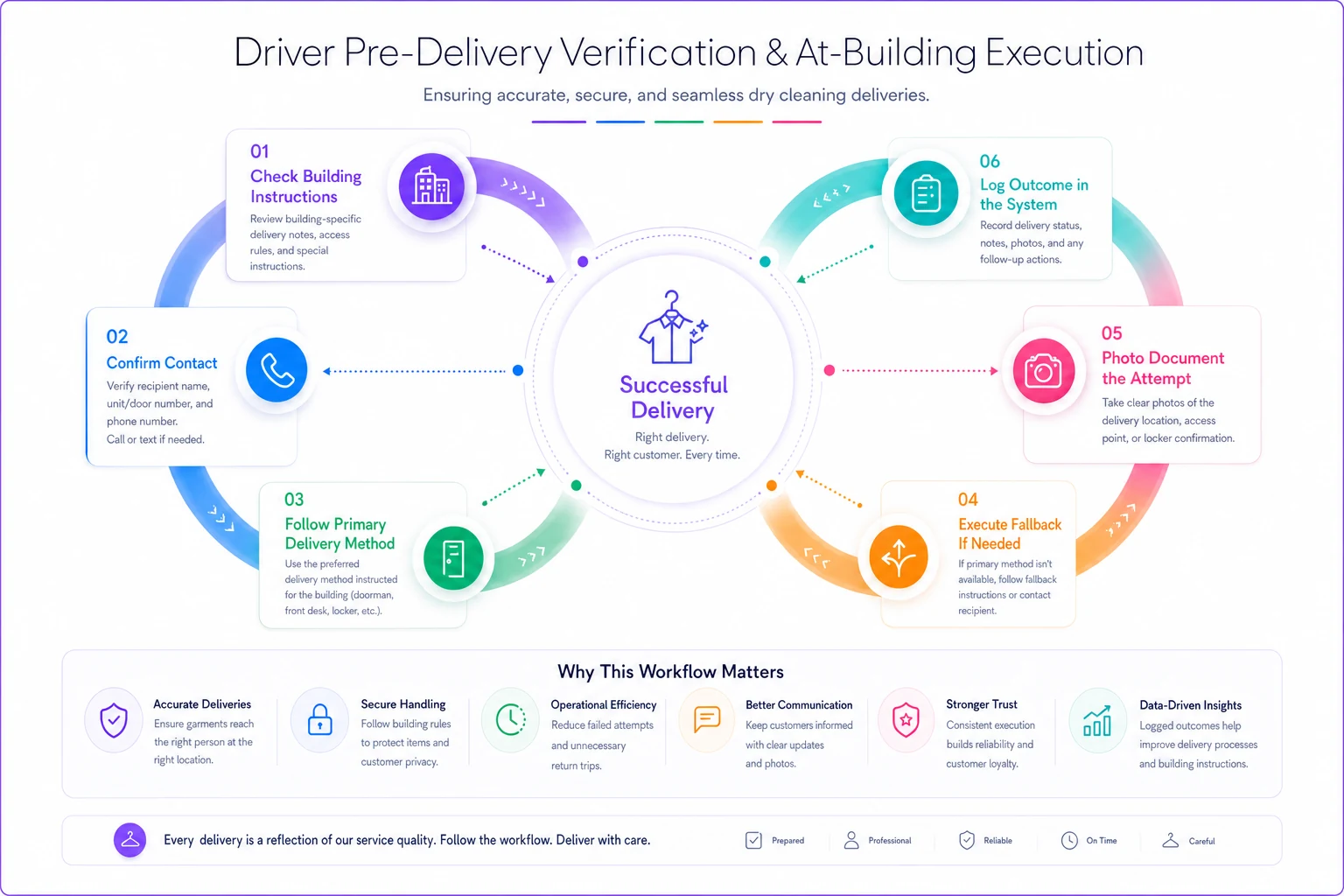
The workflow above shows the verification and execution steps drivers follow.
At-Building Execution Steps
-
Check parking against noted restrictions — some buildings tow after 10 minutes
-
Confirm today's date and time match approved delivery windows
-
Attempt primary delivery method per the agreement
-
If that fails, execute the documented fallback
-
Photo-document the delivery or attempt
-
Log the outcome immediately, not at end of shift
Photo documentation does more than protect against disputes. It helps train new drivers on acceptable drop spots and builds a visual record of what actually works at each building over time.
Permission slips and access documentation
Physical permission slips sound old-fashioned, but many buildings legally require them. A customer saying "just leave it with the doorman" doesn't protect you when the doorman refuses or the items go missing.
Customer Authorization Template
I, [Customer Name], residing at [Unit Number] authorize [Business Name] to deliver my dry cleaning to [Specific Location] at [Building Address]. Acceptable delivery locations (check all that apply): □ Concierge/front desk □ Package room □ Outside unit door □ Building's designated delivery area □ With building staff member: Special instructions: _ This authorization remains valid until revoked in writing. Signature: _ Date: __
Get these signed during initial service signup — not as a separate follow-up step customers will skip. Build it into your new customer onboarding from the start.
Building Management Agreement
-
Designated delivery acceptance hours
-
Specific staff authorized to receive items
-
Storage location and duration policies
-
Process for unclaimed items
-
Liability transfer points
-
Annual renewal requirements
Property managers appreciate vendors who come in with a professional setup. It separates you from the constant stream of food delivery drivers who create problems and disappear.
Parking logistics and time calculations
Parking kills more apartment deliveries than any other single factor. The five-minute load zone becomes a tow zone at 4pm. Visitor spots fill up after 5pm. The garage code changes monthly.
Map out parking realities for each building at your actual planned delivery times. Don't assume and don't let drivers figure it out on the fly. Send someone to observe the location during the windows you plan to deliver. Document:
-
Legal parking within reasonable walking distance
-
Time restrictions and how strictly they're enforced
-
Loading zone availability and rules
-
Building garage access and any fees
-
Double-parking feasibility and the realistic risk
Then build those realities into your routing. A house delivery might take 3 minutes. The same apartment delivery — including parking, walking, waiting for the elevator, finding the concierge, and getting back to the vehicle — takes 11-14 minutes. Your routing needs those realistic time estimates, not optimistic ones.
Factor in seasonal changes too. Convenient street parking disappears during snow emergencies. That quick lobby drop becomes a trek through slush. Summer vacation means the helpful concierge gets replaced by a substitute who's never heard of your arrangement.
The customer communication sequence
A lot of failed deliveries trace back to communication gaps, not access problems. The customer forgot they scheduled a delivery. They didn't see your text. They assumed "Tuesday delivery" meant Tuesday evening when they'd actually be home.
Day Before Delivery
-
Automated text or email
"Your dry cleaning will be delivered tomorrow between [time window]"
-
Include any building-specific instructions
-
Provide a driver contact number for day-of issues
Morning of Delivery
-
Text when the driver begins the route with a refined time estimate
-
Include a tracking link if your operational software supports it
At Building
-
Driver texts upon arrival if customer pickup is required
-
Wait a documented amount of time — usually five minutes
-
Execute fallback protocol if no response
Post-Attempt
-
Immediate notification if the delivery failed
-
Clear next steps for rescheduling
-
Photo of the attempt if relevant
This feels like overcommunication until you compare it to the back-and-forth of resolving a failed delivery. Three proactive messages prevent eight reactive ones.
When to reject apartment deliveries entirely
Some buildings aren't worth serving. This calculation rarely gets made explicitly, but running the numbers makes it clearer.
Rejection Triggers
-
Building requires liability insurance naming them specifically
-
No legal parking within a 3-minute walk
-
No secure handoff point — items would need to be left in unsecured areas
-
History of 40%+ delivery failures despite process improvements
-
Time investment consistently exceeds 20 minutes per delivery
-
Building management is openly hostile to vendors
One downtown high-rise might require paid garage parking, two security checkpoints, and advance scheduling through a specific loading dock. At 35 minutes and $8 in parking to deliver a $45 order, the economics don't work — and failures still happen anyway.
It's better to clearly communicate "we don't deliver to your building" than to repeatedly fail and frustrate everyone involved.
Technology integration and record keeping
Manual tracking of building requirements, customer permissions, and delivery outcomes doesn't scale. Once you're managing 10+ buildings with 100+ apartment customers, the complexity overwhelms paper systems and driver memory.
AI-powered operational platforms built for dry cleaners can encode building rules directly into routing logic. When a driver gets assigned an apartment delivery, the system automatically pulls building-specific requirements, adjusts time estimates for parking and access, loads customer communication preferences, and tracks success rates by building and time window.
That transforms apartment deliveries from driver-dependent variables into something systematic. New drivers can handle apartment deliveries on day one because the knowledge lives in the system — not just in the heads of whoever's been there longest.
Consistent tracking also surfaces patterns that are hard to catch manually. Maybe Tuesday afternoon deliveries to Building A succeed 90% of the time while Friday deliveries fail 60% because of parking. Maybe Buildings B and C should share a route because they have the same parking garage. Those insights only show up when you're actually recording outcomes consistently.
Making agreements pay for themselves
The effort to formalize apartment delivery agreements only makes sense if it produces measurable results.
| Metric |
|---|
| Apartment delivery success rate (target: >85%) |
| Customer calls per apartment delivery (target: <0.15) |
| Second attempt deliveries (target: <10%) |
| Apartment customer retention rate (target: >80% annually) |
| Average time per apartment delivery (target: <12 minutes) |
A shop doing 150 apartment deliveries monthly should realistically see failed deliveries drop from around 35-40 down to 15-20 through solid agreements and processes. At $15 per second attempt, that's $300-375 monthly in direct savings.
The indirect savings stack on top. Fewer angry customers means less time on service recovery. Better first-attempt success means happier customers who order more often. Drivers stop burning time on redeliveries and can handle more stops per route.
In urban areas, apartment residents can make up 30-40% of dry cleaning demand. Solving their delivery friction while competitors keep fumbling it creates a real competitive advantage that's genuinely hard to replicate.
Making it stick long-term
Creating agreements and checklists only works if the system gets maintained. Buildings change policies. Staff turns over. New properties get added to your delivery zone.
Schedule quarterly reviews of your apartment delivery performance. Look for buildings where success rates have dropped. Update agreements when buildings change management. Retrain drivers who start skipping documentation steps when they're in a rush.
The operational discipline required can feel like a lot for what seems like a simple task — dropping off clean clothes. But apartment deliveries are a concentrated source of friction that ripples through the whole operation. Getting your SLAs and delivery promises aligned with what's actually achievable in apartment buildings prevents you from promising what you can't deliver.
Build the system once, maintain it consistently, and apartment deliveries stop being a headache. The same buildings that create all this complexity also create customer lock-in — once you've solved a building's delivery puzzle, those residents tend to become some of your most loyal, highest-frequency customers.
Ready to elevate your dry cleaning operations?
Join hundreds of dry cleaners using Pressesly to save time, reduce errors, and enhance customer satisfaction.