

Most shops don't lose money on any single channel. They lose it in the gaps between channels — the moment a locker order, a rush counter ticket, and a corporate pickup all need the same presser at 2 PM, and whoever shouts loudest wins.
That's the real problem with dry cleaner cross-channel fulfillment. Each channel has its own promise. The counter promised "Thursday." The delivery app promised "next-day by 6." The B2B contract promised a hard 24-hour turn with penalties. Your plant doesn't know about any of that. It just processes garments in whatever order the racks happen to feed them. So the promises collide, and someone eats the loss — usually you.
This isn't a scheduling annoyance. It's a structural issue that gets worse the more channels you add, because every new channel is a new set of expectations stacked on top of the same finishing capacity. Below is how it actually breaks, and how to build allocation rules that hold up when things get busy.
Why channels collide even when volume looks fine
You can have plenty of total capacity and still miss SLAs constantly. Capacity isn't the issue. Timing of capacity is.
A typical week looks fine on paper. Say you can finish around 600–700 garments a day across all channels. Combined intake is well under that. So why are you paying delivery redo fees and fielding angry emails from the corporate account?
Because demand doesn't arrive evenly, and channels don't wait their turn. Counter walk-ins spike Monday morning and Friday afternoon. Locker drop-offs cluster overnight — you find a wall of them at 7 AM with no warning. Delivery routes force a hard cutoff, so anything not finished by departure simply misses the day. And B2B lands in big irregular batches: 80 shirts Tuesday, nothing Wednesday, 140 Thursday.
When all of that funnels into one wash line and one finishing area, the plant processes by physical convenience, not by promise urgency. The tickets sitting closest get done. Nobody at the press is thinking "this locker order has 4 hours of slack and this corporate order has 40 minutes." They can't — that information doesn't reach the machine.
The collisions aren't a volume failure. They're an information and sequencing failure. And they get worse as you grow.
What actually breaks as you add channels
One or two channels, you can hold it in your head. Counter and a small delivery route — the owner just knows what's tight and reshuffles by feel. That works until it doesn't.
Never lose track of an order again.
Pressesly helps you manage, track, and communicate every garment order seamlessly.
- Unified order management
- Real-time customer notifications
- Staff scheduling & workload tracking
No credit card required
-
Third channel added (usually lockers or an app). Intake is now happening when nobody's watching. Overnight locker orders don't get a promise date until someone opens the app at 8 AM, and by then the clock's already been running for 10 hours.
-
First real B2B contract. Corporate accounts come with penalties and hard SLAs. Suddenly one channel has financial consequences the others don't, and it starts jumping the queue — often silently, because staff figure out fast that the corporate account "can't be late." That's how retail delivery starts slipping.
-
Delivery scales past one route. Two or three routes with different cutoff times means multiple hard deadlines per day. Miss the 2 PM cutoff and that garment doesn't just wait — it misses an entire delivery day and you're paying to re-attempt.
Every channel you add narrows the plant's flexibility, but nobody updates the rules for how work gets prioritized. Staff keep running it by instinct. Instinct doesn't scale past about two channels.
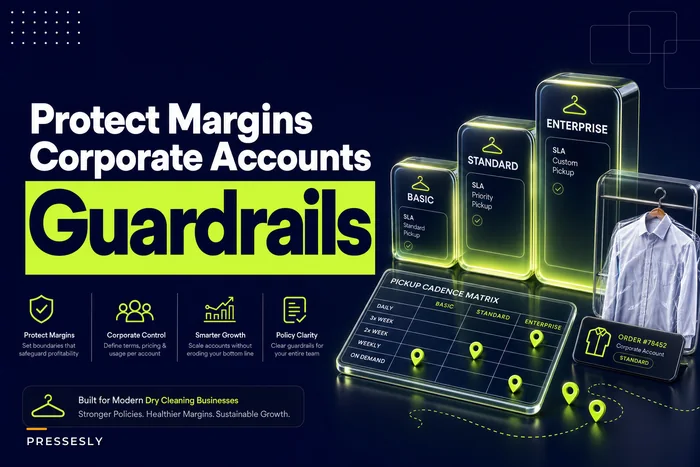
If you've already tightened up your corporate side, a lot of this connects directly to the fulfillment tiering ideas in Avoid Margin Erosion with Corporate Accounts — the SLA tiers you set there are only as good as the plant's ability to honor them under real pressure.
Start with a channel-priority matrix (not gut feel)
The fix isn't "work faster." It's deciding in advance who wins when two channels want the same slot. That decision should be made once, calmly, and written down — not improvised at the press during a rush.
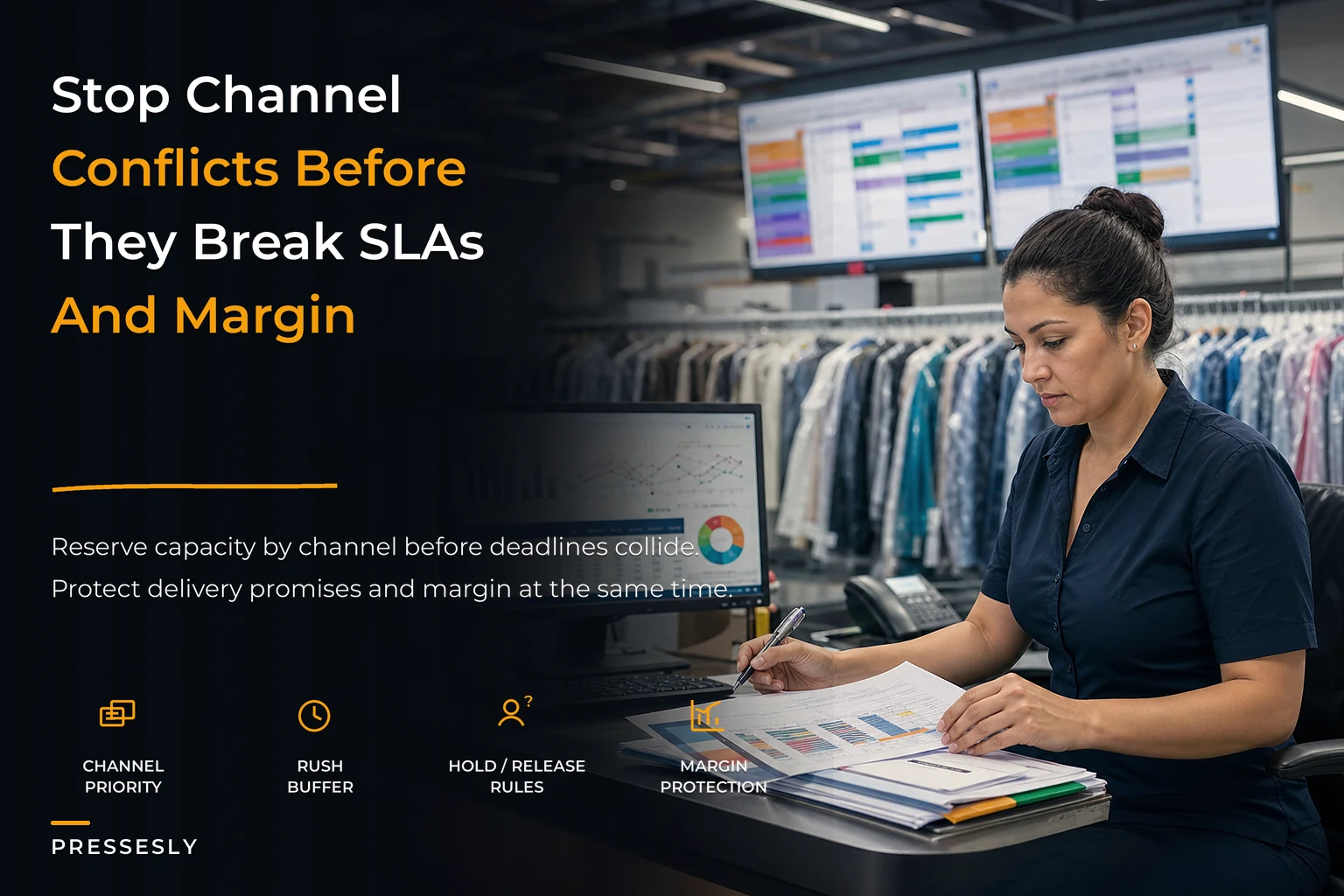
A channel-priority matrix does exactly this. For each channel, you define its promised turnaround, its slack (how much buffer before you actually miss), the cost of missing, and its priority rank when things collide.
| Channel | Promised turn | Typical slack | Cost of a miss | Priority when it collides |
|---|---|---|---|---|
| B2B contract | 24 hrs, hard | Very low | Penalty + contract risk | 1 (highest) |
| Delivery (route) | Next-day by 6 PM | Low (route cutoff) | Re-attempt fee ~$6–9/stop | 2 |
| Counter rush | Same/next day | Low | Refund + reputation | 3 |
| Counter standard | 2–3 days | High | Minor | 4 |
| Locker standard | 2–3 days | High | Minor | 5 |
The interesting insight here isn't the ranking itself — it's the slack column. Priority shouldn't be based purely on how important a channel feels. It should be based on how much runway is left before you actually break the promise. A standard counter order due in 3 days can wait behind almost anything. A locker order that came in overnight might have more real slack than a same-day counter rush, even though the counter customer is standing right in front of you.
Rank channels by available slack rather than by who's shouting.
Most shops rank by who's shouting. This ranks by who's actually about to be late. That's the whole game.
The daily capacity planner: match promises to hours, not garment counts
A priority matrix tells you who wins a collision. A daily capacity planner keeps most collisions from happening in the first place.
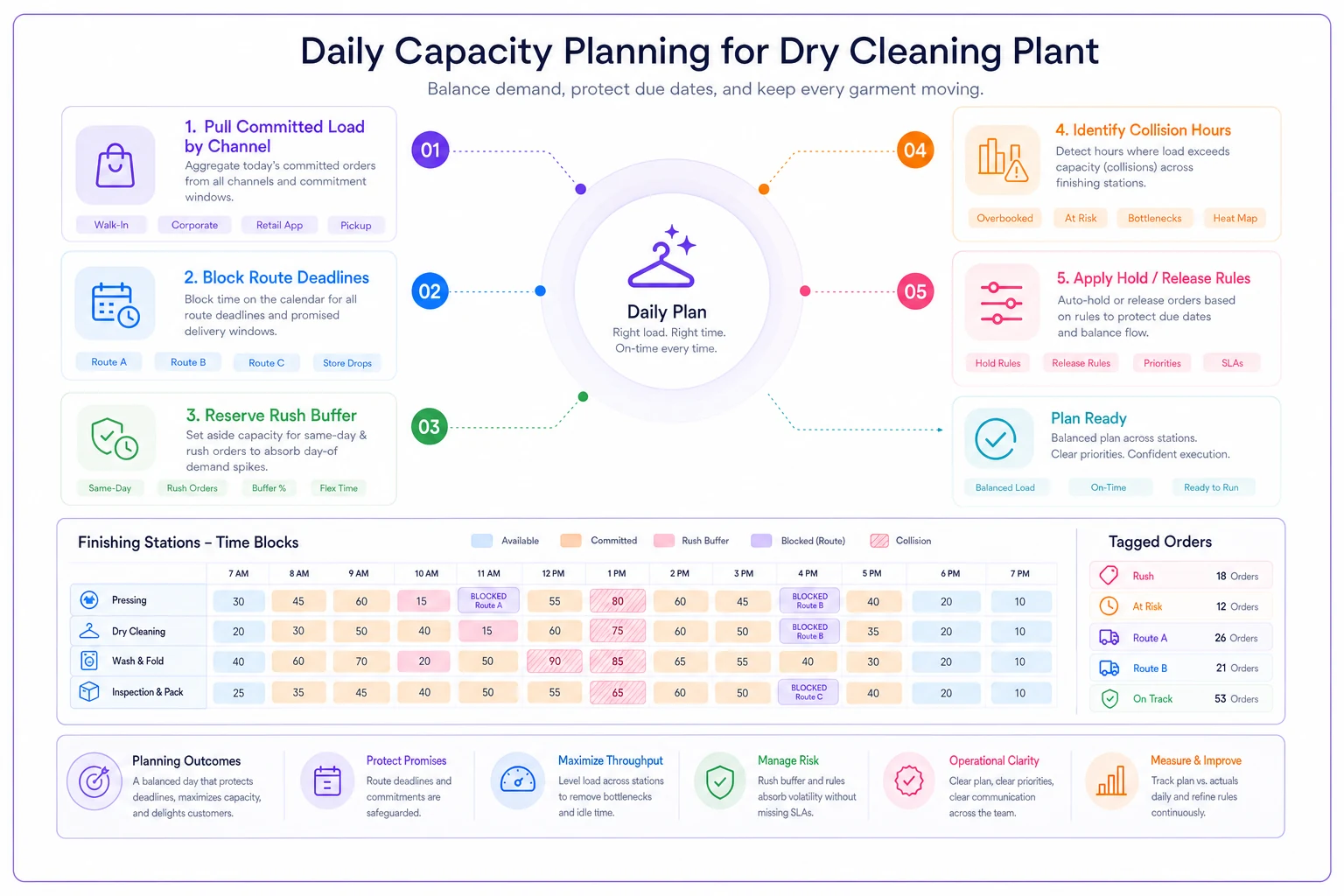
Almost everyone plans in garment counts. "We can do 650 pieces a day." That number is nearly useless. A wedding gown and a folded shirt are not the same work. Plan in finishing hours per station instead, because finishing — pressing, assembly, inspection — is almost always the real bottleneck, not cleaning.
-
Pull committed load by channel. Before the day starts, total up what's already promised for today across all channels, converted into rough finishing minutes.
-
Subtract known hard deadlines first. Delivery route leaves at 2 PM? That work has to be done by 1:30, not 2. Block that capacity first — it's non-negotiable.
-
Reserve a rush buffer. Hold back roughly 15–20% of finishing capacity for same-day counter rushes and B2B surprises. Fill to 100% planned and the first walk-in rush blows up the whole day.
-
Check the collision zones. Identify the hours where committed load exceeds available finishing time. Those are your danger windows — usually mid-morning and early afternoon.
-
Decide holds now, not later. For overflow in a danger window, apply hold/release rules before the rush, while you can still think clearly.
The payoff of planning in hours: you stop being surprised. You know by 8 AM that the 2 PM route is going to be tight, so you can act at 8, not at 1:55.
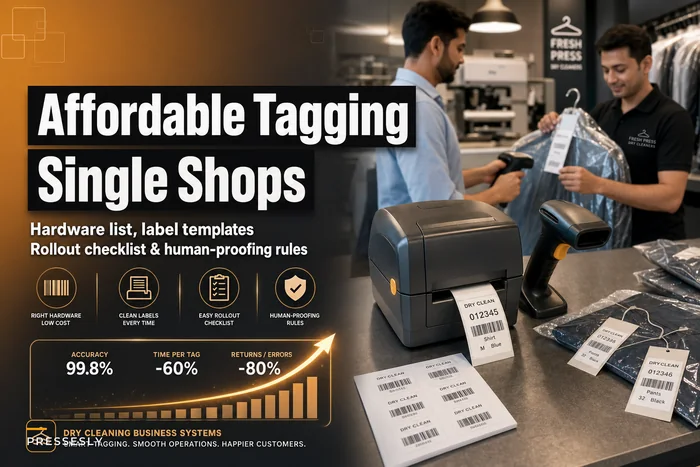
Barcode-level tracking makes this planner far less painful to run, because you're not hand-counting racks — the system already knows what's committed and where each order sits. If you haven't set that up yet, Affordable Barcode Tagging for Single Shops covers a realistic rollout that feeds directly into this kind of daily planning.
Hold/release rules: the part everyone skips
This is where margin actually gets protected, and it's the piece most shops never formalize.
A hold is a deliberate decision to not accept or not promise something at its normal turnaround, because doing so would break a higher-priority commitment. A release is the trigger that lets held work flow back in once capacity opens up.
-
Rush cutoff holds After a set time (say 11 AM for same-day), same-day counter rushes are automatically held to next-day unless the customer pays the rush surcharge and buffer capacity is still available. No negotiation at the counter.
-
Route protection holds Within 3 hours of a route cutoff, nothing new gets inserted ahead of work already committed to that route. Urgent items go on the next route.
-
B2B batch smoothing If a corporate batch exceeds the day's reserved B2B capacity, the overflow gets held to the next 24-hour window — communicated proactively, not discovered at delivery.
-
Release triggers Held work releases automatically when a station drops below planned load, or at a fixed check-in time (e.g., 12 PM re-plan). Held work should never just sit forgotten.
A planned hold with clear communication costs you almost nothing. An unplanned hold — where a promise silently slips and the customer finds out — costs you a refund, a re-delivery, or a contract. Same delay, wildly different cost. The difference is entirely whether you decided it on purpose.
Communication templates that make holds cost nothing
A hold only stays cheap if the customer hears about it before the deadline passes. This is the cheapest margin protection in the entire system, and it lives in three or four pre-written messages.
Under pressure, nobody writes a good proactive message. They avoid it entirely, hope it works out, then scramble apologetically after the miss. Pre-writing removes the hesitation.
-
Proactive delay (retail) "Hi [name] — your order needs a little extra care and will be ready [new time] instead of [original]. It'll be waiting for you then. Thanks for your patience." Sent the moment the hold is decided, never after the miss.
-
Rush declined at cutoff "We can absolutely do this — because it's after our same-day cutoff, it'll be ready [next-day time]. If you need it sooner, we do offer a rush option for [surcharge]." Turns a "no" into a clean choice.
-
B2B overflow notice "Today's batch of [X] exceeds our same-day window. We'll complete [portion] today and the remainder by [time tomorrow], within your 24-hour SLA." Frames it against the contract terms, so it reads as compliance, not failure.
-
Locker ready + slack note For high-slack locker orders, a simple ready-notification is enough — no need to over-communicate on work that was never at risk.
Proactive delay messages sent before the deadline almost never generate complaints. The same delay communicated after the fact almost always does. The garment took exactly as long either way. The difference is entirely the timing of one text message.
A real scenario: three channels fighting one afternoon
A shop running counter, a single delivery route, and a growing corporate shirt account kept eating re-delivery fees and had one corporate client threatening to leave over late batches. On the surface it looked like a capacity problem — they were even pricing out a second finishing station.
Digging in, the plant had room. The issue was the 2 PM route. Corporate batches landed around noon, staff (correctly sensing the penalties) pushed them to the front, and that shoved retail delivery orders past the cutoff. Those missed stops got re-attempted the next day at roughly $7 each, and they were missing somewhere around 15–20 stops a week. That's $400–$550 a month bleeding out purely from sequencing, plus an at-risk contract.
They didn't add a station. They built a priority matrix, reserved route capacity as a hard block, and set a rule that no new work jumps ahead of committed route orders within three hours of cutoff. Corporate overflow got held to the next 24-hour window with a proactive B2B message — still inside SLA, so no penalty. Retail delivery misses dropped to a handful a week. The corporate client stopped complaining because communication got predictable, even when timing was tight. No new equipment, no new labor.
When strict allocation rules make sense — and when they don't
This makes sense when you're running three or more channels, at least one has financial penalties (B2B or paid delivery), and you're regularly hitting afternoons where everything wants the same finishing window. If that's you, informal instinct is already costing money you can't easily see on a report.
This is overkill when you're a single counter with one small delivery route and predictable volume. You can hold that in your head. Build the formal rules when the third channel arrives, not before.
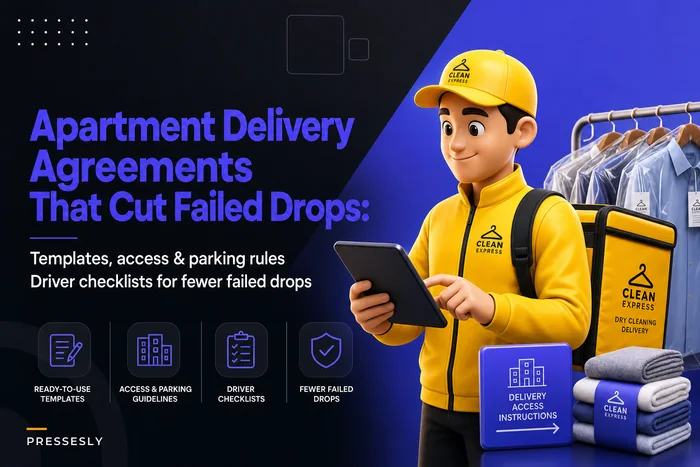
Who should be careful: shops that just landed their first big corporate contract and haven't built the plant discipline to protect the other channels from it. The instinct to protect the penalty account is right, but without route protection and rush cutoffs, that one account will quietly wreck your retail promises. The delivery-side agreements matter here too — a lot of "missed" drops are access and handoff problems, not plant problems, which is worth ruling out first using the checklists in Apartment Delivery Agreements That Cut Failed Drops.
Pulling it together
Cross-channel fulfillment breaks in the gaps, not the totals. The plant doesn't understand promises — it just processes garments — so without a clear set of rules for who wins a collision, it decides by physical convenience and you pay the difference in refunds, re-deliveries, and strained contracts.
The system that holds up is fairly simple: a priority matrix ranked by slack, not volume; a daily plan measured in finishing hours with a buffer built in; explicit hold/release rules decided before the rush instead of during it; and a handful of proactive messages that keep a planned delay from ever turning into a complaint.
None of it requires more capacity. It requires deciding, in advance and in writing, how your channels share the one resource they all depend on. Do that, and the afternoon collisions stop being emergencies — they become just another thing the plan already accounted for.
Ready to elevate your dry cleaning operations?
Join hundreds of dry cleaners using Pressesly to save time, reduce errors, and enhance customer satisfaction.