


Most shops treat alterations as a bonus service. Something you do because the customer asked, priced from memory, sent to whatever tailor has room. That casual approach is exactly why the alteration side of a dry cleaning business often runs at half the margin the owner thinks it does.
The cleaning line gets measured constantly — pieces per hour, rework rate, turn time. Alterations rarely get the same scrutiny. And because volume is low compared to cleaning, nobody notices when a $22 hem job actually cost $19 in tailor payout, rework, and counter time to quote and re-quote. Small dollars per ticket. Real bleed over a year.
This post is focused on the three things that decide whether dry cleaner alterations operations make money or quietly drain it: how you quote, how you sequence the work against your cleaning throughput, and what terms you set with the tailors doing the actual sewing.
The three ways alterations lose money (and none of them are obvious)
Before fixing anything, it helps to name where the money actually goes. In most shops it's not one big leak — it's three small ones running simultaneously.
Quoting from memory. A counter person eyeballs a pair of slacks, says "probably $18," and writes it on the ticket. The tailor gets it, sees it needs the lining opened, and it's really a $34 job. Now you either eat the difference or make an awkward call to the customer. Either way, you lost.
Alterations competing with cleaning for time and attention. A wedding party's cleaning order comes in the same day as three alteration tickets due Friday. The alteration slips, because it always feels optional — until the customer who needed a dress taken in for Saturday shows up to nothing ready.
No margin floor with third-party tailors. You pay the tailor a flat rate, charge the customer, and never check whether the spread actually covers counter labor, rework risk, and the occasional redo. Some jobs are fine. Some are underwater and you never find out which.
Fix these three and the alteration counter stops being a favor you do for regulars and starts being an actual profit line.
Quoting: kill the eyeball estimate
The biggest source of margin loss is inconsistent quoting. Two counter staff price the same alteration $8 apart, and neither number reflects what the job actually takes. Customers notice the inconsistency too — someone gets quoted $15 on Tuesday and $23 on Saturday for the same hem, and now they trust neither.
Never lose track of an order again.
Pressesly helps you manage, track, and communicate every garment order seamlessly.
- Unified order management
- Real-time customer notifications
- Staff scheduling & workload tracking
No credit card required
The fix is an estimate template with fixed prices for standard work and a clear escalation path for anything non-standard. Not a mental list. A physical or on-screen reference the counter follows every time.
Here's what a working alteration estimate structure looks like:
| Alteration type | Standard price | Add-on triggers | Auto-escalate to tailor if… |
|---|---|---|---|
| Pant hem (plain) | $14 | Cuffed +$6, lined +$8 | Original hem is blind-stitched leather trim |
| Take in waist | $22 | More than 2" +$10 | Waist has attached belt loops to move |
| Sleeve shorten (jacket) | $28 | Working buttonholes +$25 | Functional cuff buttons present |
| Dress take in (sides) | $38 | Lined +$15, zipper affected +$18 | Beading or delicate fabric at seam |
| Zipper replace (jacket) | $32 | Leather/specialty +$20 | Two-way or separating zipper |
Two rules that make this template actually work:
-
Standard price is non-negotiable at the counter. If the job fits the standard description, that's the price. No discretion, no "I'll knock a couple bucks off."
-
Anything hitting an escalate trigger doesn't get quoted on the spot. Counter tags it "quote pending," the tailor prices it within a set window, and the customer gets a firm number before work starts.
That second rule is what saves you from the $18-that-was-really-$34 problem. The moment a job has complexity you can't see from the counter, it stops being a counter quote.
A realistic example of what this recovers: a shop doing around 60–80 alteration tickets a week found that roughly one in six was being under-quoted — usually linings, functional buttons, or hidden construction. Average under-quote was $9–$12. That's somewhere in the range of $90–$130 a week walking out the door, or close to $5k–$6k a year, just from guessing instead of escalating.
TAT coordination: stop letting alterations lose to cleaning
Alterations run on a different rhythm than cleaning. A shirt moves through your process on a predictable line. An alteration sits in a queue that depends on a tailor's availability — and the tailor is often splitting their time across three or four shops.
The trap is treating alteration turnaround like cleaning turnaround: one promised date, no buffer for the outside dependency. When the cleaning line is slammed, staff push alterations back because they don't feel urgent until the due date is tomorrow. By then the tailor's week is full.
The way out is priority lanes for alterations, separate from your cleaning promise dates. A workable three-lane setup:
-
Standard lane 5–7 business days. Default for anything without a hard deadline. Batched to the tailor twice a week.
-
Event lane tied to a specific wear date the customer provides. Backdated — if the dress is worn Saturday, it's due to the customer Thursday, which means back from the tailor by Wednesday, which means it leaves your shop Monday. You work backward from the wear date, not forward from drop-off.
-
Rush lane customer needs it in 48 hours, priced with a surcharge that actually covers the tailor's rush rate plus your handling.
Separating lanes means alterations stop competing with cleaning in one undifferentiated pile. An event-lane dress has a hard backward-calculated deadline. It can't slip behind a routine cleaning batch because it's on a different clock.
This connects directly to how you think about promises across the whole shop. The logic in the Shop Turnaround Time Playbook — SLAs, buffers, escalation flows — applies to alterations even more than to cleaning, because you're managing an outside dependency you don't fully control.
The handoff window that prevents the Friday disaster
The other TAT problem is the handoff itself. Alterations pile up at the counter for two days before anyone bundles them for the tailor. You've now burned two days of your five-day window on a shelf.
Here's a simple visual of the priority-lane workflow.
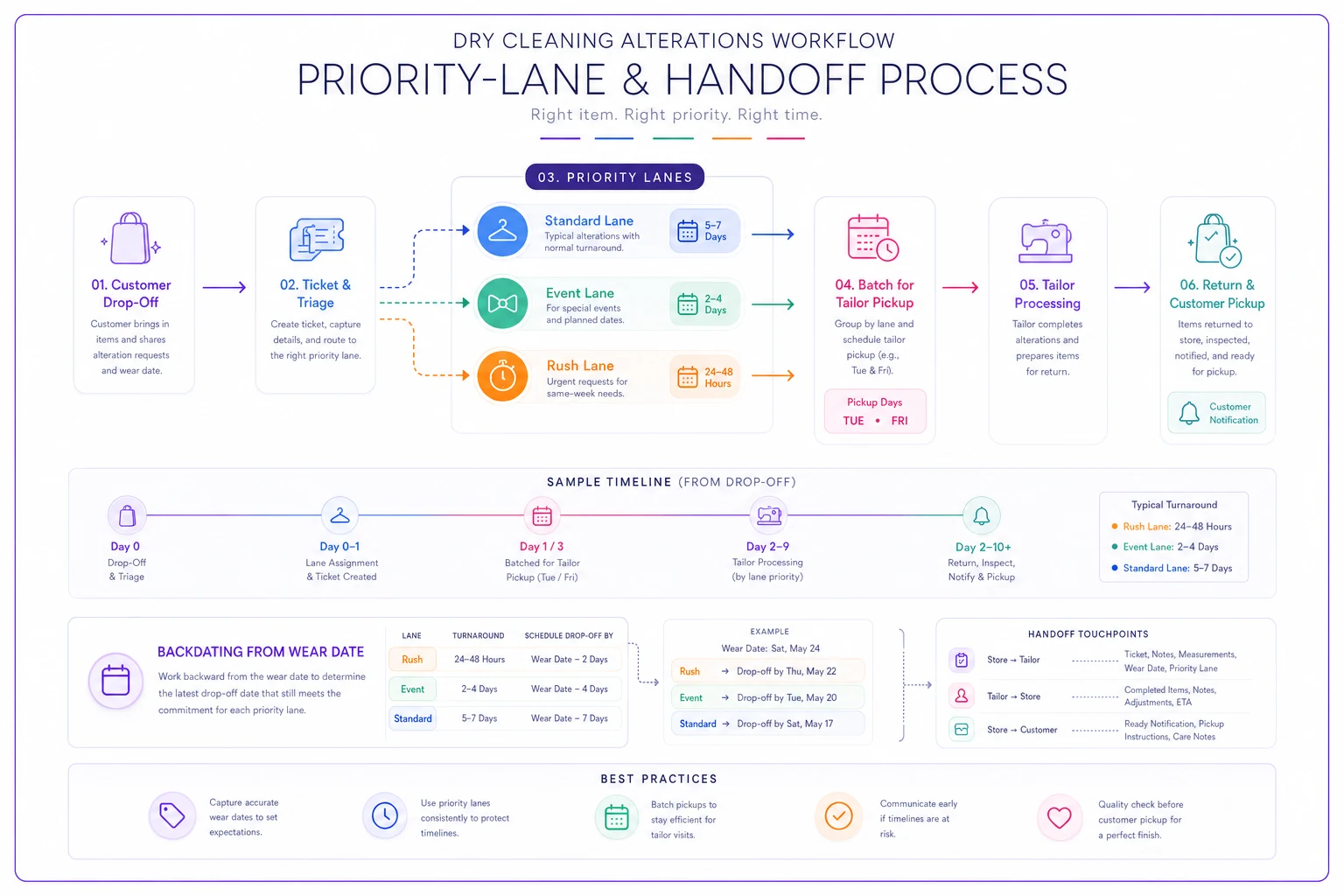
Set fixed pickup and dropoff windows with your tailor — Tuesday and Friday mornings, for example. Everything tagged before Tuesday goes Tuesday. Everything after goes Friday. Staff know the cutoff, customers get accurate dates because those dates are built around real transfer windows, and the tailor gets predictable batches instead of random daily trickles.
Third-party tailor policies that protect the spread
If you use outside tailors, your margin is the spread between what you charge and what you pay — minus counter labor and rework risk. Most shops never write this down, so the spread drifts.
-
A tailor rate sheet that maps to your estimate template. Every standard job on your customer estimate has a matching tailor payout. If a customer hem is $14 and the tailor gets $8, your gross spread is $6 before handling anything. If any line item's spread drops below your floor, that item gets repriced or dropped.
-
A margin floor. Decide the minimum spread you'll accept — many shops land somewhere around 40–50% gross on standard alterations. Anything below that either gets repriced or gets taken for regulars with full awareness of the cost.
-
Rework ownership. Who pays when a hem comes back uneven? If it's tailor error, the redo is on them at no charge. Put it in the agreement. Without this, every redo eats your spread twice — once for the original payout, once for counter time managing the complaint.
-
A firm quote-back window on escalated jobs. When you tag something "quote pending," the tailor commits to pricing it within four business hours. Otherwise "quote pending" becomes "customer waiting three days for a number" and they walk.
Track each tailor's redo and quote-back time monthly so you can reroute work before poor performance erodes your spread.
For tracking which tailors hit deadlines, which ones generate redos, and how to hold them accountable, the framework in the SLA and Scorecard Playbook for Tailors, Haulers and Suppliers pairs naturally with these pricing rules. Rates protect the spread; scorecards protect the reliability.
When outside tailoring stops making sense
Third-party tailoring works when your alteration volume is low or uneven. It stops making sense when volume gets steady enough that the spread you're giving away would cover part-time in-house tailor hours.
Rough gut check: if you're paying out more than $2k–$3k a month to outside tailors and volume is consistent week to week, run the numbers on bringing some of it in-house. The math shifts when the work is predictable enough to keep someone busy. Below that threshold, paying per-job usually still wins.
Who should not build this out yet: if you do fewer than 15–20 alteration tickets a week, don't over-engineer it. A single laminated rate card and one weekly tailor run gets you most of the benefit. The three-lane system earns its complexity once volume is high enough that jobs actually start colliding.
A short real scenario
A single-location shop was running alterations as a side service — around 50 tickets a week, quoted from memory, sent to one tailor whenever a bin filled up. Margins looked fine on paper because nobody was measuring the alteration line separately from cleaning.
When they finally broke it out, the picture was uglier: counter under-quotes were costing around $400–$500 a month, and roughly one in ten event-deadline jobs was late enough that they discounted or refunded just to keep the customer happy.
They made three changes over about a month — a printed estimate template with escalate triggers, two priority lanes (standard and event, backdated from wear dates), and a written tailor rate sheet with a 45% margin floor. Nothing complicated.
Within two months, under-quoting had basically stopped because complex jobs got escalated instead of guessed. Late event jobs dropped to almost none because those tickets ran on their own clock. Two low-spread line items got repriced — a couple of dollars each — which quietly added a few hundred a month in margin with zero customer pushback. The alteration line went from something they weren't sure made money to a dependable extra margin source.
How to actually roll this out
If you want to fix your alteration operation without a big project, work in this order:
-
Build the estimate template first. List your top 10–12 alteration types, set standard prices, and define the escalate triggers. This alone stops the biggest leak.
-
Get a written tailor rate sheet. Match every standard job to a payout. Calculate your spread on each. Flag anything under your floor.
-
Set the margin floor and reprice the losers. Small raises on underwater items. Customers rarely notice a $2–$3 change on an alteration.
-
Create priority lanes. Start with just two — standard and event. Backdate event jobs from the wear date.
-
Fix the handoff windows. Two fixed tailor transfer days a week. Build your quoted dates around them.
-
Add rework ownership in writing. Who eats the redo, and under what conditions.
You don't need software to start any of this — a laminated card and a whiteboard get the first version running. Where software helps, once the rules exist, is in enforcing them: flagging tickets quoted below standard price, alerting when an event job is approaching its backdated deadline, tracking tailor payout against customer charge so you can see the actual spread per job instead of approximating it at month end. But the rules come first. Tooling just makes them harder to ignore.
The real point
Alterations don't lose money because the work is hard. They lose money because they're treated as an afterthought bolted onto a well-run cleaning operation. The cleaning line gets measured, sequenced, and priced with discipline. The alteration counter gets a shrug and a price from memory.
Give the alteration side the same basics you already give cleaning — a firm price structure, a real place in the queue, and clear terms with whoever does the work — and it turns from a favor into a margin line. The tickets are small. The discipline is what makes them add up.
If you're also thinking about how alterations fit into what customers spend overall, there's a natural tie-in with service bundling and framing — a customer already trusting you with a suit clean is the easiest person to sell a proper fit to. But that's only worth pursuing once the underlying alteration economics actually work.
Ready to elevate your dry cleaning operations?
Join hundreds of dry cleaners using Pressesly to save time, reduce errors, and enhance customer satisfaction.