

The frustrating thing about staffing problems at a dry cleaner is how predictable they are once you step back. The Saturday rush that always runs short. The new hire who tags garments wrong for three weeks because nobody actually taught them. The presser who quits in September right before formalwear season. None of these are random. They're symptoms of a workforce being managed by instinct instead of by system.
Most single-shop owners don't have a staffing problem. They have a coordination problem that shows up as staffing. Hiring, training, scheduling, and retention get treated as four separate headaches, handled by whoever has a free minute. When they're disconnected like that, the whole thing wobbles the moment demand changes — and in this business, demand always changes.
This article is about treating dry cleaner workforce management as one connected system: a competency ladder that defines what "good" looks like, a first-week curriculum that gets people productive fast, a scheduling model tied to actual forecasted volume, and retention tactics that account for the fact that demand is lumpy and seasonal. When those pieces talk to each other, the Saturday fire stops being a weekly event.
The real failure isn't hiring — it's that nobody defined the job
Walk into most shops and ask what skills a "counter person" needs and you'll get a shrug and a list that lives in the owner's head. That's the root problem. When the job isn't defined in writing, three things break at once:
-
You can't train toward it, so new hires learn by osmosis and pick up whatever bad habits the person next to them has.
-
You can't promote fairly, so your best presser either leaves or sits at the same pay for four years and quietly resents it.
-
You can't schedule intelligently, because you don't actually know who can run the cleaning machine solo and who can't.
Shops running smoothly almost always have some version of a competency-based job ladder — even if they never call it that. It's just a clear map of what each person can and can't do yet.
Here's a simplified version of what that looks like in practice:
| Level | Title | Core competencies (signed off) | Typical pay band |
|---|---|---|---|
| 1 | Counter / Intake | Intake tagging, stain pre-assessment, POS, phone scripts | Entry |
| 2 | Production Assistant | Pressing basics, assembly, bagging, QC pass-through | Entry +$1–2/hr |
| 3 | Operator | Solo machine operation, solvent handling, spotting | Mid |
| 4 | Lead / Shift Runner | Cross-shift handoffs, daily reconciliation, training others | Mid +$3–4/hr |
| 5 | Shop Lead | Rostering input, vendor coordination, defect triage | Top band |
The point isn't the exact titles — your shop might merge levels 2 and 3. The point is that each competency has a signoff. Someone with authority watched the person do it correctly and logged it. "Maria is cleared on solvent handling as of March 12, verified by owner." That one habit changes everything downstream, because now your schedule is built on verified capability instead of hope.
The mistake almost everyone makes here
Owners write the ladder once, pin it to the breakroom wall, and never touch it again. A ladder that isn't maintained is worse than no ladder, because people stop trusting it. Competency signoffs need an expiration mindset — if someone hasn't run the machine solo in four months, that competency is stale and should be re-verified before you roster them for a solo shift.
The first week decides whether they stay
Turnover in this industry is brutal, and a big chunk of it happens in the first 10 days. Not because the work is impossible, but because the new hire spends their first week confused, underused, and quietly deciding this place is a mess.
Never lose track of an order again.
Pressesly helps you manage, track, and communicate every garment order seamlessly.
- Unified order management
- Real-time customer notifications
- Staff scheduling & workload tracking
No credit card required
-
Day 1 — Shop tour, safety and solvent basics, POS walkthrough, shadow intake. Target signoff: can process a simple drop-off under supervision.
-
Day 2 — Intake tagging rules, stain pre-assessment decision tree, phone scripts. Target signoff: tags 20 garments with zero errors.
-
Day 3 — Assembly, bagging, and the quality gate before pickup. Target signoff: passes a QC spot-check on their own work.
-
Day 4 — Pressing fundamentals on low-risk garments, handoff documentation. Target signoff: completes a clean cross-shift handoff log.
-
Day 5 — Supervised full-cycle on real orders, review of mistakes, set 30-day competency goals.
The insight most owners miss: the first-week plan should map directly onto the job ladder. Every signoff a new hire earns in week one is a real rung on Level 1. That makes the whole thing feel like progress instead of an endless probation period, and progress is what keeps people from ghosting you after payday.
Assign a single training owner for each new hire to improve early retention.
One pattern worth noting — shops that assign a single training owner for each new hire retain far better than shops where everyone trains a little. When five people train one person, nobody owns the outcome, and the new hire gets five contradictory versions of how to tag a wedding dress.
Scheduling blind is where the money leaks
Most shops schedule off memory. "Saturdays are busy, put three people on." That's fine until it isn't — until the week before prom, or the Monday after a holiday, or the random Tuesday when a corporate account dumps 80 shirts on you.
The fix is forecast-linked rostering: you build the schedule off projected volume, not off last month's gut feeling. You don't need a data science team for this. You need a rolling view of expected pieces per day, broken down by work type, and a staffing template that converts volume into shifts.
-
Estimate pieces per day for the coming two weeks (use the same period last year, adjusted for any known events or account changes).
-
Convert pieces into labor-hours using your actual throughput — one presser handles roughly 25–35 pieces/hour depending on garment mix.
-
Round into shifts, then flag any day where projected demand exceeds your base roster.
-
For flagged peak days, pull in a costed peak-shift module instead of just "calling someone in."
That last piece matters. A cost-per-shift template means every peak shift has a known price attached before you commit to it. A Saturday morning peak module might run something like: 1 extra presser + 1 extra counter = roughly $180–$240 in labor, expected to clear an additional 200–260 pieces. Now the decision is numeric, not emotional. If the volume isn't there, you don't fire up the module.
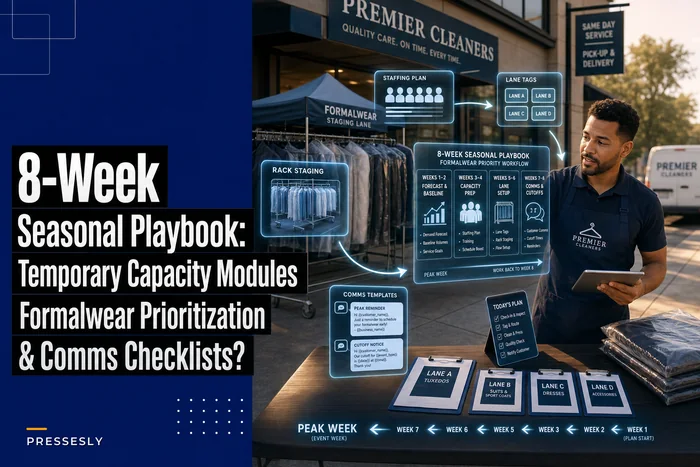
This connects directly to seasonal planning. The way you staff a normal week and the way you staff an eight-week formalwear surge are completely different, and treating them the same is how shops burn out their core team. If you haven't built temporary capacity thinking into your year, the 8-Week Seasonal Demand Playbook walks through how to bolt on capacity modules without wrecking your base schedule.
Here's a quick workflow for forecast-linked rostering.
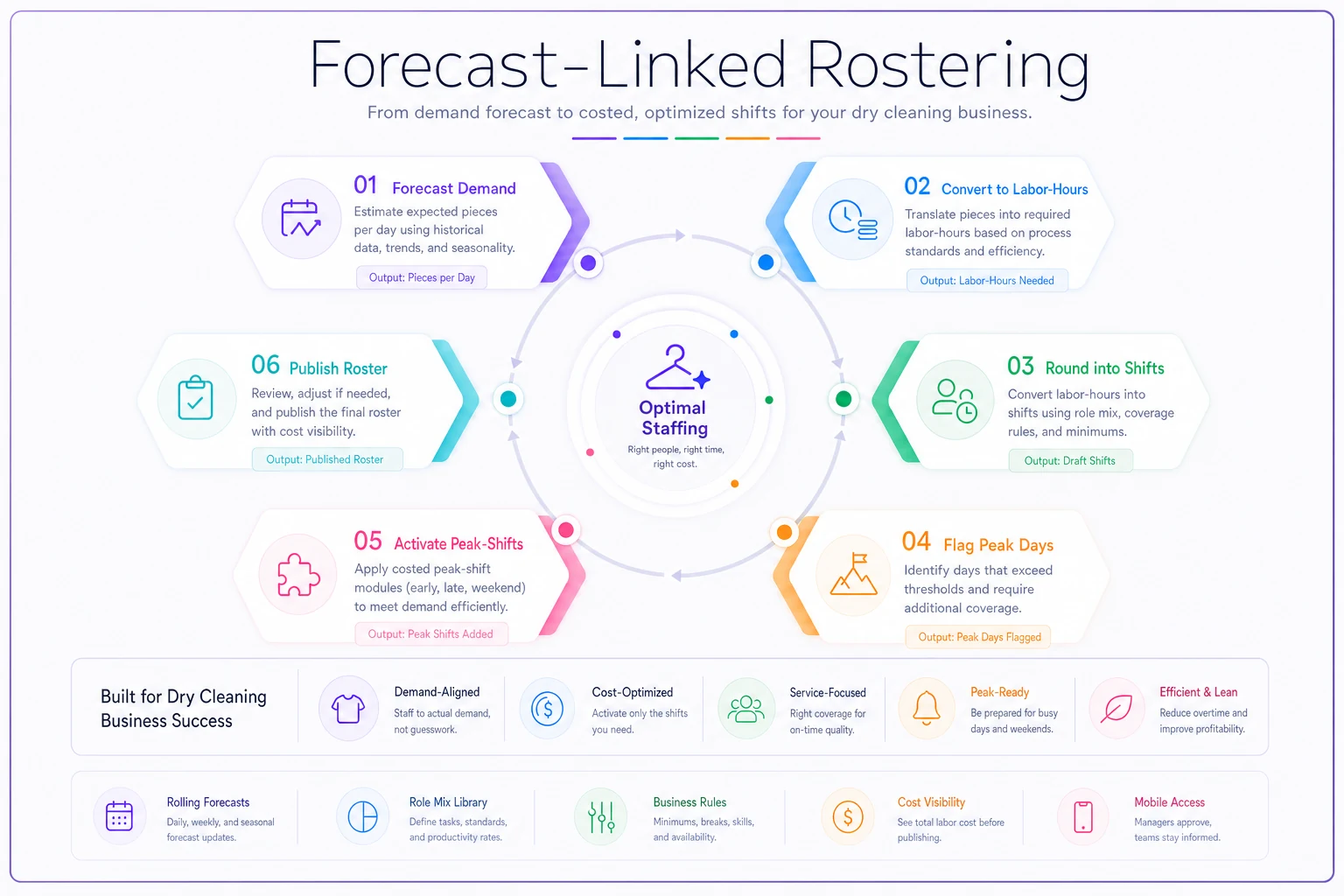
Use this flow to turn volume forecasts into staffing decisions.
When forecast-linked rostering is overkill
If you run a two-person shop with flat, predictable volume, a full forecasting model is a waste of time. You already know your week. This system starts paying off once you're running multiple shifts, carrying three or more production staff, or dealing with corporate accounts that spike unpredictably. Below that threshold, a whiteboard and good judgment still wins.
The handoff gap: where scheduled coverage still fails
You can have the right people scheduled at the right times and still lose orders, because coverage isn't the same as coordination. The weak point is almost always the seam between shifts — the moment the morning crew leaves and the afternoon crew inherits a rack full of in-progress work with no clear status.
This is a staffing failure disguised as a workflow failure. If your Level 4 Lead competency includes running a clean handoff, and your first-week curriculum trained the habit on Day 4, then the seam holds. If neither of those things happened, every shift change is a small reset where information evaporates.
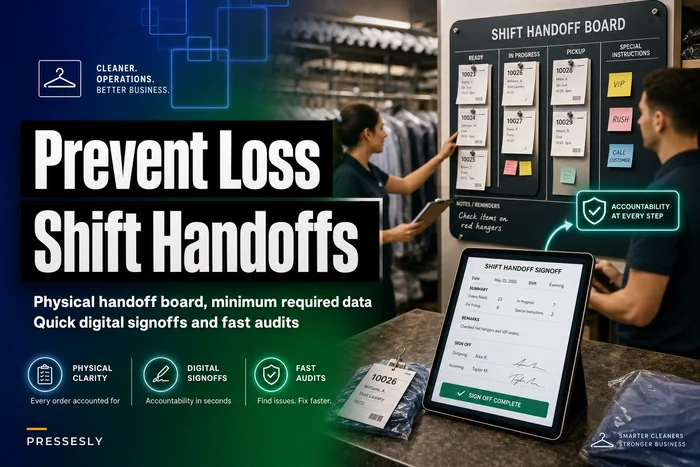
The mechanics of doing this well — physical boards, quick digital signoffs, fast audits — are their own discipline, and we broke them down in Cross-Shift Handoffs That Prevent Lost Orders. The staffing takeaway is simpler: handoff competency has to be a signed-off, trained skill, not an assumption. When it lives on the job ladder, you can roster around it — you never schedule two people who've both never run a handoff into a shift-change window alone.
Retention is a scheduling problem, not a ping-pong-table problem
Owners tend to think about retention in terms of pay and perks. Those matter, but the quieter driver of turnover in this business is unpredictable, unfair scheduling. People leave because their hours swing wildly, because the peaks always land on the same two reliable employees, or because they can't plan their lives around a schedule that changes every week.
-
Give your reliable staff predictable core hours. Build the base roster so your Level 3+ people know their anchor schedule weeks out, and use peak modules for the swing — ideally staffed by cross-trained people or part-timers who want variable hours.
-
Spread the peak load. If the same presser works every Saturday rush for a year, you'll lose them in September. Rotate peak coverage so the pain is shared.
-
Attach advancement to the ladder. When someone earns a new competency signoff, it should mean something — more pay, more responsibility, or first pick on the better shifts. Visible progression is cheaper than replacing a trained operator.
-
Pre-plan seasonal ramps. Hire your formalwear-season help before the surge, not during it, so your core team isn't carrying overflow while you scramble to onboard strangers mid-chaos.
The pattern underneath all of this: retention gets easier when demand is predictable and the schedule reflects that honestly. People don't quit lumpy demand — they quit chaos. The lumpiness is manageable. The chaos is what you create by scheduling blind.
A real scenario
A single-location shop running two shifts and four production staff kept hitting the same wall: Saturdays ran short, two senior pressers were quietly burning out, and they'd lost three new hires in a row within their first month. Turnover was costing them real money — somewhere around $1,500–$2,000 every time they had to re-recruit and retrain for a Level 2 role, and it was happening four or five times a year.
They did three things over about two months. First, they wrote down a basic five-level competency ladder and did signoffs for everyone currently on staff — which immediately revealed that only two people were actually cleared for solo machine operation, which explained why the schedule felt so fragile. Second, they built a five-day first-week curriculum with a single training owner per new hire. Third, they started forecasting Saturday volume a week out and only spun up a costed peak module when projected pieces crossed a threshold.
The results weren't dramatic overnight. Within a quarter, though, the Saturday short-staffing basically stopped, their next two hires both cleared the 30-day mark, and the two senior pressers stopped carrying every peak alone because coverage got spread. Rough estimate on turnover savings: somewhere in the $5k–$7k range over the following year, mostly from hires actually sticking around.
Nothing exotic happened. They just stopped treating four connected systems as four separate emergencies.
Pulling it together
When hiring, training, scheduling, and retention are managed as separate problems, each one undermines the others. You schedule people who were never properly trained, so you over-rely on your two veterans, so those veterans burn out and leave, so you're perpetually hiring, so you never have time to train properly — and the loop feeds itself.
A connected workforce system breaks the loop at every point. The competency ladder defines the job. The first-week curriculum fills the ladder's bottom rungs fast. Forecast-linked rostering with costed peak modules puts verified capability against real demand. And retention tactics built around predictable scheduling keep your trained people from walking out the door right when you need them most.
You don't have to build all of it at once. Start with the ladder and the signoffs, because that single piece of clarity makes every other decision — who to train, who to schedule, who to promote — dramatically easier. Whether you track it on a shared spreadsheet or in whatever operational software you already run, the goal is the same: make the next busy Saturday boring, because you saw it coming and staffed it on purpose.
Ready to elevate your dry cleaning operations?
Join hundreds of dry cleaners using Pressesly to save time, reduce errors, and enhance customer satisfaction.