

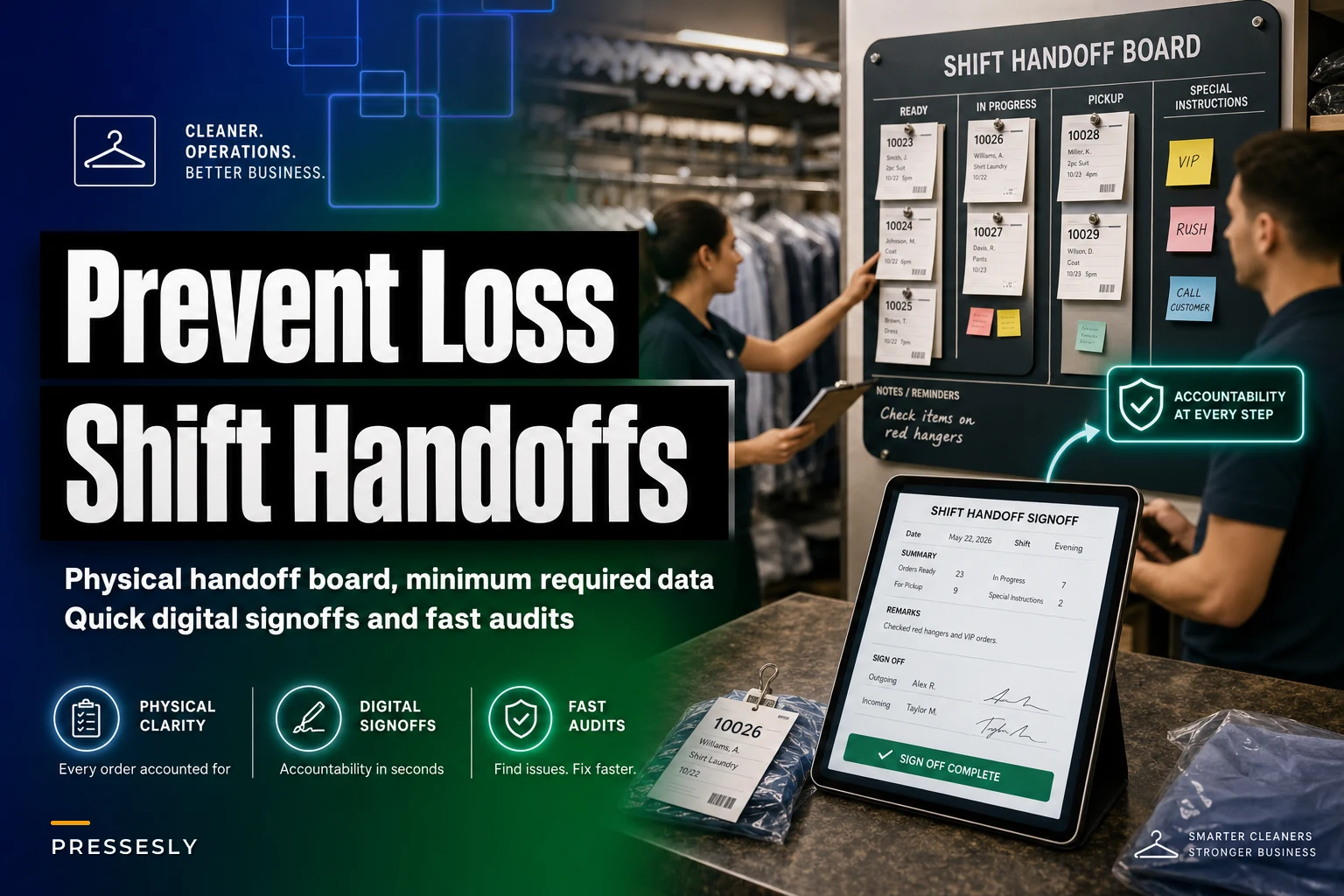

The 3pm shift change at most dry cleaners is where operational breakdowns hide. Morning staff clock out with critical information stuck in their heads—which customer complained about stain removal, which order needs rush processing, what the delivery driver said about apartment 4B's access code. Afternoon staff arrive blind, discover problems around 5pm when customers start calling angry, then scramble through incomplete notes while the morning team is already home.
A proper dry cleaner shift handoff protocol isn't about more paperwork. It's about capturing the minimum critical data that prevents customer-facing disasters—using a physical board that forces visibility, plus quick digital checkpoints that take under 90 seconds but catch problems before they blow up.
Why traditional handoff methods fail in dry cleaning operations
Most shops rely on verbal handoffs or scattered sticky notes. The counter person tells the afternoon manager about three special requests, maybe four. The pressing station leaves a note about equipment acting up. Someone mentions the silk blouse that needs extra attention. Then the afternoon crew gets slammed with their own rush of customers, those verbal notes evaporate, and by 6pm you're calling customers to apologize.
-
Special handling requests that deviate from standard workflow
-
Customer complaints that need follow-up
-
Equipment issues affecting turnaround times
-
Delivery complications requiring route adjustments
-
Inventory shortages impacting next-day capacity
When these exceptions transfer poorly between shifts, failures compound. Morning shift marks an order for same-day completion without noting the customer specifically requested no starch. Afternoon processes it standard, customer picks up at 7pm, discovers the mistake, and now you're re-doing the order during tomorrow's morning rush while eating the cost.
The physical handoff board that forces accountability
Forget digital-first solutions for shift handoffs. You need a physical board mounted where both shifts must see it—usually behind the counter or near the time clock. This isn't about being old-fashioned; it's about creating unavoidable visibility that screens genuinely can't match.
Never lose track of an order again.
Pressesly helps you manage, track, and communicate every garment order seamlessly.
- Unified order management
- Real-time customer notifications
- Staff scheduling & workload tracking
No credit card required
Your board needs exactly five sections:
-
Rush Orders & Exceptions Any order deviating from standard 2-day turnaround gets logged here with: - Order number - Customer name - Specific requirement - Deadline - Who committed to it
-
Customer Issues Active - Complaint type - Order details - Resolution promised - Who's handling follow-up
-
Equipment Status - Which machines have problems - Impact on capacity - Workaround being used - Repair scheduled for when
-
Delivery Flags - Access changes - Failed delivery attempts - Special instructions received today
-
Inventory Warnings - What's running low - What's completely out - Orders placed - Expected delivery
The board runs on a simple color-coding system. Red tags mean "handle within 2 hours," yellow means "handle today," green means "awareness only." Morning shift updates the board before clocking out. Afternoon shift initials each item to confirm they've read it.
Mount the board where staff pass during clock-out so updates become part of the routine.
That physical presence creates psychological pressure that digital tools miss. When the afternoon manager walks in and sees seven red tags, they immediately understand the operational tempo. When morning staff have to physically write problems on the board, they're far more likely to include critical details rather than assuming someone will piece it together.
The 90-second digital signoff that captures critical context
The physical board handles exceptions. You also need a digital checkpoint for operational continuity—not a complex system, just a simple form that takes 90 seconds but captures context that prevents bigger problems downstream.
The outgoing shift lead completes this form 15 minutes before shift end:
-
Order Status Snapshot - Total orders in process
__ - Orders due today still pending: _ - Tomorrow's orders already started: __
-
Capacity Check - Pressing stations available
/ - Cleaning machines running: / - Spot treatment backlog: ___ items
-
Staff Notes - Who called out sick - Who's staying late - Who's coming in early tomorrow
-
Three Things Next Shift Must Know (Free text, maximum 50 words each)
The incoming shift lead reviews the form, adds their initials, and notes any immediate concerns. Documented handoff trail that managers can pull up when something goes sideways.
This works better than lengthy handoff meetings because it forces prioritization. When you cap "things next shift must know" at three items of 50 words each, staff filter for what's actually critical. Nothing gets buried in paragraphs of text.
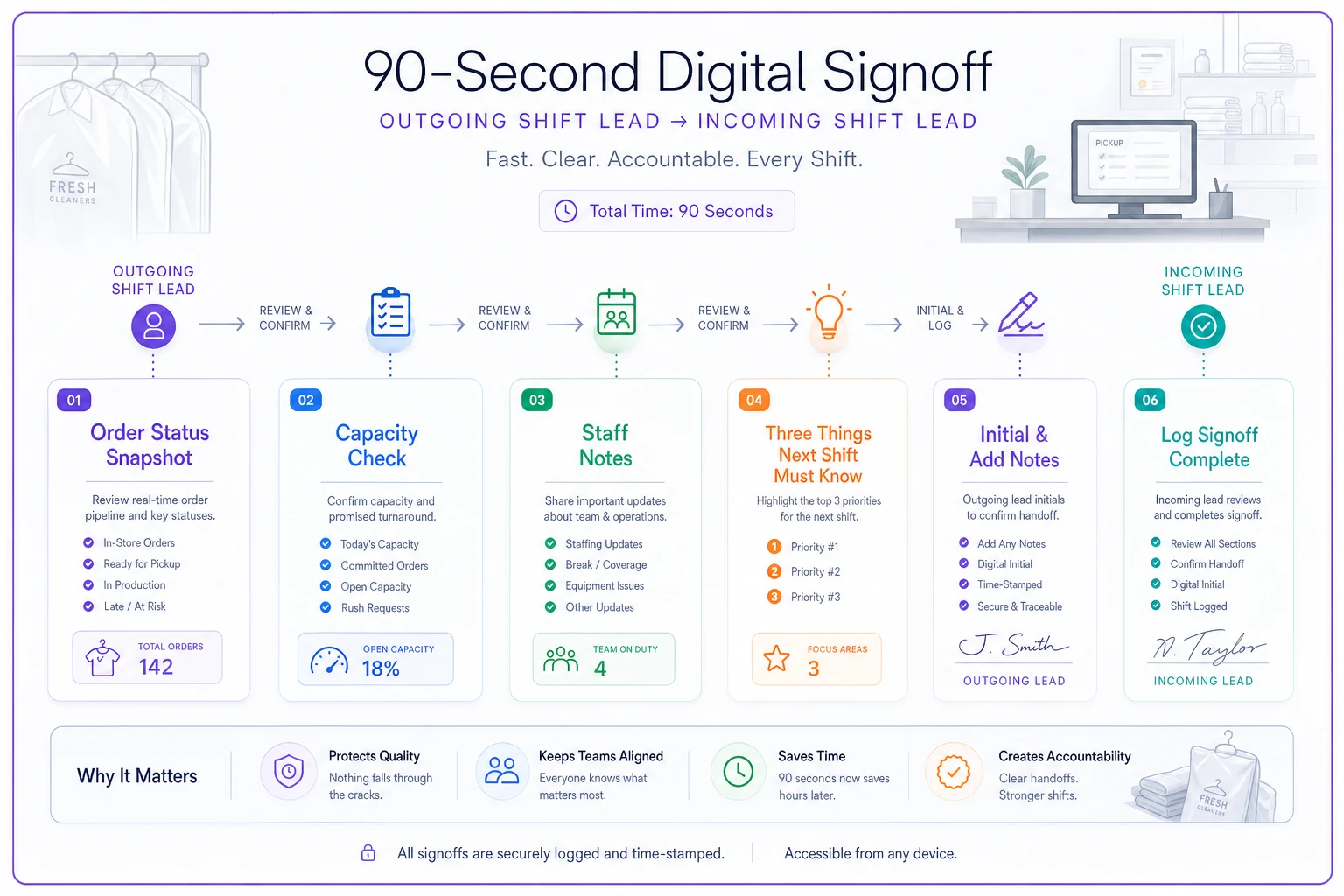
A quick visual of the signoff flow helps teams adopt the 90-second habit.
The digital form can live in a shared spreadsheet or basic form tool—nothing fancy required. Each shift's signoff becomes a row in an ongoing log. After 30 days, patterns emerge. Maybe Tuesday afternoon shifts consistently report pressing bottlenecks. Maybe Friday mornings always flag inventory issues. These patterns inform operational adjustments that standard reporting might miss.
The 5-minute audit ritual that catches problems before customers notice
Even solid handoff protocols let things slip through. That's why the incoming shift lead needs a fast audit that spots brewing problems within the first 30 minutes—not after things "settle down."
The audit follows this sequence:
-
Minute 1-2
Physical scan of all work areas
Walk the entire production floor. Look for: - Orders sitting in wrong stages - Untagged items - Equipment warning lights - Obvious bottlenecks -
Minute 2-3
Quick count verification
Count orders in three critical spots: - Ready for pickup rack - Tomorrow's due date section - Pressing queue If these numbers don't match the handoff form by more than 10%, something's wrong. -
Minute 3-4
System check
- Pull up today's pickup list - Compare against ready rack - Flag any gaps -
Minute 4-5
Call list review
Check the customer callback list. Anyone promised a return call before 5pm needs immediate attention.
The key is doing this immediately. An afternoon shift lead who discovers at 4:30pm that five rush orders weren't started is facing angry customers. The same shift lead who spots it at 3:05pm has time to reorganize workflow and still meet deadlines.
Real numbers from implementing structured handoffs
A shop processing around 180 orders daily implemented this exact protocol after losing three commercial accounts due to missed pickups and wrong processing.
| Before | After four weeks |
|---|---|
| 4-6 customer complaints weekly about missed special instructions | Customer complaints dropped to 1-2 weekly |
| 2-3 orders weekly requiring complete re-processing | Re-processing waste virtually eliminated |
| Commercial clients threatening to leave due to inconsistent service | Commercial clients noted improvement without being prompted |
| Staff spending 20-30 minutes daily hunting for missing information | Total handoff process takes roughly 6 minutes (90 seconds digital, 4-5 minutes for board updates) |
The reduction in re-work alone saved them around $400 monthly in labor and materials. More importantly, afternoon shifts stopped starting every day in crisis mode—which improved both staff retention and service quality in ways that are harder to measure but very obvious.
Common handoff failures to actively prevent
The "I'll just remember" trap Morning counter staff takes a special request, fully intends to mention it, forgets during the lunch rush. Customer returns angry. This keeps happening until you mandate everything goes on the board—no exceptions, no verbal-only communication.
The incomplete equipment warning "Press 2 is acting up" is useless. Is it overheating? Leaving marks? Running slow? Without specifics, afternoon staff can't adjust workflow and orders get damaged.
The vague customer issue "Mrs. Chen was upset about her dress" gives afternoon staff nothing to work with when she walks back in. Was it timing? Quality? Price? Missing context means awkward interactions and potential escalation.
The assumption cascade Morning assumes afternoon knows about the large corporate order due tomorrow. Afternoon assumes it's already in progress. Evening shift discovers 40 shirts needing processing at 6pm. Every shift assumed someone else had it covered, nobody verified.
Technology that supports but doesn't replace physical handoffs
Physical boards and quick forms handle 90% of handoff needs. That said, certain operational software features can strengthen the protocol without adding complexity.
A basic operations platform can automatically flag orders approaching deadlines that haven't moved through production stages. Instead of manually checking each order, the system surfaces bottlenecks before they become emergencies—particularly useful for shops managing complex turnaround time agreements with different customer tiers.
Digital photo documentation helps with quality disputes. When morning shift notes damage on an incoming item, a quick photo gives afternoon shift something concrete to reference if the customer questions it later. Removes the back-and-forth entirely.
Automated capacity tracking lets the handoff form pull real numbers instead of estimates. The system knows exactly how many orders sit in each production stage, so guesswork comes out of the handoff process.
But the critical point: technology supplements the physical board, it doesn't replace it. The board's visibility and the human act of writing on it create accountability that purely digital systems consistently miss. Shops that go fully digital for handoffs usually see compliance drop after the initial enthusiasm fades.
Making the protocol stick when staff resist change
Shift handoff protocols fail when treated as optional paperwork. Success requires making the protocol easier than the chaos it's replacing.
Start with only the physical board for one week. No digital forms yet. Let staff experience how the board prevents the daily scramble for information. Once they see afternoon shifts running smoother, add the digital signoff.
Assign ownership clearly. The shift lead owns updating the board—not "whoever has time." Build it into their paid time. Clock-out happens after board update, not before.
Make updating the board part of the shift lead's paid duties so it's not skipped to beat clock-out.
Track outcomes, not compliance. Instead of monitoring whether staff fill out forms, track weekly re-work rates and customer complaints about missed instructions. When numbers improve, staff make the connection between the protocol and easier workdays.
Address the "this is extra work" complaint directly. Yes, updating the board takes 4-5 minutes. Hunting for missing information, calling customers to apologize, and re-doing orders takes hours. The math becomes obvious once you track it.
Some shops tie small bonuses to handoff quality. When weekly audits show zero missed handoffs and complaints stay below threshold, both shifts split a small bonus. Creates peer accountability without micromanagement.
The compound effect of consistent handoffs
Strong handoff protocols do more than prevent daily fires. They create operational momentum that builds over weeks.
When afternoon shifts stop starting in crisis mode, they have mental bandwidth for actual improvement work—reorganizing a pressing station workflow, training backup staff on specialized equipment. That only happens when people aren't constantly fighting yesterday's mistakes.
Customer trust builds gradually too. The regular who always needs same-day service starts believing you'll actually deliver because special requests stop falling through cracks. The commercial account that threatened to leave starts sending more volume because consistency improved.
The data collected through handoff forms also becomes useful for planning. Those patterns showing Tuesday bottlenecks or Friday inventory issues inform scheduling, ordering, and capacity decisions. What starts as a simple communication fix quietly becomes an intelligence-gathering system.
And consistent handoffs reveal true operational problems versus communication failures. When issues persist despite solid information transfer, you know you're dealing with a process problem, not a handoff problem. That clarity matters when you're trying to focus improvement efforts.
Moving from chaos to structured handoffs
The path from scattered sticky notes to functioning handoff protocols isn't complicated, but it requires consistency over perfection. A dry cleaner shift handoff protocol doesn't need to be elaborate—it needs to be unavoidable, fast, and focused on information that prevents customer impact.
Start with the physical board. Mount it today if possible. Create the five sections, buy colored tags, and announce that starting tomorrow, all shift exceptions go on the board—no exceptions, no "I'll just tell them."
Add the digital form after one week of board-only operation. Keep it simple, use a basic Google Form or shared spreadsheet. The 90-second limit is real; if it's taking longer, you're capturing too much.
Start the 5-minute audit immediately. Don't wait for perfect handoffs before auditing. The audit itself will reveal what information needs better capture.
First week: fewer panicked phone calls. Second week: afternoon shifts stop hunting for information. By week four: the compound effects emerge—better customer satisfaction, less re-work, and shifts that accomplish improvement projects instead of just surviving until clock-out.
The difference between shops that thrive and shops that merely survive often comes down to these mundane operational protocols. Not better equipment or more skilled staff—just ensuring that critical information transfers reliably between the people who need it, when they need it, without requiring heroic memory or perfect verbal communication. That's what a proper handoff protocol delivers, and why getting it right pays off every single shift.
Ready to elevate your dry cleaning operations?
Join hundreds of dry cleaners using Pressesly to save time, reduce errors, and enhance customer satisfaction.