


The worst thing about formalwear season isn't the volume. It's the shape of the volume. A pile of 40 gowns and tuxes doesn't behave like 40 shirts. Each one has beading that snags, a lining that needs hand-finishing, a customer who wants it back for a Saturday that can't move, and a claims risk that's roughly 5x higher than everyday garments.
So when a shop that normally cruises at a 3-day turnaround suddenly starts blowing promised dates in mid-April, it's rarely because they got lazy. It's because they treated seasonal demand as "more of the same work" instead of a fundamentally different intake mix. That's what this playbook fixes.
We're going to work backward from the peak — 8 weeks out — and build capacity in temporary modules, set up prioritization lanes so formalwear doesn't drown in the regular flow, and lock in communication templates that stop SLA breaches before they turn into refund requests and one-star reviews.
Why formalwear season breaks otherwise healthy shops
Most single-location and small-chain dry cleaners run lean on purpose. Your staffing, your rack space, your pressing stations — all of it is tuned to your normal week. That's smart the other 44 weeks of the year.
The problem shows up in the transition. Formalwear demand doesn't ramp gently. It clusters around fixed calendar events — prom weekends, wedding season, holiday galas, awards banquets — and those dates don't negotiate. A customer with a Friday-night event isn't going to accept "sorry, we're running behind."
The pattern that quietly wrecks turnaround: your everyday garments and your high-touch formalwear share the same queue. A silk gown that needs 90 minutes of hand attention sits in the same rack as 200 work shirts that need 4 minutes each. Whoever pulls work off that rack grabs whatever's closest. The gown gets bumped again and again because it looks like more effort, and suddenly you're 36 hours from an event with a garment that hasn't been touched.
-
A refund on a $45–$70 formalwear ticket — your highest-margin work
-
A customer who tells their entire wedding party
-
Staff working unpaid overtime to firefight
-
Everyday customers whose shirts also slip because the whole floor is in chaos
Peak season doesn't create new problems. It amplifies the ones your normal volume was already hiding.
The 8-week structure: build in modules, not in one big push
The mistake most owners make is waiting until they feel busy, then throwing money at overtime and a couple of temp hires in a panic. By then you're already behind, and hiring under pressure means bad hires.
Never lose track of an order again.
Pressesly helps you manage, track, and communicate every garment order seamlessly.
- Unified order management
- Real-time customer notifications
- Staff scheduling & workload tracking
No credit card required
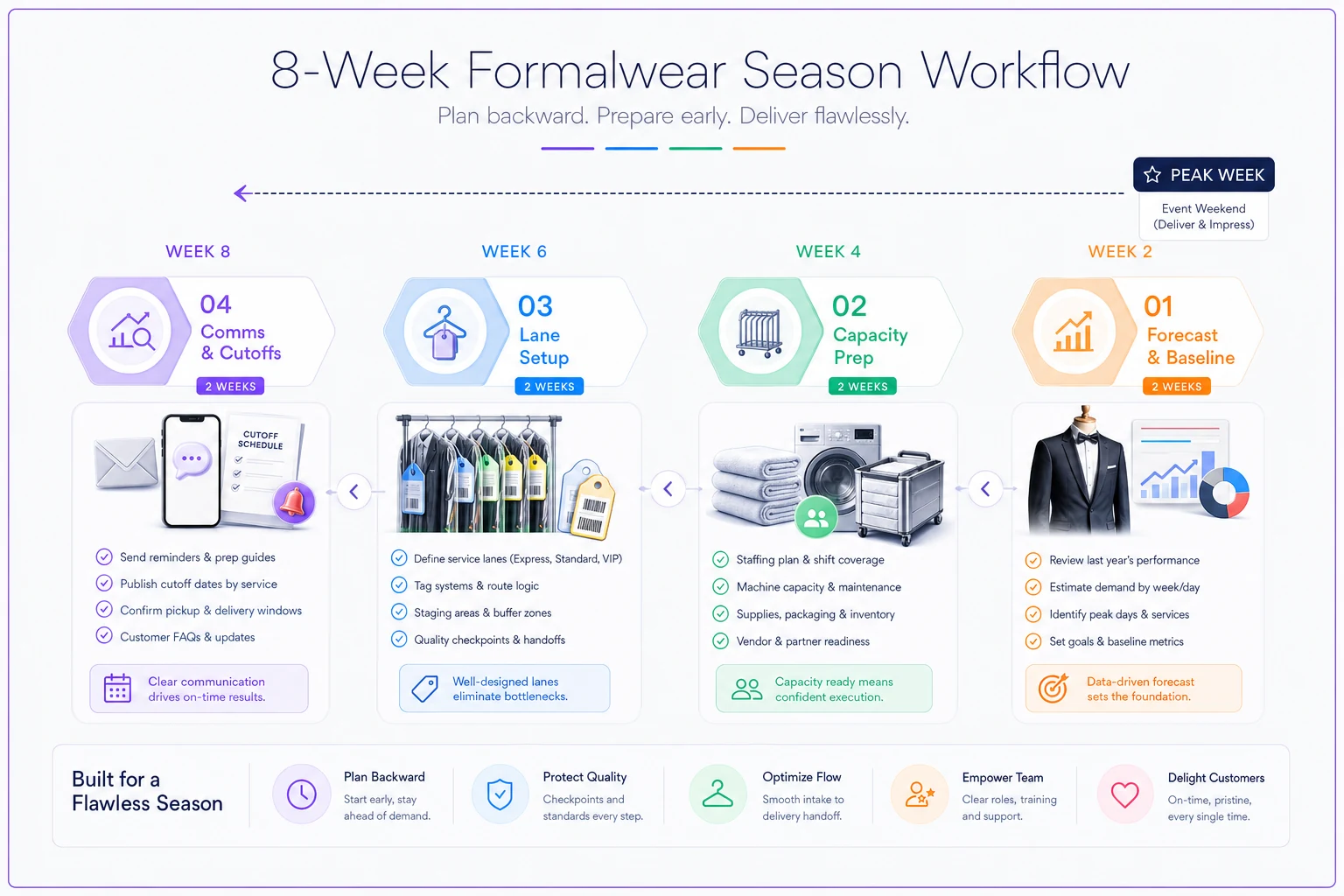
| Weeks Out | Module | Primary Focus | What You're Locking In |
|---|---|---|---|
| 8–7 | Forecast & Baseline | Pull last year's numbers, map event calendar | Expected formalwear volume by week |
| 6–5 | Capacity Prep | Temp staffing, equipment check, supply pre-order | Physical + labor headroom |
| 4–3 | Lane Setup | Build prioritization lanes, retag workflow | Formalwear can't get buried |
| 2–1 | Comms & Cutoffs | Load templates, set intake cutoffs | SLA breaches caught early |
The point of modules is that if you start late — say you're reading this at week 4 — you can still run the last two modules and get most of the protection. Not ideal, but recoverable.
Weeks 8–7: Forecast off real history, not gut feel
Pull your intake logs from the same period last year. You're looking for two things: total formalwear count by week, and the ratio of formalwear to everyday volume.
A typical example: a suburban shop found their prom-through-June window pushed formalwear from roughly 8% of their garment count to around 22% at peak. That sounds manageable until you weight it by labor — those garments ate close to 40% of finishing hours. That ratio, labor share rather than garment count, is the number that actually determines whether you'll breach SLAs.
If you don't have clean historical data, even a rough count from memory plus your POS ticket categories gets you 80% of the way there. Don't skip forecasting because your records are messy.
Weeks 6–5: Temporary capacity modules
This is where "temporary" matters. You're not permanently expanding. You're adding removable capacity that comes off when the season ends.
-
Hours modules — Extend existing staff hours in defined blocks (e.g., two extra pressers Tue/Wed/Thu evenings when formalwear finishing peaks). Fastest, cheapest, but has a burnout ceiling. Don't lean on this alone.
-
Labor modules — Bring in seasonal part-timers for the simplest tasks: bagging, tagging, assembly, front counter. This frees your skilled staff to focus entirely on formalwear finishing. Never put a temp on a beaded gown.
-
Space modules — Rent or clear a temporary staging area specifically for formalwear so it physically separates from the main rack. A folding garment rack in a back corner beats letting gowns mix into the general flow.
The part most owners miss: you don't add capacity to do more of everything. You add capacity to offload the easy work so your experts can focus on the high-risk, high-margin garments. Cross-training your regular team ahead of the crunch pays off here — there's a solid breakdown of forecast-driven rosters and flexible shift modules in this piece on avoiding peak-season burnout that pairs directly with this playbook.
Weeks 4–3: Prioritization lanes so formalwear never gets buried
This is the core of the whole playbook. Everything else supports this.
A prioritization lane is a physical and procedural separation that guarantees formalwear moves on its own track with its own promise dates. Not "we'll try to prioritize it." An actual lane.
Here's how it runs on the floor. At intake, a garment gets classified into one of three lanes:
-
Express formalwear — event date within 5 days. Hard deadline. Gets a colored tag (bright red works) and goes straight to the staging rack, never the general queue.
-
Standard formalwear — event date 6+ days out. Colored tag (yellow), tracked separately but with more buffer.
-
Everyday — normal flow, normal SLA.
The colored tag is the whole trick. When a presser walks to the rack, red tags get worked first, always, no judgment call required. You've removed the "grab whatever's closest" behavior that buries high-risk garments.
Each lane gets its own promise-date rule with a buffer baked in. If a formalwear item genuinely needs 3 days of finishing, you promise 4 and hold one day of slack. That buffer absorbs the inevitable snag — the stain that needs a second treatment, the seam that pulls. For a deeper look at how buffers and escalation flows keep promised dates honest, the turnaround time playbook covers the SLA math in detail.
One more thing that separates shops that hold their dates from ones that don't: a daily lane review. Every morning, someone scans the express formalwear rack against event dates. Anything within 48 hours of its deadline that isn't in finishing gets escalated on the spot. Ten minutes a day. It catches the breach before the customer does.
This timeline visualizes the module timeline and the key actions to take each week.
Weeks 2–1: Communication templates and intake cutoffs
By now the physical system is built. This last module is about managing customer expectations so a tight timeline never becomes a surprise.
Intake cutoffs are simple. For a garment needed by a specific date, you set the latest intake time you'll accept without a rush surcharge. Example: "Gowns for this Saturday must be dropped by Wednesday noon for standard pricing." Past that, it's rush pricing or a declined intake. Put it on a sign, on the counter, and have staff say it out loud at drop-off.
The cutoff protects you from the customer who hands you a beaded gown Friday afternoon for a Saturday wedding and leaves a furious review when it's not ready. You either priced that risk in or you declined it. What you never do is silently accept it and hope.
Communication templates stop the slow-motion breaches. The goal is proactive contact — you reach out before the customer worries, not after they're already angry.
-
Intake confirmation — restates the garment, the promise date, and the event date so any mismatch surfaces immediately
-
Extra-treatment notice — sent the moment a stain or repair means the garment needs more time, with a revised date
-
Ready-early notice — when formalwear finishes ahead of the deadline, tell them; it drives early pickup and clears your staging rack
-
At-risk heads-up — message sent when a garment is trending late, offering options before the date is blown
-
Post-event thank-you — quick note for high-value formalwear customers; these are your best repeat and referral source
The shops that have clean seasons versus the ones drowning in complaints usually come down to one thing: whether the extra-treatment notice is treated as mandatory. The single biggest source of formalwear SLA breaches isn't slow work — it's a garment that needed a second stain treatment nobody communicated, so the customer's mental deadline and your actual timeline quietly drifted apart.
A real scenario: how the numbers move
A two-location shop in a wedding-heavy region kept blowing formalwear dates every May and June. They were refunding somewhere around 12–15 formalwear tickets a month at peak, plus eating overtime and losing repeat customers they never tracked or counted.
They ran the 8-week structure the following year. Nothing exotic — a few seasonal part-timers on tagging and assembly, a dedicated red-tag express lane with a back-corner staging rack, and the five communication templates loaded into their system.
The change wasn't dramatic on paper but it was real on the floor. Formalwear refunds dropped to roughly 2–3 a month during peak. The morning lane review caught most at-risk garments a full day early, which meant the at-risk heads-up template did its job before anything actually breached. Overtime hours fell noticeably because skilled staff weren't firefighting — they were working a clean, prioritized queue.
The owner mentioned the part that's hard to quantify: the season stopped feeling like a crisis. Even at a conservative $50 average formalwear ticket, cutting 10 refunds a month across the peak window is real money. The retained customers and referrals that follow a clean season are worth more than the tickets themselves.
When this playbook makes sense — and when it doesn't
Run the full 8-week version if: formalwear is a meaningful share of your peak volume, you have hard-date events driving demand, and you've breached SLAs on high-value garments in past seasons. This is built for you.
Run a lighter version if: your seasonal spike is mostly everyday garments — a post-holiday surge in coats and everyday wear, for example. You still want capacity modules and cutoffs, but the elaborate formalwear lane matters less. A single priority tag may be enough.
Skip the temporary space module if: you genuinely can't carve out a staging area. Lean harder on the tagging system and the daily lane review instead. The physical separation is ideal but the colored-tag discipline is what actually does the work.
Who should not bother with the full formalwear lane: a shop where formalwear is a rare one-off. If you see maybe two gowns a month, building a dedicated lane is over-engineering. Flag them individually and give them personal attention.
Keeping it running without a spreadsheet nightmare
Most of this can run on paper and colored tags, and plenty of shops do exactly that. The friction shows up in the tracking — knowing which express garments are within 48 hours of their event date, remembering to send the extra-treatment notice, keeping lane counts visible across two shifts.
Start with the tags and the daily review though. The system matters less than the discipline.
That's where a workflow platform with basic automation earns its keep. When intake classification, promise-date buffers, and customer-communication templates are tied into one system, the at-risk garment surfaces automatically each morning instead of depending on someone remembering to walk the rack. The templates fire off the revised-date message the moment a garment's status changes. You're not replacing the operational thinking — you're just removing the manual reminders that break down exactly when you're busiest.
Start with the tags and the daily review though. The system matters less than the discipline. A shop with red tags and a ten-minute morning scan will beat a shop with fancy software and no lane rules every single time.
Pulling it together
Formalwear season punishes shops that treat it as busier normal. It rewards shops that recognize the intake mix has fundamentally changed and build a separate track for the garments that carry the most risk and the most margin.
Work backward from your peak. Forecast off real labor share, not garment count. Add capacity in removable modules that offload the easy work so your experts focus on the hard garments. Build a prioritization lane that makes it physically impossible to bury a gown. Load the communication templates that catch a slipping date before it becomes a refund.
Do that across eight weeks and the season stops being the part of the year you dread — it becomes the part where your highest-margin work actually pays off.
Formalwear season punishes shops that treat it as busier normal. It rewards shops that recognize the intake mix has fundamentally changed and build a separate track for the garments that carry the most risk and the most margin.
Work backward from your peak. Forecast off real labor share, not garment count. Add capacity in removable modules that offload the easy work so your experts focus on the hard garments. Build a prioritization lane that makes it physically impossible to bury a gown. Load the communication templates that catch a slipping date before it becomes a refund.
Do that across eight weeks and the season stops being the part of the year you dread — it becomes the part where your highest-margin work actually pays off.
Ready to elevate your dry cleaning operations?
Join hundreds of dry cleaners using Pressesly to save time, reduce errors, and enhance customer satisfaction.