



Most shop owners don't switch solvents because they want to. They switch because something forced their hand — a landlord asking about environmental liability, a supplier discontinuing a product, an insurance renewal that suddenly gets pointed, or a customer who read something online and wants to know if their sweater is being cleaned in "chemicals." And once that pressure shows up, the decision usually gets made emotionally instead of on the numbers.
That's the real problem with dry cleaner chemical management. It's rarely treated as a system. It gets treated as a one-time crisis. You panic-research three alternatives, call your distributor, pick whatever sounds cleanest, and then discover six months later that your utility bill went up, your cycle times got longer, or your disposal costs quietly doubled. The solvent choice touches machine wear, insurance, compliance paperwork, throughput, and even how you're allowed to talk about your shop — and almost nobody maps those connections before deciding.
This is about building an actual decision framework: a matrix you can sit down with, weigh honestly, and defend later. Not "which solvent is best," because that answer doesn't exist. The right answer depends on your machine, your volume, your local regulations, and what you charge per piece.
## Why solvent decisions quietly become expensive
The sticker price of a solvent is almost never the number that matters. What matters is the total cost per operating hour, and that number hides across five or six different line items that never appear together on one page.
A gallon of perc looks cheap on paper. But then you factor in hazardous waste manifests, filter and cartridge disposal, regulatory reporting time, and the fact that in several states you can't even install a new perc machine anymore. Meanwhile a hydrocarbon or newer alternative solvent might cost more per gallon and run longer cycles — which eats labor and electricity — but generates less regulated waste and gives you a cleaner story to tell customers.
In real operations, the expensive mistake usually looks like this: a shop switches to a "greener" solvent to satisfy a marketing goal, doesn't recalibrate cycle times, and ends up running 20–30% longer per load. On a shop doing a few hundred pieces a week, that's real money in electricity and a real hit to throughput during the morning rush. The solvent didn't cost more per gallon. The workflow around it got more expensive, and nobody attributed the cost back to the switch.
Solvent decisions don't fail at the point of purchase. They fail downstream, weeks later, in places you're not measuring.
## The tradeoffs you're actually weighing
Before you can build a matrix, you need to be honest about what dimensions actually matter. Owners tend to fixate on one or two — usually price and "is it green" — and ignore the ones that generate the surprise bills.
Never lose track of an order again.
Pressesly helps you manage, track, and communicate every garment order seamlessly.
- Unified order management
- Real-time customer notifications
- Staff scheduling & workload tracking
No credit card required
Here's how the main solvent categories tend to shake out in practice. Treat these as directional, not gospel, because your local rules and machine model swing everything.
| Dimension | Perc | Hydrocarbon | Newer alternative solvents (e.g., glycol ethers, modified alcohols) | Wet cleaning |
|---|---|---|---|---|
| Cleaning aggressiveness | High | Moderate | Moderate–high | Moderate, technique-dependent |
| Cycle time | Shorter | Longer | Longer | Varies, labor-heavy |
| Regulatory burden | Heavy, increasing restrictions | Moderate (flammability rules) | Lighter, but check locally | Lightest |
| Disposal cost | High (hazardous waste) | Moderate | Lower | Lowest |
| Machine/retrofit cost | N/A (often can't install new) | Moderate | Moderate–high | High (new equipment + training) |
| Customer-facing story | Weak, getting weaker | Neutral | Good | Strongest |
| Operator skill required | Standard | Standard | Standard | High |
The mistake isn't picking the wrong column. It's picking based on a single row. A shop that optimizes purely for "customer-facing story" and jumps to wet cleaning without accounting for the labor and skill demands can end up with slower throughput and more redo work on structured garments. A shop that optimizes purely for cleaning aggressiveness stays on perc until a regulation makes the decision for them — at the worst possible time, with no runway.
## Building the decision matrix
A weighted matrix forces you to admit what you actually care about instead of pretending everything matters equally. The setup is simple, but the discipline is in being honest with the weights.
-
List your criteria. Cost per operating hour, cleaning quality on your typical garment mix, disposal and compliance burden, throughput impact, retrofit cost, and marketing value. Six criteria is usually enough. More than eight and you're overthinking it.
-
Assign weights that sum to 100. This is the honest part. If you're a high-volume shop near a business district doing suits and shirts, throughput and cleaning quality probably deserve 25 points each. If you're a boutique positioning around eco-conscious customers, marketing value and disposal burden climb. Don't copy someone else's weights.
-
Score each solvent option 1–5 on every criterion. Use your own shop's reality, not the brochure. If you've never run wet cleaning, score its throughput conservatively — you will be slow at first.
-
Multiply score by weight, sum the columns. The highest total is your candidate. Not the winner — the candidate.
-
Pressure-test the top two. Run a small trial batch. Track actual cycle time, actual redo rate, actual solvent consumption per load. Matrices are only as good as the scores you fed them, and trial data is how you correct a bad guess.
If you've never run wet cleaning, score its throughput conservatively — you will be slow at first.
A simple visual of the process helps keep the steps straight.
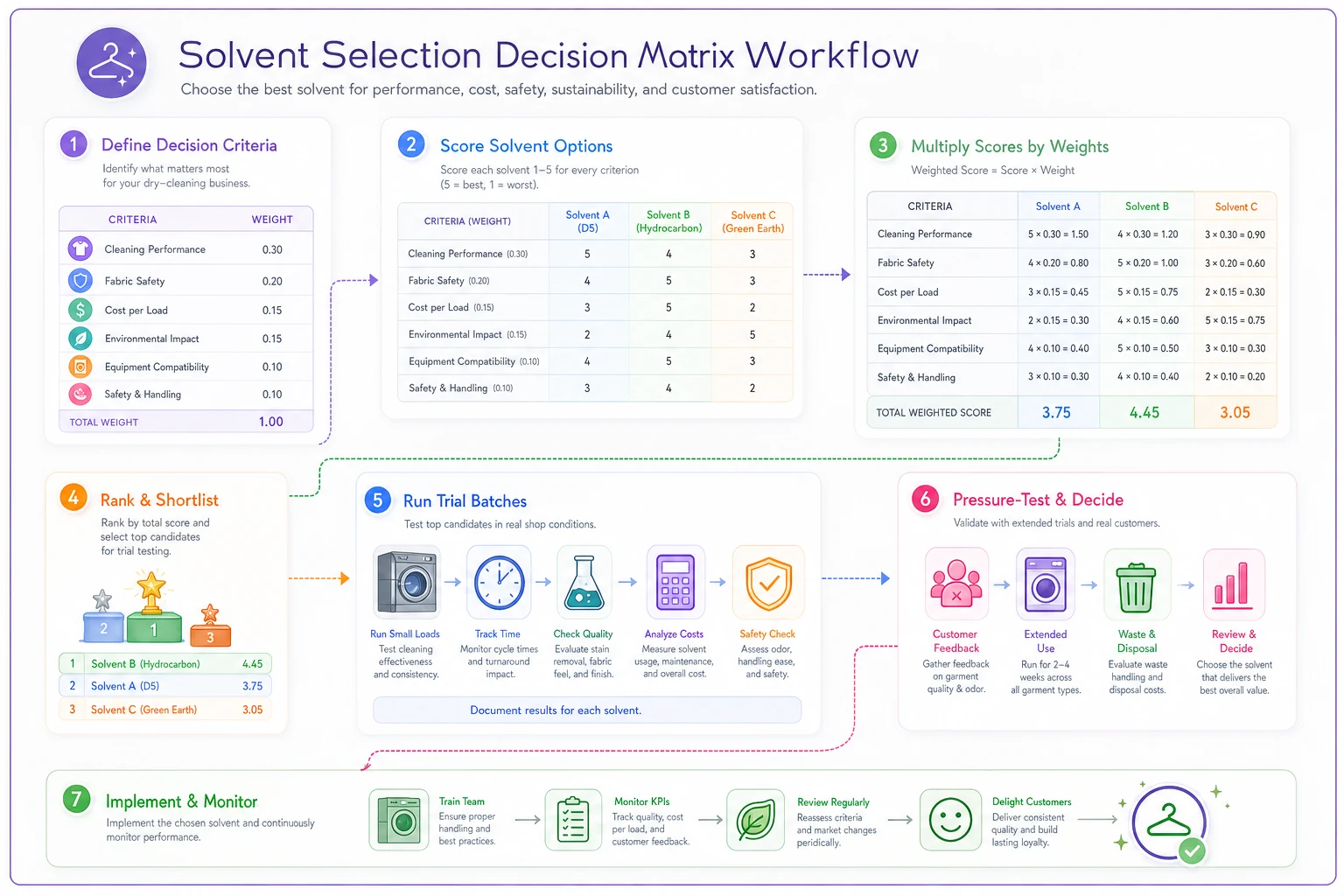
A worked example: a mid-volume shop doing roughly 400–500 pieces a week weighted throughput at 25, cleaning quality at 20, cost-per-hour at 20, compliance at 20, retrofit at 10, and marketing at 5. Perc scored high on quality and throughput but got hammered on compliance. A hydrocarbon system came out slightly ahead on the weighted total — not because it won any single category, but because it didn't lose badly in any of them. That's usually what the winner looks like: not dominant, just balanced against your weights.
## The cost-impact calculator that actually reflects your shop
Forget solvent price per gallon as your headline number. Build your comparison around fully loaded cost per load, which you can estimate with inputs you already have.
-
Solvent cost per load (consumption per cycle × price)
-
Plus electricity per cycle (cycle time × machine draw × your kWh rate)
-
Plus labor per load (cycle time and handling × loaded wage)
-
Plus filter and cartridge cost amortized per load
-
Plus disposal cost amortized per load (waste volume × disposal rate, plus manifest and admin time)
-
Plus retrofit or equipment cost amortized across expected loads over the machine's life
Then multiply by your annual load count to get the number that matters.
This is where switches surprise people. Suppose Solvent A costs less per gallon than Solvent B, but Solvent B runs a shorter cycle. If B saves even a few minutes per load across a thousand-plus loads a year, the electricity and labor savings can quietly erase the gallon-price gap. The reverse is just as common — a "cheaper to run" solvent that generates more hazardous waste can cost you more once disposal and admin time hit the ledger.
For the disposal side specifically, don't estimate from memory. Your hazardous waste picture — manifests, storage limits, SDS filing — is its own compliance system with real teeth, and it feeds directly into your solvent math. If that side of the house is shaky, tighten it first using a structured approach like the one in our hazardous waste and SDS compliance checklist, because disposal cost and regulatory exposure are the two variables most likely to blow up your matrix after the fact.
## A simple ROI calculator for a solvent change
When you're deciding whether to switch, the question isn't "which solvent is cheaper." It's "will the switch pay back the transition cost in a reasonable window." Here's a lightweight way to frame it:
Annual savings = (old cost per load − new cost per load) × annual loads
Transition cost = retrofit/equipment + training/downtime + initial solvent + disposal of old stock
Payback period (years) = transition cost ÷ annual savings
A realistic scenario: a shop calculates a fully-loaded savings of around $0.60–$0.90 per load after switching systems. Running roughly 22,000 loads a year, that's somewhere in the $13k–$20k range annually. If the retrofit, training, and downtime run $30k–$40k all-in, payback lands in the two-to-three-year range. That's defensible for a machine that'll run a decade. If the same math showed a seven-year payback, you'd want a non-financial reason — like an impending regulation — to justify moving now.
The trap is counting the savings and ignoring the transition cost, or vice versa. Both sides have to be on the page. And if your per-piece pricing is fuzzy, your per-load cost will be too — which is why garment-level costing feeds directly into solvent decisions. If you haven't nailed down what each service actually costs you, our breakdown on garment-level costing and margin protection is worth reading before you trust any solvent ROI number, because a bad cost baseline makes every downstream calculation wrong.
## Customer-facing sustainability claims — and the guardrails
This is where shops get themselves in trouble. Once you switch to something greener, the temptation is to slap "eco-friendly," "green cleaning," or "non-toxic" on the window and the receipts. Some of those words are legally loaded, and regulators in multiple regions have gotten aggressive about unsubstantiated environmental marketing.
-
Say what you do, not what you are. "Perc-free process" beats vague adjectives like "green."
-
Avoid absolute words — "non-toxic," "chemical-free," "zero waste" — unless you can literally prove them.
-
Match the claim to the actual process. If you run wet cleaning on some garments and hydrocarbon on others, don't imply the whole shop is one thing.
-
Keep documentation. SDS sheets, supplier statements, process descriptions — the paper that backs the claim.
-
Date your claims. If you switch solvents again, update the signage and the website. Stale claims are still claims.
-
Skip comparative attacks. Publicly calling a competitor's process "toxic" invites the exact scrutiny you don't want on your own operation.
The pattern worth watching: shops treating marketing claims and operational reality as two separate departments. They're not. The claim is only as clean as the process behind it, and the moment those two drift apart, you've created a liability that won't show up on any P&L until it's already a problem.
## When switching makes sense — and when it doesn't
When it makes sense: Your local regulations are tightening and you're on borrowed time with your current setup. Your existing machine is near end-of-life anyway, so the retrofit cost partly overlaps with a replacement you'd make regardless. Your customer base genuinely rewards a cleaner process. Or your disposal and compliance costs have crept high enough that the ROI math closes on its own.
When it's a bad idea: You're switching purely for marketing with no regulatory or cost pressure, your current machine has years of life left, and your customers aren't asking. In that case you're spending real capital to solve a problem you don't have, and the payback period will tell you so if you run the numbers honestly.
Who should probably wait: Shops with unstable volume or cash flow. A solvent transition adds downtime, a learning curve, and temporary redo risk. If your throughput is already strained during peak hours, layering a new process on top of that stress usually backfires. Stabilize operations first, switch second.
## The part that usually gets skipped: tracking after the switch
The decision doesn't end when the new solvent arrives. The most common failure is that nobody measures whether the matrix was right. Cycle times drift, consumption runs higher than the brochure promised, redo rates spike during the learning curve — and because nobody logged it, the shop never figures out whether the switch actually delivered.
Keep a simple running log for the first 60–90 days: loads per day, cycle time, solvent consumed, pieces redone, and any disposal pickups. This is the same discipline you'd apply to any other operational change — you're validating the assumption, not just hoping. Whether you track it in a spreadsheet or inside whatever management system runs your shop, the data closes the loop. A solvent switch you can't measure is a solvent switch you can't defend, to your accountant or to a regulator.
## Bringing it together
Chemical decisions feel technical, so owners either over-defer to their distributor or over-react to a single pressure point. Neither approach accounts for how many parts of the business the solvent actually touches — cost per load, throughput during your busiest hours, disposal paperwork, insurance exposure, and the words you're legally allowed to put on your window.
The matrix isn't there to give you a clean answer. It's there to make you weigh the tradeoffs before a crisis forces a rushed one, and to leave a trail you can point to when someone asks why you chose what you chose. Run the numbers with your real inputs, trial the top two candidates, keep your marketing claims tied to what you can prove, and log the results after the switch. Do that, and solvent management stops being the thing that ambushes you and becomes just another part of the shop you actually control.
Chemical decisions feel technical, so owners either over-defer to their distributor or over-react to a single pressure point. Neither approach accounts for how many parts of the business the solvent actually touches — cost per load, throughput during your busiest hours, disposal paperwork, insurance exposure, and the words you're legally allowed to put on your window.
The matrix isn't there to give you a clean answer. It's there to make you weigh the tradeoffs before a crisis forces a rushed one, and to leave a trail you can point to when someone asks why you chose what you chose. Run the numbers with your real inputs, trial the top two candidates, keep your marketing claims tied to what you can prove, and log the results after the switch. Do that, and solvent management stops being the thing that ambushes you and becomes just another part of the shop you actually control.
Ready to elevate your dry cleaning operations?
Join hundreds of dry cleaners using Pressesly to save time, reduce errors, and enhance customer satisfaction.