


Most dry cleaners find out they have a compliance problem when an inspector shows up unannounced — or worse, when a worker gets hurt and suddenly everyone wants to see safety data sheets from 2019. Fines start around $5,000 for minor violations. Major ones can hit six figures and shut you down.
The frustrating part? Dry cleaner hazardous waste compliance isn't actually that complicated. The problem is every state has slightly different rules, and most compliance guides are written by lawyers who've never touched a pressing machine. What you need is a practical system that works regardless of where you operate.
Why Standard Compliance Templates Fall Short for Dry Cleaners
Generic hazardous waste templates assume you're either a massive industrial facility or a tiny office that occasionally tosses printer cartridges. Dry cleaners sit in a weird middle zone — handling serious chemicals like perchloroethylene or hydrocarbon solvents, but not running a chemical plant.
Your team rotates shifts, employees come and go, and the person handling chemical disposal on Tuesday might be pressing shirts on Thursday. You need systems that hold up when your most experienced person calls in sick and the new hire has to deal with a solvent spill.
Most shops try to solve this with a binder full of EPA printouts. Then perc prices spike, you switch solvents, and suddenly half your documentation is outdated. Your waste hauler changes their pickup requirements, and nobody updates the disposal checklist because it's buried on page 47 of a binder nobody opens anyway.
The Five Compliance Pillars That Actually Matter
After watching dozens of shops navigate inspections, certain patterns become obvious. The shops that sail through tend to focus on five specific areas. Not twenty. Five.
Never lose track of an order again.
Pressesly helps you manage, track, and communicate every garment order seamlessly.
- Unified order management
- Real-time customer notifications
- Staff scheduling & workload tracking
No credit card required
1. Chemical labeling that survives real operations
Your labeling system needs to handle reality — containers get moved, labels get wet, and temporary workers need to understand what they're looking at immediately.
Use waterproof labels with three pieces of information: what's in it, the main hazard (flammable/toxic/corrosive), and the date it was opened or transferred. Print extras and keep them near the chemicals, not locked in an office. When someone peels off a damaged label, they can slap on a new one immediately without hunting for supplies.
For waste containers, add accumulation start dates. A lot of shops get cited because they can't prove when waste accumulation began. A simple date label eliminates this problem entirely.
Keep extra waterproof labels in the chemical storage area so replacements are immediate.
2. SDS handling that people actually follow
The traditional approach — keeping safety data sheets in a binder — fails because nobody updates it consistently. Sheets go missing, new chemicals arrive without documentation, and you're scrambling when an inspector asks about the spot remover you started using six months ago.
Build redundancy into the system. Keep physical copies at the point of use AND maintain a digital backup. Clear plastic sheet protectors mounted on the wall near chemicals work better than binders — workers can reference them without searching, and the sheets don't disappear into someone's desk drawer.
Create a simple intake rule: when any new chemical arrives, the SDS gets copied three times. One goes to the wall mount, one to the compliance binder, one gets scanned into your digital system. No exceptions, even for products you're "just trying out."
3. Storage rules based on chemical compatibility, not convenience
Inspectors love finding incompatible chemicals stored together. It's an easy citation that signals broader problems. Most shops organize chemicals by workflow convenience — stain removers here, pressing chemicals there — without thinking about reactivity.
Separate acids from bases, oxidizers from flammables, and everything from water-reactive chemicals. Use physical barriers, not just different shelves. A $20 plastic bin can prevent a $10,000 fine.
Keep your segregation labeling simple. Not hazard diamonds that require interpretation — just "ACIDS ONLY" or "NO WATER-BASED PRODUCTS HERE." When your part-time weekend employee needs to put something away, they shouldn't need a chemistry degree to figure it out.
4. Disposal partner selection beyond lowest bid
Picking waste haulers purely on price creates downstream problems. The cheapest option might not provide proper documentation, might miss pickups during busy seasons, or might not be licensed for your specific waste types.
Evaluate haulers on three things that matter operationally: documentation quality, pickup reliability, and incident response capability. Ask for examples of their manifests. Call references and specifically ask about missed pickups and how problems got resolved. Get their incident response protocols in writing.
A hauler who costs a little more but provides clean manifests, shows up on schedule, and answers the phone on a Friday evening is worth every extra dollar. One missed pickup that pushes you past accumulation limits can trigger fines that dwarf whatever you saved on the cheaper service.
5. Incident reporting that protects you legally
When spills or exposures happen, your documentation becomes critical. Generic incident forms miss dry cleaning-specific details that matter during investigations.
Your incident form should capture: specific chemical involved (not just "solvent"), quantity even if estimated, exact location in your facility, names of everyone present, specific cleanup actions taken, and disposal method for contaminated materials. Include a section for photos — every smartphone can document before, during, and after cleanup.
Train your team on the difference between "reportable" and "recordable." Not every spill requires external reporting, but everything should be documented internally. A simple decision tree helps here: > If it leaves the containment area → reportable > Requires outside cleanup help → reportable > Involves any injury → reportable > Everything else → internal record only, but still document it
The Inspection Preparation Checklist
When an inspector arrives, you have minutes to make a first impression. Fumbling for documents or not knowing where your waste accumulation area starts signals broader problems fast.
-
Current EPA ID number
-
Waste hauler license verification
-
Last six months of disposal manifests
-
Current SDS for all chemicals on-site
-
Your written contingency plan
Update it monthly, not annually.
Inspection Readiness at a Glance
| Area | What to Check | How Often |
|---|---|---|
| Chemical labels | Legible, dated, hazard noted | Weekly |
| Waste containers | Accumulation start dates visible | Weekly |
| SDS binder/wall mounts | Current for all on-site chemicals | Each new delivery |
| Inspection packet | EPA ID, manifests, hauler docs | Monthly |
| Secondary containment | No cracks, spills, or overflow | Weekly |
| Emergency equipment | Extinguishers, eyewash, spill kits | Monthly |
Designate one person per shift as the compliance contact. They should know where every document lives, when the last waste pickup occurred, and be able to walk an inspector through your storage areas without panicking. This isn't about having a compliance expert on staff — it's about having someone who won't freeze and start making things up under pressure.
Physical Preparation
Walk your facility weekly with inspection eyes. Look for lint accumulation near chemical storage (fire hazard), unlabeled containers, and secondary containment issues. That cracked drip pan under your machine might seem minor, but it's an easy violation that signals you're not paying close attention.
Check emergency equipment monthly. Fire extinguishers, eyewash stations, and spill kits need to actually work when needed — not just exist. Date-stamp your checks visibly. Inspectors notice current inspection tags. They also notice missing ones.
A Typical Compliance Workflow
Use this flow as a daily checklist loop.
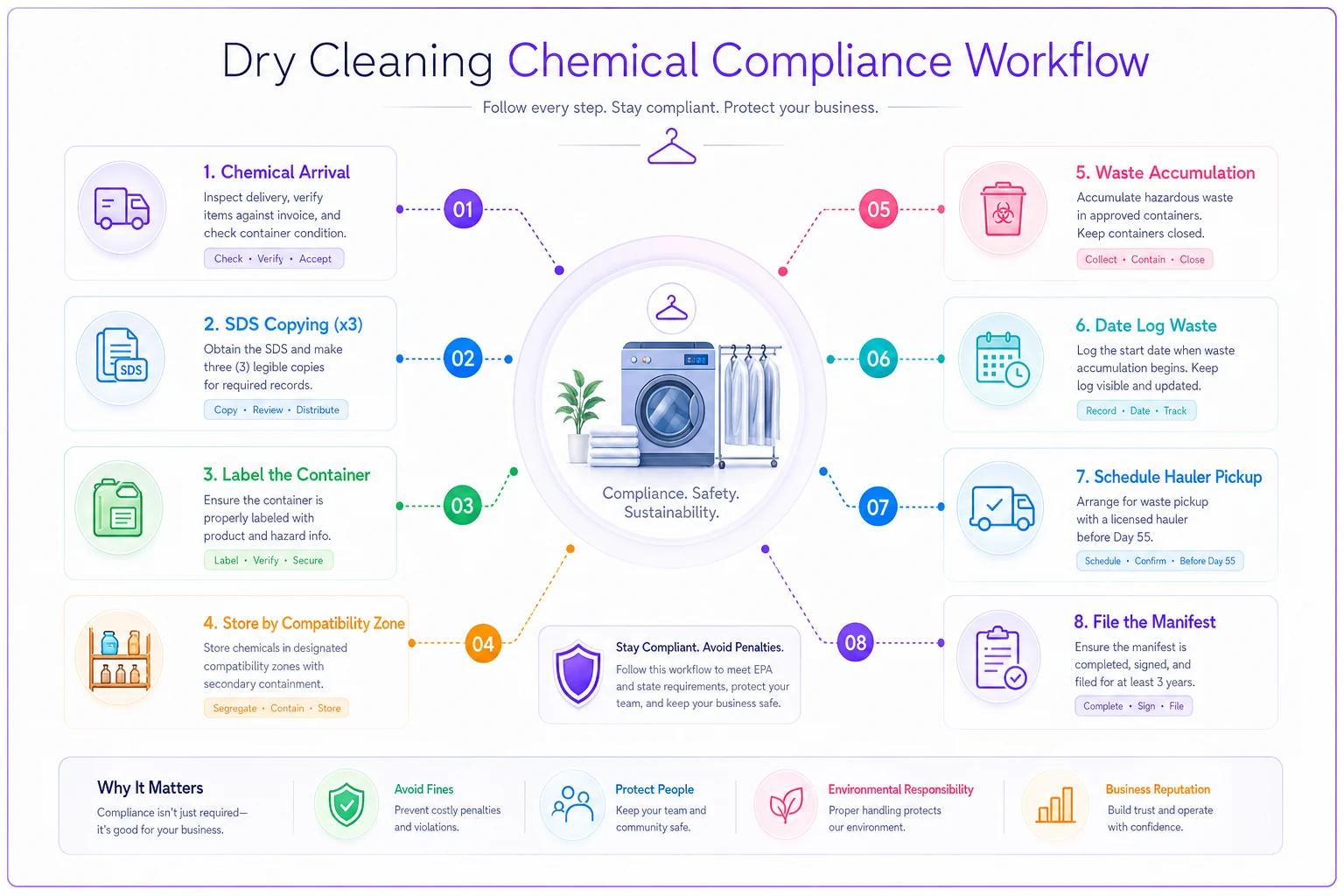
Running compliance like a checklist loop rather than an annual scramble is what separates shops that pass inspections from shops that get surprised by them.
When Technology Actually Helps
The challenge with compliance isn't knowing the rules — it's maintaining systems when you're focused on running a business. AI-powered operational software can centralize compliance documentation without adding complexity. Instead of juggling separate systems for chemical inventory, waste tracking, and incident reporting, these platforms maintain compliance records as part of daily operations.
When you receive chemicals, the system can prompt for SDS upload and verify current documentation exists. When waste accumulates, it tracks dates and quantities without manual logs. If an incident occurs, guided forms ensure your team captures required information while details are still fresh.
The real value isn't replacing human judgment. It's removing the administrative burden that creates compliance gaps in the first place. Your team focuses on safe chemical handling while the system maintains the paper trail inspectors want to see.
Regional Variations Without the Legal Complexity
Federal rules provide the baseline, but state and local requirements add layers. Rather than trying to master every regulation, build your systems to exceed common requirements across the board.
Federal rules might allow 90 days of waste accumulation, but some states limit it to 60. Set your system for 55-day pickups and you're covered everywhere without tracking state-specific rules. Same logic applies to training documentation — if any jurisdiction requires annual training, make that your standard even if your state only mandates it every two years.
It costs slightly more upfront but eliminates the constant worry about missing some obscure local rule.
Making Compliance Stick Day to Day
The best compliance system means nothing if your team doesn't follow it. Build compliance into daily routines rather than treating it as a separate task. Checking chemical labels becomes part of opening procedures. SDS verification happens before the delivery driver leaves.
Use visual cues that reinforce the right behavior. Different colored bins for different waste types. Timers near accumulation areas counting down to pickup dates. Reference cards at workstations showing proper handling for common tasks.
Small shops often share employees with other businesses or bring in family during busy stretches. Your systems need to work for people who aren't there every day. Visual management and clear labeling matter far more than detailed training manuals that temporary help won't read.
The Hidden Costs of Non-Compliance
Beyond fines, compliance failures create operational disruptions that often hurt more than the penalties themselves. A stop-work order during busy season — even for just two days — can cost thousands in lost revenue and damage customer relationships you've spent years building.
Insurance complications tend to linger. One significant violation can triple your premiums or make coverage difficult to obtain at all. Some violations require public notification, which damages reputation in ways marketing can't fix quickly.
Employee morale takes a hit too. Good workers don't want to handle dangerous chemicals without proper protection or training. They leave for shops that take safety seriously, and they take their experience with them.
Start With These Three Actions
If your current compliance system is good intentions plus a dusty binder from 2018, start here.
-
Identify and label every chemical in your facility this week. Not next month — this week. Simple labels any employee can understand: chemical name, main hazard, date. This alone eliminates a significant chunk of common citations.
-
Establish a relationship with a licensed waste hauler if you don't have one. Get their documentation requirements in writing and set up a regular pickup schedule. Even if you're accumulating slowly, regular pickups prevent limit violations before they happen.
-
Create a simple incident report template and train everyone on when to use it. Run through hypothetical scenarios — "What would you document if a customer complained about chemical odor?" Make reporting easy and blame-free, with the focus on prevention rather than punishment.
Make reporting easy and blame-free, with the focus on prevention rather than punishment.
Building Long-Term Compliance Culture
Compliance becomes sustainable when it's embedded in operations rather than bolted on top. Mention your commitment to safety during interviews — people who balk at safety requirements probably aren't great long-term fits anyway. During onboarding, spend real time on chemical handling, not just pointing to the binder and saying "read this when you get a chance."
Regular safety moments during staff meetings reinforce importance without becoming preachy. Share near-misses from other shops and discuss how to prevent similar issues. When someone identifies a hazard or suggests an improvement, recognize it publicly. That kind of culture compounds over time.
The Compliance Investment That Pays Itself Back
Proper hazardous waste compliance typically runs somewhere in the $200–400 per month range between hauling services, supplies, and documentation time. That might feel significant for a small operation, but one minor violation starts at $5,000. One workers' comp claim from chemical exposure can hit six figures.
Beyond avoiding penalties, good compliance reduces daily operational friction. When chemicals are properly labeled and stored, your team works faster and makes fewer handling mistakes. When intake procedures are documented, chemical damage claims decrease. When everyone knows the protocols, you spend less time managing problems and more time running the business.
The shops that last long-term treat compliance as a competitive advantage, not a burden. They attract better employees, keep insurance costs manageable, and don't lie awake wondering if a surprise inspection will shut them down. In an industry with tight margins and real competition, operational excellence in compliance becomes a differentiator customers might not see directly — but they benefit from it every time they pick up a clean, undamaged garment.
Ready to elevate your dry cleaning operations?
Join hundreds of dry cleaners using Pressesly to save time, reduce errors, and enhance customer satisfaction.