

The problem with rush orders isn't the rush order itself. It's the fifth one that lands at 11:40am when your presser is already 40 minutes behind and you've got two wedding gowns due at 3pm that can't slip. One rush garment is a favor. A steady drip of "can you do it by tonight?" with no system behind it is how a shop quietly loses money while looking busy.
Most owners handle rush requests by gut. The counter person reads the customer's face, guesses at capacity, and says yes or no based on how the morning felt. That works until it doesn't — and when it breaks, you've got a garment promised at 5pm that physically can't be cleaned, pressed, inspected, and bagged in time, an angry customer, and a staff scramble that pushes three other orders late.
This piece is about building a same day dry cleaner triage system: a decision tree anyone at the counter can run in ten seconds, plus the cutoffs and surcharges that keep rush work from cannibalizing your regular throughput.
Why rush orders quietly wreck throughput
The damage isn't the single garment. It's what jumping the queue does to everything behind it.
When a presser pulls a rush shirt out of sequence, they lose batching rhythm. Same fabric, same temperature, same finishing technique — that's what makes a press station fast. Break the batch to squeeze in one wool blazer between cotton shirts and you're not just spending two minutes on the blazer. You're spending reheat time, setup time, and the mental reset of switching contexts. A single out-of-sequence garment can realistically cost you the pace equivalent of three or four normal garments.
There's a second problem that's harder to see: rush work eats your buffer. If your normal turnaround already runs tight, every rush order borrows time from the slack you were counting on to absorb the unexpected — a re-clean, a missing button, a machine hiccup. Once your buffer is gone, one small problem cascades into a pile of late orders. If you haven't built structured buffers into your turnaround yet, that's the foundation this whole system sits on — worth reviewing the Shop Turnaround Time Playbook before layering rush rules on top.
The pattern across shops: owners who accept rush work generously feel more profitable because ticket prices look good, but their on-time rate for regular customers slowly erodes. And regular customers are the ones who actually keep the lights on.
The core idea: rush capacity is a fixed budget, not an open door
The mental shift that fixes most of this is treating your daily rush capacity like a limited number of seats on a plane. You have X slots. Once they're gone, they're gone — regardless of how much someone wants to pay or how nice they are.
Never lose track of an order again.
Pressesly helps you manage, track, and communicate every garment order seamlessly.
- Unified order management
- Real-time customer notifications
- Staff scheduling & workload tracking
No credit card required
You figure out X by asking a blunt question: how many garments can you pull out of sequence in a day before your regular SLA starts slipping? For most single-location shops, that number is surprisingly small — somewhere between 8 and 15 garments depending on staffing and equipment. Not 8 rush orders. Eight rush garments, because a "quick" order of six shirts and two suits is really eight interruptions.
Once you know your seat count, everything else — the decision tree, the cutoffs, the surcharge — exists to protect those seats and ration them to the work that's actually worth pulling out of line.
The triage decision tree
Step 1 — Is it physically possible? Run the clock backward from the promised time. Cleaning cycle + dry time + press + inspection + bagging. If the math doesn't fit before your last press pass of the day, it's an automatic decline. No exceptions, no "we'll try." Trying is how you make three other orders late.
Step 2 — Does the garment type allow it? Some items can never be rushed and staff need to know them cold:
-
Anything requiring wet cleaning with extended dry time
-
Leather, suede, and specialty materials
-
Garments with visible stains needing pre-treatment and dwell time
-
Silk or structured pieces where a rushed press means a re-do
Step 3 — Are there rush seats left today? Check the count. If you're at your daily limit, the answer is no — and this is the one people cheat on. Don't. The whole system collapses the first time someone says "just this once."
Step 4 — Does the customer accept the surcharge and the terms? If yes to everything above, quote the surcharge and the exact ready time. Get verbal confirmation on both. If they balk at the surcharge, you've just protected a seat for someone who values it more.
Four questions. Most of the decision is already made before anyone's feelings get involved.
Here's how the triage flow works from intake to execution:
RUSH ORDER TRIAGE FLOW Customer requests rush | v [1] Clock check — does time math work? No → Decline (automatic) Yes ↓ [2] Garment type — on never-rush list? Yes → Decline (automatic) No ↓ [3] Rush seats available today? No → Decline (seats full) Yes ↓ [4] Customer accepts surcharge + ready time? No → Decline (seat held for next request) Yes ↓ Log seat used → Tag garment → Route to designated rush handler → Execute
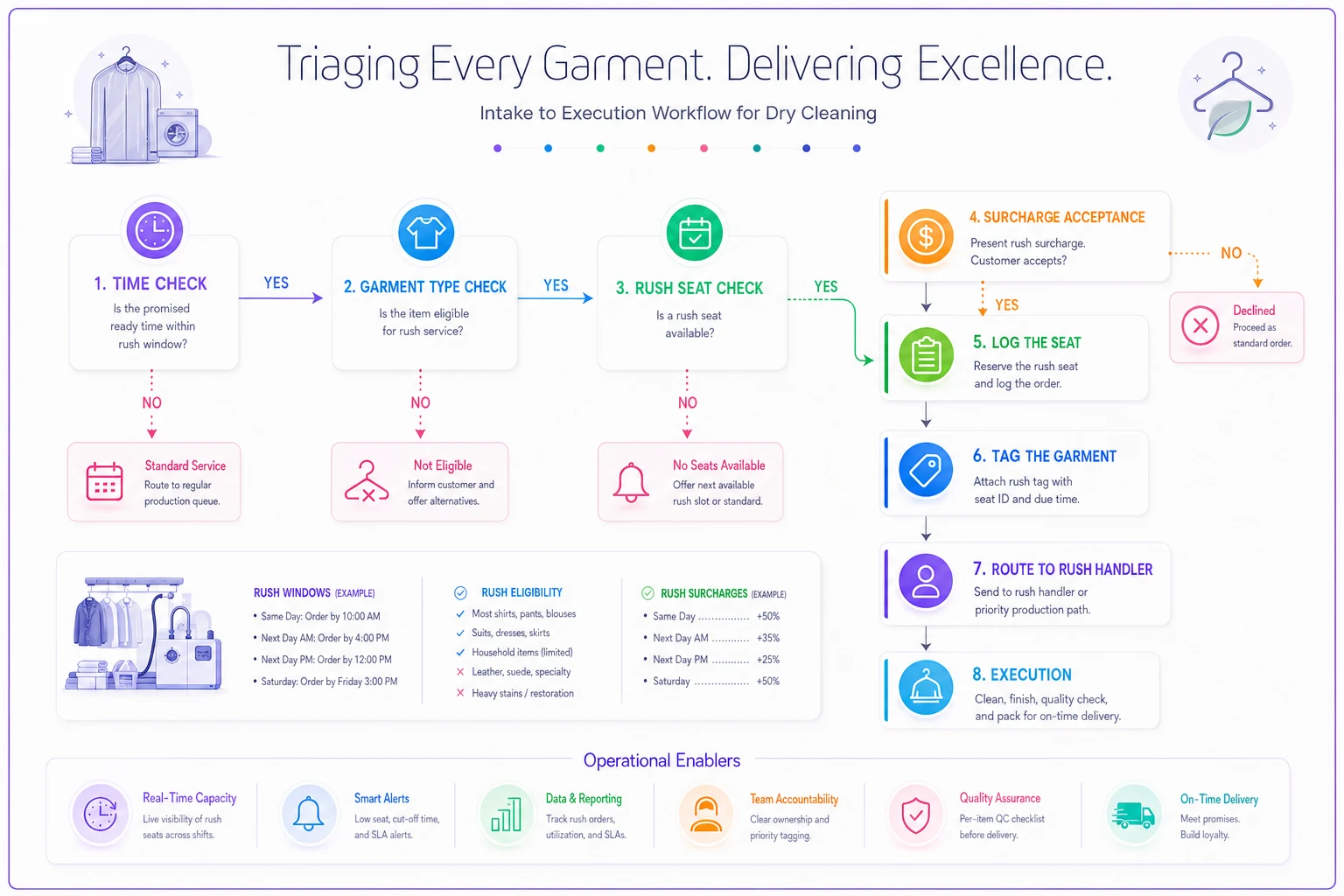
The flow is linear by design. Steps one through three aren't conversations — they're mechanical checks with fixed outputs. No negotiation, no reading the room.
Setting cutoffs that actually hold
A cutoff time is only real if the whole shop treats it as real. The most common failure: a 10am cutoff that's really 10am-unless-it's-slow-or-the-owner-is-in-a-good-mood. Soft cutoffs train your regulars to push, and they train your staff to negotiate.
Anchor your cutoff to your last productive press pass, not an arbitrary clock time. If your presser needs a garment in hand by 2pm to guarantee a same-day finish with inspection, your customer-facing cutoff should be comfortably earlier — say 10 or 11am — so intake, tagging, and cleaning have room to run.
A simple cutoff framework by service tier:
| Service tier | Intake cutoff | Ready time | Rush seats it uses |
|---|---|---|---|
| Standard same-day (shirts, simple items) | 10:00am | Same day 5pm | 1 per garment |
| Complex same-day (suits, dresses) | 9:00am | Same day 6pm | 2 per garment |
| Express (under 4 hrs) | By capacity only | Quoted individually | 3 per garment |
| Anything after cutoff | — | Next day standard | 0 |
The seats column is what keeps express work honest. A four-hour turnaround on a suit isn't one favor — it's three interruptions, so it should burn three of your limited seats. Price and ration it accordingly.
Pro-tip: Anchor cutoffs to your last productive press pass rather than an arbitrary clock time so intake has room to run.
That table isn't the only way to structure it, but the logic matters more than the specific times. Whatever you pick, the numbers need to be anchored to your actual production floor, not copied from somewhere else.
The surcharge that protects margin instead of just feeling premium
Most rush surcharges are set emotionally — "let's add 50%" — with no relationship to what the rush actually costs. That's backwards. The surcharge has two jobs, and only one of them is revenue.
The first job is demand control. The surcharge should be high enough that people only invoke it when they genuinely need speed. If everyone's happily paying your rush fee without hesitation, it's too low, and your seats are being filled by people who'd have been fine waiting.
The second job is covering the real cost of the interruption — the lost batching pace, the buffer you're burning, the overtime risk. What's the margin you lose on the regular garments that got slowed down when you pulled this one out of sequence? That's your floor.
A practical structure:
-
Base rush fee covering the disruption to normal flow — often a flat amount, not a percentage, because the disruption is roughly constant regardless of item price.
-
Multiplier for complexity tier, since a suit interrupts more than a shirt.
-
Peak surcharge during your busiest intake windows, when a rush seat is genuinely scarce.
-
Hard express premium for anything under four hours, priced to make you slightly hope they say no.
The point isn't to gouge. It's to make sure that when you break your shop's rhythm, you're paid enough that you don't quietly resent every rush order for the rest of the day.
Staffing rules that make rush work survivable
Even a perfect decision tree fails if there's no one to execute the rush without dropping the regular queue.
-
Designate a rush handler per shift, not "whoever's free." When rush work is everyone's job, it's no-one's job, and it interrupts everyone equally. One person owning it contains the damage.
-
Cap rush intake in the final two hours of the day. Late rush orders have zero buffer and the highest failure rate. Most shops should stop accepting any same-day work well before closing.
-
Give counter staff explicit authority to decline. If every "no" has to route through the owner, they'll say yes to avoid the awkwardness. Write the decline into their job so it's the system saying no, not them.
-
Track rush seats visibly. A whiteboard tally at intake is enough. When the last seat's crossed off, everyone can see it, and there's no argument.
The staffing piece connects to routing too, if you deliver. A same-day promise means nothing if the garment's clean but the driver already ran your route. Aligning rush cutoffs with your delivery windows is its own small puzzle — the logic in local route heuristics and time-window rules applies directly here.
When rush programs make sense — and when they don't
When this actually makes sense: You have a customer base that genuinely values speed — corporate clients, professionals with time-sensitive events — and you have enough press capacity slack to sell it. If you regularly finish your day with press stations idle for an hour, you've got room to monetize rush work.
When this is a bad idea: If you're already running at or near capacity on normal days, adding a rush program doesn't add revenue — it just moves your existing failures around. You'll be robbing regular customers to serve rush customers, and your on-time rate for the people who come every week will slide. Fix your baseline throughput first.
Who should not do this: Shops with a single presser and no backup. One person out sick and your entire rush program is a liability, because you've made same-day promises you now physically can't keep. Build depth before you build a rush tier.
A real scenario
A single-location shop doing roughly $28k–$32k a month was saying yes to nearly every rush request. On paper the rush tickets looked great. In practice, their same-day regular orders were finishing late two or three days a week, and they'd started hearing "you used to be faster" from long-time customers.
They did three things: capped rush at 12 garment-seats a day, moved their same-day cutoff from a vague "afternoon" to a hard 10am, and rebuilt the surcharge from a flat 50% to a tiered structure with a real express premium.
The immediate effect was fewer rush orders — maybe 30% fewer. But the rush orders they did take paid substantially more, and their on-time rate on regular work climbed back to where it had been a couple years earlier. Net revenue on rush work barely moved; the difference was that the whole shop stopped running behind. A few regulars who'd drifted started coming back. Not a dramatic jump — just a shop that stopped bleeding goodwill.
Keeping the system honest over time
The hardest part isn't building the tree. It's holding the line after it's built. Rush systems decay from the edges — one exception for a good customer, one "we're slow today so let's push the cutoff," and within a month you're back to gut-feel chaos.
Some shops track it manually with a whiteboard and a tally, which works fine at low volume. The trouble starts when your seat count, cutoffs, and surcharge tiers live only in someone's head — then a new hire, a busy Saturday, or a covering manager quietly undoes months of discipline. Having your intake rules, capacity counts, and surcharge logic built into the system your counter staff already use makes a real difference: the decision tree runs the same way whether you're standing there or not, and nobody has to be the bad guy who says no. The rules do it for them.
The tooling is secondary, though. The real win is the decision itself: rush capacity is a fixed budget, cutoffs are anchored to your last real press pass, and the surcharge exists to ration scarcity — not just to feel premium. Get those three right and rush orders become a small, reliable profit line instead of the thing that quietly runs your shop into the ground every busy week.
Ready to elevate your dry cleaning operations?
Join hundreds of dry cleaners using Pressesly to save time, reduce errors, and enhance customer satisfaction.