


Running delivery routes for a dry cleaning business without any real planning burns through cash faster than most owners expect. The gap between a well-organized route system and just winging it daily typically means 30-40% more fuel costs, longer driver hours, and frustrated customers wondering why their Tuesday delivery arrived at 6pm when it used to show up at noon.
Most dry cleaners running their own delivery don't need complex routing software. They need practical zone-based rules that work with how customers actually behave and when they actually need their clothes back.
The Zone Grid System That Cuts Miles Without Software
Forget trying to optimize mathematically perfect routes. Real delivery efficiency for dry cleaners comes from understanding your service area's natural patterns and building zones around them.
Start by pulling your last 60 days of delivery addresses and plotting them on a basic map—even a printed one works. You'll notice clusters forming around specific neighborhoods, office buildings, and residential pockets. These clusters aren't random. They reflect where your marketing worked, where word-of-mouth spread, and where people actually value delivery enough to pay for it.
Draw boundaries that create 4-6 zones maximum. More than that and you'll spend too much mental energy deciding where orders belong. Boundaries should follow major roads or natural barriers like highways or rivers. Each zone needs at least 15-20 regular stops to justify dedicated routing.
A suburban dry cleaner might end up with zones like: Downtown offices (Monday/Thursday), Westside residential (Tuesday/Friday), Eastside residential (Wednesday/Saturday), and a flex zone for outliers. The key is matching zones to when customers actually want their items—office workers need clothes before Monday meetings, residential customers often prefer end-of-week delivery.
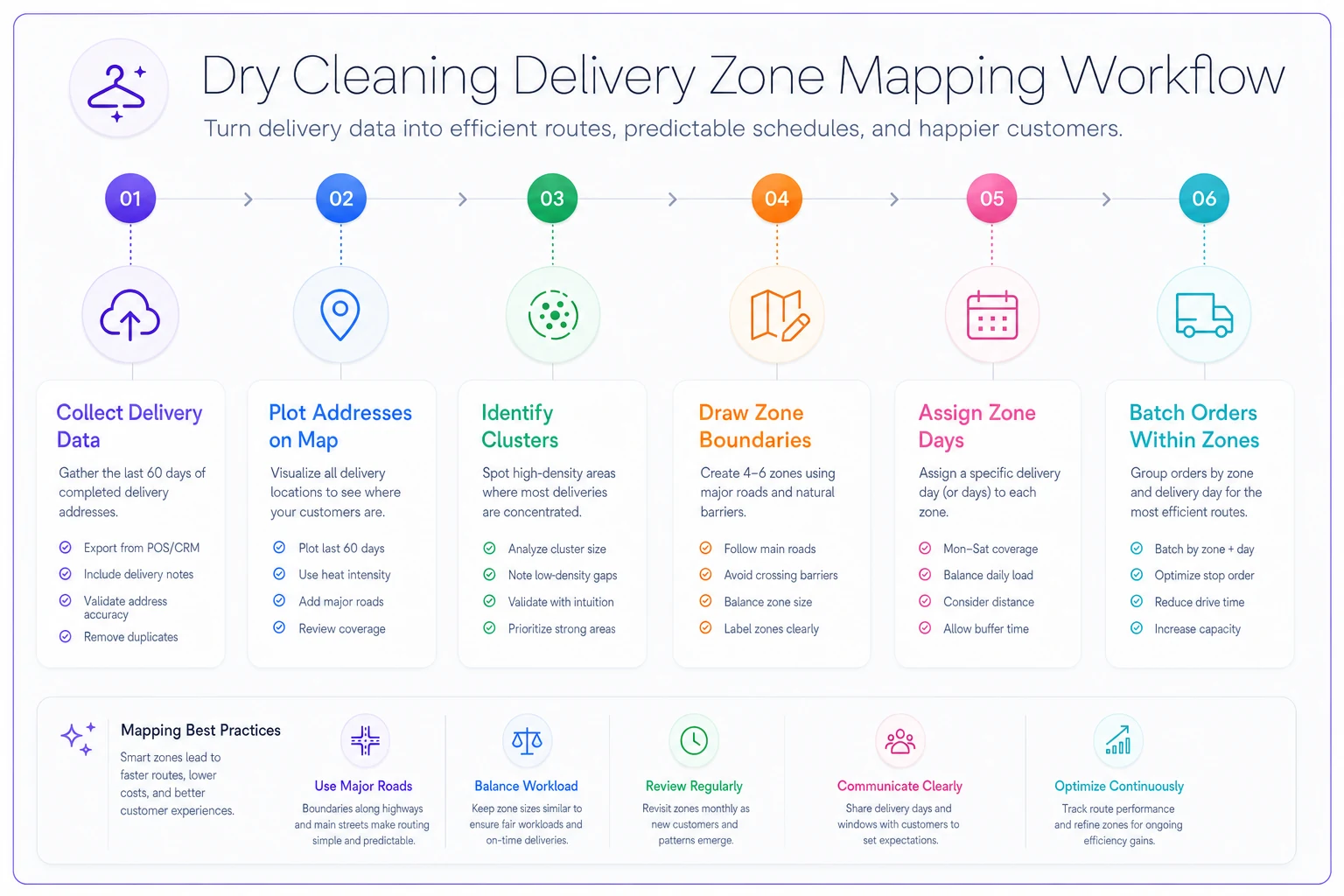
A quick visual of the zone-mapping workflow.
Zone violations kill efficiency fast. When someone from Zone A wants delivery on Zone B's day, you either say no, charge extra, or batch them for the next appropriate day. Letting exceptions slide means your carefully planned routes turn into zigzag nightmares by Thursday.
Batching Rules That Match Customer Behavior
The biggest mistake in dry cleaner delivery route optimization is treating all orders equally. A twice-weekly regular picking up $400 worth of shirts monthly operates completely differently than someone who orders delivery once for a wedding outfit.
Never lose track of an order again.
Pressesly helps you manage, track, and communicate every garment order seamlessly.
- Unified order management
- Real-time customer notifications
- Staff scheduling & workload tracking
No credit card required
Build your batching hierarchy around customer value and flexibility. Top-tier customers—weekly pickups, $200+ monthly—get priority slots and can request specific delivery windows. These customers anchor your routes. You build around them because they're paying the bills.
Prioritize regular weekly customers when designing routes so they form the backbone of profitable batches.
Mid-tier customers (monthly users, $50-150 in value) get assigned to standard zone days with 4-hour delivery windows. They appreciate the service but don't need special treatment. These orders fill out your routes and make stops more efficient.
Occasional users get batched aggressively. Unless they're paying rush fees, those orders wait until you have enough stops in their zone to justify the trip. Three occasional orders in the same neighborhood turn a money-losing detour into a profitable multi-stop.
Time-sensitive orders create their own category. Items needed for events, business trips, or specific occasions jump the queue but should still follow zone boundaries when possible. Charge appropriately for that flexibility—customers who need their suit for tomorrow's presentation will happily pay $15 extra for guaranteed morning delivery.
The batching sweet spot for most small operations sits somewhere around 8-12 stops per route. Below 8 stops, you're wasting vehicle time. Above 12, you start missing delivery windows and dealing with items that won't fit comfortably in the vehicle.
Simple Routing Heuristics Without Getting Lost in Optimization
Professional route optimization talks about traveling salesman problems and complex algorithms. Small dry cleaning operations need simpler rules that drivers can actually follow without constantly staring at their phones.
The Right Turn Rule works surprisingly well in suburban areas. Plan routes that prioritize right turns over left. UPS famously saves millions annually with this approach, and it scales down directly to small operations. Right turns mean less waiting at intersections, fewer risky left turns across traffic, and more predictable timing.
Start each route at the furthest point and work back toward the shop. It feels counterintuitive—why drive past closer stops?—but it guarantees you're always moving toward home base as the day progresses. Late-day traffic, unexpected delays, or additional pickups don't leave your driver stranded across town at 6pm.
Group stops by street whenever possible, even if it means slight backtracking. Customers on the same street often talk to each other. Delivering to house #24 at noon and house #28 at 3pm creates confusion and looks sloppy. Hit the entire street in one pass.
The Deadline First principle overrides geographic efficiency for time-sensitive deliveries. A customer who specifically requested morning delivery for a meeting gets priority, even if it means driving past afternoon stops. Breaking promises costs more long-term than the extra miles.
Dense commercial buildings need special handling. Don't just show up—coordinate with building management or establish regular drop points. One building with 10 customers shouldn't mean 10 separate trips to different floors. Set up a twice-weekly schedule with the concierge or mailroom.
Time Windows That Reduce Failed Deliveries
Failed deliveries—when nobody's home or the office is closed—waste more money than almost any other routing mistake. Each failed stop costs roughly $8-12 in driver time, fuel, and rescheduling hassle.
Build delivery windows around actual availability patterns, not arbitrary scheduling. Residential areas typically work best with 10am-2pm or 4pm-7pm windows. The morning slot catches retirees, work-from-home professionals, and stay-at-home parents. Evening windows work for traditional office workers.
Office deliveries need tighter coordination. Most offices want deliveries between 9am-11am or 2pm-4pm, avoiding lunch hours and end-of-day rushes. Friday afternoon office deliveries fail more often—people leave early or go remote.
Create "smart defaults" for different customer types. New residential customers get assigned to morning windows initially, then adjust based on actual success rates. Office customers default to Tuesday/Thursday mid-morning unless they specify otherwise.
The Three Strike Rule helps identify problem addresses. After three failed delivery attempts, that address moves to pickup-only or requires pre-delivery confirmation. Some customers love the idea of delivery but are never actually around—identify them early and stop absorbing the cost.
Weather patterns matter too. Rainy days see higher success rates for residential delivery as people stay home. Sunny Fridays in summer? Expect more failed deliveries as people check out early.
Decision Rules for When to Break Your Own System
Every efficient routing system needs escape valves for when reality doesn't match the plan. The key is knowing when breaking the rules makes money versus when it just feels like good customer service.
The $50 Rule provides some clarity: if breaking your zone or batch system for a special request generates $50+ in gross margin, do it. A customer needing their entire wardrobe delivered outside normal zones because they're leaving for a month-long trip? That $300 order justifies the deviation.
Emergency same-day service should cost enough to cover the actual disruption. Sending a driver off-route for 30 minutes typically runs $25-35 in real cost. Price emergency delivery at roughly 2x that to stay profitable.
VIP customers earn rule-breaking privileges through volume, not complaints. The customer spending $500 monthly gets flexibility that a $50 customer doesn't. That's not unfair—it's recognizing who keeps the lights on.
Seasonal peaks might justify running routes on typically off days. December holiday parties, June weddings, September back-to-school—these can warrant temporary adjustments. Just shut those exceptions down immediately when demand normalizes.
Never break rules for "potential" big customers without upfront payment. "I'll give you lots of business if you can deliver to my office this Sunday" rarely turns into recurring revenue.
Route Metrics That Matter (Skip the Complex Ones)
Tracking every possible routing metric paralyzes small operations. Three numbers actually drive profitability.
Cost per delivery tells you if routes are making money. Add up driver wages, vehicle costs, fuel, and insurance for the week, then divide by deliveries completed. Most dry cleaners need this under $8-10 per delivery to maintain margins. Above $12, routes need immediate restructuring.
Deliveries per hour measures routing efficiency. Good suburban routes average 3-4 deliveries per hour including drive time. Urban routes might reach 5-6. Below 2.5 per hour means too much windshield time—zones are too large or stops too scattered.
Failed delivery rate reveals scheduling problems. Anything above 10% suggests your time windows don't match customer availability. Track failures by day and time to find patterns. Consistent Tuesday morning failures might mean those customers work traditional schedules and need evening windows instead.
| Metric | Target Range | Action Needed |
|---|---|---|
| Cost per delivery | Under $8-10 | Restructure routes if above $12 |
| Deliveries per hour | 3-4 (suburban), 5-6 (urban) | Review zones if below 2.5 |
| Failed delivery rate | Under 10% | Adjust time windows if above 10% |
Checking these three numbers weekly takes maybe 10 minutes and will tell you more than any complex dashboard.
When Manual Routing Hits Its Limit
Manual zone-based routing works well up to around 40-50 deliveries per day across 1-3 vehicles. Beyond that, the mental overhead starts to outpace the cost savings.
Signs you've outgrown manual routing: spending over an hour daily on route planning, drivers regularly calling in for directions, customers complaining about inconsistent delivery times, or finding yourself mentally routing through traffic while trying to sleep.
-
Up to ~25 daily stops — manual routing handles this without much strain
-
25-50 stops — zone rules manage this reasonably well with consistent discipline
-
50+ stops, or multiple simultaneous routes — complexity multiplies faster than any manual system can keep up with
At that point, transitioning to AI-powered operational software starts making real financial sense. Modern platforms can maintain your zone preferences while automatically optimizing within those constraints. They'll respect time windows, remember customer preferences, and catch traffic patterns you'd likely miss.
The work you put into building manual zone-based rules doesn't go to waste either. Your zones become geofences, your batching logic becomes algorithm constraints, and your time windows become system parameters. The operational knowledge you've built becomes the foundation for smarter automation rather than something you abandon.
The Monday Morning Route Audit
Every Monday morning, before routes roll out for the week, spend 20 minutes reviewing the previous week's performance.
Pull up last week's actual routes versus what was planned. Where did drivers deviate? Random deviations suggest unclear instructions or unexpected problems. Consistent deviations might mean your zones need adjusting.
Check the failed delivery list. Look for patterns by address, zone, or time window. Three failures at office buildings on Friday afternoon? Stop scheduling Friday afternoon office deliveries.
Calculate actual cost per delivery for the previous week. If it's trending up, figure out why. New customer in an outlying area? Driver taking longer breaks? Vehicle needs maintenance? Address it before it becomes a habit.
Review special requests that broke your zone rules. Did those exceptions generate enough revenue to justify the disruption? If not, tighten policies for the coming week.
Routes naturally degrade over time without active management. This isn't about perfection—it's about catching small inefficiencies before they compound into something expensive.
Profit Margins Hide in Routing Discipline
Smart dry cleaner delivery route optimization doesn't require complex software or a math degree. It needs clear zones, consistent batching rules, and the discipline to follow them even when customers push back.
Shops maintaining 15-20% delivery profit margins aren't running perfect algorithmic routes. They're following simple heuristics consistently, measuring what matters, and saying no to unprofitable exceptions.
Start with zones based on where your customers actually cluster. Build batching rules around customer value, not first-come-first-served. Use routing heuristics drivers can follow without constant phone checking. Set time windows that match when people are actually available.
Recognize when your manual system has hit its ceiling. The zone maps and batching rules you develop now become the foundation for whatever comes next—whether that's hiring another driver, expanding your service area, or moving to routing automation.
The difference between profitable and unprofitable delivery isn't about driving the theoretically shortest routes. It's about building a system that balances operational efficiency with customer expectations, and then having the discipline to actually stick with it.
Smart dry cleaner delivery route optimization doesn't require complex software or a math degree. It needs clear zones, consistent batching rules, and the discipline to follow them even when customers push back.
The difference between profitable and unprofitable delivery isn't about driving the theoretically shortest routes. It's about building a system that balances operational efficiency with customer expectations, and then having the discipline to actually stick with it.
Ready to elevate your dry cleaning operations?
Join hundreds of dry cleaners using Pressesly to save time, reduce errors, and enhance customer satisfaction.