


Most dry cleaners think their quality control process is fine because they check everything before delivery. But checking isn't quality control—it's just looking. Real dry cleaning pre-delivery quality control means having exact standards, documented decision trees, and specific protocols that catch defects before angry customers call back.
I watched a cleaner lose their biggest corporate account after delivering pressed shirts with collar stains three times in two months. They swore they checked every order. They did check. They just didn't have standards for what "acceptable" meant, so different staff made different calls and customers received wildly inconsistent results.
Why visual standards beat "just checking carefully"
When you tell staff to "check everything carefully before delivery," you're basically asking them to make hundreds of micro-decisions every day with no guidance. Is that slight wrinkle on the back pleat acceptable? Does that faint shadow near the pocket need rewashing? Can we deliver with a tiny thread pull on the hem?
Without documented standards, your morning shift might reject items that evening shift would pass. Your experienced presser catches issues your newer counter staff misses. Everyone develops their own internal quality bar, and customers get whatever standard happened to inspect their order that day.
Photo reference guides change this completely. Instead of judgment calls, staff compare actual garments to documented examples—a laminated sheet showing "acceptable vs unacceptable" collar pressing, photos of stain shadows that require rework versus normal fabric variations, visual guides for button alignment, hem straightness, and crease sharpness.
One shop I worked with created a simple photo matrix: five quality levels for each garment type, from "perfect" to "must redo." Staff knew instantly whether a shirt met Level 2 standards (deliverable) or fell to Level 4 (needs touch-up). Their return rate dropped from around 8% to under 2% in about six weeks, just from having clear visual benchmarks.
The triage system that prevents bottlenecks
What kills most quality control systems is treating every defect the same way. A missing button gets the same full rewash cycle as a tiny wrinkle. A loose thread triggers complete re-pressing instead of a 30-second fix. Everything gets routed backward through the entire workflow, creating delays and destroying your turnaround promises.
Never lose track of an order again.
Pressesly helps you manage, track, and communicate every garment order seamlessly.
- Unified order management
- Real-time customer notifications
- Staff scheduling & workload tracking
No credit card required
Smart triage means categorizing defects into three buckets with different handling paths:
Quick fixes (under 2 minutes)
-
Loose threads
-
Minor wrinkles on non-critical areas
-
Small lint spots
-
Button tightening
-
Hem tape adjustments
These get handled at the inspection station immediately. No paperwork, no routing back, just fix and move on.
Spot treatments (2–15 minutes)
-
Collar touch-ups
-
Pocket re-pressing
-
Small stain spots that need targeted treatment
-
Zipper adjustments
-
Minor repairs
These go to a dedicated fix station with basic equipment—a spotting board, hand steamer, and the essentials. One person handles all spot fixes during their shift, keeping items moving without full reprocessing.
Full rework (over 15 minutes)
-
Multiple stains
-
Overall poor pressing
-
Color issues
-
Damaged items needing evaluation
-
Wrong process applied
Only these items go back through the full workflow, and they get priority routing to protect delivery promises.
The power comes from having exact criteria for each category. "Minor wrinkle" means less than 2 inches, not on front panels, and fixable with hand steaming. "Small stain spot" means under quarter-size, not on visible areas when worn, and removable with standard spotting chemicals. No debates, no judgment calls—just clear routing rules.
Here's a quick visual of the triage workflow.
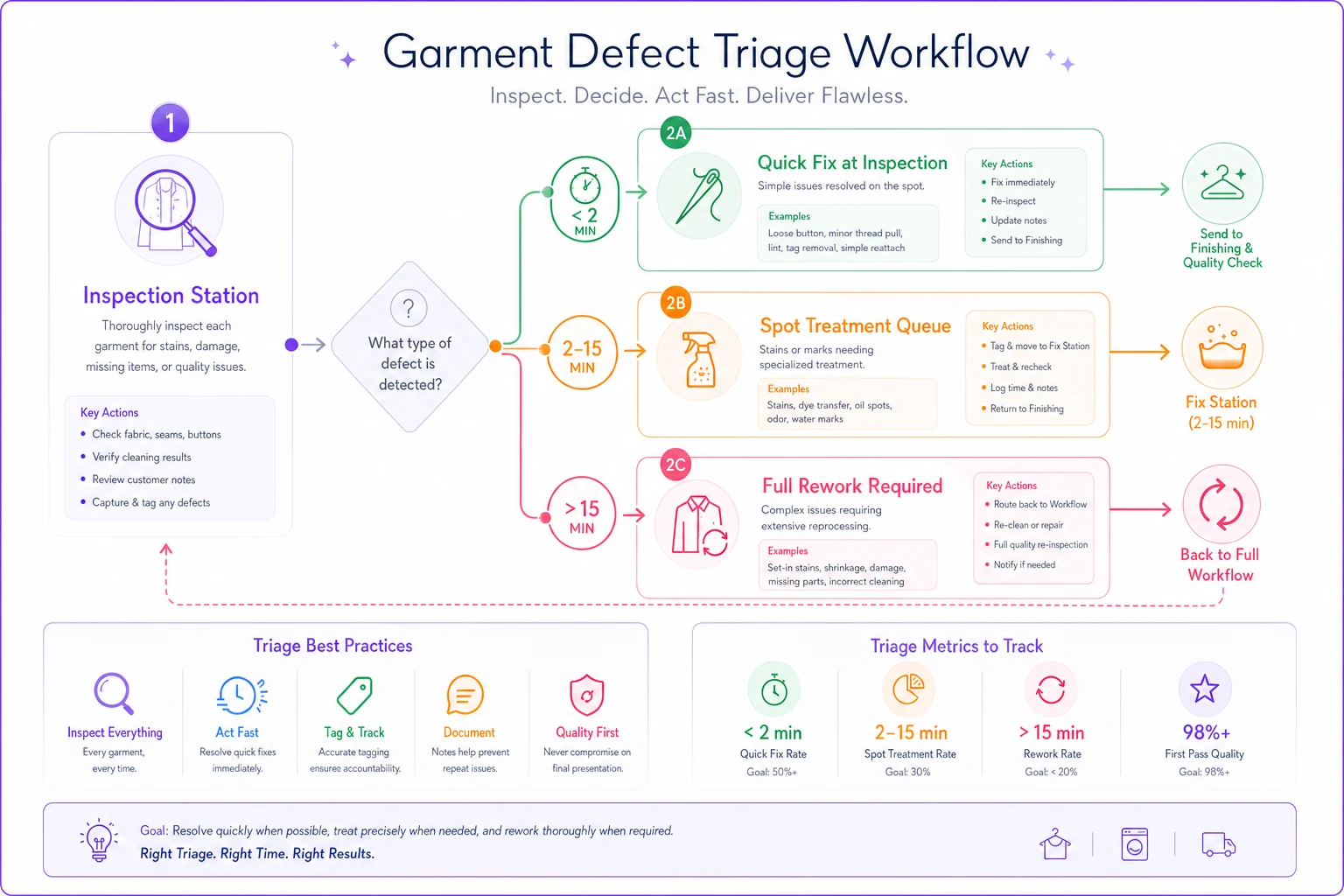
Use this to train staff on routing decisions so fixes don't clog the main workflow.
Documentation that actually prevents problems
Most cleaners document quality issues after customers complain. That's backwards. You need logs that catch patterns before they become customer problems.
A basic QC log captures five things:
-
Item identifier (ticket number + garment type)
-
Defect type (specific category from your list)
-
Source (which process step caused it)
-
Fix applied (quick/spot/rework)
-
Time taken (actual minutes)
What makes logs actually useful is pattern analysis. When you see six shirts from Tuesday's pressing shift with collar issues, you know exactly where to focus training. When spot treatments spike on rayon blouses, you adjust your initial processing. When quick fixes cluster around 3 PM, you know that shift needs a closer look.
| QC Log Field |
|---|
| Item identifier (ticket number + garment type) |
| Defect type (specific category from your list) |
| Source (which process step caused it) |
| Fix applied (quick/spot/rework) |
| Time taken (actual minutes) |
One cleaner discovered through simple logging that around 40% of their rework came from one pressing machine with inconsistent temperature. Another found that most stain failures happened on items tagged as "rush"—staff were skipping proper pre-treatment to meet deadlines. You can't see these patterns without documentation.
The log doesn't need to be complex. A spreadsheet or even a paper form works if staff actually fills it out. The key is making it fast—checkboxes for common issues, codes for standard fixes, batch entry for similar items. If logging takes more than 30 seconds per item, it won't happen consistently.
The inspection checklist that catches everything
Generic checklists waste time. "Check stains, check pressing, check damage" doesn't actually help staff catch problems. Effective checklists break down specific inspection points in the order staff naturally examines garments.
For shirts:
-
Collar points—sharp and symmetrical
-
Collar body—no ring marks or shadows
-
Cuffs—properly pressed, no button damage
-
Front placket—straight, no puckering
-
Pockets—flat, aligned, no bulging
-
Back pleat—centered and crisp
-
Hem—even and straight
-
Overall—no odors, spots, or pressing marks
For suits:
-
Lapels—properly rolled, no shine
-
Shoulders—smooth, properly shaped
-
Back vent—aligned and pressed
-
Pockets—empty, flat, properly shaped
-
Lining—smooth, no bunching
-
Trouser crease—sharp and centered
-
Hem—proper length and finish
-
Overall—matching pieces, no mixed items
Specificity matters here. "Check pockets" becomes "Pockets empty, flaps aligned, no corner dog-ears, interior pocket smooth." "Check pressing" becomes "No shine marks, no water spots, no double creases, proper hand finishing on edges."
Staff should physically touch each checkpoint, not just scan visually. Fingers catch things eyes miss—rough spots from improper chemical removal, sticky residue from sizing issues, loose buttons that look fine but won't survive customer handling.
Time-saving strategies that don't sacrifice quality
Traditional inspection where one person checks every item individually doesn't scale. You need systems that keep quality high while moving orders efficiently.
Batch inspection by type speeds things up considerably. Instead of checking mixed items, group all shirts together, all pants together, all dresses together. Your brain stops switching between different quality criteria, and you build a rhythm that catches issues faster.
Risk-based sampling works well once you're tracking quality history. Customers with no complaints in six months get standard inspection. New customers or those with recent issues get a closer look. Corporate accounts always get full inspection. This focuses effort where problems are most likely or most costly.
Station pre-checks catch issues before they reach final inspection. Pressers do a quick check before sending items forward. Spotters verify stain removal before moving pieces along. Assembly staff confirms all pieces are present before bagging. Each station owns their output quality, so final inspection becomes confirmation rather than discovery.
Photo documentation for problems cuts down on arguments. When you reject an item for rework, snap a photo showing the issue. No debates about whether the stain was really visible or if the wrinkle was actually there. Photos also do a better job of training staff than any written manual.
Rotate inspection duties every couple of hours to keep eyes fresh and maintain detection rates.
Station pre-checks catch issues before they reach final inspection. Pressers do a quick check before sending items forward. Spotters verify stain removal before moving pieces along. Assembly staff confirms all pieces are present before bagging. Each station owns their output quality, so final inspection becomes confirmation rather than discovery.
Common failure points that destroy quality systems
Even solid QC systems break down when certain things go wrong. The most common: end-of-day rush. When delivery drivers are waiting and customers are calling, standards slip. "Good enough" replaces "meets standard," and problems get delivered hoping customers won't notice.
The fix requires discipline: set a hard cutoff time for same-day delivery quality checks. Anything arriving at inspection after 3 PM (or whatever fits your schedule) automatically gets bumped to next-day delivery unless it passes expedited inspection with photo documentation. This removes the pressure to compromise.
Another failure point is inconsistent authority. When anyone can override QC decisions for "good customers" or "urgent orders," standards become meaningless. One shop solved this by requiring photo approval for any QC override—managers could still make exceptions, but they had to document the reason.
Staff fatigue creates quality blindness too. After checking 200 garments, small issues become invisible. Rotate inspection duties every couple of hours, or alternate between inspection and other tasks. Fresh eyes catch what tired ones don't.
Making fixes without destroying margins
Quality control feels expensive until you calculate the real cost of returns. A single re-delivery runs roughly $12–18 in labor and fuel. A redo adds another $8–15 in processing costs. Lost customers from quality failures can mean thousands in lifetime value gone. Prevention is almost always cheaper than fixing problems after the fact.
Smart QC doesn't require major investment though. A photo standard board costs under $50 to create. Triage stations use equipment you already have. Digital logs can start with a free spreadsheet. The expensive part isn't tools—it's the time to develop standards and train staff to follow them.
Track your QC metrics to understand the ROI. Measure defects caught before delivery, customer complaints, redo costs, and delivery expenses. Most shops see payback within 60 days just from reduced re-delivery costs. One cleaner tracked around $3,400 in monthly savings from catching defects before delivery—mostly by eliminating emergency re-cleaning and last-minute special delivery runs.
Real automation opportunities in quality control
Human eyes are still essential for quality inspection, but dry cleaning pre-delivery quality control gets a lot easier with the right operational software behind it. Digital tracking shows exactly which items need inspection and when, so nothing ships without QC approval. Photo capture tools let staff document issues on the spot, which also builds your visual standards library automatically over time.
AI-powered platforms can flag high-risk items for enhanced inspection based on garment type, customer history, and processing notes—so instead of checking everything equally, staff focuses on items most likely to have problems. The system learns from your QC logs and surfaces patterns that are easy to miss when you're just eyeballing spreadsheets.
Automated routing ensures failed items reach the right fix station without manual sorting. Quick fixes get handled immediately, spot treatments queue for the dedicated station, and full reworks enter the priority pipeline with updated delivery notifications sent to customers automatically. It removes a lot of the chaos that comes with managing defective items mid-shift.
Building QC into your shop culture
Quality control only works when everyone owns it, not just the final inspector. This means changing how you talk about defects. Instead of "who screwed this up," ask "how did our process allow this?" Instead of blaming the presser for wrinkles, look at why items reached pressing in a condition that made good results hard to achieve.
Make quality visible throughout your shop. Post defect rates by station—not to shame anyone, but to show improvement over time. Share photos of excellent work alongside examples of problems to avoid. When someone catches a defect before it reaches a customer, that's worth acknowledging.
Train quality control as a skill, not just a task. Don't just show staff what to look for—explain why certain defects matter. A tiny stain on an inside hem might be acceptable, but the same stain on a collar ruins someone's presentation. When staff understand the customer impact, standards feel important rather than arbitrary.
The competitive advantage of consistent quality
Every dry cleaner claims quality service. Few deliver it consistently. Real quality means customers know what to expect every single time—no surprises in either direction. That predictability builds trust that marketing can't buy.
Your dry cleaning pre-delivery quality control system becomes a genuine selling point when you can back it up with numbers. "Every garment inspected at 27 checkpoints before delivery." "Photo-documented quality verification on every order." "Less than 2% defect rate." These mean something when you have the system behind them.
Start small if you need to. Pick your highest-volume item type and develop photo standards just for that. Create a basic triage system for your most common defects. Build one inspection checklist and run with it for a week. Each improvement compounds—better standards lead to faster inspection, which allows more thorough checking, which catches more problems, which reduces rework costs.
The goal isn't perfection. It's consistency. Customers will forgive an occasional mistake if they trust your normal quality. They'll leave permanently if they can't predict what they're getting. A documented, systematic approach to quality control delivers that predictability while reducing operational costs at the same time. The only real question is whether you build the system before or after losing customers to preventable problems.
The goal isn't perfection. It's consistency. Customers will forgive an occasional mistake if they trust your normal quality. They'll leave permanently if they can't predict what they're getting. A documented, systematic approach to quality control delivers that predictability while reducing operational costs at the same time. The only real question is whether you build the system before or after losing customers to preventable problems.
Ready to elevate your dry cleaning operations?
Join hundreds of dry cleaners using Pressesly to save time, reduce errors, and enhance customer satisfaction.