


Most dry cleaners lose money on stain claims because counter staff can't properly document what came in the door. You get a wedding dress with yellowing that was already there, customer swears it was pristine, and now you're eating a $400 replacement cost because nobody took intake photos.
The real problem isn't just the money—it's that your best cleaners waste hours on disputes instead of actually cleaning clothes. A structured stain assessment SOP changes this.
Why Standard Intake Falls Apart
Your counter person sees 200+ items daily. They're juggling phone calls, processing payments, trying to move the line. When a silk blouse comes in, they mark "stain on front" and move on. Two days later, your cleaner finds wine stains, grease spots, and underarm yellowing—none of it documented. Customer gets the garment back, sees pre-existing damage they forgot about, and blames your shop.
This pattern destroys margins. The average dry cleaner handles somewhere around 8-12 damage claims a month, with settlements ranging from $75 to $800. A good chunk of those—roughly 60%—involve pre-existing conditions that weren't documented at intake. That's potentially $3,000-$5,000 annually in preventable losses, not counting the time spent arguing with customers or the reputation hit from bad reviews.
The core issue is that intake staff don't have clear standards for what to photograph, how to describe damage, or when to escalate. They're making judgment calls without real guidance, which creates inconsistency across every shift.
Photo Documentation Standards That Actually Work
Effective photo documentation needs specific protocols, not vague instructions like "take pictures of stains." Here's what works in shops processing 400+ items daily:
Never lose track of an order again.
Pressesly helps you manage, track, and communicate every garment order seamlessly.
- Unified order management
- Real-time customer notifications
- Staff scheduling & workload tracking
No credit card required
Three-Photo Minimum for Problem Garments
First photo captures the entire garment laid flat with decent lighting—establishes overall condition and color. Second photo shows the care label clearly. You'd be amazed how many disputes involve customers claiming you ignored care instructions. Third photo zooms in on specific issues: stains, tears, discoloration, missing buttons.
For high-risk items—wedding dresses, leather, suede, vintage pieces—take five photos minimum. Add close-ups of seams, embellishments, and any areas prone to damage during cleaning.
Lighting and Background
Photos against a white or light gray background work best. Natural light from a window beats overhead fluorescents every time. Fluorescent lighting can hide yellowing and make stains look different than they actually are. If you need artificial light, use daylight-balanced LED panels at 45-degree angles to minimize shadows.
Mark each photo with a timestamp and item number. Some shops keep a small whiteboard in frame showing the date and ticket number. Prevents any confusion about when photos were taken or which garment they belong to.
Keep a small whiteboard in frame showing the date and ticket number for photo clarity.
Storage and Organization
Create folders by date, then by customer last name. Keep photos for 90 days minimum—most disputes happen within the first 30 days, but occasional issues surface months later. Cloud storage costs almost nothing compared to one disputed claim.
The Decision Tree That Eliminates Guesswork
Counter staff need a clear decision path, not general guidelines. This decision tree handles the vast majority of intake scenarios:
Level 1: Standard Processing
-
Garment appears clean, no visible stains or damage
-
Common fabric (cotton, polyester, standard wool)
-
Clear care label present
-
Action
Process normally, no special documentation needed
Level 2: Document and Process
-
Minor stains (food, dirt, light perspiration)
-
Small imperfections (loose button, minor pilling)
-
Designer items under $300 retail value
-
Action
Take three standard photos, note issues on ticket, process with standard care
Level 3: Document and Flag for Cleaner Review
-
Set-in stains (wine, blood, ink)
-
Delicate fabrics (silk, cashmere, linen)
-
Items $300-$1,000 retail value
-
Vintage or heirloom pieces
-
Action
Five-photo documentation, detailed notes, cleaner reviews before processing
Level 4: Manager Approval Required
-
Unknown stains or substances
-
Structural damage (tears, burns, severe fading)
-
Items over $1,000 retail value
-
Wedding dresses or formal wear
-
Previous claim history with the customer
-
Action
Full photo set, manager inspection, written consent form before processing
This structure removes ambiguity. New counter staff can follow it immediately without extensive training. Experienced staff appreciate the consistency—no more wondering whether they should have escalated something.
| Level | Criteria | Action |
|---|---|---|
| Level 1: Standard Processing | Garment appears clean, no visible stains or damage; Common fabric (cotton, polyester, standard wool); Clear care label present | Action: Process normally, no special documentation needed |
| Level 2: Document and Process | Minor stains (food, dirt, light perspiration); Small imperfections (loose button, minor pilling); Designer items under $300 retail value | Action: Take three standard photos, note issues on ticket, process with standard care |
| Level 3: Document and Flag for Cleaner Review | Set-in stains (wine, blood, ink); Delicate fabrics (silk, cashmere, linen); Items $300-$1,000 retail value; Vintage or heirloom pieces | Action: Five-photo documentation, detailed notes, cleaner reviews before processing |
| Level 4: Manager Approval Required | Unknown stains or substances; Structural damage (tears, burns, severe fading); Items over $1,000 retail value; Wedding dresses or formal wear; Previous claim history with the customer | Action: Full photo set, manager inspection, written consent form before processing |
Visual workflow of the decision tree for intake.
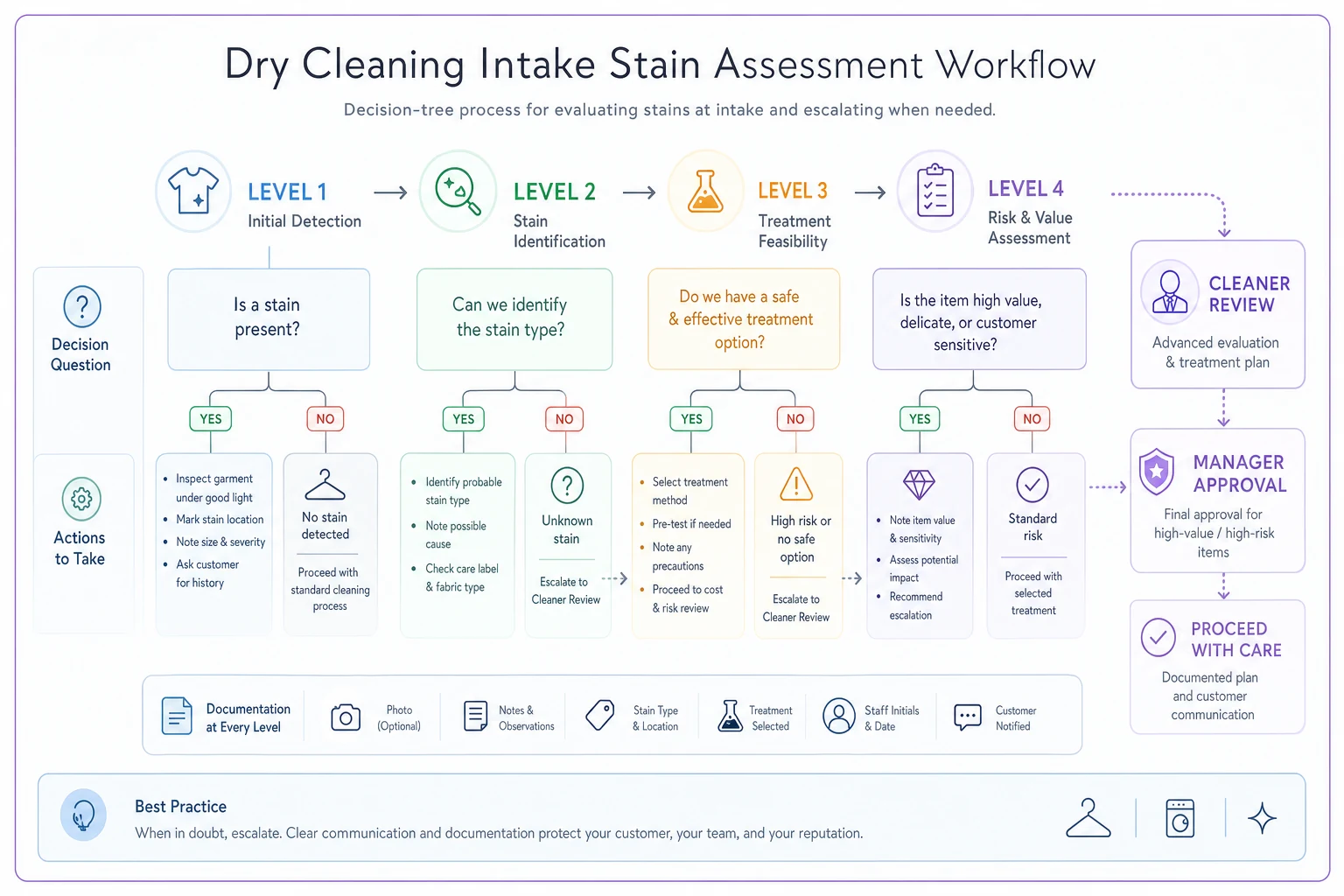
New counter staff can follow it immediately without extensive training. Experienced staff appreciate the consistency—no more wondering whether they should have escalated something.
Escalation Thresholds and Manager Involvement
Clear escalation thresholds prevent small issues from becoming big problems. Here's what should trigger action:
Immediate Manager Escalation
-
Customer mentions a previous damage claim at any shop
-
Garment value exceeds $1,000
-
Customer seems anxious or mentions a special event deadline
-
Any item without a care label
-
Visible mold, mildew, or biological contamination
End-of-Shift Manager Review
-
All Level 3 items from the day
-
Any customer who questioned pricing or turnaround time
-
Items with conflicting care labels (dry clean only jacket with machine washable lining)
Weekly Pattern Review
-
Track which staff members escalate most frequently
-
Identify garment types causing repeated issues
-
Review any items held over 30 days
One pattern that comes up consistently: shops that involve managers early in questionable situations see far fewer escalated customer complaints down the line. The manager conversation at intake sets proper expectations and prevents the surprise factor that turns minor issues into disputes.
Customer Consent Language That Holds Up
Generic consent forms don't protect you when disputes arise. Specific language addressing common scenarios makes the difference. Here's language that's been tested through real claims:
For Pre-Existing Damage:
"Customer acknowledges the following existing conditions documented in photos: [specific description]. These conditions were present before cleaning and may become more visible after processing. Shop is not responsible for pre-existing damage."
For High-Risk Items:
"This garment requires specialized handling due to [fabric type/age/condition/lack of care label]. Despite our best efforts, there is inherent risk of [shrinkage/color loss/texture change]. Customer accepts this risk and releases shop from liability for these specific possibilities."
For Stain Removal Attempts:
"Stain removal is attempted at customer's risk. Some stains cannot be removed without damaging fabric. Shop will use industry-standard methods but cannot guarantee complete removal. Aggressive stain treatment may cause color loss or fabric weakness."
For Items Without Care Labels:
"This garment lacks manufacturer care instructions. Shop will use professional judgment based on fabric type and construction. Customer accepts all risks associated with processing items without care labels."
Get signatures on tablets, not paper. Digital signatures with timestamps eliminate the "I never signed that" defense. Store consent forms alongside photo documentation for easy retrieval.
Common Intake Mistakes That Create Claims
Even with solid systems, certain patterns create problems repeatedly.
The Invisible Stain Problem
Some stains only appear after cleaning—sugar spills, clear alcohol, certain perfumes. These substances may be invisible when dry but caramelize or oxidize during the cleaning process. Counter staff can't document what they can't see, which leads to "you caused this stain" arguments.
Solution: For light-colored garments, use a UV flashlight during intake. Many invisible stains fluoresce under UV light. Document any areas that glow, even if nothing looks off in normal light.
The Pocket Check Failure
Customer leaves lipstick, a pen, or gum in a pocket. Item goes through cleaning, damages the whole load. Customer claims your staff should have checked more carefully.
Solution: Make pocket checking visible and documented. Have the customer watch as counter staff checks each pocket. For high-value items, have the customer sign confirming they've removed everything.
The Matching Set Trap
Customer brings in a suit jacket, keeps pants at home. Cleaned jacket looks brighter, customer complains the set no longer matches. Or worse—they bring the pants in later expecting you to fix the color difference.
Solution: Always ask about matching pieces. Document if a customer chooses to clean only part of a set. Recommend cleaning everything together to maintain uniform appearance.
Building Operational Consistency
The best SOP means nothing if staff don't follow it when things get busy.
Morning Huddle Review
Spend two minutes each morning covering one aspect of the intake SOP. Monday might be photo standards, Tuesday covers escalation triggers. Repetition builds muscle memory without feeling like constant training.
Spot Check Tests
Have a friend bring in a garment with specific issues quarterly. See if staff follow documentation and escalation protocols. This reveals real-world performance versus theoretical knowledge.
Claim Pattern Analysis
Track every claim by intake staff member, garment type, and day of week. Patterns emerge quickly—maybe the Tuesday evening shift needs more training, or silk blouses create disproportionate issues.
Technology That Makes Intake More Consistent
Modern operational software can turn intake from a paper-based guessing game into something more reliable. Instead of handwritten tickets, tablets capture photos directly into customer records. AI-assisted platforms can flag common risk factors automatically—missing care labels, high-value items, customers with previous claims—and prompt staff for additional documentation before they move on.
For new employees especially, this kind of guided workflow helps. The system walks them through each decision point so nothing gets missed. For experienced staff, it eliminates repetitive manual steps: photos upload automatically, consent forms populate with customer info, common stain descriptions auto-fill based on prior cases.
It doesn't replace good judgment, but it does reduce the gap between your best counter person and your newest hire.
Real Operational Improvements From Better Intake
A shop in Phoenix processing around 340 items daily implemented this SOP structure. Before, they averaged 11 damage claims monthly, with typical settlements around $200 each. Six months in, claims dropped to 3-4 monthly—and most of those were legitimate cleaning issues, not documentation disputes.
More importantly, cleaners stopped wasting time on defensive documentation. When every garment arrives with proper intake photos and consent forms, cleaners can focus on actual cleaning. Processing time improved by roughly 15% just from eliminated back-and-forth between cleaning and counter staff.
Customer satisfaction went up too, though maybe not for the reason you'd expect. When customers see you documenting everything carefully at intake, they trust you're taking their garments seriously. They're less likely to make frivolous claims when they know photos exist. The professional intake process prevents disputes before they start.
Making Your SOP Stick Long-Term
The hardest part isn't creating the SOP—it's maintaining it when things get hectic. December rush hits, an experienced staff member quits, new equipment arrives. These disruptions cause intake standards to slip, and you see a wave of claims a few weeks later.
Build reinforcement into daily operations. Print the decision tree and laminate it at every intake station. Create a one-page photo standards guide with example images. Set reminders for managers to review escalated items. Physical and digital nudges keep standards high even during chaos.
Consider appointing an intake champion—someone who owns this process and keeps everyone accountable. Rotate the role quarterly so different perspectives can improve the system. That person reviews claims to identify SOP gaps and suggests changes based on what's actually happening.
Wrapping Up
A solid stain assessment SOP transforms dry cleaning intake from a liability into something that actually protects your business. When customers see you documenting everything carefully, they choose you over shops that hand-wave intake concerns. When staff have clear standards and decision trees, they feel confident handling any situation. When claims drop significantly, that money goes straight to your bottom line.
Start with photo standards staff can actually follow. Build decision trees that remove guesswork. Use consent language that holds up in a real dispute. Add consistent reinforcement and smart software where it makes sense, and you've built an intake process that scales without creating new problems as volume grows.
Most shops lose thousands annually on preventable claims. With the right intake SOP, that money stays in your business while customers get better service. The investment in proper documentation and training pays for itself after preventing just two or three disputed claims.
Most shops lose thousands annually on preventable claims. With the right intake SOP, that money stays in your business while customers get better service. The investment in proper documentation and training pays for itself after preventing just two or three disputed claims.
Ready to elevate your dry cleaning operations?
Join hundreds of dry cleaners using Pressesly to save time, reduce errors, and enhance customer satisfaction.