

Most dry cleaners don't think about equipment lifecycle until a boiler quits on a Friday afternoon with 400 garments in the queue. Then it becomes the only thing anyone thinks about for about a week — the frantic calls to the service tech, the emergency rental, the customers getting pushed back two days, the capex decision made in a panic instead of a plan.
The problem isn't that machines break. They always will. The problem is that small shops almost never build a system around the predictable decline of their core assets — the press, the boiler, the dry-cleaning machine, the conveyor, the air compressor. Without that system, every piece of equipment hits end-of-life as a surprise, and surprises are the most expensive way to buy a $40k machine.
This is about the connective tissue: how total cost of ownership, failure-rate thresholds, spare-part kits, and vendor timing all tie together into a repeatable decision framework instead of a recurring emergency.
Why equipment decisions go bad in small shops
The core issue is that the three things you need to make a smart replacement call live in three different places and never talk to each other.
You've got the repair history — usually in the service tech's memory or a stack of invoices in a drawer. You've got the operating cost — buried in utility bills and solvent purchases, never broken out per machine. And you've got the capital timing — which gets decided by whatever cash happens to be in the account the week something dies.
When those three stay disconnected, you get the classic failure pattern: a shop keeps pouring money into a 14-year-old dry-cleaning machine because each repair feels "small" — $600 here, $900 there — while the machine quietly eats 20% more solvent and runs slower cycles that burn labor hours. Over 18 months that "cheap" machine burned through more than a down payment on a new one, and nobody added up the pieces.
At a one-location shop this is survivable, barely. The owner knows every machine personally and can usually feel when something's getting ragged. But the second you add a satellite drop store, a delivery route, or a second plant, that gut-feel knowledge doesn't scale. Nobody can track the health of six machines across two buildings from memory. That's where you need the numbers written down, because the informal system that worked for one plant collapses when coordination gets harder.
Total cost of ownership: the number you're probably not tracking
Most owners evaluate a machine on purchase price and maybe repair bills. That's maybe half the real picture. The true cost of owning a piece of equipment over its life looks more like this:
Never lose track of an order again.
Pressesly helps you manage, track, and communicate every garment order seamlessly.
- Unified order management
- Real-time customer notifications
- Staff scheduling & workload tracking
No credit card required
| TCO Component | What it actually includes | How often it's ignored |
|---|---|---|
| Acquisition | Purchase + install + electrical/plumbing changes | Rarely ignored |
| Energy & utilities | Gas/electric per cycle, standby draw | Almost always ignored per-machine |
| Consumables | Solvent, filters, detergent, steam | Tracked as a lump, not per-machine |
| Maintenance | Scheduled PM + reactive repairs | Tracked as invoices, never summed |
| Downtime cost | Lost throughput, reroutes, rush reruns | Almost never quantified |
| Labor drag | Slower cycles, manual workarounds | Invisible until you measure |
| Disposal/trade-in | Removal, residual value | Forgotten until replacement |
The one that hurts small shops most is downtime cost, because it never shows up on an invoice. If your dry-cleaning machine goes down for a day during a normal week, and you're processing somewhere around 250–300 pieces daily at an average ticket in the $9–12 range, you're not just losing that day — you're paying overtime to catch up, risking late pickups, and sometimes sending work to a competitor-slash-wholesaler at a margin you hate.
A TCO template doesn't need to be complicated. One row per major machine, one column per cost category, updated monthly. The goal isn't accounting precision — it's seeing which machine's cost per month of operation is quietly climbing while its output stays flat or drops. That ratio is your early warning, and it ties directly into the kind of per-unit thinking covered in garment-level costing and cash rhythm. You can't protect margins on a $10 shirt if the machine pressing it is silently 25% more expensive to run than it was two years ago.
MTBF and MTTR: turning breakdowns into thresholds
Two numbers make the whole system work once you start logging repairs.
MTBF (Mean Time Between Failures) tells you how long, on average, a machine runs before something goes wrong. MTTR (Mean Time To Repair) tells you how long it typically takes to get it back up once it does. You don't need engineering-grade data — you need enough logged events to spot a trend.
Track MTBF for each major asset and watch for the compression. A boiler that used to go nine or ten months between service calls and now needs attention every six or seven weeks isn't "having a bad year." It's telling you the failure curve has steepened. Equipment doesn't fail linearly — it fails on a bathtub curve, stable for years then accelerating. Compression of MTBF is the elbow of that curve.
MTTR matters because it determines how much a failure actually costs you. A machine with a two-hour MTTR and good spare-part availability is annoying. A machine with a three-day MTTR because the part ships from overseas is a business risk. This is the same logic behind running MTTR experiments inside a preventive maintenance plan — you're not just preventing failures, you're shrinking the cost of the ones you can't prevent.
The connection most people miss: MTTR should drive your spare-part strategy, not the other way around. If a part failure causes long downtime and the part is cheap and small, it belongs in a kit on your shelf. You're buying insurance at pennies on the dollar.
Tying spare-part kits to failure thresholds
A spare-part kit isn't "buy some extra stuff." It's a deliberate inventory decision tied to each machine's failure pattern and repair time. Here's how to build one that actually works:
-
List every failure event from the last 18–24 months per machine (or as far back as your invoices go).
-
Flag the ones with high downtime — anything where you waited on a part.
-
Check part cost and shelf life. Cheap, non-perishable, long-lead parts are the obvious stock candidates.
-
Set a reorder trigger so a used spare gets replaced immediately, not "next time I think of it."
-
Store it labeled, near the machine, not buried in a back room where the tech can't find it at 7am.
A small-shop spare-parts kit for a typical plant usually ends up looking like:
-
Press solenoid valves and common gaskets
-
Steam traps and a spare pressure gauge
-
Belts for the conveyor and air compressor
-
Common filters (solvent, lint, water) at one full change ahead
-
Thermostats / temperature sensors for press heads
-
A spare contactor or relay for the main machines
-
Buttons, snaps, and tensioning parts for the finishing equipment
-
Hose clamps, fittings, and the specific couplers your system uses
Label kits clearly and keep them next to the machine for quick access.
The pattern worth noting: shops over-stock the cheap obvious stuff (filters, belts) and under-stock the expensive, long-lead electronic parts that actually cause the multi-day outages. The right kit is weighted by MTTR impact, not by what's easy to grab from the supply catalog.
Replacement decision triggers: when "fix it again" becomes a mistake
The hardest call is knowing when a machine crosses from "worth repairing" to "money pit." Gut feel gets this wrong in both directions — some owners replace too early out of frustration, others nurse a dying machine for years.
These are the triggers that actually signal end-of-life. You want two or more firing before you commit capital:
-
The 50% rule a single repair quote approaches half the cost of a comparable new or refurbished unit.
-
MTBF compression time between failures has dropped by roughly half from its baseline.
-
Rising TCO per output monthly operating cost climbing while throughput is flat or falling.
-
Parts going obsolete the manufacturer or your tech says a key part is getting hard to source.
-
Downtime bleeding into customer promises you're missing pickup times or rerouting work more than occasionally.
-
Energy or solvent creep consumption per load measurably higher than spec or than it used to be.
When only one trigger fires, repair is usually still the right call. When two or three fire together — say, MTBF compression plus a part going obsolete plus a repair quote over 40% of replacement — you're not repairing a machine anymore, you're financing its retirement one invoice at a time.
When replacement is actually the wrong move
-
The machine is old but failures are rare and cheap, and parts are still easy to get.
-
You're in a cash-tight stretch and the failure risk is low enough to bridge with a good spare-part kit.
-
A lease renewal, relocation, or service-mix change is coming that would change what machine you'd even buy.
An old machine that runs reliably and cheaply is an asset, not a liability. Age alone is a terrible trigger.
Vendor negotiation timing: don't buy on the day it breaks
The price you pay for a major machine depends heavily on when you negotiate, and panic-buying guarantees the worst terms.
-
Equipment distributors often have quarter-end and year-end targets. Walking in with a planned purchase in the last few weeks of a quarter gives you leverage a Friday-emergency buyer never has.
-
Trade-show season and new-model releases create discounting on outgoing models, which are often perfectly good for a small plant.
-
Bundled service contracts are far more negotiable when you're not desperate. A planned buyer can trade a longer service agreement for a better install price or free first-year PM.
The whole point of tracking TCO and MTBF is that it buys you time. When you can see the replacement coming three to six months out, you negotiate from strength — multiple quotes, favorable financing, trade-in credit, and an install scheduled during a slow week instead of mid-crisis. The shop that tracks failure trends isn't just preventing downtime; it's buying every major asset at a better price than the shop that waits for the smoke.
A real scenario: the boiler that cost more than it looked like
A single-location shop running roughly 1,400–1,600 pieces a week had a boiler creeping up on 15 years old. Repairs looked harmless on paper — a steam trap here, a valve there, maybe $500–$900 each time, three or four times a year. The owner's mental math: "A new boiler is $18k–$20k, these repairs are small, I'll ride it out."
What the drawer full of invoices hid: the boiler was cycling inefficiently and the gas bill had crept up a few hundred dollars a month over two years. Add the repair spend — close to $3k annually by then — plus two full-day outages that pushed work to a wholesaler at terrible margin, and the overtime to recover, and the "cheap" option was costing somewhere in the range of $8k–$10k a year in blended, mostly invisible cost.
Once laid out on a one-page TCO sheet, the picture flipped. The owner timed the replacement for a slow stretch in late winter, got three quotes, negotiated a trade-in and the first year of PM thrown in, and scheduled install on a Sunday-Monday to minimize disruption. The new unit cut gas cost noticeably and eliminated the surprise-outage risk entirely.
The lesson wasn't "boilers are expensive." It was that the information to make the right call had existed the whole time — just scattered across enough places that nobody ever added it up.
Pulling it into one system
The reason equipment decisions feel chaotic in small shops is that each piece lives in isolation. Repair invoices in a drawer. Utility costs in a bill you skim. Replacement decisions made under pressure. The fix isn't more discipline on any single piece — it's connecting them so each one informs the next.
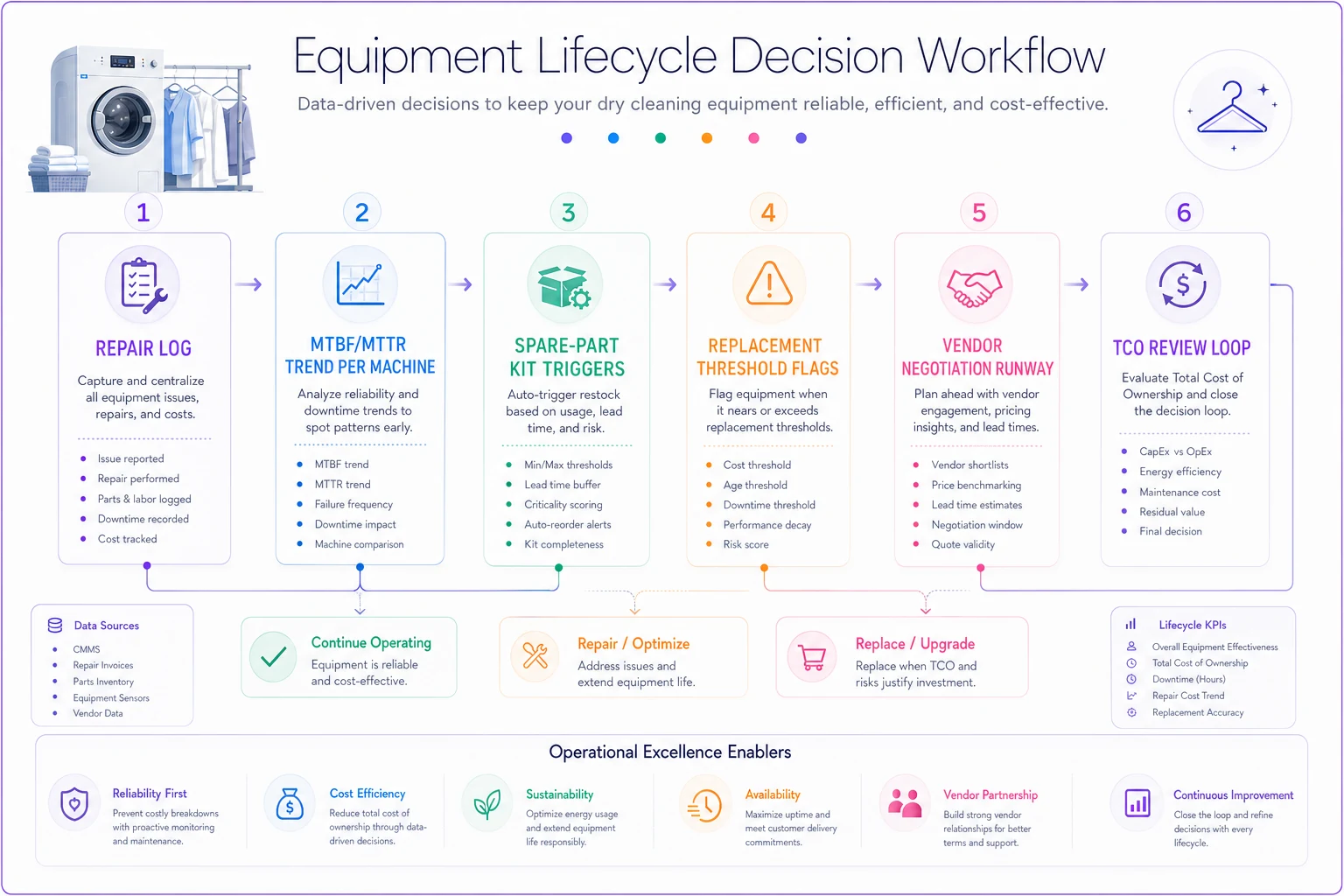
In plain terms, the workflow runs like this: every repair gets logged with date, cost, and downtime. That log feeds your MTBF/MTTR picture per machine. Those numbers flag which parts belong in your spare kit and which machines are approaching a replacement trigger. The trigger gives you a 3–6 month runway. That runway lets you negotiate vendor terms from strength instead of panic. And the TCO sheet ties it all back to whether each machine is still earning its keep.
Done manually, this is a monthly hour with a spreadsheet and a folder — totally doable for one plant. As you grow to multiple machines or locations, the logging and trend-spotting is exactly where AI-powered operational software starts earning its place. Repair history, maintenance schedules, and cost tracking living in one shared system instead of one person's head changes how fast you can spot the patterns that matter.
The tool matters less than the habit, though. A shop that writes down every failure and reviews the trend quarterly will out-decide a bigger competitor running on gut feel every single time. Machines will always break — the difference between a shop that absorbs that gracefully and one that lurches from crisis to crisis isn't luck or better equipment. It's whether the decline was tracked, priced, and planned for before the part finally gave out.
Ready to elevate your dry cleaning operations?
Join hundreds of dry cleaners using Pressesly to save time, reduce errors, and enhance customer satisfaction.