

Most dry cleaners track defects the same useless way – writing them down in a notebook that nobody looks at again. The shirt comes back with a broken button, you apologize, fix it, move on. Two weeks later, same problem, different customer. The presser who keeps scorching collars? Still doing it three months later because nobody connected the dots.
A proper dry cleaner quality management system doesn't need expensive consultants or ISO certification. What it needs is a defect taxonomy your team actually understands, sample audits that catch problems before customers do, and corrective action loops that stick.
Why Traditional Quality Tracking Fails in Dry Cleaning Shops
The dry cleaning industry has a weird relationship with quality control. Everyone knows it matters – one ruined wedding dress can tank your reputation – but the actual systems most shops use are laughably primitive. A clipboard by the press. Maybe a spreadsheet if you're organized. Usually just memory and hope.
The problem isn't laziness. Generic quality systems weren't built for shops processing 150–300 garments daily with constant customer turnover. Manufacturing QMS assumes you're making the same product repeatedly. Restaurant systems focus on food safety. Neither maps onto the reality of cleaning everything from silk blouses to leather jackets with a rotating cast of part-time pressers.
What ends up happening is shops develop this patchwork of informal checks. The experienced presser knows to double-check zippers on vintage dresses. The owner remembers which customers are picky about creases. But when that presser quits or the owner takes a week off, the knowledge walks out the door.
Meanwhile, defects follow predictable patterns. Broken buttons cluster around specific garment types. Pressing burns happen more during rush periods. Spotting chemical damage correlates with new employee training gaps. A structured QMS would catch these patterns, but instead shops just eat the cost of redos and refunds.
Building Your Defect Taxonomy Without Overcomplicating It
Categorizing defects sounds simple until you're actually doing it. Make it too complicated and nobody will use it. Too simple and you miss the patterns that actually matter.
Never lose track of an order again.
Pressesly helps you manage, track, and communicate every garment order seamlessly.
- Unified order management
- Real-time customer notifications
- Staff scheduling & workload tracking
No credit card required
Start with four main buckets that cover the vast majority of what goes wrong:
Mechanical damage covers anything physical – broken buttons, torn seams, zipper damage, missing trim. These usually trace back to specific equipment or handling procedures.
Chemical issues include color loss, fabric weakening, spots that won't come out, or new stains from cleaning chemicals. This category often reveals training gaps or equipment maintenance problems.
Pressing defects encompass burns, shine marks, improper creases, or distorted shapes. These tend to cluster around specific operators or equipment settings.
Process failures catch everything else – lost items, mixed-up orders, missed stains, delayed turnaround. These point to workflow breakdowns rather than technical problems.
Under each bucket, create 3–5 specific codes. Don't overthink it. "B1" for broken button, "B2" for missing button, "B3" for loose button – that level of detail. The goal is pattern recognition, not a research paper.
Keep codes short and consistent so staff can record them quickly.
The useful part comes when you start tracking location and timing alongside those codes. A simple grid with garment type on one axis and defect code on the other starts surfacing things like "80% of broken buttons happen on women's blouses during the press cycle" or "chemical spots spike every time we switch detergent suppliers." That's actionable. A notebook entry that says "button fell off" is not.
Sample Audit Cadence That Catches Problems Early
Random quality checks fail in practice because "random" becomes "whenever someone remembers." Build audits into your existing workflow rhythm instead.
Pull 5 garments every morning before delivery prep. Not 50, not 2 – five gives you enough data without wrecking the morning. Rotate who does the audit so fresh eyes catch different issues. Takes maybe 10 minutes if you're systematic about it.
Focus morning audits on completed orders ready for pickup. Check against your final inspection protocol standards, but also look for patterns. Are pressing defects clustering on certain days? Do chemical issues spike after equipment maintenance?
Then run a deeper audit once a week on in-process work. Pull 3 garments from each major stage – after spotting, after cleaning, after pressing. This catches problems before they compound. Finding shine marks after pressing means adjusting temperature or pressure. Finding them at customer pickup means eating the cost of rework.
| Garment ID | Stage | Defect Code | Operator | Notes |
|---|---|---|---|---|
| #4782 | Press | P2 (shine) | Maria | Silk blend, temp too high |
| #4791 | Spot | C3 (residue) | James | Pre-spot chemical not rinsed |
| #4799 | Final | None | Lisa | Pass |
After a month, patterns jump out. Maria needs silk pressing training. James is rushing the rinse cycle. The Wednesday crew has twice the defect rate of Monday's team. None of that shows up in a notebook.
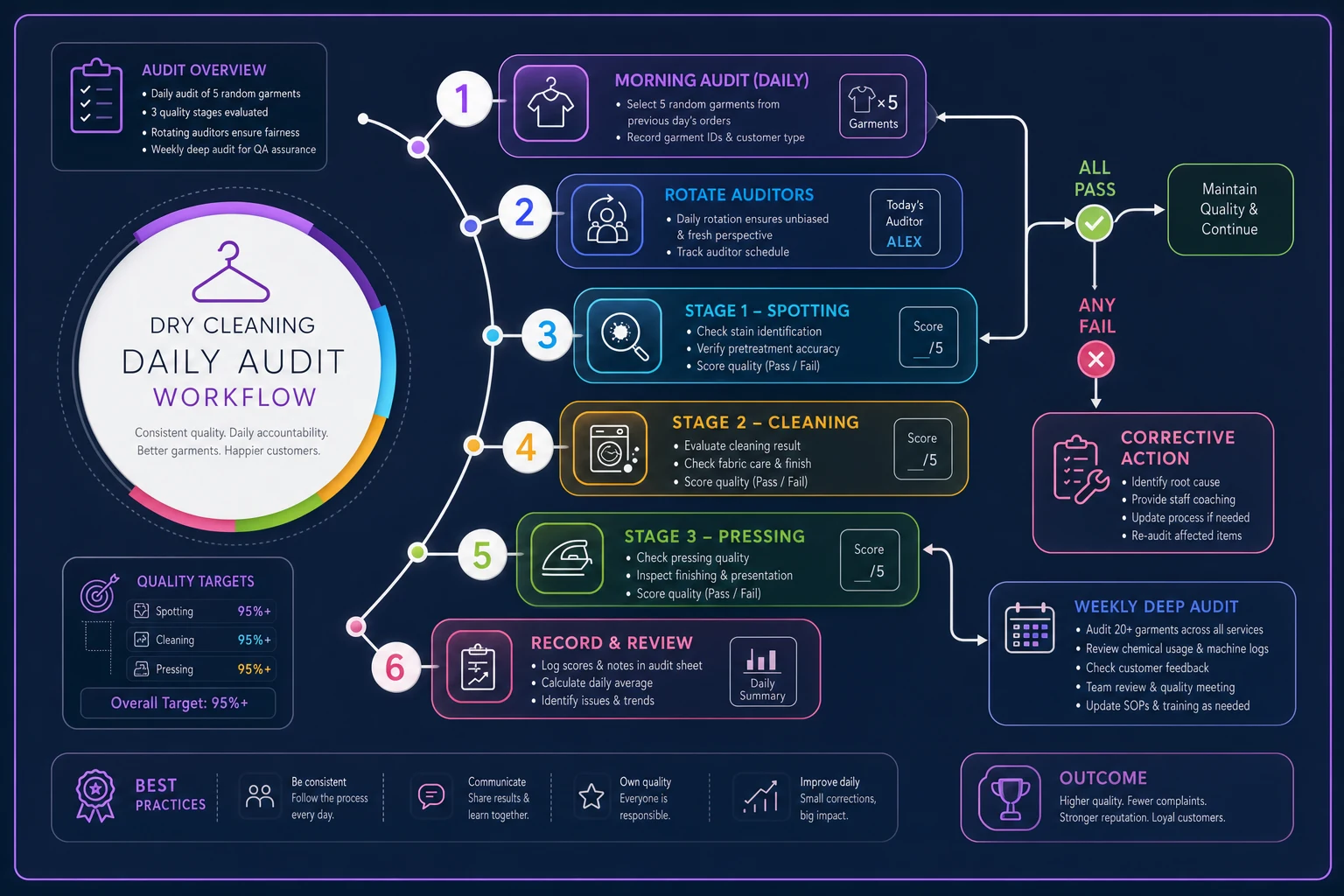
This illustrates the audit workflow and feedback loop to corrective actions.
Corrective Action Loops That Actually Change Behavior
Finding problems means nothing if the response is just "be more careful." That's not a corrective action, that's wishful thinking.
Effective corrective action has three parts: immediate fix, root cause analysis, and systemic prevention. Miss any piece and the same problem resurfaces with slightly different symptoms.
Take broken buttons. Immediate fix: replace the button, apologize to the customer. Root cause: presser is using the wrong temperature for synthetic buttons. Systemic prevention: temperature guide taped to each press station, quick synthetic button check during the morning equipment walkthrough.
The key is making corrections stick without creating bureaucratic overhead. A presser who scorched three shirts doesn't need a written warning – they need a 15-minute refresher on heat settings and fabric types. But if scorching continues after training, you've identified either an equipment problem or someone who shouldn't be pressing delicates.
Document corrections simply. Date, defect pattern, action taken, check-in date. Not novels – just enough to track what worked:
"3/15: 5 shine marks on silk this week, all from Press #2. Recalibrated pressure settings, posted silk handling reminder. Recheck 3/22."
Build correction reviews into your weekly routine. Every Friday, spend 20 minutes reviewing what corrections were made and whether they're holding. No improvement after two weeks usually means the correction didn't address the real problem.
Some corrections need same-day implementation – equipment damaging garments gets fixed today. Others can wait for natural break points. Retraining on stain assessment procedures during a slow stretch makes more sense than pulling staff mid-rush.
Linking Quarterly Experiments to Frontline SOPs
Quality systems stagnate when they turn into compliance exercises instead of actual improvement tools. Shops that maintain strong quality tend to run small controlled experiments every quarter, testing new methods against current standards.
Pick one recurring defect pattern to focus on. Say you're seeing regular complaints about whites coming back dingy. Current SOP is a standard bleach protocol for all whites. The experiment: segment whites by fabric type, use oxygen bleach for delicates, chlorine for cottons.
Run it on a subset – maybe 20% of white garments for a month. Track what actually changes. Are defects dropping? Is processing time increasing? What about chemical costs?
If it works, update the SOP. But update all the connected pieces too, which is what most shops miss. A new bleaching protocol means updating intake procedures to identify fabric types, training staff on the segmentation, potentially adjusting pricing if processing takes longer, and revising the audit checklist.
Q2 Experiment: Double-rinse protocol for wool garments
-
Current issue
3–4 wool items monthly with chemical residue complaints
-
Test
Add second rinse cycle for all wool
-
Measurement
Residue complaints, processing time, customer satisfaction
-
Result after 4 weeks
Complaints dropped to zero, added 8 minutes per load
-
Decision
Implement for all wool, update SOPs
Failed experiments teach plenty too. That fancy spotting chemical that promised better results? If it doesn't outperform your current method on real orders, you just saved yourself from an expensive switch.
Technology Integration Without Losing the Human Touch
Small dry cleaners often resist operational software because they assume it means replacing experienced staff with computers. That's not how it works in practice.
Modern dry cleaner software handles the tedious parts – logging defects, tracking patterns, scheduling audits, storing correction history. That frees your experienced staff to do what they do best: identify problems, train newer employees, and make nuanced calls on garment care.
The better platforms let you photograph a defect, tag it with your taxonomy code, and automatically link it to the customer order. No more coffee-stained notebooks. When you need to review patterns from the last 90 days, everything's searchable.
AI-powered operational software is particularly useful for pattern recognition across large volumes of data. While you're focused on today's orders, the system can surface things like defect rates spiking whenever humidity exceeds 70%, or new employees averaging significantly more pressing burns in their first month. Patterns a manual notebook would never catch.
That said, don't let software replace physical checks. The presser still needs to examine garments. The spotter still needs to test chemicals on hidden seams. Technology tracks and analyzes – humans inspect and decide.
Real Shop Implementation Example
A dry cleaner in suburban Denver implemented this QMS structure after hitting 15 customer complaints in a single month. They were processing around 280 garments daily with 6 employees.
They started by building their defect taxonomy – took about an hour to agree on 15 codes covering their most common issues. Set up morning audits of 5 garments, rotating between their three experienced employees. Weekly deep audits happened Thursday afternoons during their slow period.
The first month revealed two clear patterns: pressing defects concentrated on Tuesday and Wednesday (their busiest days), and chemical spots clustered around their newest employee's shifts.
Corrections were straightforward. They adjusted scheduling to put two pressers on busy days instead of one working overtime, and paired the new employee with experienced staff for additional training. They also discovered their spotting chemical supplier had quietly changed formulas without telling anyone, which was causing unexpected reactions with certain dyes.
After three months, complaints dropped to 2–3 per month. More importantly, they were catching most issues before customer pickup. Their redo rate fell from around 12% to roughly 4%. The time invested – maybe 3 hours weekly across audits, reviews, and corrections – paid for itself in reduced rework and fewer refunds.
They run quarterly experiments now, mostly focused on efficiency since quality has stabilized. A recent test looked at whether pre-sorting by fabric type before cleaning reduced overall processing time. It did – by roughly 20 minutes per load.
Making It Sustainable for Small Operations
The hardest part isn't building a dry cleaner quality management system. It's maintaining one when you're understaffed, dealing with equipment issues, and trying to get through a holiday rush with two people out sick.
Keep it lightweight. Audits that take more than 15 minutes won't happen consistently. Defect codes that require a reference manual won't get used. Corrections that need three levels of approval won't get made. If the system adds real friction, it'll quietly die within a few months.
Build quality tasks into existing routines rather than layering on new ones. Morning equipment checks already happen – add a quick audit. Weekly scheduling meetings exist – spend 5 minutes on defect patterns. Quarterly inventory is standard – a natural time for process experiments.
Rotate who handles audits. The same person reviewing garments every day starts going blind to certain issues. Different eyes catch different things, and involving more staff builds actual buy-in instead of just compliance.
Zero defects isn't the goal. That's not realistic for a service handling hundreds of unique garments daily from different customers with different expectations. The goal is catching patterns early, fixing root causes instead of symptoms, and reducing the repeat problems that eat into margins.
When things improve, say so. When complaints drop, tell the team. When an experiment works, give credit to whoever suggested it. Quality systems don't survive when they only show up as criticism – they survive when people feel like they're actually working.
The dry cleaners that maintain strong quality long-term don't necessarily have better equipment or more resources. They have systems that catch problems early, address root causes, and actually evolve based on data. A simple QMS, consistently applied, beats an elaborate program that lives in a binder nobody opens.
Ready to elevate your dry cleaning operations?
Join hundreds of dry cleaners using Pressesly to save time, reduce errors, and enhance customer satisfaction.