

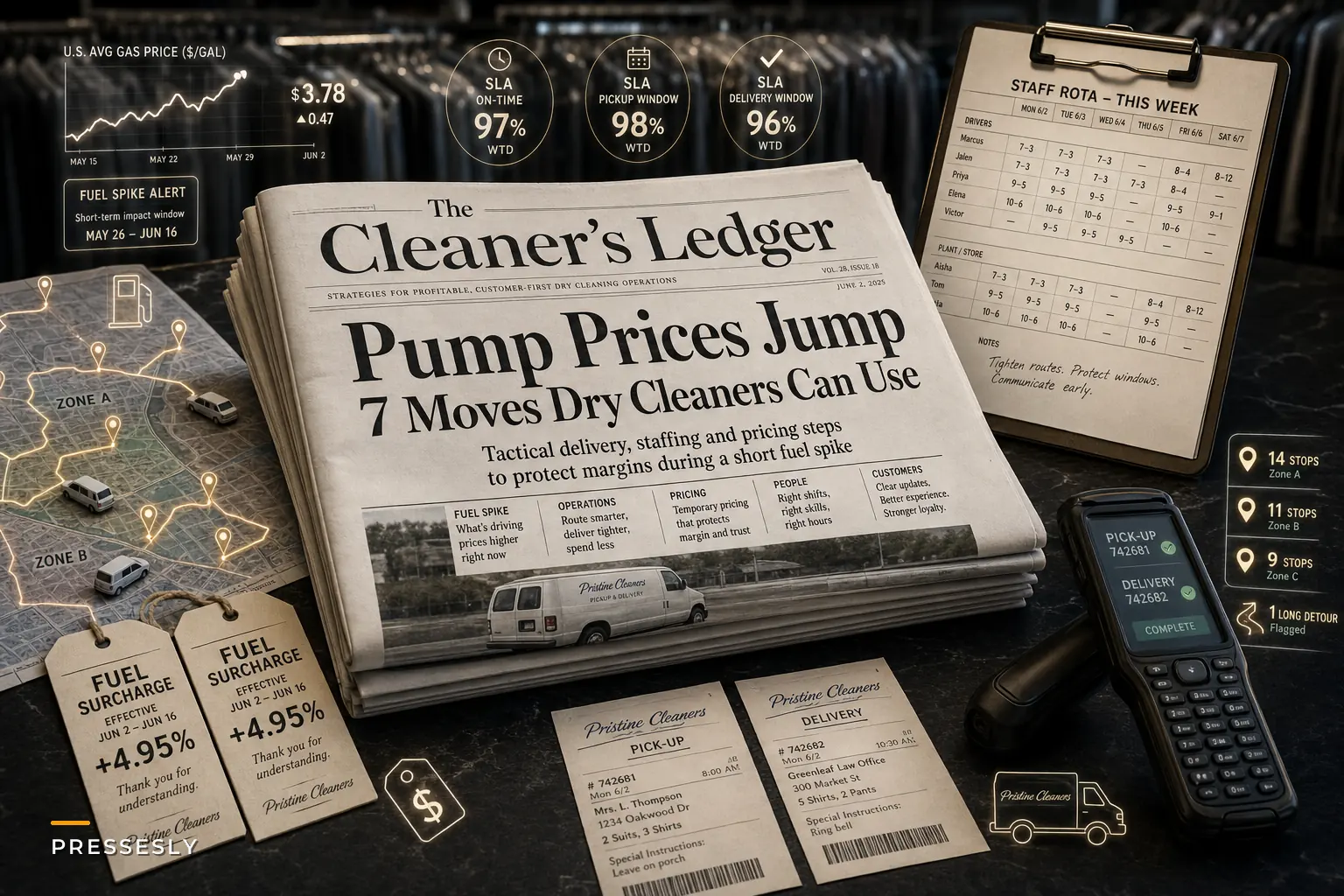

The switch happened faster than most shop owners noticed. Regulators moved to let gas stations shift early from summer-blend to winter-blend fuel to try to ease pressure at the pump — a move Reuters reported in late August. Meanwhile AAA flagged that this August was on track to set a new record for pump prices for the month.
For a dry cleaner running a couple of vans and a pickup-delivery route, that headline isn't abstract. It's a direct hit to per-order economics — the kind that doesn't show up on day one but quietly eats your margin over a few billing cycles. The blend policy might soften prices a bit, but the underlying volatility is the real problem. You can't build a pricing model on "maybe cheaper next month."
What fuel spikes really expose is how loosely most small shops track the true cost of moving a garment from a customer's door to your plant and back. When gas was cheap, sloppy routing and generous delivery windows didn't hurt much. Now they do. So here are seven moves you can act on this week — not a rebuild, just tightening the bolts that come loose first.
First, know which orders are actually losing you money
Before you touch pricing or routes, you need one number most shops don't have: the fuel-and-labor cost of a single delivery stop.
Here's the rough math. If a driver covers 60 stops in a shift, burns about 14 gallons, and gas jumps from around $3.40 to $4.20 a gallon, that's roughly $11 more per shift. Sounds small. Spread across 60 stops, then multiply by six routes a week, and you're looking at a few hundred dollars a month appearing out of nowhere — before you count extra idling on failed drops and re-attempts.
The bigger issue isn't the per-gallon number. It's that low-ticket orders — a couple of shirts, a $9 pickup — often don't cover their share of the drive. Picture a customer three miles off your main loop with one $12 order. At old fuel prices that stop maybe broke even. Now it's a small loss every single time, and you're running it twice a week because they're a "regular."
-
The order total is under your average ticket AND the address sits outside your dense zones
-
The customer requires a narrow time window that forces a detour
-
You're re-attempting the drop more than once a month
-
The stop adds meaningful mileage but sits alone with no nearby orders
You don't need software to start. Pull last month's delivery log, mark the outliers, and you'll usually find that 15–20% of your stops are dragging the rest.
Move 1: Tighten your delivery windows before you raise prices
The instinct is to add a surcharge first. Wrong order. The cheapest fix is reducing how many times your van visits the same neighborhood.
Never lose track of an order again.
Pressesly helps you manage, track, and communicate every garment order seamlessly.
- Unified order management
- Real-time customer notifications
- Staff scheduling & workload tracking
No credit card required
Most shops offer daily or near-daily delivery to feel competitive. But when you actually look at the density, half those runs carry three or four orders. Consolidating a zone from five delivery days to three — while keeping the promise clear to customers — can cut route mileage significantly without anyone feeling downgraded.
The move here is batching by zone and day, not by request. If Tuesday and Friday are your east-side days, everything east routes to those days. Customers adapt fast when the schedule is predictable. What kills you is the ad-hoc "can you swing by today" exceptions that blow a tight route apart. We go deep on how to structure this in our guide on cutting delivery costs with local route heuristics — the zone-mapping and time-window logic there does most of the heavy lifting when fuel gets expensive.
Move 2: Set a delivery minimum — and make it feel fair
A minimum order threshold for free delivery is the single fastest margin protector, but shops botch the framing and lose customers over it.
Don't announce a "fuel surcharge." Customers hate variable fees they can't predict. Instead, set a clean free-delivery minimum — say $25 or $30 — and offer a flat, modest fee below that. The message is "free delivery over $30," not "we're charging you more because gas went up." One feels like a perk. The other feels like a penalty.
When this makes sense: shops where a real chunk of delivery orders fall under the minimum. When it's a bad idea: if your average delivery ticket is already well above the threshold, you're solving a problem you don't have and adding unnecessary friction.
The nudge effect is real. When there's a minimum, a lot of customers throw in an extra shirt or a comforter to hit it. You protect the route and your ticket goes up.
Move 3: Rebuild your route around density, not chronology
Most drivers route by "who called first" or by rough memory. Fine at $3 gas. At record prices it gets expensive fast.
-
Group every stop by zone the night before, not the morning of.
-
Sequence within each zone by tightest cluster, not by pickup time.
-
Hold non-urgent stops that fall outside the day's zones for their assigned day.
-
Batch re-attempts into the next scheduled zone visit rather than same-day retries.
-
Cap detours — any stop pulling the van more than a set distance off the loop gets flagged for review.
The re-attempt piece is underrated. A failed drop you retry same-day can cost more in fuel and time than the order is worth. Rolling it to the next zone day almost always wins. This is exactly where an operational platform earns its keep — instead of a driver eyeballing the sequence, the system groups stops by zone and flags money-losing detours automatically, so the routing discipline holds even when you're slammed.
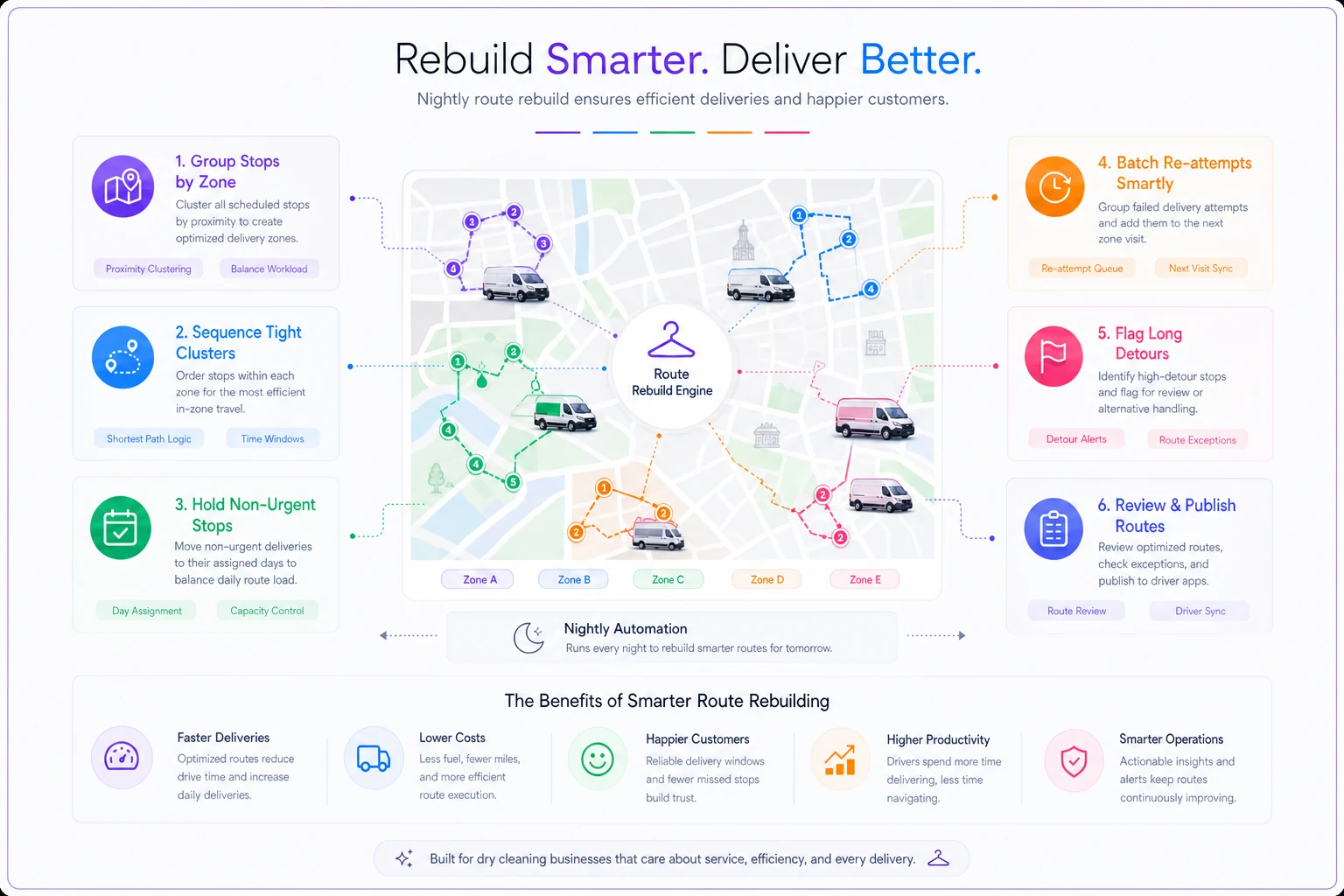
Use this workflow as a checklist when you plan tomorrow's runs.
Move 4: Handle staff commuting costs before they become a retention problem
Here's the fuel cost nobody puts on the whiteboard: your team feels the pump too, and it shows up as attendance and turnover.
For a presser or counter staffer commuting 20 miles round-trip, an extra 80 cents a gallon can quietly add up to a real chunk of their weekly take-home. When that happens, you see more call-outs, more "I found something closer to home," and the retraining costs that follow. Losing an experienced presser mid-fuel-spike is far more expensive than any surcharge you'd ever collect.
-
Offer compressed schedules — four longer days instead of five — so fewer commutes
-
Let two staff who live near each other coordinate carpool shifts
-
Adjust start times slightly so commutes miss the worst traffic (idle time burns gas too)
-
Where roles allow, let counter or admin staff handle some tasks on a shifted schedule
Encourage staff carpooling by aligning adjacent shifts for employees who live near each other.
None of these cost you money. They cost a little scheduling flexibility, and they buy loyalty during exactly the stretch when people are tempted to leave.
Move 5: Reprice the routes, not the whole menu
Across-the-board price hikes during a fuel spike scare customers and are hard to walk back. Surgical repricing on the delivery layer is cleaner.
| Approach | Customer reaction | Margin impact | Reversibility |
|---|---|---|---|
| Raise all garment prices 5% | High — noticed immediately, feels like inflation | Broad but blunt | Hard to reverse without looking unstable |
| Add delivery minimum + small out-of-zone fee | Low — feels like a policy, not a price hike | Targeted at the stops that actually lose money | Easy to drop when fuel eases |
| Cut low-density delivery days | Very low if framed as schedule | Reduces cost instead of adding revenue | Fully reversible |
The right stack is usually the bottom two together: tighten the schedule and add a minimum. You almost never need to touch the core garment menu, which is the part customers are most price-sensitive about.
Move 6: Communicate the schedule change so it lands as an upgrade
How you announce a route change decides whether customers grumble or shrug.
Frame everything around reliability, not cost. "We're moving to fixed delivery days for your area so you always know exactly when we'll be there" reads as better service. It's also true — a tighter, predictable route usually does improve on-time performance. Nobody needs to hear the word "fuel."
Send it once, clearly, with the specific days for their zone. Vague announcements generate a flood of "wait, what day am I now?" calls that eat your counter staff's time. A short, specific message per zone — ideally automated so each customer only sees their own schedule — prevents that confusion entirely. This is one of those spots where a platform that segments customers by delivery zone and sends the right message to the right people saves you a full day of phone calls.
Move 7: Watch the right numbers weekly, not monthly
Fuel volatility moves fast. If you're reviewing delivery economics once a month, you're always reacting to damage that already happened.
-
Cost per delivered order (fuel + driver labor ÷ orders delivered) — if it's climbing while your ticket stays flat, your minimum or your zones need adjusting.
-
Failed-drop rate — every failed drop is a stop you paid for twice. A rising rate usually means your windows are too loose or your access info is stale.
Shops that track these weekly catch a bad trend while it's still a small number. The ones checking monthly find out when it's already a hole in the P&L.
A real scenario
A single-location shop running two vans across a mid-sized suburb was doing daily delivery to five zones with no minimum. When fuel climbed, their cost per delivered order crept up noticeably and margins on the delivery side went thin — a lot of it driven by low-ticket single-garment stops scattered across sparse zones.
They didn't raise garment prices. They consolidated each zone from five delivery days to three, set a $28 free-delivery minimum with a flat $4 fee below it, and rolled all same-day re-attempts into the next zone day. They framed it to customers as "fixed, reliable delivery days for your neighborhood."
Over the following two months, route mileage dropped meaningfully, failed-drop retries mostly disappeared, and the average delivery ticket ticked up as customers added items to clear the minimum. A handful of far-flung low-value customers dropped off — but those were the exact stops losing money anyway. Delivery-side margin recovered to roughly where it sat before fuel spiked, without touching the core price list.
What to do this week
Pick the moves that fit your shop and start:
-
Pull last month's delivery log and flag the money-losing stops
-
Set a free-delivery minimum framed as a perk, not a fee
-
Consolidate at least one sparse zone from daily to two or three fixed days
-
Batch re-attempts into the next zone day instead of retrying same-day
-
Offer schedule flexibility to your longest-commute staff before they walk
-
Announce changes per zone, framed around reliability
-
Check cost-per-delivered-order and failed-drop rate every week until fuel settles
The blend switch and record prices are the headline, but the real lesson is quieter: fuel spikes just reveal the loose spots in your delivery model that were always there. The shops that come out fine aren't the ones who guessed which way gas would go — they're the ones who tightened their routes, set clean rules, and stopped running vans past addresses that never paid their way. Do that now, and whatever the pump does next matters a lot less.
The blend switch and record prices are the headline, but the real lesson is quieter: fuel spikes just reveal the loose spots in your delivery model that were always there. The shops that come out fine aren't the ones who guessed which way gas would go — they're the ones who tightened their routes, set clean rules, and stopped running vans past addresses that never paid their way. Do that now, and whatever the pump does next matters a lot less.
Ready to elevate your dry cleaning operations?
Join hundreds of dry cleaners using Pressesly to save time, reduce errors, and enhance customer satisfaction.