

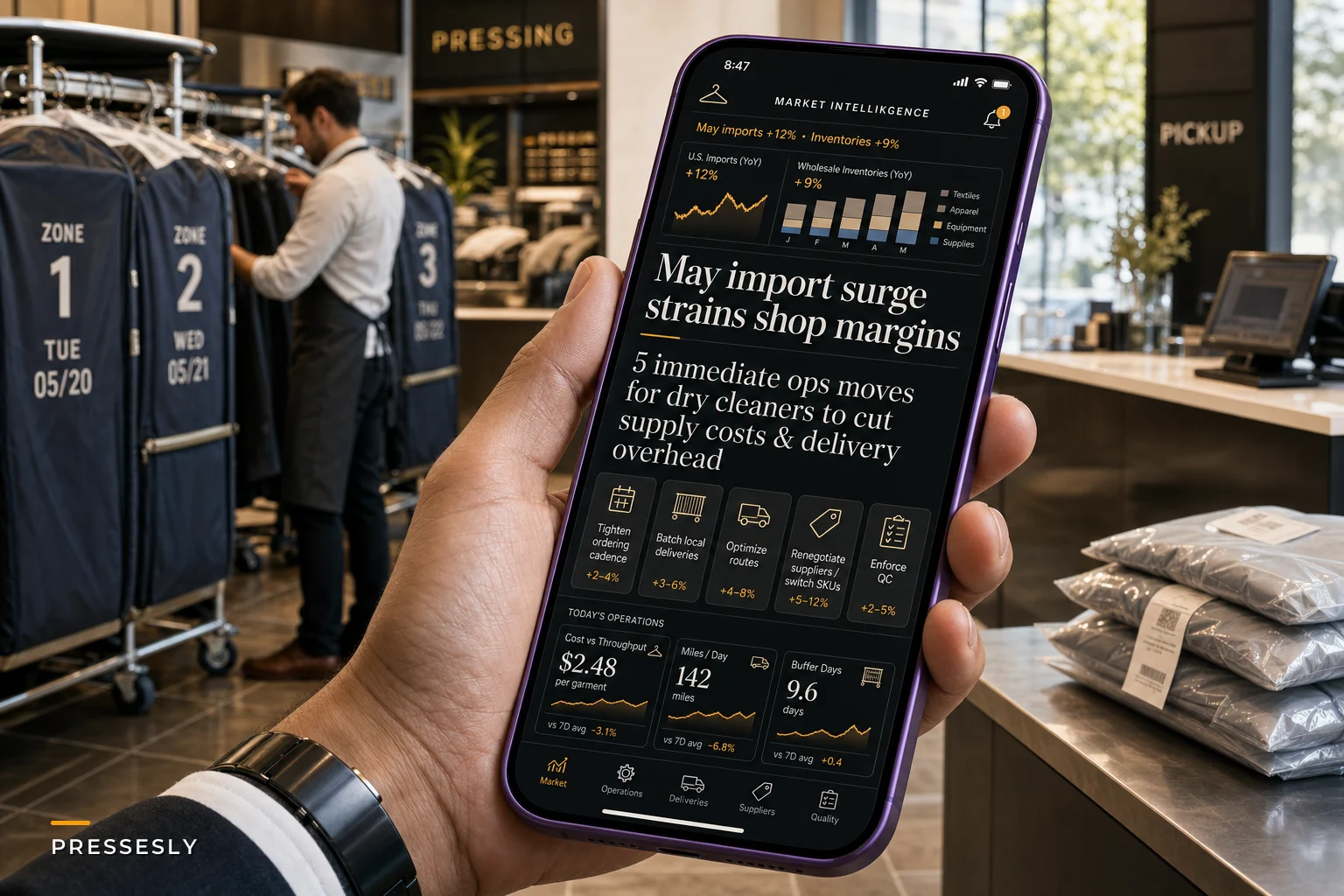

The U.S. trade deficit hit $105.8 billion in May as businesses scramble to front-load inventory before prices climb further. According to recent Reuters coverage, companies are stockpiling supplies to avoid shortages and dodge even higher costs coming down the pipeline. For dry cleaners, this means your chemical suppliers, hanger distributors, and packaging vendors are all dealing with the same bottlenecks—and passing those delays straight to you.
Last week, a cleaner in Kansas City told me their perchloroethylene costs jumped 18% overnight when their regular supplier ran out and they had to buy from a secondary vendor. Another shop in Phoenix has been waiting six weeks for replacement parts for their pressing equipment that used to arrive in ten days. This isn't isolated anymore.
The real frustration? Your supply chain dry cleaning costs are climbing while you're still charging the same $4.50 for a shirt you were two years ago. Meanwhile, you've got delivery routes to maintain, quality standards to hit, and customers expecting their clothes back on time regardless of whether your supplies showed up this week.
Why Chemical and Supply Volatility Hits Dry Cleaners Harder Than Most
Dry cleaning runs on a surprisingly fragile supply ecosystem. Unlike restaurants that can swap produce vendors or retailers that can find alternative product lines, you need specific chemicals, specialized equipment parts, and industry-standard hangers that often come from just a handful of manufacturers.
Your perchloroethylene or hydrocarbon solvent isn't something you can grab at Costco. Those poly bags and shoulder covers are manufactured in bulk runs overseas, often months in advance. When global shipping backs up or raw material costs spike, there's no easy local alternative because they simply don't exist at the volume you need.
The squeeze happens in three places at once. Your direct material costs jump—sometimes 20-30% in a single reorder cycle. You burn cash holding extra inventory because you can't risk running out of essentials. And your delivery overhead climbs as you scramble to maintain service levels with inconsistent supply availability.
A typical 3,000-garment-per-week operation might normally keep around $8,000 in supplies on hand. When lead times stretch and prices go volatile, that same shop needs $12,000-15,000 just to maintain the same buffer. That's real cash tied up that could've gone toward equipment upgrades or just stayed in your account.
Move #1: Restructure Your Chemical Ordering Cadence Around Price Locks
Most dry cleaners order chemicals monthly or when they hit a reorder point. That reactive approach kills your budget when prices swing week to week. The smarter play is negotiating quarterly price locks with commitment volumes.
Never lose track of an order again.
Pressesly helps you manage, track, and communicate every garment order seamlessly.
- Unified order management
- Real-time customer notifications
- Staff scheduling & workload tracking
No credit card required
Operationally, it looks like this: instead of ordering 55 gallons of solvent each month at whatever the current price is, you commit to 165 gallons per quarter at a locked rate. Yes, you're fronting more cash and need storage space, but you're buying predictability.
The math usually works. Say solvent runs $28/gallon today. Your supplier offers $26/gallon for a quarterly commitment of 150+ gallons. Even if you rent a small storage unit at $200/month to hold the extra inventory, you're saving around $330 per quarter on chemical alone—not counting protection against mid-quarter price spikes.
What makes this actually work is pairing it with simple consumption tracking. Monitor your real usage weekly, not just when you reorder. Most shops find they're using 15-20% less chemical than they think because they don't account for partial drums or spillage. Knowing your actual burn rate lets you negotiate commitment volumes more aggressively without risking overstock.
Monitor your real usage weekly, not just when you reorder.
What makes this actually work is pairing it with simple consumption tracking. Monitor your real usage weekly, not just when you reorder. Most shops find they're using 15-20% less chemical than they think because they don't account for partial drums or spillage. Knowing your actual burn rate lets you negotiate commitment volumes more aggressively without risking overstock.
Move #2: Build a Multi-Tier Supplier Network (Not Just a Backup Vendor)
Having "a backup supplier" isn't enough when everyone is fighting for the same limited inventory. You need suppliers operating at different scales and supply chains—think diversification, not redundancy.
Tier one stays your primary wholesale distributor, probably someone like Cleaners Supply or Fabritec. Tier two should be a regional distributor who might cost 5-10% more but sources from different warehouses. Tier three is direct relationships with manufacturers for critical items, even if minimum orders are higher.
| Tier | Allocation |
|---|---|
| Tier one | Keep roughly 60% of your volume with tier one for price efficiency |
| Tier two | 30% with tier two for availability insurance |
| Tier three | 10% testing tier three for critical items |
A shop in Tampa restructured their supply network this way and found something worth noting: their tier-two supplier, a regional outfit based in Atlanta, actually had better availability on pressing pads and spotting chemicals because they served fewer customers and kept deeper local stock. The 8% price premium was worth it to avoid stockouts.
The operational shift is splitting orders strategically. Keep roughly 60% of your volume with tier one for price efficiency, 30% with tier two for availability insurance, and 10% testing tier three for critical items. This isn't just about options when someone runs out—it's about maintaining leverage when any single supplier tries to raise prices.
Move #3: Shift from Individual Garment Packaging to Bulk Protection Systems
Every poly bag and hanger costs more when petroleum prices rise and container shipping backs up. A medium-volume shop using 500 poly bags daily at $0.03 each pre-spike might now be paying $0.045 or higher. That's an extra $250/month just in bags.
The fix is rethinking your entire packaging workflow. Instead of individually bagging every garment, implement a zone-based bulk protection system. Cleaned garments move to rolling racks with fitted rack covers—reusable, one-time purchase around $40 each. Individual poly bags only go on delivery orders and special requests.
Quick visual of the bulk protection workflow.
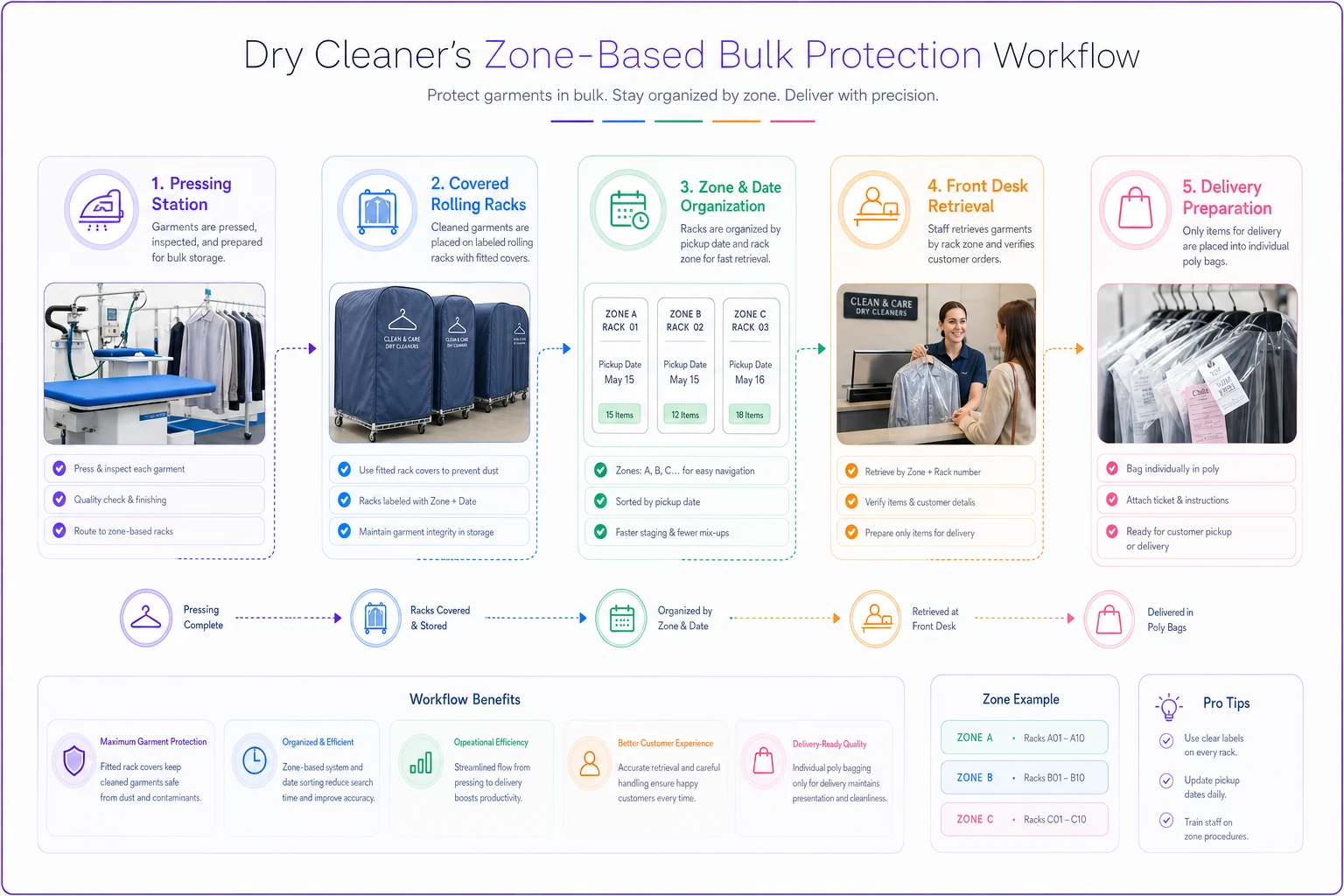
The workflow: pressing station outputs to covered racks organized by pickup date, customer notification includes their rack zone number, front desk retrieves from the right covered rack, and only bags items heading out for delivery. This cuts poly bag usage by 60-70% while actually speeding up retrieval.
One thing that surprised shops making this switch: customers tend to like it. Clothes on clean hangers in a covered rack feels more premium than plastic bags stuffed together. Several shops reported customers commenting positively, with no idea the change was driven by cost pressure.
Move #4: Convert Delivery Routes to Dynamic Density Zones
When supply costs eat into margins, delivery overhead becomes the next target. But cutting delivery service is a fast way to lose customers. The better move is restructuring how routes get built and priced.
Traditional delivery runs on fixed geographic routes—Monday is neighborhood A, Tuesday is neighborhood B. This worked when gas was cheap and inefficiency was affordable. Now you need density-based routing that concentrates stops.
Divide your service area into density zones based on stops per mile, not geography. Zone 1 might be downtown apartments with 8+ stops per mile. Zone 3 could be suburban sprawl with 2 stops per mile. Pricing and frequency adjust accordingly—dense zones get free next-day delivery, sparse zones pay a delivery fee for twice-weekly windows.
The operational gain comes from batching rules. Zone 3 orders accumulate until you hit 12+ stops, then trigger a route. Some customers wait an extra day, but they're paying a delivery fee that reflects actual cost, so the math makes sense for both sides.
For more detail on zone mapping and batching strategies, the complete guide to cutting delivery costs with route heuristics covers it thoroughly.
Move #5: Implement Chemical Recycling and Waste Reduction Protocols
When solvent costs $30+ per gallon, every drop wasted is a real number. Most shops lose 10-15% of their chemical through inefficient processes, poor maintenance, and outdated equipment settings.
Start with still maintenance. A poorly maintained still might recover 85% of solvent versus 95%+ for a well-tuned one. That's three gallons wasted per 30-gallon batch. At current prices, you're burning $90 every time you run a dirty still.
The bigger opportunity is machine loading. Most operators load by eyeball, running partial loads during slow periods. Enforcing minimum 80% capacity for standard runs—saving small loads for end-of-day batch processing—cuts chemical consumption by around 20%.
Track chemical usage per pound of garments cleaned, not per day or week. A well-run shop processes roughly 8-10 pounds of garments per gallon of solvent used (including recovery). If you're hitting 12+ gallons per 100 pounds cleaned, something is mechanically off or your processes need attention.
One thing worth noting: shops that post their chemical efficiency numbers somewhere visible see operators naturally improve consumption within a month, without any other changes. People just become more deliberate about load sizes when the numbers are in front of them.
The Real Cost of Waiting: A Portland Shop's $47,000 Lesson
A 4,500-garment-weekly shop in Portland ignored the warning signs through early 2024. They kept ordering week-to-week, maintained single-vendor relationships, and ran the same delivery routes they'd used since 2019. By the time they reacted, the damage was done.
Monthly supply costs jumped from roughly $4,200 to $6,800. Delivery overhead climbed from $3,100 to $4,200 as they made emergency runs for out-of-stock supplies. Three major customers left when stockouts caused multi-day delays. Total impact: around $47,000 in excess costs and lost revenue over eight months.
After working through the five moves above, their numbers shifted. Supply costs stabilized around $5,100 monthly—still higher than 2019 but manageable. Delivery overhead actually dropped to $2,900 through better routing. They haven't had a supply stockout in four months.
The lesson is simple: waiting multiplies the damage. Every month you operate with old ordering patterns, single suppliers, and inefficient packaging is money gone that you won't recover.
Making These Changes Stick
The hardest part isn't implementing these changes—it's maintaining them when things feel stable again. Supply costs will eventually moderate, lead times will improve, and the temptation to slide back to old habits will get strong.
The difference is building systematic operations rather than emergency responses. Document your new chemical ordering cycles. Create actual supplier scorecards tracking price, availability, and lead times. Build route density reports into your weekly reviews. These become permanent improvements, not temporary patches.
Shops navigating supply volatility well tend to share a few traits: they track metrics consistently, they test changes incrementally rather than overhauling everything at once, and they use actual systems to maintain consistency rather than relying on memory. AI-powered operational platforms designed for dry cleaners can handle a lot of this automatically—route optimization, chemical consumption tracking, reorder point predictions based on historical usage and current bookings. That kind of tooling turns a crisis response into a permanent operational upgrade.
But whether you run this through software or a spreadsheet, the principle is the same: your supply chain needs active management, not passive acceptance of whatever vendors and markets throw at you.
Your Next Seven Days
The import surge and inventory buildup patterns reported by the Census Bureau suggest supply volatility will keep intensifying through summer. Waiting for conditions to improve means accepting escalating costs in the meantime.
-
Start with Move #1. Call your primary chemical supplier tomorrow and ask about a quarterly price lock.
-
Even a modest commitment volume beats riding spot market pricing. Then pull your actual chemical consumption from the past month to establish a real baseline.
-
By next week, you should have initial conversations with at least two additional suppliers and a clear picture of your current packaging usage.
-
The routing and chemical efficiency work takes longer but delivers sustained savings. Block out time this week to map your current delivery patterns and identify which zones have density worth optimizing.
-
Schedule still maintenance if it's been more than 30 days.
Supply chain instability isn't resolving quickly. But shops that respond operationally rather than waiting on market conditions tend to come out of these cycles leaner and more efficient than they went in. The forced optimization cuts waste that was always there—you just didn't have a reason to look for it before.
These five moves put you in that position.
Ready to elevate your dry cleaning operations?
Join hundreds of dry cleaners using Pressesly to save time, reduce errors, and enhance customer satisfaction.