

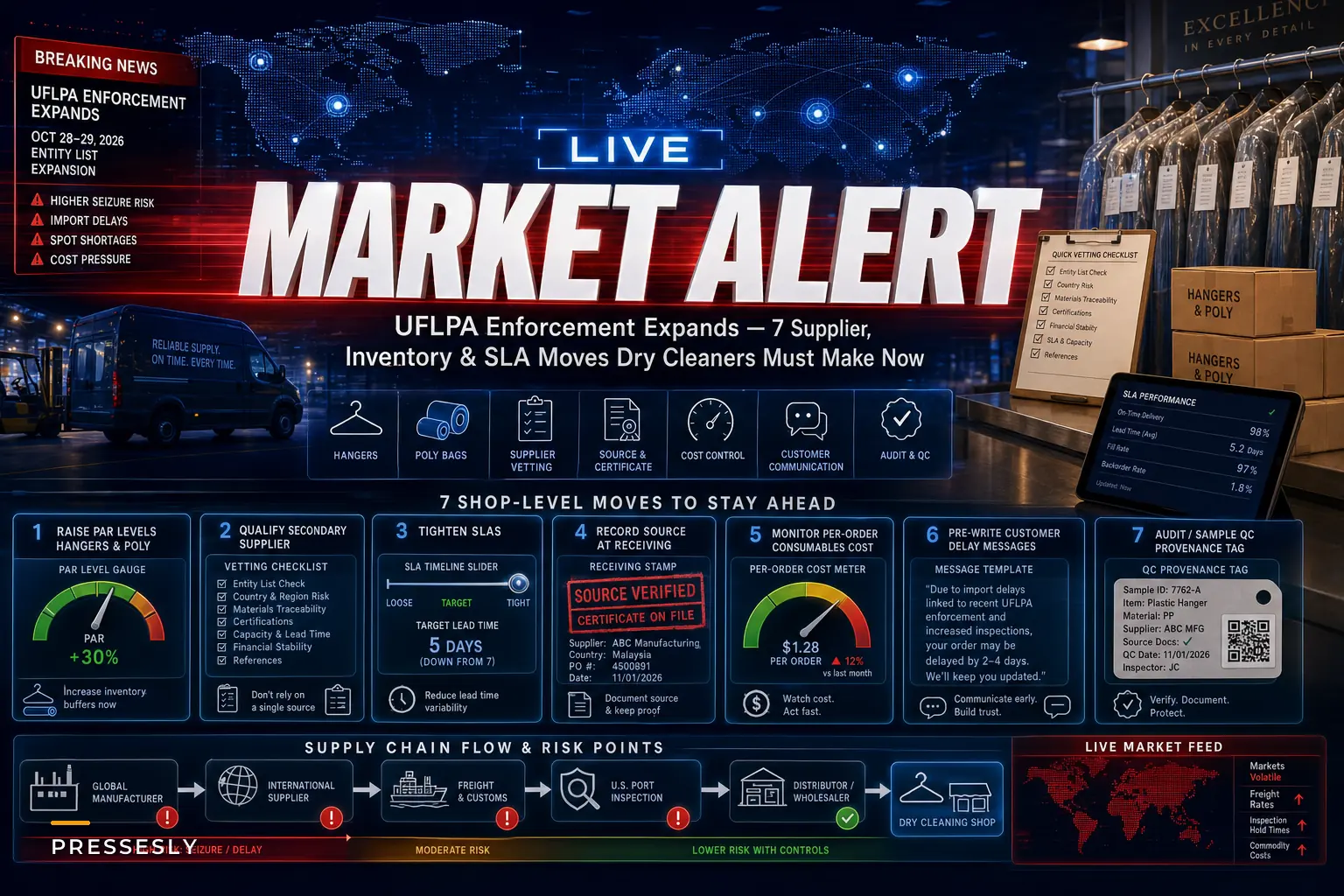

On October 28–29, 2026, the Department of Homeland Security added three more Chinese firms to the UFLPA Entity List, and Customs and Border Protection immediately began applying its rebuttable presumption — meaning shipments connected to those entities get held at the border unless the importer can prove the goods weren't made with forced labor. DHS covered it in its official announcement, and Reuters reported on the trade friction that followed in its piece on the additions.
You might be thinking: genomics companies, medical equipment firms — what does any of that have to do with hangers and poly bags? Directly, not much. But that's the wrong way to read these updates. The real story isn't which companies got added. It's that enforcement is widening, detentions are moving faster, and the paperwork burden is shifting downstream onto everyone who imports — including the distributors you buy wire hangers, poly, press pads, and solvent drums from.
The part most shops miss: your distributor doesn't have to be the one on the list. If their supplier gets caught in a presumption, your order is the one that doesn't show up. You inherit the disruption without ever touching the actual trade issue.
This post isn't about customs law. It's about what a tighter import environment exposes in how dry cleaners buy, stock, and hold vendors accountable — and seven concrete moves worth making before your next big consumables order.
The real exposure isn't customs — it's how thin your sourcing actually is
Walk through the back of most single-site shops and you'll find the same quiet vulnerability: nearly every consumable traces back to one distributor, and that distributor leans heavily on imports. Wire hangers especially. A huge share of the wire and finished hangers moving through U.S. dry-cleaning supply channels originates overseas. Same with a lot of poly film and some specialty pressing supplies.
That concentration works fine when ports run smoothly. The problem is it's invisible until it isn't. You don't notice you have a single point of failure until a container gets detained and your rep calls to say the hanger order "slipped two weeks" with no firm reship date.
Most shops treat consumables as an afterthought. They're low-dollar per unit, they always show up, so nobody builds a buffer or a backup. Then lead times stretch from a few days to a few weeks, and suddenly you're bagging finished orders in whatever poly you can grab from a hardware store at triple the cost.
The underlying issue isn't the law. It's supplier fragility that nobody priced in. UFLPA enforcement is just the thing making that fragility visible this quarter.
Where dry cleaners actually get hit
Before the moves, it's worth being specific about where the pressure lands. Not everything in your supply closet carries the same exposure.
Never lose track of an order again.
Pressesly helps you manage, track, and communicate every garment order seamlessly.
- Unified order management
- Real-time customer notifications
- Staff scheduling & workload tracking
No credit card required
| Input | Import exposure | Typical lead-time risk if disrupted | Local/US substitute available? |
|---|---|---|---|
| Wire & finished hangers | High | 2–4 weeks | Partially — some domestic, higher cost |
| Poly bags / garment film | High | 1–3 weeks | Yes, but MOQs and price jumps |
| Solvent (perc/hydrocarbon/alt) | Medium | Varies by chemistry | Regional distributors, limited |
| Press pads, covers, filters | Medium | 2–5 weeks | Some domestic sources |
| Equipment parts (boiler, press, machine) | High | 3–8 weeks+ | Rare for proprietary parts |
| Detergents / spotting agents | Low–Medium | 1–2 weeks | Mostly domestic |
The items that bite hardest are the ones that are both high-exposure and slow to substitute: hangers, poly, and equipment parts. Equipment parts in particular — a detained specialty part can idle a press for weeks, and there's rarely any local shelf stock to pull from.
That table is the map. The seven moves below are about shoring up the high-risk rows before they fail.
The 7 moves
1. Raise par levels on your two or three highest-exposure consumables — not everything
The instinct when supply feels shaky is to over-order across the board. Don't. Tying up cash in slow-moving detergent just to feel prepared is the wrong trade.
Pull the high-exposure, fast-turning items off the table above and raise par on those specifically. For most shops that's hangers and poly. If you normally hold a two-week supply, push safety stock on those two to cover four to six weeks of a normal run — enough to ride out a detention-driven delay and a full reorder cycle.
A rough way to size it: take your weekly usage, multiply by the new worst-case lead time, and add a buffer. If you run through roughly 1,800 hangers a week and lead time could stretch to three weeks, your reorder point needs to sit around 5,400 units plus whatever buffer helps you sleep. The exact number matters less than the principle — you reorder before you'd run dry at the longer lead time, not after.
The mistake to avoid: raising par without raising the reorder trigger. Shops bump the max and leave the reorder point where it was, so they still order late, just in bigger batches. Move both numbers.
2. Line up a second source for hangers and poly now — before you need it
The worst time to find a backup supplier is the week your primary one fails. Prices are jumpy, MOQs are inflated, and you're negotiating from desperation.
Source a secondary vendor while you still have stock. You don't have to move volume to them — just qualify them. Get a sample order, confirm pricing holds at a small quantity, verify they can actually ship on a normal timeline. A backup you've never placed an order with isn't a backup; it's a phone number.
Where possible, bias the secondary toward domestic or regional supply even if it costs more per unit. The premium on a US-sourced hanger is real, but it's cheaper than emergency-bagging orders in retail poly or losing a day of finished-goods throughput.
3. Ask every consumables vendor one direct question — and get it in writing
Here's the question: "If any of your upstream suppliers get caught in a UFLPA detention, what's your backup, and how fast can you reship?"
Most reps will give you a vague "we don't anticipate any issues." That's not an answer. Push for specifics — do they dual-source? Do they hold domestic safety stock? What's the realistic reship timeline if a container is held?
A vendor's answer tells you how fragile they are, which is really what you're buying. Two distributors can quote the same hanger price, and one of them is a single detained container away from failing you. You can't see that from the invoice. You can only see it by asking — and by watching whether their answers hold when things actually get tight.
4. Tighten supplier SLAs so delays cost them something
A handshake "we usually ship in three days" means nothing when the supply chain seizes up. Put the expectations in writing, and attach consequences.
A real scorecard earns its keep here. Define the fill rate, the on-time ship percentage, the notification window for any delay, and what happens when they miss. Track it month over month so you're making renewal and volume decisions on data, not on who you like talking to. If you haven't built one yet, the framework in our SLA and scorecard playbook for tailors, haulers and suppliers lays out the exact metrics worth holding vendors to and how to run the review cadence without it becoming a chore.
-
Advance delay notice vendor must flag any expected delay within 48 hours of knowing, not after the ship date passes
-
Provenance documentation on request they can produce sourcing/country-of-origin paperwork if you ask
-
Substitution rights you can source elsewhere without penalty if they miss the committed date
-
Price-hold window quoted pricing holds for a defined period so a disruption can't quietly become a surprise surcharge
Key SLA terms to add in a tightening import climate:
5. Rework receiving to actually record where things came from
Most shops receive a consumables shipment by checking the count and tossing the packing slip. That's fine until you need to know fast which of your hangers came from which source — for example, if a vendor notifies you of a supply issue after the fact.
Add two fields to your receiving routine: source/vendor and lot or ship date. Ten seconds at intake, and you have traceability you'll be glad to have. If a supplier later says a batch is affected, you can see exactly how much you're holding and from where instead of guessing.
Log supplier and ship date at intake immediately — it takes seconds and prevents hours of tracking later.
Shops running a digital inventory or receiving log pull ahead here — logging supplier and date at receiving means par levels, reorder triggers, and source history all live in one place instead of on a clipboard that gets lost. The point isn't the software. The point is that provenance data is only useful if you capture it the moment the box hits the dock.
6. Protect your COGS from quiet price creep
Supply disruptions rarely show up as a dramatic shortage. More often they show up as slow margin erosion — the per-unit cost on poly ticks up, a fuel or handling surcharge appears, MOQs climb so you're forced into bigger orders. None of it is alarming on its own. Add it up over a quarter and your consumables line is noticeably heavier.
Build a simple monthly check: track your per-order consumables cost (hangers plus poly plus packaging divided by orders processed). If that number drifts up more than a few percent without you deciding it should, something changed in your supply chain and you want to catch it early — not at year-end when the damage is already done.
When costs genuinely rise and hold, decide deliberately whether to absorb it or adjust pricing. Don't let it silently eat your margin for months because each individual increase felt too small to react to.
7. Pre-write the customer message you hope you won't need
If a delay hits and you have to swap to plain poly or push a few turnaround times, the difference between a shrug and a complaint is almost entirely communication.
Draft the message now, while you're calm. Something short and honest: a brief note that supply conditions have temporarily affected packaging or timing, that garment quality is unaffected, and that you appreciate their patience. Keep it ready to send by text or post at the counter.
Customers tolerate almost any temporary inconvenience they're told about in advance. What they don't tolerate is finding out at pickup that their suit is in a different bag and nobody mentioned it. Getting ahead of it costs you five minutes of writing today.
Below is a simple workflow to follow when implementing the seven moves.
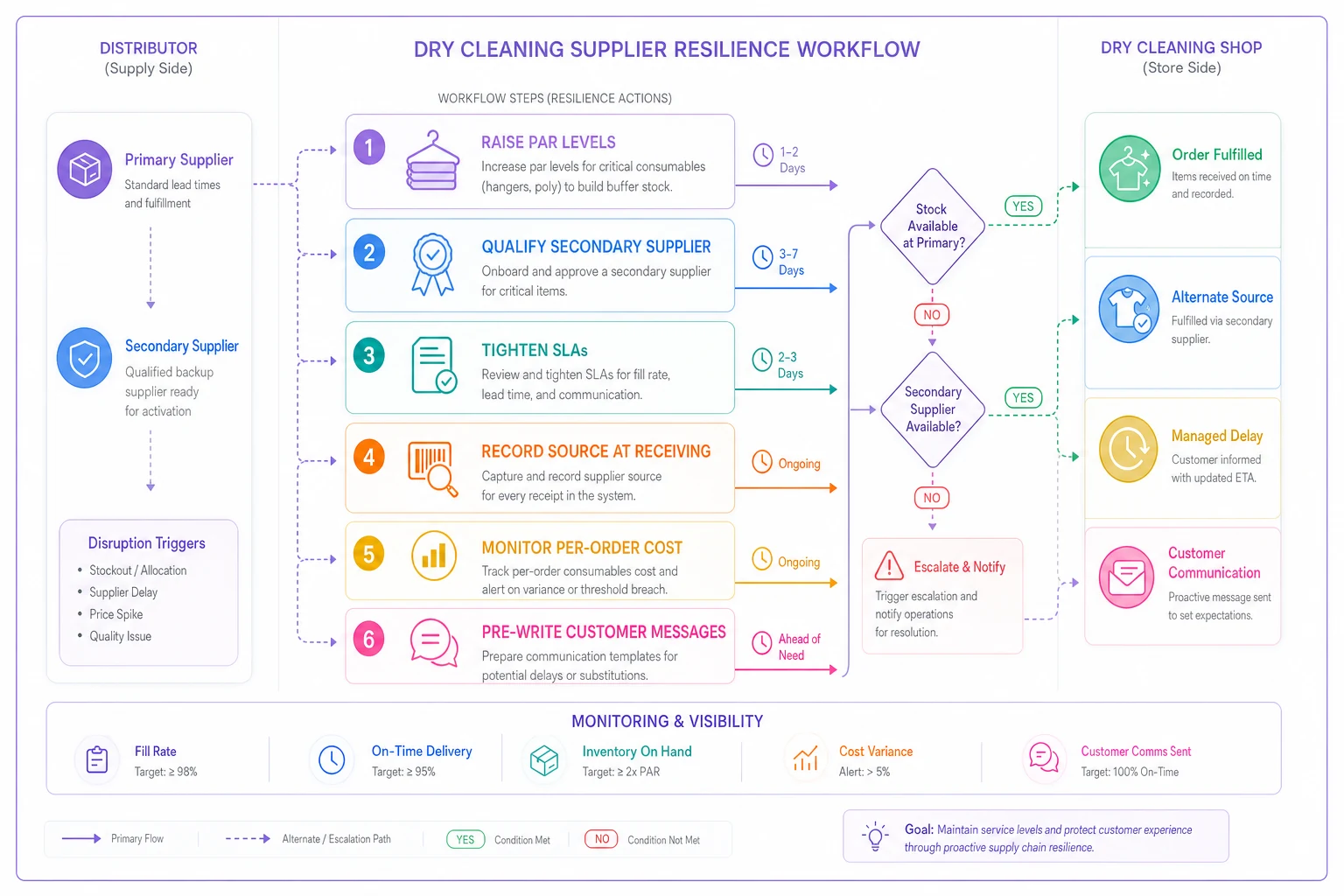
The graphic above maps the practical sequence: secure stock, qualify backups, formalize expectations, capture provenance, and monitor costs.
A real scenario
A two-location shop in a mid-size metro ran everything through a single regional distributor — hangers, poly, press supplies. Comfortable relationship, fine prices, never a reason to look elsewhere.
During an earlier enforcement-driven slowdown, that distributor's hanger shipment got held up. The rep gave a soft "couple weeks" with no firm date. The shop had maybe eight days of hangers on hand. They ended up buying finished hangers retail at roughly double their normal unit cost for about three weeks — somewhere in the range of $1,400–$1,800 in extra consumables spend across both sites, plus a few frustrated commercial accounts who noticed the packaging change.
Afterward they did three things: qualified a domestic secondary hanger source, raised par on hangers and poly to roughly a month of cover, and added supplier and ship-date fields to receiving. Next time their primary slipped, they placed one order with the backup, kept bagging as normal, and the customer-facing impact was basically zero. The fix wasn't expensive. It was just earlier.
When these moves make sense — and when they don't
Worth doing now if:
-
Hangers, poly, or parts come through a single import-reliant distributor
-
You're heading into a busy Q4 run with thin consumables buffers
-
You've had even one "it slipped a couple weeks" surprise this year
Probably overkill if:
-
You already dual-source your high-exposure items and track vendor performance
-
You run mostly domestic-sourced consumables with proven short lead times
-
Your cash is genuinely tight — in that case, do moves 2, 3, and 4 (they're nearly free) and skip the heavy par increases for now
Who should be careful: shops tempted to panic-stock everything. Over-ordering slow-movers to feel safe just converts a supply risk into a cash-flow problem. Be surgical — protect the high-exposure, fast-turning, hard-to-substitute items and leave the rest alone.
Bottom line
The entity-list update itself probably won't touch your supply closet directly. But it's a clean reminder that the consumables you treat as automatic are riding on import chains you don't control and can't see. The shops that come through tightening enforcement windows without much drama aren't the ones with insider trade knowledge — they're the ones who already raised par on the right two items, qualified a backup, and held their vendors to written commitments.
None of these seven moves are expensive or complicated. Most are a phone call, a receiving-sheet tweak, or a monthly number to watch. Do them while things are quiet, and the next detention headline becomes something you read about instead of something you live through.
Ready to elevate your dry cleaning operations?
Join hundreds of dry cleaners using Pressesly to save time, reduce errors, and enhance customer satisfaction.