


The delivery driver called me at 8:47 AM last Tuesday. "I can't get through downtown — every loading zone has a truck double-parked."
That wasn't unusual for the shop on Wilshire Boulevard I was helping optimize. What made it different was hearing the same complaint from three other shops that same morning — one in Denver, one in Houston, another in Seattle. Different cities, same problem: local delivery networks getting crushed.
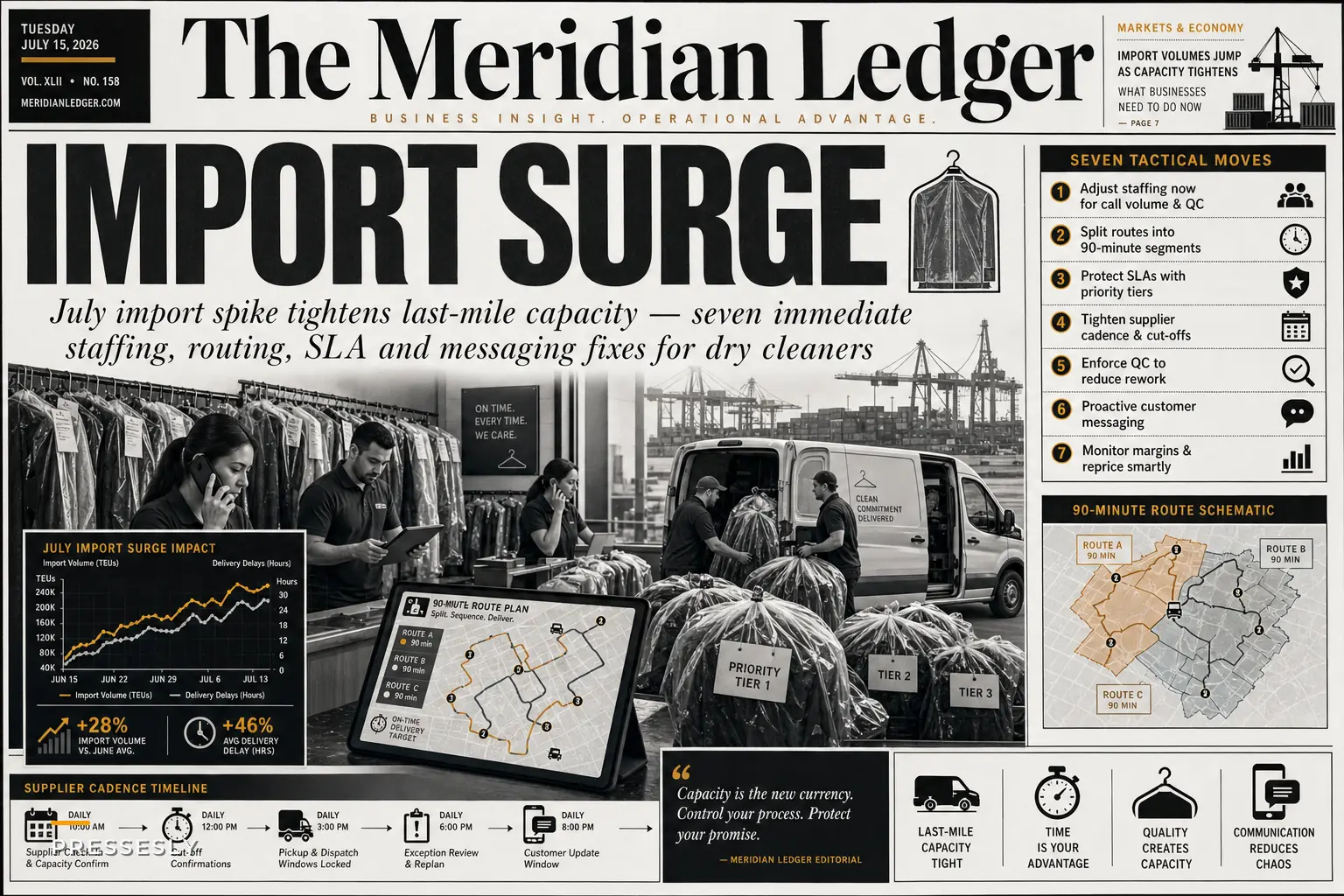
Reuters reported that container imports jumped 8% in June, with July expected to hit record volumes. For dry cleaners running pickup and delivery routes, this creates an operational crunch that most owners won't see coming until drivers start missing time windows.
The cascade effect is worth understanding before we get into fixes, because most people underestimate how quickly port congestion travels from a dock in Long Beach to a loading zone on your street.
The cascade effect
Port congestion doesn't stay at the port. When containers stack up at Long Beach or Newark, the ripple hits local streets within days. Big box retailers push emergency shipments through expedited carriers. Amazon flexes its entire logistics network. FedEx and UPS max out capacity.
Then comes the part that wrecks your week: all that overflow dumps onto local courier networks and gig delivery platforms. The same drivers you rely on for Tuesday pickups suddenly have surge-priced offers from a dozen other businesses. Your regular courier starts quoting 48-hour turnarounds. Third-party platforms show "no drivers available" during peak afternoon hours.
This played out at a shop in Austin during the 2021 shipping crisis. Their delivery completions dropped from 94% to 71% in a single week — not because their process broke, but because every available driver in the city was making $35/hour delivering Target orders instead of $18/hour running dry cleaning routes.
Why the usual fixes won't cut it
Most dry cleaners respond to delivery pressure the same way: hire temp drivers, extend windows, or eat the cost of expedited shipping. These moves work during normal seasonal fluctuations. Under import surge conditions, you're competing against businesses with much deeper pockets for the same constrained resources — and you'll lose that competition every time.
Never lose track of an order again.
Pressesly helps you manage, track, and communicate every garment order seamlessly.
- Unified order management
- Real-time customer notifications
- Staff scheduling & workload tracking
No credit card required
A shop owner in Phoenix tried hiring two temporary drivers last summer during a similar crunch. Both quit within three days when DoorDash offered guaranteed minimums that beat her hourly rate by 40%. Another shop in Portland switched to a premium courier service, watched costs triple, then found out the "premium" service was just subcontracting to the same overwhelmed gig drivers anyway.
The core problem isn't finding drivers — it's that dry cleaning delivery economics assume stable capacity and predictable costs. When ports forecast record July volumes, those assumptions fall apart fast.
Move #1: Split your routes before the squeeze hits
Standard practice says to optimize routes by geography. During capacity crunches, you need to optimize by driver availability windows instead.
What works: take your existing routes and break them into 90-minute segments any driver can complete. Instead of one driver owning the "north side route" all day, you create modular segments that different drivers can pick up based on availability.
A shop near LAX did this after losing their main driver. They went from needing three full-time drivers to using eight part-time drivers, each handling two or three segments per week. When surge pricing hit, they could swap segments without rebuilding entire routes from scratch. On-time delivery stayed above 87% even when two drivers called out sick on the same day.
The detail most people miss: you need overlapping pickup and delivery windows between segments. If segment A ends at 11:30 and segment B starts at 11:30, you've built a failure point. Add 20-minute buffers so drivers can actually complete handoffs without racing.
Add 20-minute buffers between segments to ensure handoffs aren't rushed.
A simplified view of how this segmentation looks in practice:
| Route Segment | Time Window | Buffer | Driver Requirement |
|---|---|---|---|
| Segment A | 8:00 – 9:30 AM | 20 min | Any qualified driver |
| Segment B | 9:50 – 11:20 AM | 20 min | Any qualified driver |
| Segment C | 11:40 AM – 1:10 PM | 20 min | Any qualified driver |
| Segment D | 1:30 – 3:00 PM | 20 min | Any qualified driver |
| Segment E | 3:20 – 4:50 PM | 20 min | Any qualified driver |
The goal is a route structure where losing one driver means losing one segment — not losing the entire day.
Move #2: Create driver pools, not driver schedules
Stop scheduling individual drivers for specific shifts. Start building pools for time blocks.
Instead of "Tony handles Tuesday afternoons," maintain a pool of four or five drivers qualified for Tuesday 2–6 PM. When surge conditions hit and Tony picks up a $200 Amazon Flex block, you've got backups already trained on those routes.
The math matters here. Most shops need roughly 1.5x backup coverage for normal operations. During import surges, you need closer to 2.5x minimum. That sounds like overkill until you run the numbers — ten drivers each working ten hours a week costs less than overtime for four drivers covering 50-plus hour weeks when things spike.
A Denver shop learned this the hard way. Four regular drivers, no backup pool. When cannabis dispensaries started offering $30/hour for delivery work, they lost three drivers in one week. Building the pool in advance would've cost a few hundred dollars a month in training and occasional shifts. Instead, they paid over $3,000 in emergency courier fees that month.
Move #3: Pre-negotiate surge pricing caps now
Every third-party courier will hit you with surge pricing when capacity tightens. The difference between shops that survive and shops that bleed money is who negotiated caps ahead of time.
Call your courier contacts this week — not when the surge hits. Get written agreements on maximum surge multipliers. Most couriers will agree to 1.5x caps for established customers if you guarantee minimum weekly volumes. Without that cap, you're looking at 2.5x or 3x pricing when desperation sets in.
One tactic that actually works: offer to pay 10% above standard rates year-round in exchange for surge protection. A shop in Miami Beach ran this math — paying an extra $340/month normally to avoid $2,800 surprise charges during surge weeks. The courier agreed because it smoothed their revenue. The shop came out ahead by several thousand dollars over the year.
Move #4: Implement "delivery holding patterns" for high-value customers
Airlines use holding patterns when airports get congested. Your delivery operation needs the same concept.
Identify your top 20% of customers by lifetime value. When capacity drops, these customers get priority routing. But instead of just bumping them to the front, you create holding patterns where their orders wait for the next available premium slot rather than getting dumped into a vague delayed delivery queue.
-
Priority hold (top 20% customers)
Orders wait up to 4 hours for the next premium slot
-
Standard flow (middle 60%)
Normal routing rules apply
-
Flex delivery (bottom 20%)
Can be pushed 24–48 hours if needed
A shop in Boston ran this during a blizzard. Instead of disappointing their best customers with vague delay messages, they communicated "your order is in priority queue" — and delivered within the original window 78% of the time, even with half their drivers out. The tiering is simple to set up and makes a real difference in who you're protecting when capacity gets tight.
Move #5: Build inventory buffers for volume accounts
Commercial accounts hate delivery uncertainty more than price increases. Tell a hotel you might miss their Tuesday linen delivery and they start shopping competitors before you hang up.
The fix: pre-position inventory at volume accounts before surge periods hit. If the Marriott usually needs 200 pounds of linen weekly, deliver 280 the week before. They hold the excess, you buy yourself a buffer if deliveries slip.
This needs coordination and some trust, but the economics hold up. A shop in San Diego tested this with three hotels. Holding costs for the extra inventory ran about $50 per hotel per week. The saved delivery runs during surge pricing saved around $400. Plus, zero panicked calls from hotel managers threatening to switch vendors.
It's a small operational shift, but it removes one of the most stressful pressure points during a crunch.
Move #6: Dynamic customer communication (that actually works)
Everyone says to communicate with customers during disruptions. Almost no one explains what works versus what makes things worse.
Bad: "Due to industry conditions, deliveries may be delayed."
Good: "Tuesday delivery scheduled 2–4 PM. If we can get there earlier, we'll text you. Reply FLEX if 4–6 PM works better."
The difference is giving customers some control instead of just uncertainty. When people feel helpless, they complain. When they have options, they adapt.
Three templates worth building:
Template A (24 hours before delivery): "Tomorrow's delivery confirmed for [TIME]. Reply CHANGE if you need a different window."
Template B (Day of, if running late): "Running 30 mins behind. New arrival: [TIME]. Reply DOOR if we should leave at door."
Template C (If missing window entirely): "Can't make today's window. Priority delivery tomorrow AM, or reply CREDIT for $10 account credit."
The credit option sounds costly but runs cheaper than losing the customer. A Chicago shop tracked this — customers who received credits after delays had 85% retention. Customers who just got apologies had 61%. That gap adds up fast when you're dealing with repeat customers.
Move #7: Staff the phone, not the truck
Counter-intuitive, but proven: during delivery crunches, moving staff from trucks to phones saves more money than adding drivers.
When delivery capacity drops, customer service calls spike. Every call is someone anxious about their order. If they can't reach anyone, they assume the worst. If they reach a person who can check status and adjust delivery, most of them relax.
A shop in Nashville proved this during tornado season. They pulled one driver off routes to handle phones full-time. That person prevented over 40 cancellations in a single week by simply answering calls and rescheduling. The lost delivery capacity from one fewer truck was nothing compared to keeping 40 customers from walking.
Here's roughly how the operational flow looks when you apply all seven moves together:
IMPORT SURGE DETECTED ↓ Split routes into 90-min segments ↓ Activate driver pool (not fixed schedule) ↓ Confirm surge pricing caps with couriers ↓ Apply customer priority tiers (A / B / C) ↓ Pre-position inventory at volume accounts ↓ Deploy communication templates (A / B / C) ↓ Shift one staff member to phone coverage ↓ Monitor delivery margins in real time
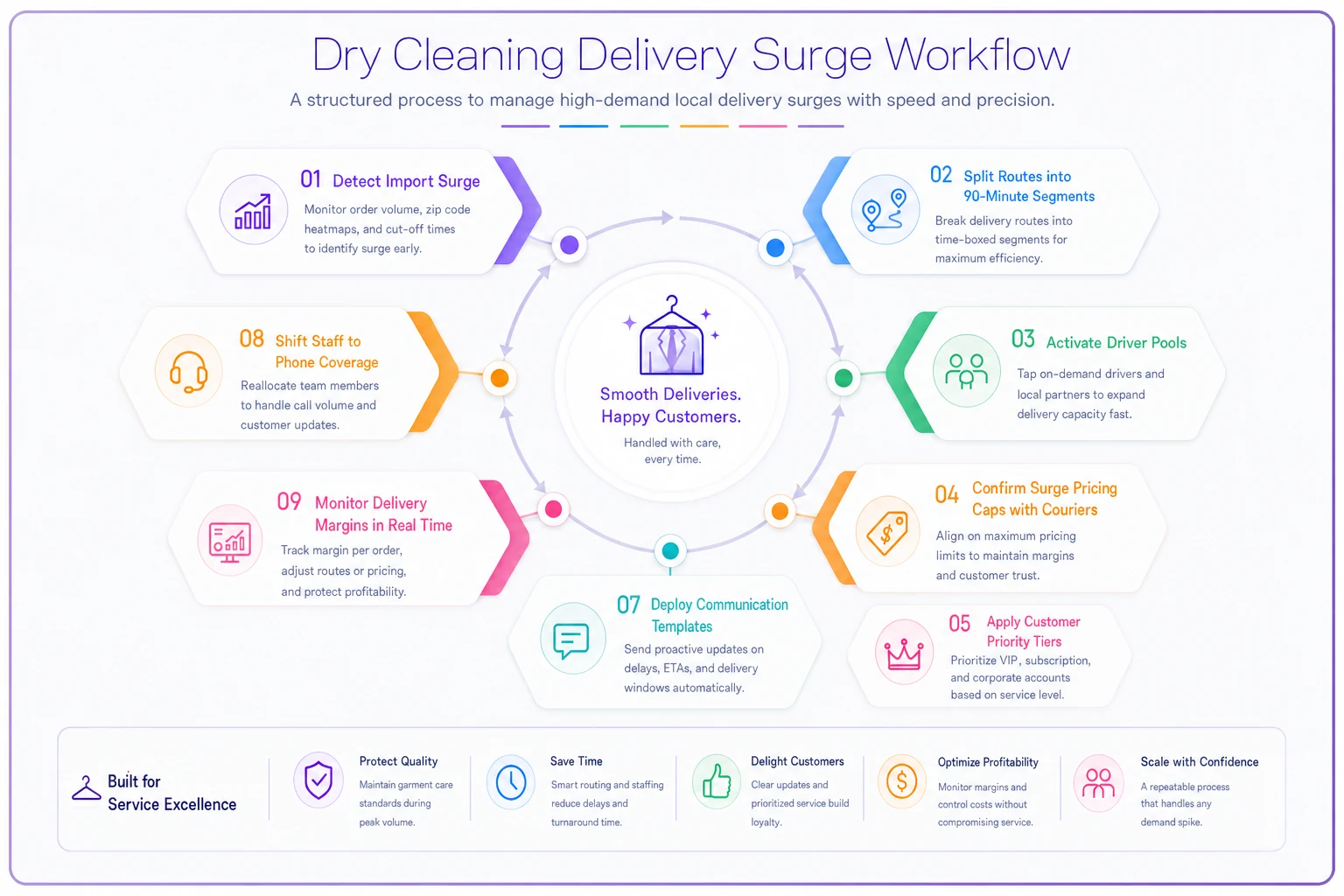
Each step triggers the next. The shops that get through surges cleanly are the ones that run this as a sequence, not a series of last-minute reactions.
The technology piece that makes this manageable
Coordinating seven operational adjustments during a live delivery crisis breaks most manual systems. Shops running spreadsheets and paper routes can't pivot fast enough when conditions are changing by the hour.
This is where AI-powered operational software earns its keep. Instead of manually juggling driver pools, surge pricing contracts, and customer communications across different tools, you want a system that can automatically flag when surge pricing exceeds negotiated caps, reassign routes when drivers drop out, trigger customer messages based on delivery status, and give you a real-time margin read on each delivery decision.
The shops that got through previous import surges without serious margin damage had operational visibility when it counted. They could see degrading metrics before customers noticed service gaps — which meant they could pull triggers on backup plans early instead of reacting after things broke.
A Seattle shop implemented delivery management software about three months before the 2021 shipping crisis. During their worst week, margins only dropped around 8% while competitors saw 20–30% compression. The difference was being able to see delivery costs spiking in real-time and immediately shift to batched deliveries for non-priority customers. Their zone mapping system automatically grouped orders to minimize driver miles when capacity tightened.
What happens if you do nothing
The import surge isn't theoretical. Container ships are already stacking up at ports. The cascade into local delivery networks typically takes two to three weeks from peak port congestion.
Shops that wait until they feel the squeeze will face emergency courier costs at 3x normal rates, lost customers who can't get deliveries, blown margins from expedited shipping, staff burnout from complaint volume, and commercial accounts jumping to whoever can guarantee service.
Shops that get ahead of even half these moves will hold service levels and protect margins when competitors are scrambling.
The timeline that matters
Two weeks is roughly what you have before July import volumes fully hit local delivery networks. Here's the priority order:
Week 1:
-
Call couriers about surge pricing caps
-
Break routes into 90-minute segments
-
Set up customer communication templates
-
Identify top 20% of customers for priority routing
Week 2:
-
Build driver pools for each time block
-
Pre-position inventory at volume accounts
-
Train one person for full-time phone coverage
-
Test your backup routing plans
The shops that come through import surges without serious damage don't have better drivers or bigger budgets. They have better plans, and they move before the crisis arrives.
Most dry cleaners will read about the import surge, worry for a day, and go back to normal operations until drivers start missing deliveries. A few will spend the next two weeks building contingencies that protect their margins when everyone else panics.
Spend a few hours now, or spend a few thousand dollars fixing emergencies later.
Ready to elevate your dry cleaning operations?
Join hundreds of dry cleaners using Pressesly to save time, reduce errors, and enhance customer satisfaction.