

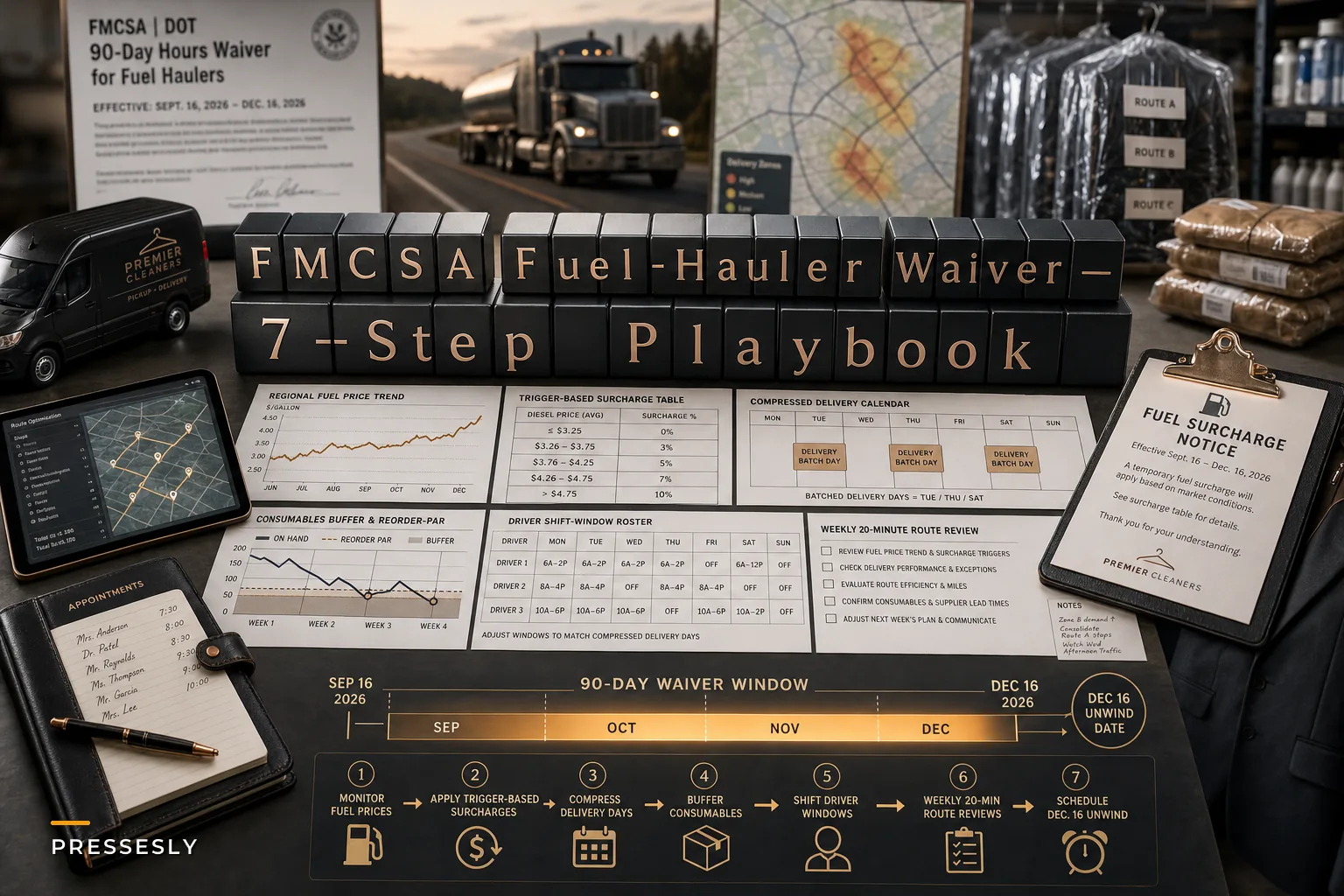

When the FMCSA cleared fuel‑hauling drivers to run up to 16 hours in a 24‑hour window from Sept. 16 through Dec. 16, 2026, most of the coverage framed it as a trucking story. Reuters reported it as an emergency step to keep gasoline and diesel moving amid supply pressure, and the official waiver document spells out the hours‑of‑service relief in plain regulatory language.
What most shop owners miss is that the waiver itself doesn't matter to them. What matters is why regulators felt they had to issue it. You don't ease rules on fuel drivers when supply is comfortable. You do it when distribution is tight enough that someone in Washington is worried about pumps running dry or prices spiking in pockets. That's the real signal — and it reaches your delivery routes faster than it reaches the news.
This isn't a "gas is expensive, raise prices" post. We already covered the broad playbook in When Pump Prices Jump: 7 Immediate Delivery, Staffing and Pricing Moves Dry Cleaners Should Use. This one is narrower: what a short‑run capacity event — a 90‑day window of fuel uncertainty — actually does to a small delivery operation, and seven moves that let you absorb it without eating the cost yourself.
What a waiver like this is really telling you
A fuel‑hauler hours waiver is a capacity patch. Regulators are letting drivers stretch their shifts because there aren't enough driver‑hours to cover delivery demand under normal limits. Translate that into your world and it means two things are probably about to wobble at the same time:
-
Pump prices get jumpy and uneven. Not necessarily higher everywhere — jumpy. One station near your route holds steady, another two miles away jumps 30 cents because its delivery slipped a day. That unevenness is the part that breaks naive surcharge rules.
-
Your consumables carrier may re‑prioritize. The same tightness that pushed the waiver can nudge local LTL and parcel carriers to protect their high‑value, high‑density routes first. Your detergent, hanger, and poly delivery doesn't get cancelled — it just quietly slides from Tuesday to Thursday, and nobody calls to tell you.
Treating this as purely a price story is a mistake. It's really a timing story. The cost per gallon is annoying. The 1–2 day drift in your consumable restocks and the compressed pickup windows are what actually blow up an SLA.
The underlying problem: your delivery economics are built for a stable week
Most single‑shop and small‑fleet delivery operations are tuned for a predictable week. You know roughly what fuel costs, roughly how many stops a driver clears per hour, and roughly when your supplier truck shows up. The whole thing runs on quiet assumptions.
Never lose track of an order again.
Pressesly helps you manage, track, and communicate every garment order seamlessly.
- Unified order management
- Real-time customer notifications
- Staff scheduling & workload tracking
No credit card required
A 90‑day capacity event breaks those assumptions in a way that's too short to justify restructuring your whole route, but too long to just ride out. That's the awkward middle. Overreact and you're annoying customers with surcharges and tighter windows for no real reason. Underreact and you absorb three months of margin leak that never shows up as one big number — just a slightly worse delivery line every single week.
Here's a quick comparison of how a stable week versus a capacity‑stress week actually behaves on a small route:
| Factor | Stable week | Capacity‑stress week (waiver conditions) |
|---|---|---|
| Fuel cost variance across your route | ±3–5% | ±10–20%, station to station |
| Consumable delivery reliability | On expected day | 1–2 day drift, no notification |
| Stops per driver‑hour | Predictable | Lower, due to longer refuel detours |
| Surcharge logic needed | Flat or none | Trigger‑based, reviewed weekly |
| Customer comms needed | Minimal | Proactive on any window change |
The column on the right is your next 90 days. The playbook below is about moving from the left column to the right deliberately instead of getting dragged there.
The 7‑step short‑run playbook
These are shop‑level moves. None of them require new vehicles, new hires, or a routing overhaul. They're meant to be stood up in a few days and torn down when the window closes in December.
Step 1: Set a fuel‑trigger surcharge instead of a flat one
A flat delivery surcharge during a jumpy‑price period is almost always wrong — either too high and you lose price‑sensitive customers, or too low and you eat the difference. Tie it to a trigger instead.
Pick a reference: a regional average diesel/gas price you can check weekly. Set a threshold where the surcharge kicks in, and a ceiling where you re‑evaluate. A realistic structure looks something like this:
-
Below your baseline (say, whatever you were paying in early September)
no surcharge.
-
8–15% above baseline
small per‑delivery surcharge (often $1.50–$2.50 on a residential route).
-
Above 15%
review routing and batching before adding more surcharge — don't just keep raising it.
The trigger protects your relationship with customers. "We add a small fuel adjustment when regional prices climb past a set point, and remove it when they drop" is a reasonable thing to tell someone. A permanent fee that quietly lingers through a 90‑day event is the kind of thing that ends up in a bad review.
Step 2: Compress your delivery days, not your delivery promise
The instinct under fuel stress is to cut the promise — go from next‑day to two‑day delivery. Don't lead with that. Lead with fewer, denser days.
If you're currently running deliveries five days a week with light routes, collapsing to three fuller days usually beats stretching your SLA. Denser routes mean more stops per gallon, which is the single biggest lever available during a fuel event. You keep the delivery promise intact for the zones you serve on their assigned days — you just shift which days those are.
Step 3: Build a 10‑day consumables buffer on your two most delivery‑sensitive items
You don't need to hoard. You need to protect the two or three items whose stockout actually stops you from delivering: poly bags, hangers, and whatever detergent or solvent you'd scramble for. If your supplier's carrier is going to drift 1–2 days, a 10‑day buffer on those specific items turns a potential crisis into a non‑event.
This is narrower than a full par‑level overhaul. It's a short‑run buffer on the handful of SKUs tied directly to getting garments out the door. Everything else can run on its normal rhythm.
Step 4: Shift your driver window to match carrier behavior
The waiver means fuel trucks and other carriers may be running longer, odder hours — which can actually work in your favor if you adjust. If your consumable deliveries start arriving later in the day because carriers re‑sequenced their routes, pushing your driver's start time back an hour might let you load restocks the same morning instead of waiting a day.
Worth watching: track the actual arrival time of your supplier truck for two weeks. If it's consistently drifting, stop scheduling around a delivery window that stopped being real. Small shops lose a surprising amount of capacity that way.
Step 5: Pre‑write your "window changed" customer message
The single cheapest margin protector in a capacity event is a message you've already written. When a pickup or drop‑off window moves, the damage isn't the delay — it's the silence. A customer who gets a heads‑up text absorbs a 2‑hour slip fine. The same customer who finds out by the driver not showing up calls to complain, and sometimes churns.
Have two templates ready: one for "your delivery window shifted by a few hours," one for "your delivery moved to the next scheduled day." Keep them factual, no over‑apologizing. The goal is to make the change feel managed, not chaotic.
Step 6: Add a weekly 20‑minute route review for the duration of the window
Put a recurring 20‑minute review on the calendar. Look at three numbers only:
-
Fuel cost per delivery, versus your baseline
-
Average stops per driver‑hour
-
Any consumable that drifted or ran short
That's it. The point isn't deep analytics — it's catching drift while it's small. A capacity event does its damage slowly. A weekly glance is enough to decide whether to tighten batching, adjust the trigger surcharge, or just do nothing.
Step 7: Set a hard end date to unwind everything
Write "Dec. 16" on every temporary change you make. Surcharges, compressed days, buffers — all of it. The failure mode with short‑run moves isn't making them; it's forgetting to remove them. The surcharge that made sense in October is quietly annoying your customers in February. Treat the whole playbook as temporary, tied to the waiver window, and schedule the unwind now.
Here's a simple workflow visualization of the seven steps to help coordinate execution across the 90‑day window.
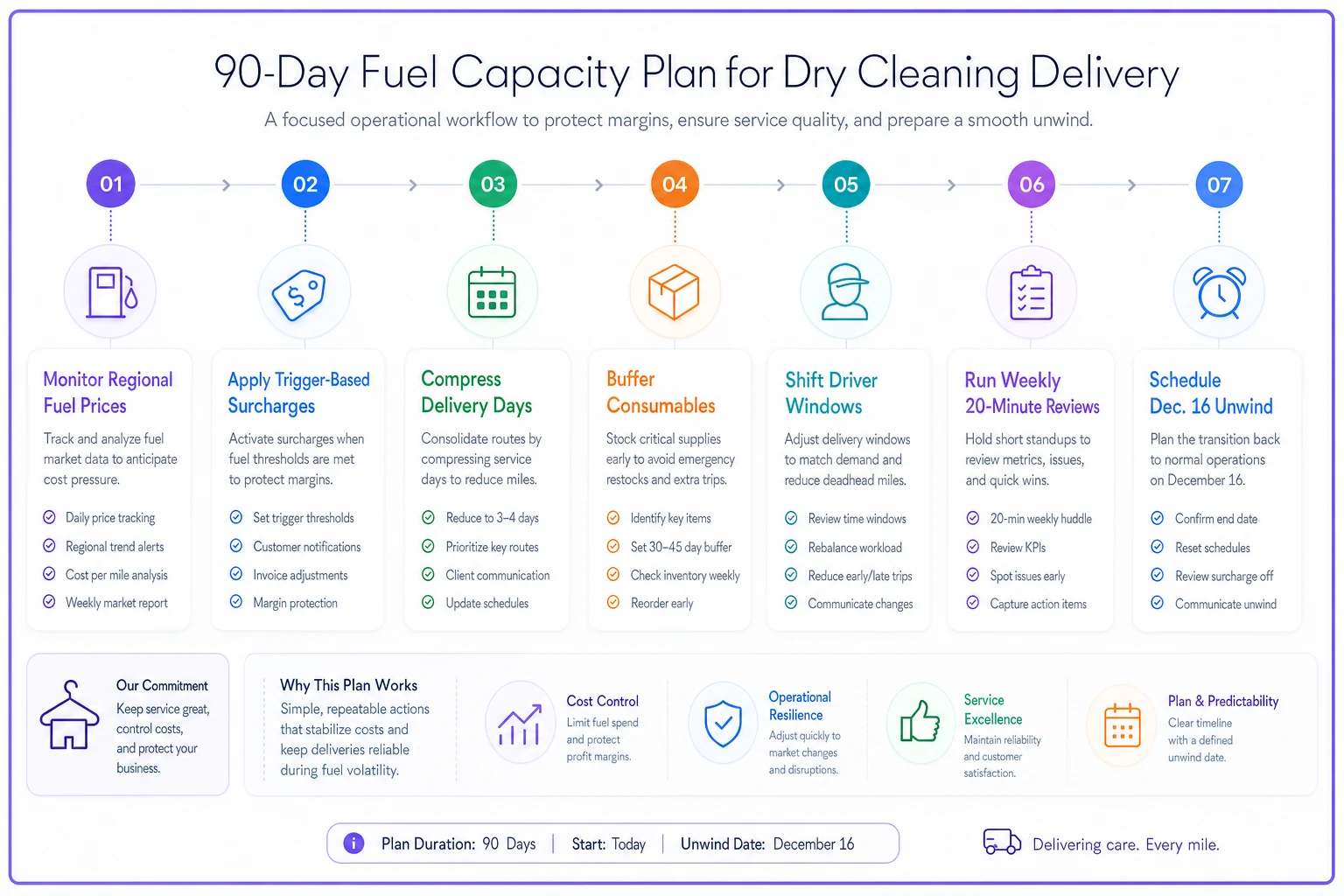
Use this flow to keep the plan coordinated across the 13 weeks.
A realistic scenario
Picture a suburban shop running its own delivery route — one van, roughly 55–65 residential deliveries a week, plus a handful of small‑business accounts. Before the fuel event, the owner wasn't tracking fuel cost per delivery at all; it was buried in the general vehicle expense line.
When regional prices started jumping unevenly, the owner ran three of the seven moves: trigger surcharge, compressed from five days to three, and a 10‑day poly/hanger buffer. Nothing complicated.
Fuel cost per delivery had been creeping toward roughly $2.80–$3.10 a stop on the old five‑day pattern. On three dense days it settled back closer to $2.00–$2.20. The small trigger surcharge covered most of the remaining gap on the weeks prices spiked. The buffer meant the one time the supplier truck slid two days, the shop didn't notice — they had poly and hangers on hand. No missed SLAs that month traced back to fuel.
The outcome wasn't dramatic. It was boring, which is exactly the point. A capacity event handled well should feel like a normal three months.
When this playbook makes sense — and when it doesn't
Run the full playbook if:
-
You operate your own delivery van or small fleet and fuel is a real line in your P&L.
-
You're in a region where prices are already moving unevenly.
-
Your consumables come through local carriers that could re‑prioritize.
Skip or trim it if:
-
You're a counter‑only shop with no delivery — the fuel story barely touches you beyond consumable timing, so just do step 3.
-
You've locked fuel pricing through a fleet card program that insulates you for the quarter — the surcharge step is less urgent, but the timing and buffer steps still apply.
-
You use a third‑party courier on a fixed contract — in that case the lever is your contract terms and communication, not your routing.
Who should skip the surcharge step: shops with thin, price‑sensitive residential bases where a $2 adjustment risks more churn than it recovers. For those, lean harder on batching and compressed days — fix the cost structure rather than passing it on.
Where tooling quietly earns its keep
None of this requires software to start. You can run the whole 90‑day playbook on a spreadsheet and a group text.
Flag when fuel cost per delivery crosses your trigger and nudge when a consumable dips below its buffer line so the weekly checks actually happen.
But the parts that drift — the weekly route review, the trigger surcharge thresholds, the customer messages, the consumable buffer running low — are exactly the kind of small recurring checks that fall through the cracks when the shop gets busy. That's where a delivery and workflow platform with light AI automation earns its keep: not by doing anything you couldn't do manually, but by making sure the boring weekly checks actually happen across all 13 weeks of the window instead of just the first two. Flagging when fuel cost per delivery crosses your trigger, nudging you when a consumable dips below the buffer line, firing the pre‑written customer message when a window shifts. Most short‑run plans fall apart quietly right around week three. That's the gap tooling actually fills.
Bottom line
The waiver is a 90‑day flag that fuel distribution is under pressure. Your job isn't to react to the trucking news — it's to protect your delivery margins and SLAs during a window that's too short to rebuild your operation and too long to ignore.
Tie surcharges to triggers, densify your routes, buffer the handful of consumables that actually stop you, communicate every window change, review weekly, and schedule the unwind for December. Do that, and three months of fuel uncertainty turns into a non‑story — which, for a delivery operation, is the best possible outcome.
The waiver is a 90‑day flag that fuel distribution is under pressure. Your job isn't to react to the trucking news — it's to protect your delivery margins and SLAs during a window that's too short to rebuild your operation and too long to ignore.
Tie surcharges to triggers, densify your routes, buffer the handful of consumables that actually stop you, communicate every window change, review weekly, and schedule the unwind for December. Do that, and three months of fuel uncertainty turns into a non‑story — which, for a delivery operation, is the best possible outcome.
Ready to elevate your dry cleaning operations?
Join hundreds of dry cleaners using Pressesly to save time, reduce errors, and enhance customer satisfaction.