

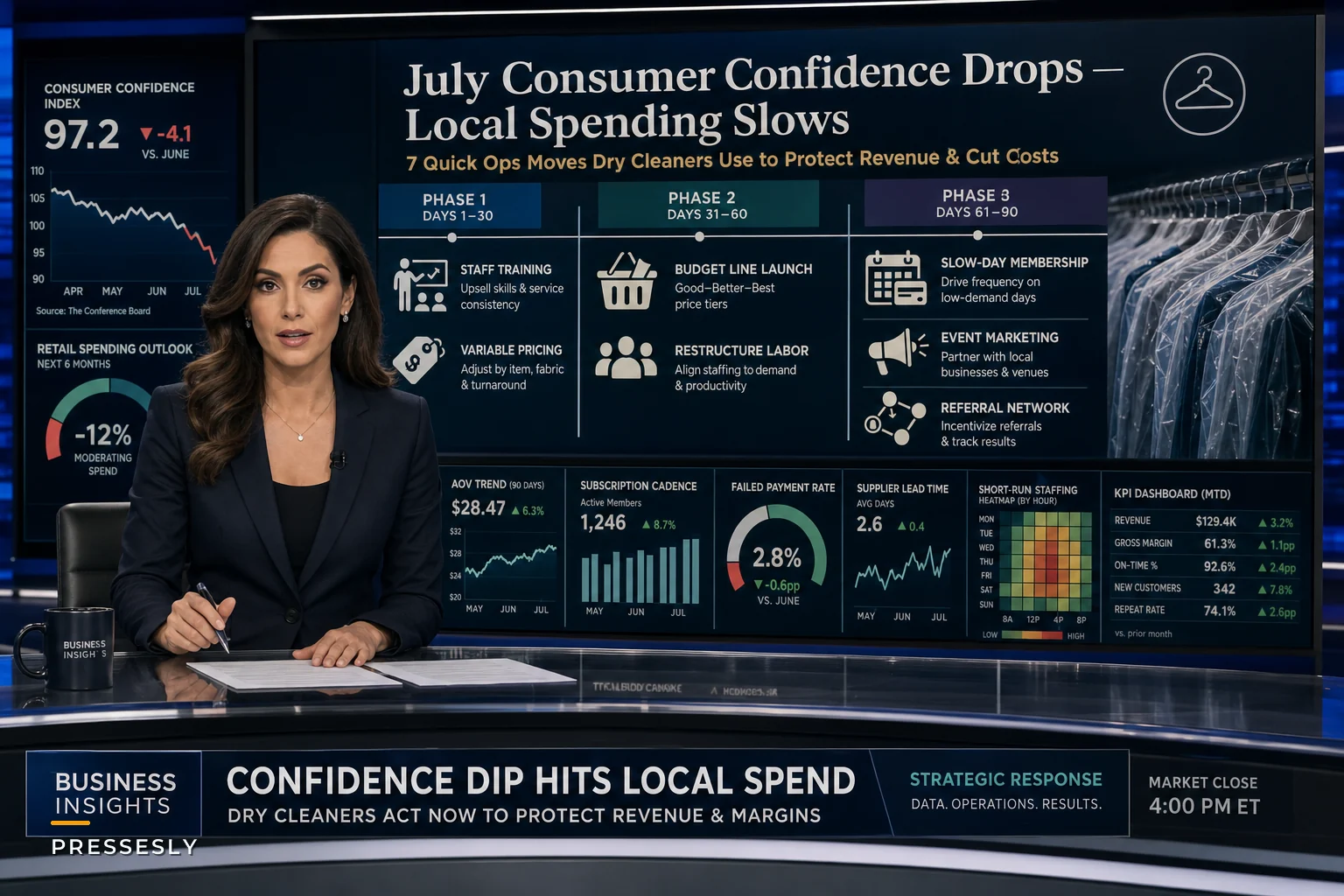

The Conference Board just dropped their July numbers, and consumer confidence slipped to 90.8 — not a crash, but enough of a dip that any dry cleaner paying attention should be thinking about their next move. Weaker labor market assessments and softer business expectations tend to translate quickly into customers getting pickier about where they spend.
I watched this exact pattern play out in 2019 when confidence wobbled. The shops that adjusted their operations quickly kept their margins intact. The ones that waited watched their pickup-and-delivery volume crater and specialty cleaning drop noticeably over a few months.
What makes this moment tricky for dry cleaners specifically is that we sit right at the intersection of essential and discretionary spending. People still need their work clothes cleaned, but that $45 leather jacket treatment or $8 same-day surcharge suddenly feels negotiable when confidence dips.
1. Strip Down Your Service Menu (But Keep the Profit)
Most dry cleaners carry somewhere between 15 and 20 different service options. When consumer confidence softens, that complexity works against you. Customers facing uncertainty want simple choices.
Pull your last 90 days of transaction data and figure out which services are generating roughly 80% of your gross profit. For most shops it ends up being five or six core offerings — standard cleaning, pressing-only, alterations, maybe two specialty services.
| Core offerings |
|---|
| standard cleaning |
| pressing-only |
| alterations |
| maybe two specialty services |
Bundle everything else into rotating "seasonal specials." A shop I worked with in Phoenix discovered they were offering eleven different leather treatments, but only two generated meaningful profit. They collapsed it down to three options — basic, premium, restoration — and conversion rates actually went up because customers stopped getting paralyzed at the counter.
The operational benefit goes beyond simplicity. Counter staff can memorize pricing without constantly checking the system. Training new employees takes days instead of weeks. And inventory gets easier to manage when you're not stocking supplies for rarely-ordered treatments.
2. Implement Variable Pricing Without the Backlash
Nobody wants to be the shop that raised prices during a confidence dip. But you can restructure your revenue model without touching posted rates.
Never lose track of an order again.
Pressesly helps you manage, track, and communicate every garment order seamlessly.
- Unified order management
- Real-time customer notifications
- Staff scheduling & workload tracking
No credit card required
Start with time-based discounts. Offer 15% off for orders picked up after 5 PM on weekdays. Your fixed costs — rent, equipment, base labor — are already covered by the morning and lunch rush. Evening pickups run at high margin even discounted.
Then adjust how you handle rush orders. Instead of a flat rush fee, build a sliding scale based on turnaround time. Keep same-day at your current premium but add a 24-hour option at roughly half the rush price. Price-sensitive customers get an alternative, and the customers who genuinely need same-day still pay for it.
A multi-location operator in Dallas restructured their rush pricing this way and found that rush order volume dropped around 20%, but rush revenue only fell about 5%. The customers who really needed speed paid full price. Everyone else took the 24-hour option they didn't previously have.
3. Turn Your Slowest Day Into a Revenue Generator
Every dry cleaner has that one day — usually Tuesday or Wednesday — where volume drops 40% below average. When confidence weakens, slow days get slower.
Instead of eating the fixed costs, create a members-only discount day. Not a subscription service, just a simple $20 annual membership that unlocks 25% off on your slowest day.
The math works because you're filling capacity that would otherwise sit empty. A shop processing 180 garments on a typical Tuesday could absorb 60 to 70 discounted pieces without adding labor. Even at 25% off, that's high-margin volume since overhead is already covered.
The key operationally: limit the discount to standard services only. No alterations, no specialty cleaning, no rush orders. Keeps the complexity out and stops customers from gaming it with their most expensive items.
4. Create a "Budget Line" Without Cheapening Your Brand
Consumers under pressure don't always want cheaper — they want to feel like they're being smart about their money. A strategically positioned budget option can actually protect your premium services rather than undermine them.
Essentials-only tier: cleaning and pressing, no special treatments, 3-day minimum turnaround, basic poly bags. Price it about 20% below your standard service.
This isn't about racing anyone to the bottom. It's about keeping price-conscious customers from wandering off to that discount chain down the street. A shop in Tampa that introduced this during the 2020 slowdown found roughly 30% of budget-line customers eventually upgraded back to standard service once they were on steadier footing financially.
Keep this service visually and procedurally separate — different colored tags, different rack section, different pickup window if you can swing it. You want customers to see and feel the difference. That contrast protects the perceived value of everything else you offer.
5. Restructure Labor Without Layoffs
The instinct when demand softens is to cut hours. But losing experienced staff during a downturn means you're scrambling when volume comes back. Better move: restructure how you deploy the people you have.
Shift from fixed shifts to demand-based scheduling. Pull your hourly volume data from the last 60 days and build overlapping short shifts that concentrate labor during peak periods. A full-time presser working eight hours straight might become two part-timers working five-hour overlapping shifts, both present during the 11 AM to 2 PM rush.
Add cross-training incentives — an extra dollar per hour when employees work outside their primary role. Counter person learns spotting. Presser picks up basic alterations. That flexibility lets you run leaner without sacrificing service quality.
Start cross-training on slow days so coverage is seamless during peak hours.
A three-location chain in Austin restructured this way and trimmed labor costs by around 15% without cutting anyone's weekly hours. They just deployed people more deliberately, and the cross-training actually improved how engaged employees felt day to day.
6. Flip Your Marketing from Push to Pull
Aggressive discount marketing during a confidence dip tends to feel off. Stop pushing and start solving specific problems people actually have.
Build micro-campaigns around life events that require dry cleaning regardless of economic mood. Job interviews, weddings, holiday parties, estate sales — these create non-negotiable demand. Partner with local wedding venues, funeral homes, and job placement centers. Offer their clients a defined service package, not a generic coupon. Something like a "wedding guest refresh" or an "interview ready" service with clear deliverables.
The operational advantage is predictability. Event-based demand is easier to forecast and schedule around. You know when wedding season peaks, when graduations cluster, when corporate holiday parties hit. Staff accordingly, manage inventory better.
This approach also connects naturally to behavioral bundling strategies — customers coming in for event-specific needs are already primed to add related services.
7. Build a Reciprocal Network with Non-Competing Services
Your customers are still spending, just more selectively. Partnering with businesses that serve the same demographic but don't compete for the same dollars is a low-cost way to stay visible.
Set up reciprocal referral agreements with hair salons, auto detailers, house cleaning services, local tailors. Simple setup: you display their cards and recommend them, they do the same. But what makes it actually work during a confidence dip is building specific trigger points into the referrals.
The hair salon doesn't just display your cards — they mention you when someone asks about removing hair product stains from a jacket. The auto detailer brings you up when someone spills coffee on their suit. Those triggered referrals convert at several times the rate of generic recommendations.
Track everything with a simple code system. Each partner gets their own referral code. You track redemptions monthly and share the results. Transparency keeps partners engaged and makes it easy to cut relationships that aren't producing.
The 90-Day Implementation Timeline
Trying to run all seven of these at once pretty much guarantees you'll do none of them well. Here's the sequence that tends to work:
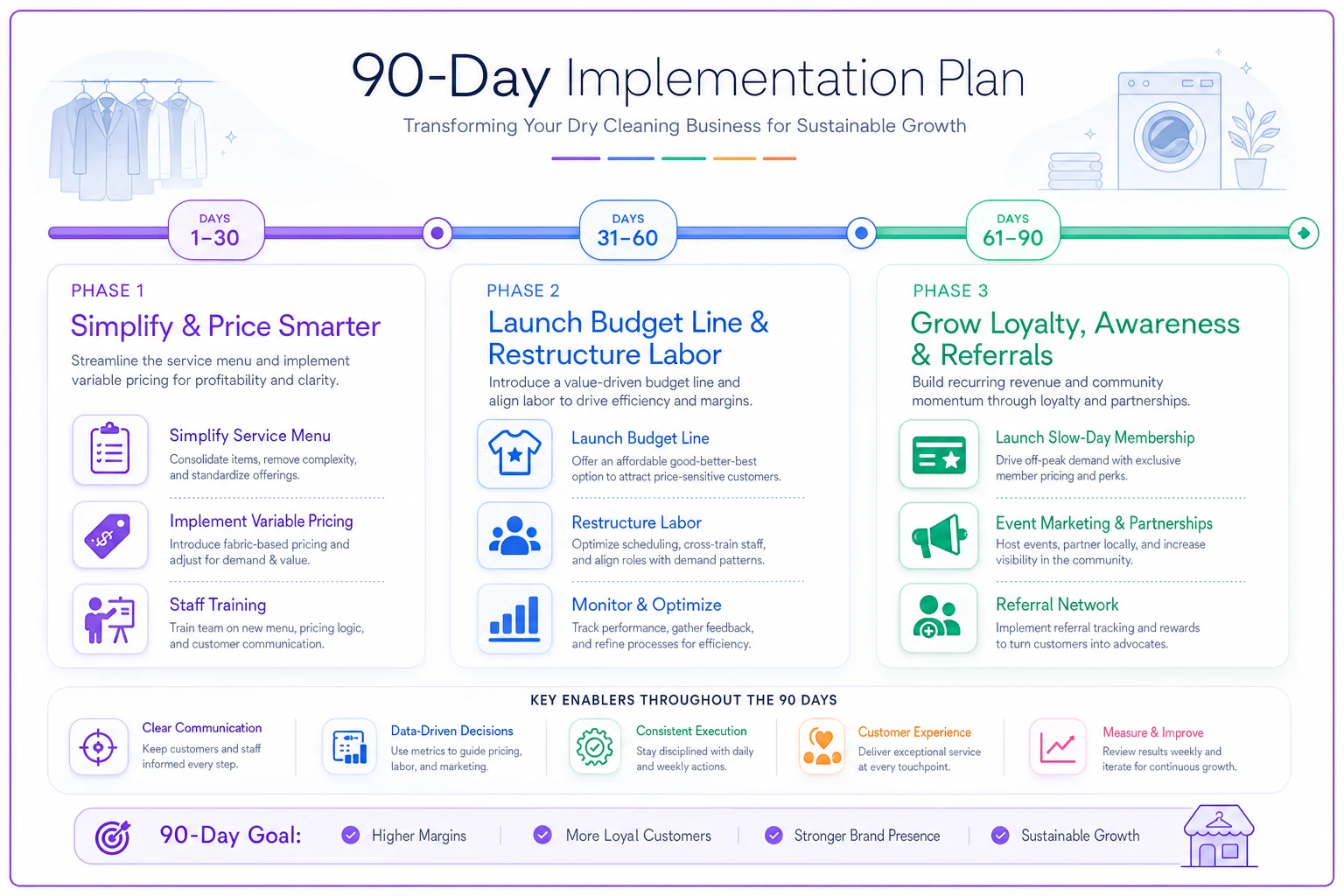
Here's a quick visual workflow for the 90-day rollout.
-
Days 1–30 Simplify your service menu and implement variable pricing. These are internal changes you control entirely. Use the month to train staff and update your POS.
-
Days 31–60 Launch the budget line and restructure labor. The simplified menu from month one makes the budget tier easier to position cleanly. The new pricing structure gives you real data to optimize staffing.
-
Days 61–90 Roll out the slow-day membership, event marketing, and referral network. External-facing initiatives land better once your internal operations are already tightened.
The Reuters analysis of this confidence data suggests we're looking at a period of consumer caution rather than panic. That's actually decent conditions for making these changes — customers are still spending, just more deliberately.
Operational software that tracks these metrics in real time is genuinely useful during a shift like this. When you can see daily revenue by service type, hourly labor efficiency, and referral source performance in one place, you're adjusting weekly instead of quarterly. Shops still running on spreadsheets and gut feel are going to feel this confidence dip more than they need to.
The dry cleaners that come out ahead won't necessarily be the ones with the deepest pockets or the best locations. They'll be the ones who recognized early that operational agility matters more than financial cushion when customer behavior shifts. These seven moves cost almost nothing to put in place, but they set you up to keep capturing value while competitors are still trying to figure out why their old approach stopped working.
The dry cleaners that come out ahead won't necessarily be the ones with the deepest pockets or the best locations. They'll be the ones who recognized early that operational agility matters more than financial cushion when customer behavior shifts. These seven moves cost almost nothing to put in place, but they set you up to keep capturing value while competitors are still trying to figure out why their old approach stopped working.
Ready to elevate your dry cleaning operations?
Join hundreds of dry cleaners using Pressesly to save time, reduce errors, and enhance customer satisfaction.