


Walk into most dry cleaning shops and you'll spot the rework pile pretty quick. That corner rack with tickets marked "redo" or "fix." The pressing station where someone's re-steaming a jacket that got wrinkled during bagging. The spot-treatment area where a shirt's getting another chemical pass because the first one didn't take.
Every piece in that pile is lost profit. Not just the extra labor and chemicals — the delayed orders, the rushed deliveries, the customer who might not come back after their suit needed two attempts.
Rework in dry cleaning isn't random. It follows predictable patterns based on how work moves through your shop. When you map out where garments actually get damaged, stained, or misprocessed, the same failure points keep showing up.
Why traditional dry cleaning layouts create rework loops
Most dry cleaners inherit their shop layout. You take over a space, the equipment's already positioned, and you build your workflow around what's there. Maybe you've shuffled a few things over the years, but the basic flow stays the same.
This creates what I'd call "invisible handoff zones" — places where garments change hands without clear ownership. The rack between spotting and cleaning. The area where pressed items wait for bagging. The spot where alterations sit before going back into the main flow.
These zones become rework generators because nobody owns the quality check. The spotter assumes the cleaner will catch remaining stains. The presser figures the bagger will notice wrinkles. The bagger thinks final inspection happens at pickup. And so nothing actually gets checked properly.
Then there's equipment placement. In a typical shop, your cleaning machine might be 30 feet from your spotting station. Pressing equipment split across two areas. Inspection happening wherever there's decent light and open space. Garments travel more, get handled more, and pick up new problems in the process. A perfectly cleaned suit gets a grease mark from brushing against equipment during transport. A pressed shirt gets wrinkled sitting too long on an overcrowded rack.
The work-cell approach that cuts rework by design
Instead of thinking about your shop as one big space with equipment scattered around, break it into focused work cells. Each cell handles a specific type of garment or process from start to finish.
Never lose track of an order again.
Pressesly helps you manage, track, and communicate every garment order seamlessly.
- Unified order management
- Real-time customer notifications
- Staff scheduling & workload tracking
No credit card required
Here's what a basic three-cell layout might look like for a shop doing around 400 pieces daily:
Cell 1: Everyday Garments
-
Shirts, pants, basic dresses
-
Own spotting station
-
Direct path to cleaning
-
Dedicated pressing area
-
Quality check before bagging
Cell 2: Specialty Items
-
Suits, coats, delicate fabrics
-
Extended spotting time
-
Lower-temp cleaning cycles
-
Hand-finishing station
-
Two-person quality verification
Cell 3: Rush & Redo
-
Same-day service
-
Rework items
-
Special requests
-
Isolated from main flow
-
Single operator ownership
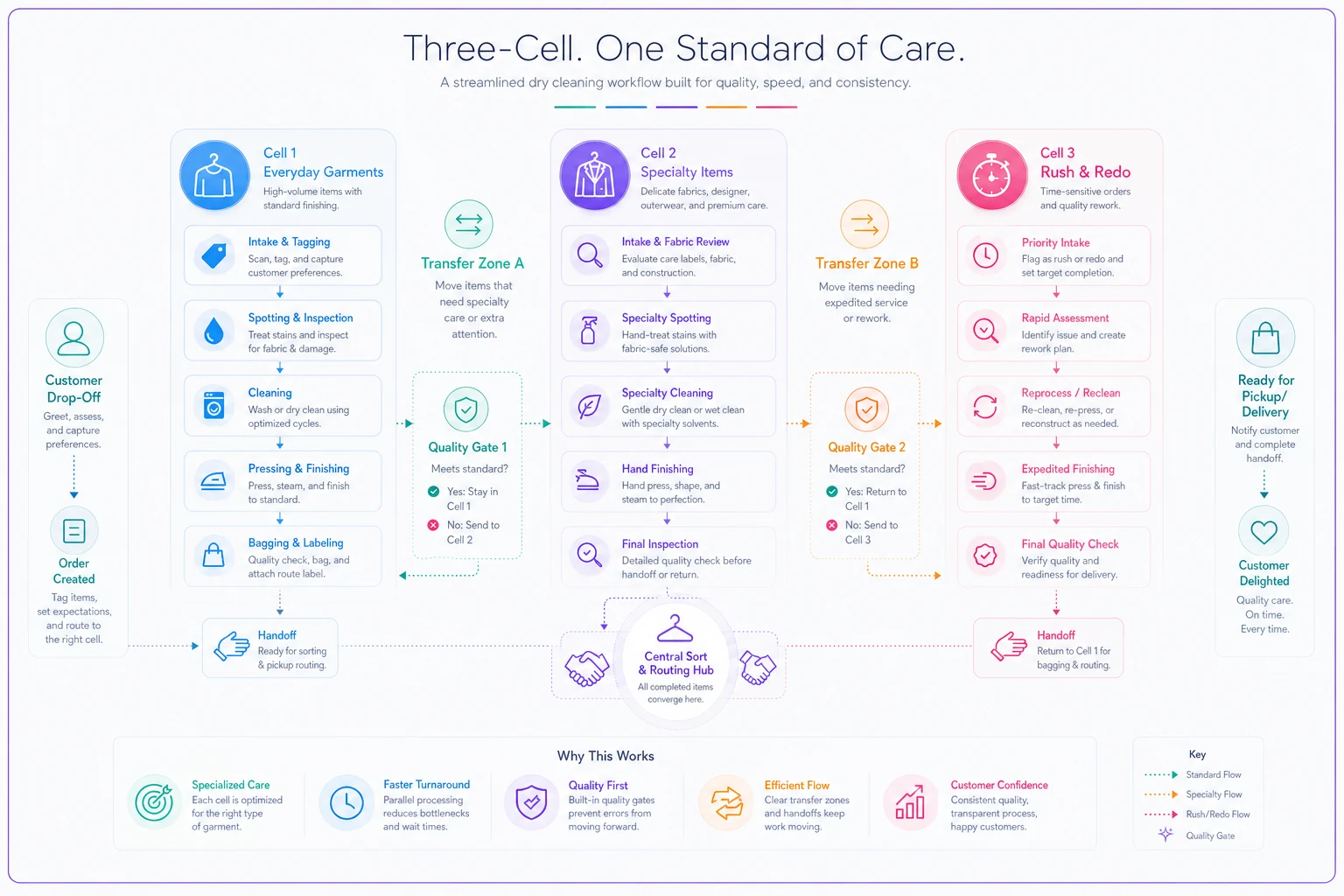
A visual like this clarifies where handoffs and quality checks belong.
Each cell operates like a mini dry cleaner. Garments don't bounce between departments — they flow through a contained process with clear ownership. This setup cuts several common rework triggers almost immediately. Everyday items don't wait behind specialty pieces. Rush orders don't disrupt the main workflow. Rework gets handled by someone who knows exactly what went wrong the first time.
Defining handoff points that actually prevent problems
Handoffs kill quality when they're vague. "Just put it on the rack" or "someone will grab it" creates gaps where problems slip through unnoticed.
Strong handoff points have three elements: physical placement, visual confirmation, and documented transfer. Sounds complicated but it's simple in practice.
Take the handoff from cleaning to pressing. Instead of hanging clean garments on a rolling rack, you create a specific transfer zone — a section of stationary rack painted green, say. Only clean, ready-to-press items go there. Nothing else. The cleaner groups garments by type, faces everything the same direction, and puts a timestamp card on each group showing when cleaning finished. The presser takes the oldest timestamp first, checks that everything looks clean, and moves the card to their "in-progress" board.
Use timestamp cards to prioritize the oldest items first.
This handoff takes maybe 10 seconds longer than the old "throw it on a rack" method. But it eliminates the situation where a presser discovers stains mid-press, rush items sit while regular orders move, or nobody knows how long something's been waiting.
Building lightweight quality gates without slowing production
Quality gates sound like they'd slow everything down. More checking means less processing, right? Not when they're built correctly. The most effective quality gates take under 30 seconds and catch problems before they compound.
Here's a gate system that works in practice:
-
Gate 1
Intake Assessment
(15 seconds) Quick scan under bright light. Is this item cleanable? Any existing damage? Special requirements? Mark issues on ticket, route accordingly. -
Gate 2
Post-Spot Check
(10 seconds) Before cleaning, verify spots are pre-treated. Run a fingernail test on treated areas — if residue flakes, needs more work. If smooth, ready for cleaning. -
Gate 3
Post-Clean Inspection
(20 seconds) Still damp — check for remaining stains, odors, or cleaning marks. Way easier to re-clean now than after pressing. -
Gate 4
Pre-Bag Verification
(15 seconds) Final check for wrinkles, loose buttons, finishing issues. A 2-minute fix now beats a 15-minute redo if the customer complains.
Total added time: roughly 60 seconds per garment. Rework prevented: usually 3-5 pieces per 100 processed. The math works. Preventing rework on 4 items saves roughly 45-60 minutes of labor (assuming 12-15 minutes per redo). That's far more than the 100 seconds spent on quality gates for those same 100 items.
Creating defect-tracking loops that actually get used
Most shops track customer complaints but not internal defects. You know when someone calls about a stain, but not when your presser had to redo three shirts because the cleaning cycle ran short.
A usable defect tracking system needs to be faster than not tracking. If it takes more than 5 seconds to log a defect, people stop doing it.
Here's a dead-simple approach: colored clips on a pegboard. Red clip = cleaning issue. Blue = pressing problem. Yellow = spotting miss. Green = damage during handling. When someone catches a defect, they clip the appropriate color to the garment and keep working. End of each shift, someone counts clips, logs them in a basic spreadsheet (date, type, count), and resets.
After two weeks, patterns emerge. Lots of red clips on Tuesdays — that's when your part-timer runs the cleaning machine. Blue clips spiking whenever you process comforters — your presser needs more reps on bulky items. The data tells you where to focus. Not vague "we need better quality" but specific "adjust the Tuesday cleaning schedule" or "build a comforter-specific press procedure."
Micro-experiments that validate changes without risk
Every operational change is a gamble. Move a pressing station and maybe you improve flow — or maybe you create a new bottleneck. Change your cleaning chemistry and perhaps stains lift better — or colors fade.
Micro-experiments let you test changes without betting the whole shop. Keep them small, time-limited, and measurable. Say you think rework drops if spotters initial their work. Instead of mandating it shop-wide, run a one-week test. Have one spotter initial their pieces with a fabric marker in an inconspicuous spot. Track rework rates for initialed versus non-initialed items. If rework drops noticeably on initialed pieces, you've found something worth expanding. If there's no difference, you've saved yourself from implementing a useless procedure.
Other micro-experiments worth trying:
-
Cleaning cycle test Run whites at 2 degrees cooler for one week. Compare brightness and re-clean rates.
-
Pressing sequence change Press shirts before pants for three days. Measure total pressing time and wrinkle complaints.
-
Handoff location shift Move the clean-to-press rack 10 feet closer to pressing. Track transport time and handling damage.
-
Quality gate addition Add a 10-second pocket check before cleaning. Count items found and damage prevented.
Keep experiments under two weeks. Change one variable at a time. Track numbers, not feelings.
Common work-cell arrangements for different shop sizes
Work cells aren't one-size-fits-all. A 200-piece-per-day shop needs different arrangements than a 1,000-piece operation.
Small Shop (Under 300 pieces daily)
Two cells usually work best:
-
Main cell Regular cleaning and pressing
-
Specialty cell Rushes, redos, and delicate items
Physical layout forms an L-shape. Main cell runs along the long wall, specialty cell in the corner. Shared equipment (like the cleaning machine) sits at the intersection point.
Medium Shop (300-700 pieces daily)
Three cells become necessary:
-
High-volume cell Shirts and pants needing standard processing
-
Quality cell Suits, dresses, and items needing careful handling
-
Problem-solving cell Rushes, redos, and special requests
Layout shifts to a U-shape. High-volume cell takes one side, quality cell takes the other, problem-solving cell connects them at the back.
Larger Shop (700+ pieces daily)
Four or more cells, typically organized by garment type:
-
Laundry cell Shirts requiring wet cleaning
-
Dry clean basics Everyday dry clean items
-
Specialty cell Leather, suede, wedding gowns
-
Finishing cell All alterations and repairs
-
Express cell Rush and redo items
Layout becomes modular.
| Shop Size | Daily Volume | Recommended Cells | Layout Shape |
|---|---|---|---|
| Small | Under 300 pieces | 2 cells | L-shape |
| Medium | 300–700 pieces | 3 cells | U-shape |
| Large | 700+ pieces | 4+ cells | Modular |
Each cell operates semi-independently with its own equipment where possible. Shared resources like the cleaning machine become scheduled assets rather than first-come-first-served.
The equipment placement math nobody talks about
Where you put equipment matters more than what equipment you buy. A perfectly good pressing station in the wrong spot creates more rework than an older unit in the right location.
The calculation is simple: travel distance multiplied by trips per day. If your presser walks 50 feet from cleaning to pressing and processes 100 garments daily, that's 5,000 feet of walking — nearly a mile just moving clothes around. Every extra foot of travel increases drop risk, handling damage, and time delays.
But here's what most people miss — diagonal travel is worse than straight lines. When workers cut corners (literally), they bump into things, clothes brush against surfaces, hangers tangle. Optimal equipment placement follows the process flow with minimal direction changes. Spotting flows straight to cleaning. Cleaning flows straight to pressing. Pressing flows straight to bagging. When you can't achieve straight lines, create protected pathways. A simple rope barrier or painted floor path reduces accidental contact by keeping traffic predictable.
What changes as volume grows
At 200 pieces daily, one person can mentally track every garment. They know which jacket needs extra starch, remember that the blue dress has a tricky zipper, noticed the suit came in with a faint ink mark.
At 500 pieces, mental tracking breaks down. That's when you need physical systems — work cells, handoff points, quality gates. But these systems can't be too complex or they'll slow you down more than rework ever did.
At 1,000 pieces, even simple physical systems start failing. Paperwork gets lost, verbal handoffs get forgotten, quality checks get skipped during rushes. The progression usually looks like this:
-
Under 300 pieces
Mental tracking plus basic physical markers
-
300–600 pieces
Structured work cells and written handoffs
-
600–1,000 pieces
Digital tracking supplementing physical systems
-
Over 1,000 pieces
Full operational platform managing workflow
The mistake shops make is jumping straight from mental tracking to complex software without building the physical foundation first. Software can't fix bad work-cell design or unclear handoff points. That part has to come first.
Where AI-powered operations fit the dry cleaning workflow to reduce rework
Once your physical workflow is solid — work cells defined, handoff points clear, quality gates in place — operational software starts amplifying your results in ways that are hard to achieve manually.
Modern AI-powered operational platforms don't replace your physical systems. They make them smarter. Instead of manually counting defect clips at the end of each shift, the system tracks patterns automatically. Instead of guessing which work cell is bottlenecked, you get real-time flow data.
The real value is in prediction. These platforms can analyze your defect history and flag high-risk garments before they become problems — based on fabric type, stain type, and processing history. For example, the system might notice that silk blouses processed on humid days have significantly higher rework rates. It automatically routes those items to your specialty cell on those days, cutting the problem before it starts.
Or it identifies that garments sitting in post-clean inspection for over two hours develop wrinkles far more often. The platform alerts pressers to prioritize those pieces — without anyone manually tracking wait times. This kind of pattern recognition turns a solid physical workflow into a genuinely exceptional one. You're not replacing human judgment. You're giving your team information that's impossible to maintain manually at scale.
Building a shop that prevents rework by design
Rework isn't inevitable in dry cleaning. It's a symptom of workflows that evolved accidentally rather than being designed with intention.
When you organize your shop into focused work cells, define clear handoff points, add lightweight quality gates, and track defects consistently, rework drops — not through heroic effort or constant vigilance, but through better design. Start small. Pick your biggest rework generator — maybe pressing issues, maybe spotting failures — and build one improved work cell around fixing that problem. Define the handoffs in and out. Add one quality gate. Track defects for two weeks.
Once that cell is running smooth, expand the approach. Build the next cell. Add another gate. Before long, you've moved from a rework-heavy scramble to a predictable, well-structured operation. The shops that win long-term aren't the ones with the newest equipment or the lowest prices. They're the ones that build systems preventing problems rather than just fixing them faster — and that's how you reduce dry cleaning workflow rework permanently, not just temporarily.
Ready to elevate your dry cleaning operations?
Join hundreds of dry cleaners using Pressesly to save time, reduce errors, and enhance customer satisfaction.