

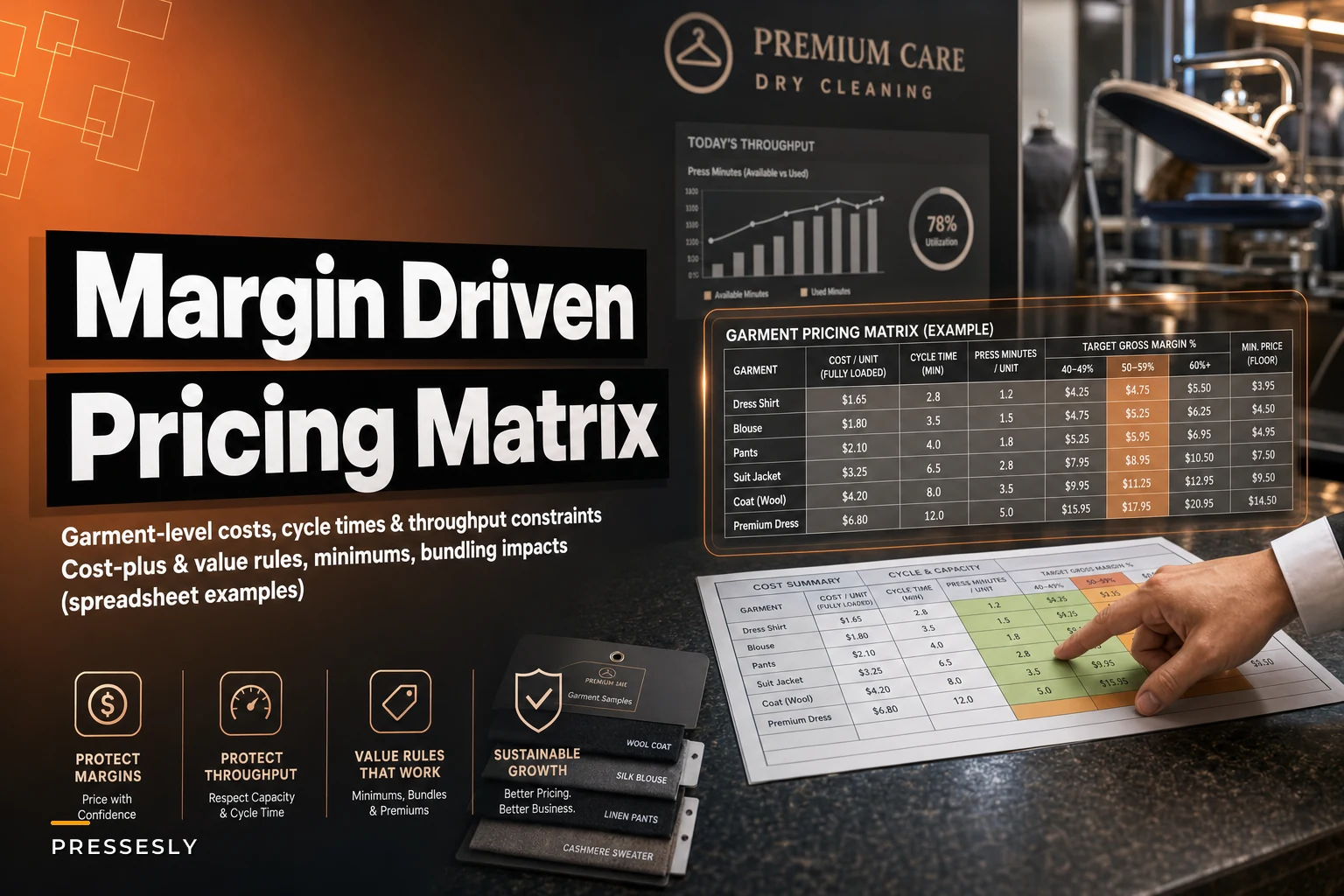

Most shops price garments the way they inherited them. The previous owner charged $7.95 for a shirt, so it's still $7.95, maybe bumped to $8.50 after the last solvent price hike. Nobody ran the math on whether a wedding gown at $110 actually earns more per press-hour than a stack of dress shirts at a buck and change in margin each.
That gap — between what you charge and what the garment actually costs you in time and capacity — is where a lot of single-shop profit leaks out. And it gets worse on your busiest weeks, because the garments clogging your presses during peak hours are often the ones you've underpriced relative to how much throughput they consume.
This isn't a "raise your prices" article. It's about building a pricing matrix that ties three things together: the direct cost of handling a garment, the cycle time it consumes, and the throughput ceiling of your bottleneck station. Once those three live in one place, cost-plus and value-based pricing stop fighting each other.
The three numbers that have to sit in the same row
Garment pricing usually breaks because people only track one of these and guess at the other two.
Direct cost per garment. Solvent share, poly/hanger/tag, pressing labor minutes, allocated utilities. This is the floor. If you price below it, you're literally paying customers to bring you work.
Cycle time (press-minute equivalent). Not clock time — bottleneck time. In most shops the finishing/pressing station is the real constraint, not cleaning. A silk blouse might spend the same minutes in the machine as a cotton shirt but eat three times the pressing attention. That's the number that determines how many garments you can physically push through on a Saturday.
Throughput value. What that press-minute is actually worth when you're at capacity. During slow Tuesdays, a press-minute is nearly free — idle hands, open schedule. During the Thursday-Friday crunch, every press-minute is scarce, and a slow garment is blocking a faster, higher-margin one behind it.
The mistake almost everyone makes: pricing cost-plus on direct cost alone. You add a markup to the solvent-and-hanger number, feel good about a 60% margin, and never notice that the garment is sitting on your constraint for eight minutes while a shirt that earns nearly the same dollar margin clears in two.
Why cost-plus alone quietly kills your peak days
Cost-plus is fine for commodity items where cycle time is uniform. The problem is dry cleaning isn't uniform. A typical mix during a busy afternoon looks something like this:
Never lose track of an order again.
Pressesly helps you manage, track, and communicate every garment order seamlessly.
- Unified order management
- Real-time customer notifications
- Staff scheduling & workload tracking
No credit card required
-
Dress shirts
fast press, low direct cost, thin per-unit margin, high volume
-
Trousers/slacks
medium everything
-
Blouses and delicate tops
slow press, moderate cost, inconsistent pricing
-
Coats, comforters, gowns
slow, high-cost, usually priced okay but unpredictable timing
When you price purely on cost-plus, blouses are the trap. They don't feel expensive to handle — solvent cost is low — so shops tack on a modest markup and call it done. But a skilled presser spends real minutes on them. On a slow day that's invisible. On a Friday when you're turning away same-day requests, every blouse priced like a shirt is stealing capacity from garments that would've paid better per minute.
Across a lot of small shops, the "profitable" items on paper (high markup %) and the profitable items in reality (high margin per bottleneck minute) are often completely different lists. That's the whole reason the matrix exists — to surface that difference before it shows up in your bank account.
Building the matrix: a worked spreadsheet example
Here's a simplified version you can rebuild in any spreadsheet. The numbers are illustrative — plug in your own press-minute observations and solvent allocation. The structure matters more than these exact figures.
| Garment | Direct cost | Press-min (bottleneck) | Current price | Gross margin $ | Margin $ / press-min |
|---|---|---|---|---|---|
| Dress shirt | $1.15 | 1.8 | $3.25 | $2.10 | $1.17 |
| Slacks | $2.40 | 3.0 | $7.50 | $5.10 | $1.70 |
| Blouse (delicate) | $2.10 | 5.5 | $7.95 | $5.85 | $1.06 |
| Sport coat | $3.80 | 4.5 | $11.00 | $7.20 | $1.60 |
| Wool overcoat | $5.50 | 6.5 | $16.00 | $10.50 | $1.62 |
| Comforter (queen) | $6.75 | 9.0 | $28.00 | $21.25 | $2.36 |
Read the last column, not the margin dollars. The blouse — which looks like a healthy $5.85 margin — is actually your worst earner per bottleneck minute at $1.06. Below the humble dress shirt. During peak hours it's the garment you'd least want crowding the press, yet it's priced like a routine item.
That single column changes decisions. Either the blouse price needs to move up toward the ~$1.60/min band the rest of your mix holds, or you treat it as a slow-day-only item and stop scheduling it during crunch windows.
The two pricing rules the matrix produces
Once the columns exist, you run two rules against them:
-
Cost-plus floor. No garment prices below direct cost × your minimum markup multiple. This catches the solvent-and-packaging math so you never lose money on materials. It sets the bottom.
-
Value rule (per-minute parity). Each garment's margin-per-press-minute should land inside a target band. If something sits well below the band, it's either underpriced or should be routed off your peak window. This sets the shape of your price list relative to capacity.
Cost-plus protects you from losses. The value rule protects your throughput. You need both, and they almost never produce the same answer — which is exactly why running them separately and reconciling beats a single blended markup.
[Garment received] ↓ [Calculate direct cost floor] ↓ [Pull press-minute estimate] ↓ [Calculate margin $/press-min] ↓ [Below target band?] ↙ ↘ YES NO ↓ ↓ [Adjust price [Price approved — or restrict schedule normally] to slow-day routing]
It's not complicated once it's set up. The hard part is doing it the first time and actually trusting what the numbers show.
Here's the decision flow visualized.
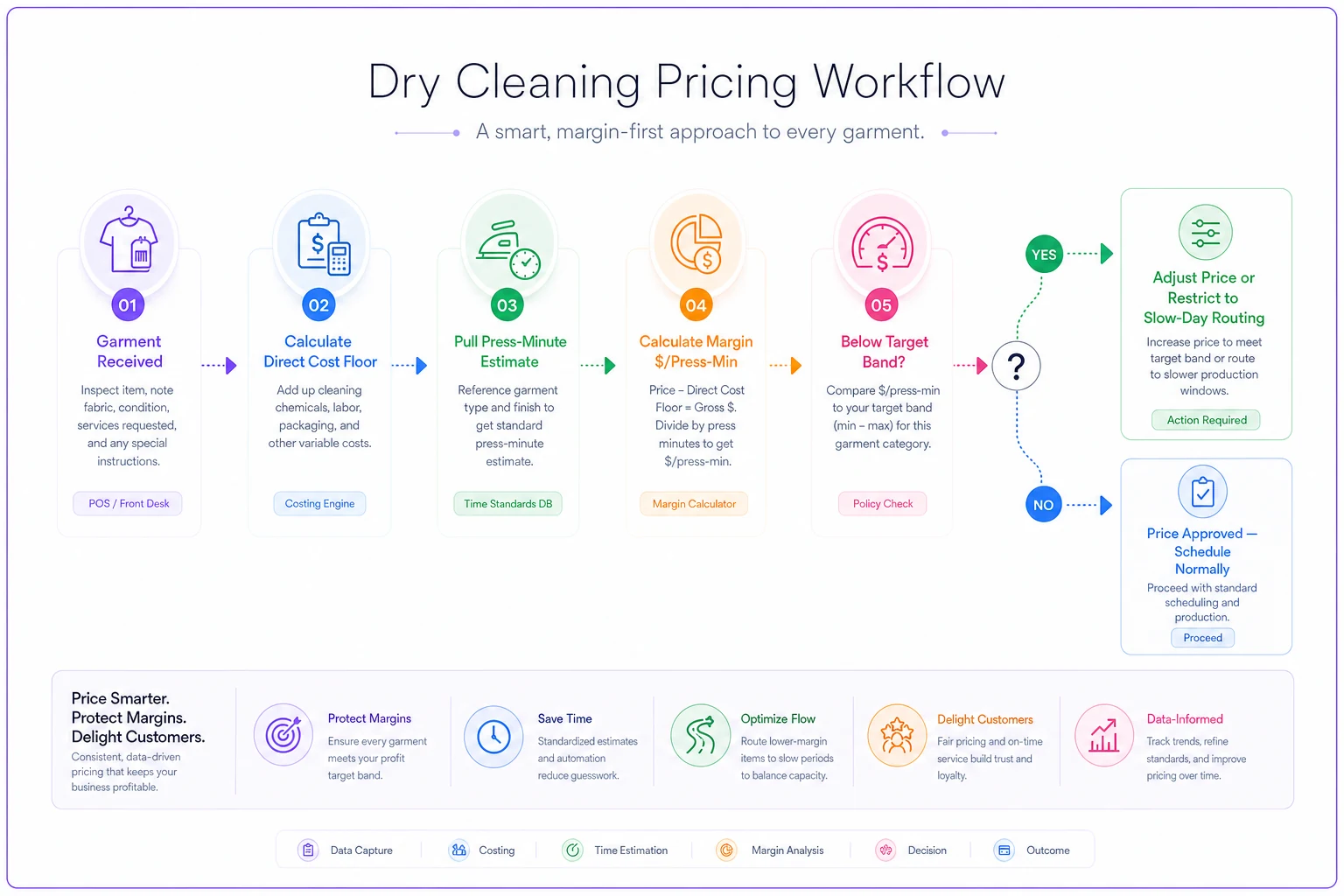
Use this to align your spreadsheet.
Minimums: the line item that saves small tickets
Minimums aren't a nicety — they're a structural defense for the fixed cost of handling a ticket at all. Intake, tagging, bagging, assembly, counter time, and the pickup transaction happen whether the order is one shirt or twelve.
A single $3.25 shirt looks fine on garment margin. But that order touched five staff interactions and a full counter transaction. On a single-item ticket, per-order overhead can swallow most of what you just earned.
Two practical minimum structures work:
-
Per-order minimum (e.g., a $12–$15 floor per ticket). Simple, protects against tiny orders, though it can annoy regulars who drop two shirts.
-
Per-garment-class minimum on slow, high-attention items. A blouse never prices below the press-minute parity floor regardless of promos.
The point that often gets missed: minimums interact with your delivery and subscription channels. If you run route delivery, a single-item stop is far worse than a single-item walk-in — now you've added drive time on top of ticket overhead. Your delivery minimum should be higher than your counter minimum. Not the same number copied over.
How bundling distorts the matrix (and how to keep it honest)
Bundles are where carefully built pricing quietly comes apart. A "5 shirts + 2 slacks weekly" bundle feels like a volume win, but if you priced it off a blended discount percentage, you may have discounted away exactly the margin-per-minute you were protecting.
The rule that keeps bundles honest: build the bundle from the matrix, not from a discount percentage. Sum the individual margin-per-minute contributions, apply the discount, and confirm the bundle still clears your per-minute floor at peak capacity. A bundle that pencils out on a slow Tuesday but goes underwater on a Friday rush is a bundle that trains your best customers to concentrate their drop-offs on your worst day.
A few specific distortions to watch:
-
Mixing fast and slow items at one flat per-piece bundle price. Customers naturally load the bundle with slow, high-attention garments because that's where they get the most value. You end up subsidizing exactly the pieces you didn't want to discount.
-
Bundles that waive the minimum. If your bundle undercuts your per-order floor, you've reopened the small-ticket leak you just closed.
-
Subscription bundles with no cap on garment mix. Same problem, but recurring.
Done right, bundling is one of the better tools for smoothing demand. You can structure it to reward slow-day drop-off and keep peak capacity for full-margin walk-ins.
A quick real scenario
A single-location shop doing roughly 320–360 orders a week rebuilt its price list around the per-minute column. Nothing dramatic changed on the surface — most prices moved a dollar or two.
The two real moves: delicate blouses and silk tops went up to hit per-minute parity (roughly a $1.50 bump), and single-item walk-ins got a modest order minimum. The comforter line, which was already earning well per minute, got pushed harder in seasonal messaging because the matrix showed it was their best capacity earner.
The owner wasn't trying to grow revenue — they were trying to stop Fridays from being their least profitable day. Over the following couple of months, peak-hour throughput on high-margin items improved because the slow, underpriced blouses either carried their weight or shifted to midweek. Weekly margin ticked up a few hundred dollars without any volume increase. The change wasn't the price bumps — it was that peak capacity stopped being consumed by the worst per-minute items.
When this approach makes sense — and when it doesn't
When it's worth building:
-
You regularly hit a capacity ceiling on certain days and turn away or delay work.
-
Your garment mix is varied (lots of delicates, specialty, household items), so cycle times differ significantly.
-
You've already got rough press-minute observations, or you're willing to time a sample week.
When it's overkill:
-
You're a low-volume shop that never approaches your bottleneck. If the press is idle half the day, per-minute value is low everywhere and plain cost-plus is fine.
-
Your mix is overwhelmingly one or two uniform item types.
Who should hold off: anyone who doesn't yet have reliable direct-cost numbers per garment. The matrix is only as good as its inputs, and guessing at solvent allocation and press minutes produces a confident-looking spreadsheet that's quietly wrong. Get the costing baseline solid first, then layer the per-minute logic on top.
The one timing variable to add once the basics work
The version above treats a press-minute as worth the same all day. The next refinement is time-of-day weighting — a press-minute during your two busiest hours is genuinely scarcer than one at 10am Tuesday.
You don't need dynamic pricing to act on this. Just apply the value rule more strictly to your peak window: the per-minute floor is higher for same-day and peak-drop work, which is really what rush surcharges and same-day premiums are when you trace them back to the matrix. Slow-day work can live closer to the cost-plus floor because the capacity is there anyway.
Keeping all of this in a single spreadsheet — direct cost, press minutes, margin-per-minute, minimums, and bundle checks in one place — means that when solvent or packaging costs jump, you re-run one sheet instead of guessing your way through a price list. That's the practical payoff: not a fancier pricing model, just one that tells you which garments are secretly consuming your best hours, and gives you a defensible reason every time you move a number.
Ready to elevate your dry cleaning operations?
Join hundreds of dry cleaners using Pressesly to save time, reduce errors, and enhance customer satisfaction.